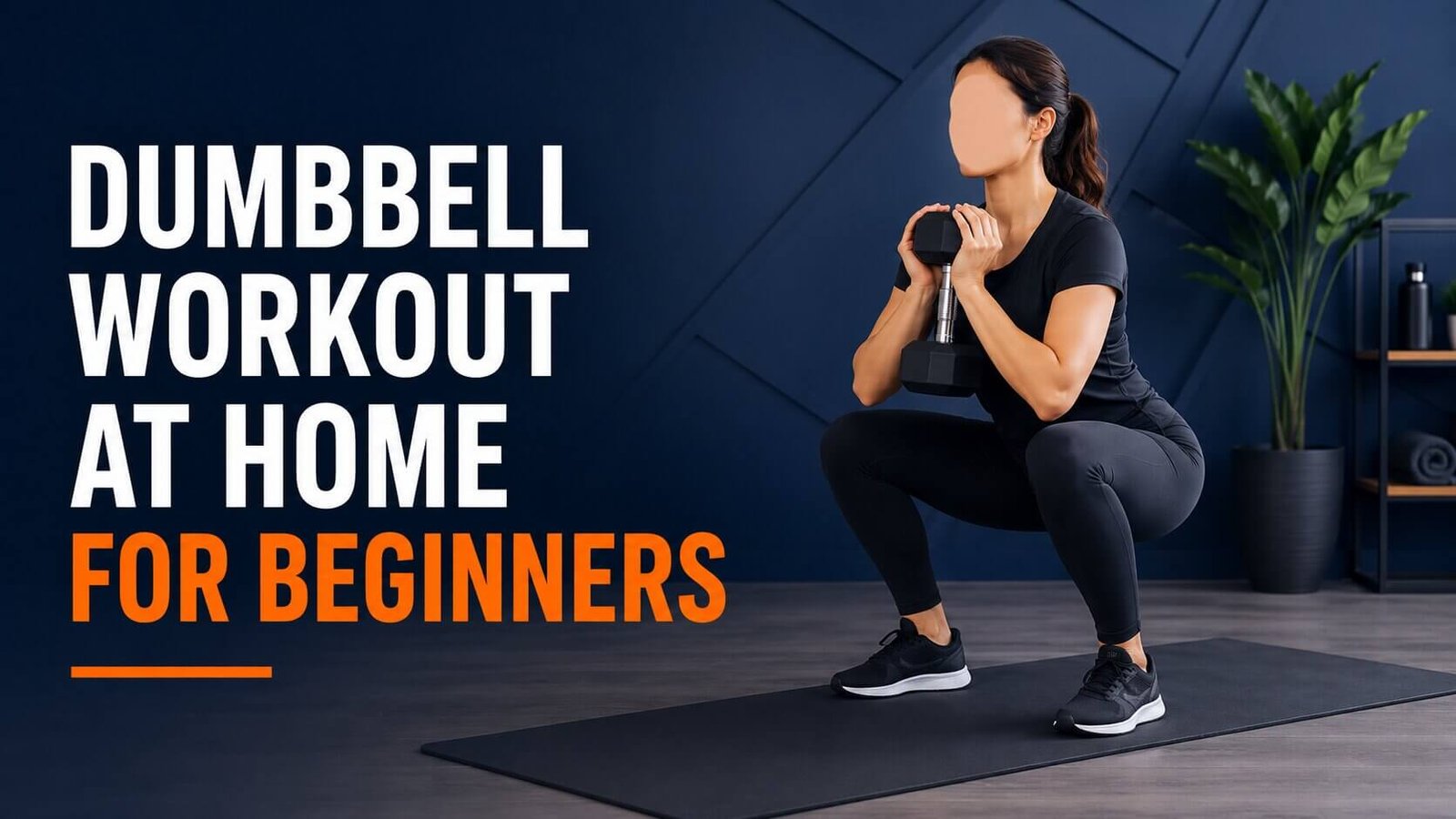
Beginners can build strength and muscle at home with dumbbells. A practical starting plan is to complete two or three full-body workouts per week, use five or six exercises per session, and leave at least one rest day between demanding sessions when possible.
Start with two working sets per exercise and a weight you can control for roughly 8–15 repetitions. The final repetitions should feel challenging, but your technique should remain stable. Most sets should end with about two or three good repetitions still available rather than reaching complete failure.
The program below uses two alternating workouts. It requires only dumbbells, clear floor space, and an optional sturdy chair for support. No exercise bench is necessary.
Can Beginners Build Muscle With Dumbbells at Home?
Yes. Dumbbells can provide progressive resistance for the legs, hips, chest, back, shoulders, arms, and core without a commercial gym. Results depend on how the training is performed, not on being inside a particular building.
The American College of Sports Medicine’s 2026 position stand reviewed 137 systematic reviews involving more than 30,000 participants. It concluded that progressive resistance training improves strength, muscle size, power, endurance, and physical function, and that home-based and nontraditional training methods can be effective. (Currier et al., 2026)
Dumbbells are free weights. Research comparing free-weight and machine-based resistance training generally finds similar muscle-growth outcomes when the programs are otherwise comparable. Strength gains tend to be specific to the movements and equipment used: practicing dumbbell exercises improves performance on dumbbell exercises, while practicing machine exercises improves performance on those machines. (Haugen et al., 2023)
This does not mean every home routine is automatically effective. A workout still needs:
- Exercises that cover the major movement patterns
- Enough effort to challenge the target muscles
- A repeatable weekly schedule
- Gradual progression
- Appropriate recovery
- Consistent technique and range of motion
What Results Should a Beginner Expect?
Beginners commonly improve exercise skill and strength during the first weeks, but the rate varies widely. Training history, age, sleep, nutrition, health, starting strength, exercise selection, and program adherence all matter.
Avoid promises such as gaining a specific amount of muscle in 30 days. Instead, look for measurable progress: cleaner repetitions, more repetitions with the same weight, a heavier controlled dumbbell, or a harder variation performed through the same range of motion.
What Equipment Do You Need?
You need one or more dumbbells and enough clear floor space to move safely. A bench is optional because floor presses, supported rows, split squats, and glute bridges can train the full body without one.
Basic Setup
- One pair of dumbbells, preferably adjustable
- Clear floor space roughly the length of your body
- A stable wall or heavy chair for balance support
- An exercise mat if the floor is uncomfortable
- A workout log, notebook, or phone note
Adjustable dumbbells make progression easier because different exercises require different loads. Fixed dumbbells still work, but you may need to change repetitions, use one dumbbell at a time, or select harder and easier variations.
Home Safety Check
Before training:
- Remove loose rugs, toys, cords, and clutter.
- Keep children and pets outside the lifting area.
- Confirm that adjustable-dumbbell plates and collars are locked.
- Use a floor surface that does not slide.
- Wear stable footwear or train barefoot only when the surface and exercise are appropriate.
- Use furniture for light balance support only if it cannot tip or roll.
- Place dumbbells down under control rather than dropping them.
Do not use a folding chair, wheeled office chair, or light table as a pressing bench. If furniture is not designed to support exercise, use the floor-based alternative.
How to Choose the Right Dumbbell Weight
Choose the weight based on your performance in each exercise, not on a universal “beginner weight” or gender-based rule. A suitable weight lets you complete the target repetitions through a controlled range while the final few repetitions become noticeably harder.
The Weight-Selection Test
For an exercise programmed for 8–15 repetitions:
- Select a weight that appears manageable.
- Perform eight controlled repetitions.
- Check your balance, range of motion, and technique.
- Continue only while those remain stable.
- Stop when you believe you could complete about two or three more good repetitions.
The unperformed repetitions are called repetitions in reserve, or RIR. Stopping with two RIR means you estimate that two more technically sound repetitions were possible.
Beginners often estimate RIR imperfectly. Treat it as a practical effort guide, not a precise measurement. If you finish 15 repetitions and could easily perform 10 more, the weight or variation is probably too easy. If you cannot reach eight repetitions without compensating, it is too difficult for that prescribed range.
Use Different Weights for Different Exercises
Your goblet squat or Romanian deadlift will usually allow more total weight than a lateral raise. That difference is normal because the exercises use different muscles, leverage, and ranges of motion.
Do not force one pair of dumbbells to produce the same repetition count in every exercise. When only one pair is available, change the exercise, perform one side at a time, or use a different rep range rather than sacrificing technique.
Should Beginners Train to Failure?
Most beginner sets do not need to reach momentary muscular failure—the point where another repetition cannot be completed with proper form. Research does not show that failure is required for strength or muscle gain, and stopping earlier can reduce fatigue and technique breakdown. (Grgic et al., 2022; Refalo et al., 2023)
The final set of a simple isolation exercise may occasionally reach closer to failure, but it should not be the default for every exercise and every session.
Beginner Dumbbell Workout Overview
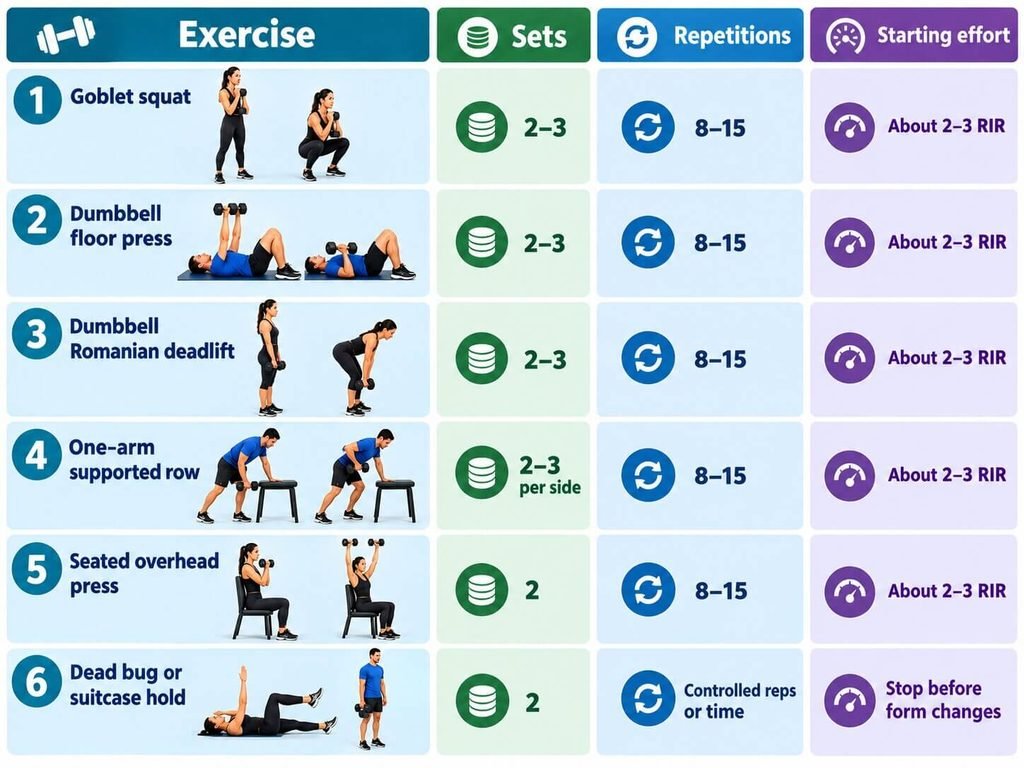
The program alternates two full-body sessions. Workout A emphasizes a squat, hip hinge, horizontal push, and row. Workout B uses unilateral leg work, a glute-dominant movement, pressing, pulling, and smaller-muscle accessories.
Workout A
Workout B
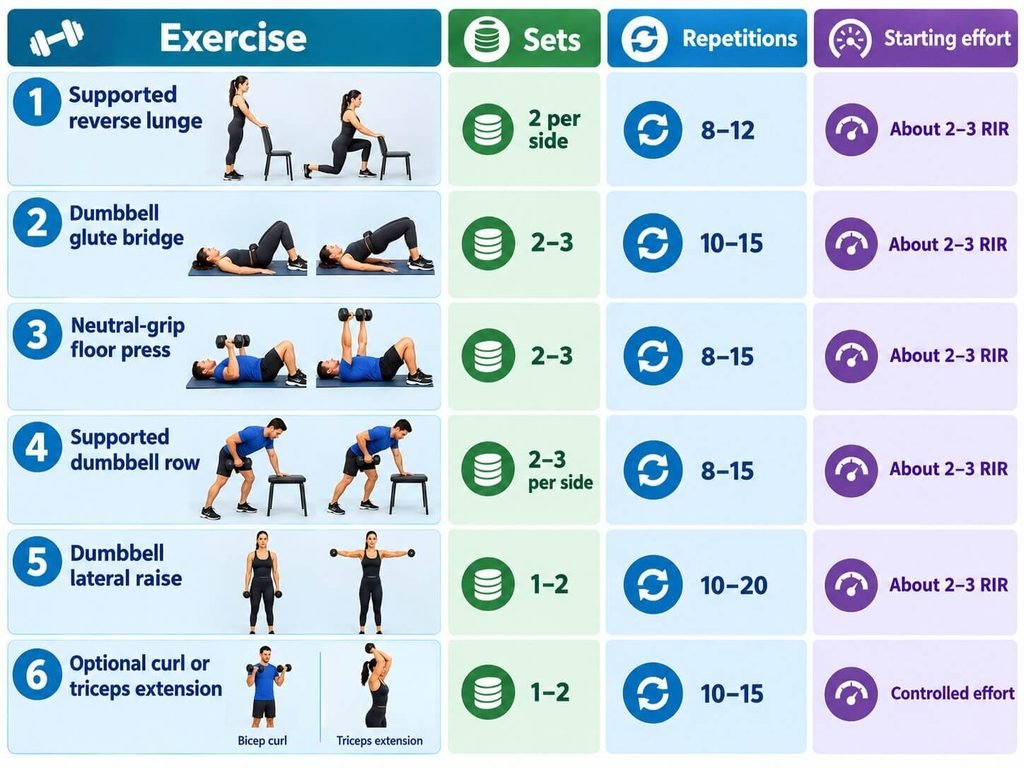
Begin with two sets for most exercises. A third set is optional after several weeks if sessions are going well, soreness resolves before the next workout, and performance is not declining.
How to Warm Up
A short warm-up should raise your readiness and help you rehearse the upcoming movements without creating fatigue. You do not need a long or elaborate sequence.
Try:
- Two to five minutes of easy walking, marching, or cycling.
- Five to ten controlled bodyweight squats or sit-to-stands.
- Five to ten unweighted hip hinges.
- Gentle arm circles and shoulder movements.
- One lighter practice set before the first demanding lower- and upper-body exercises.
A practice set might use one light dumbbell, fewer repetitions, or a reduced range of motion. Increase gradually until the movement feels prepared and stable.
Static stretching is not required before lifting. If a brief stretch helps you reach a comfortable position, use it without forcing a painful range.
Full-Body Dumbbell Workout A
Workout A covers the main movement patterns with six exercises. Perform the exercises in order unless equipment, discomfort, or a clear priority requires a change.
1. Goblet Squat
The goblet squat trains the quadriceps and glutes while teaching a controlled squat pattern. Holding one dumbbell near the chest often feels more manageable than holding weights at the sides.
How to perform it:
- Hold one dumbbell vertically at chest height with both hands.
- Stand with your feet in a comfortable squat stance.
- Brace your trunk and keep the whole foot in contact with the floor.
- Sit down between your hips as your knees bend.
- Descend only as far as you can control without pain or major posture changes.
- Push through the floor and stand tall.
Make it easier: Squat to a stable chair or box, pause lightly, then stand. Use the chair as a depth guide rather than collapsing onto it.
Make it harder: Add repetitions, increase the dumbbell weight, pause near the bottom, or progress to a split squat.
Common mistake: Forcing depth by rounding the lower back or lifting the heels. Use the largest comfortable range you can control; “deeper” is not automatically better for every person.
2. Dumbbell Floor Press
The floor press trains the chest, triceps, and front shoulders without a bench. The floor limits the bottom position, which can make setup easier for home trainees.
How to perform it:
- Sit on the floor with a dumbbell beside each thigh.
- Bring the weights into position and carefully lie back.
- Bend your knees and place your feet on the floor.
- Position your upper arms at a comfortable angle from your torso.
- Press the dumbbells upward without banging them together.
- Lower slowly until the upper arms gently contact the floor.
Make it easier: Press one dumbbell with both hands or use one arm at a time with a lighter weight.
Make it harder: Add load, repetitions, or a controlled pause when the upper arm reaches the floor.
Common mistake: Allowing the elbows to flare straight out at shoulder height or using a large back arch to move the weight.
3. Dumbbell Romanian Deadlift
The Romanian deadlift trains the hamstrings, glutes, and back muscles that hold the torso stable. It is a hip hinge, not a squat.
How to perform it:
- Stand tall with the dumbbells in front of your thighs.
- Soften your knees slightly and keep that angle relatively stable.
- Push your hips backward while keeping the weights close to your legs.
- Lower until you feel tension in the hamstrings or your trunk position begins to change.
- Drive the hips forward and return to standing.
Make it easier: Reduce the range, use one dumbbell held in both hands, or practice an unweighted hinge against a wall.
Make it harder: Add weight, perform more repetitions, or use a staggered stance after mastering the basic version.
Common mistake: Turning the movement into a squat or reaching the dumbbells toward the floor by rounding the back. The weights do not need to touch the floor.
4. One-Arm Supported Dumbbell Row
The supported row trains the upper back, lats, rear shoulders, and elbow flexors. Support reduces the balance demand and helps you focus on pulling.
How to perform it:
- Place one hand on a stable chair, couch arm, or your own front thigh.
- Step back enough to create room for the dumbbell.
- Keep your torso steady and let the working arm extend.
- Pull the dumbbell toward your hip or lower ribs.
- Pause briefly, then lower under control.
- Complete the prescribed repetitions and switch sides.
Make it easier: Use a lighter dumbbell and a more upright torso.
Make it harder: Increase weight or repetitions while preventing torso rotation.
Common mistake: Twisting the torso to throw the dumbbell upward. Some natural shoulder-blade movement is expected, but the trunk should remain controlled.
5. Seated Dumbbell Overhead Press
The overhead press trains the shoulders and triceps. Sitting on the floor or a sturdy chair can reduce lower-body assistance.
How to perform it:
- Sit tall with one dumbbell in each hand at shoulder height.
- Brace your trunk without excessively arching your lower back.
- Press the dumbbells upward through a comfortable path.
- Finish with the arms extended without forcing the shoulders upward.
- Lower the weights slowly to shoulder level.
Make it easier: Press one dumbbell with both hands or perform a one-arm press with a lighter load.
Make it harder: Add weight or repetitions while keeping the same trunk position.
Common mistake: Leaning backward and turning the movement into an incline press. If that happens, lower the weight or use a supported seated position.
6. Dead Bug or Suitcase Hold
Both options train the trunk to resist unwanted movement. Choose the version that fits your space and current control.
Dead bug: Lie on your back, brace gently, and slowly lower the opposite arm and leg without allowing the lower back to arch excessively.
Suitcase hold: Stand tall while holding one dumbbell beside your body. Resist leaning toward or away from the weight. Hold for 20–40 seconds, then switch sides.
Stop before your breathing, spinal position, or balance changes substantially.
Full-Body Dumbbell Workout B
Workout B changes the lower-body pattern and includes a few targeted exercises while still training the major muscle groups. Use at least one rest day after Workout A when possible during the first weeks.
1. Supported Reverse Lunge
The reverse lunge trains the quadriceps, glutes, and balance. Holding a stable support can make it more appropriate for beginners than an unsupported walking lunge.
How to perform it:
- Stand beside a stable support and hold one dumbbell in the opposite hand.
- Step one foot backward and land on the ball of that foot.
- Bend both knees while keeping the front foot planted.
- Descend only as far as you can control.
- Push through the front foot and return to standing.
Make it easier: Practice without weight, reduce the range, or use a split squat without stepping between repetitions.
Make it harder: Hold two dumbbells, increase the range, or add repetitions.
Common mistake: Using an unstable chair for support or taking such a narrow stance that balance becomes the limiting factor.
2. Dumbbell Glute Bridge
The glute bridge trains hip extension with minimal equipment. It is useful when heavier dumbbells make standing hinge exercises difficult to set up.
How to perform it:
- Lie on your back with your knees bent and feet on the floor.
- Place one dumbbell across the front of your hips and hold it securely.
- Brace your trunk and push through your feet.
- Lift your hips until the glutes contract without overextending the lower back.
- Lower under control.
Make it easier: Use bodyweight or reduce the range.
Make it harder: Add weight, pause at the top, or progress to a supported single-leg variation.
Common mistake: Driving the movement through a large lower-back arch instead of hip extension.
3. Neutral-Grip Dumbbell Floor Press
This floor-press variation keeps the palms facing each other. It still trains the chest and triceps while providing a slightly different arm position from Workout A.
Follow the same setup as the regular floor press. Keep the wrists stacked above the forearms, lower with control, and use a pain-free elbow position.
If two pressing days feel excessive or shoulder symptoms increase, replace this exercise with a light push-up variation, remove one set, or seek qualified guidance for persistent pain.
4. Supported Dumbbell Row
Repeat the supported one-arm row or use a two-arm bent-over row if you can maintain a stable hip hinge. Beginners with lower-back fatigue should keep the supported version.
To create variation without changing the movement completely, use a neutral grip, pull slightly toward the lower ribs, or pause briefly in the contracted position.
Avoid replacing a controlled row with an upright shrug or rapid torso twist.
5. Dumbbell Lateral Raise
The lateral raise trains the side portion of the shoulder with relatively light weights. It is an accessory exercise, so it should not determine whether the full workout is productive.
How to perform it:
- Stand or sit with light dumbbells beside your body.
- Keep a soft bend in your elbows.
- Raise your arms out and slightly forward through a comfortable range.
- Stop around shoulder height or earlier if control changes.
- Lower slowly.
Make it easier: Raise one arm at a time or use no weight to learn the path.
Common mistake: Swinging heavy dumbbells and shrugging the shoulders to complete the repetition.
6. Optional Curl or Triceps Extension
Choose one arm exercise if time and recovery allow. The rows and presses already train the biceps and triceps, so direct arm work is optional.
Dumbbell curl: Keep the upper arms relatively still as you bend the elbows and lower under control.
Two-hand overhead triceps extension: Hold one dumbbell securely, bend the elbows, and extend through a comfortable range without excessive back arching.
If an overhead position is uncomfortable, use a lying triceps extension on the floor or omit the exercise.
Two-Day and Three-Day Schedules
Two weekly sessions are enough to begin. A third session provides more practice and potential volume, but you should alternate workouts rather than performing both routines at every visit.
Two-Day Schedule
| Day | Training |
| Monday | Workout A |
| Tuesday | Rest or easy activity |
| Wednesday | Rest or cardio |
| Thursday | Workout B |
| Friday–Sunday | Recovery and optional activity |
Any two nonconsecutive days can work. If your schedule requires consecutive days, reduce the sets or effort and avoid pushing both sessions close to failure.
Three-Day Alternating Schedule
| Week 1 | Training |
| Monday | Workout A |
| Wednesday | Workout B |
| Friday | Workout A |
| Week 2 | Training |
| Monday | Workout B |
| Wednesday | Workout A |
| Friday | Workout B |
Start with two sets per exercise when moving to three days. Do not take a high-volume two-day program and simply repeat it a third time without considering recovery.
What If You Miss a Workout?
Continue with the next workout in sequence. If you completed A last time, perform B next. There is no need to cram two complete sessions into one day or add “make-up” sets.
Consistency across months matters more than making every calendar week perfect.
How Many Sets, Reps, and Minutes Should You Use?
Most beginners can start with two sets of 8–15 repetitions for the main exercises. The exact repetition count is less important than controlled technique, meaningful effort, and gradual progression.
Sets
Use two working sets for most exercises during the first several weeks. Warm-up sets do not count as working sets because they are intentionally easier.
Add a third working set to selected exercises only when:
- You complete the current work consistently.
- Soreness resolves before the next session.
- Repetitions or loads are not declining.
- Technique remains stable late in the workout.
- The additional set fits your available time.
Repetitions
The 8–15 range is practical for many dumbbell movements, but it is not a biological boundary. Lateral raises and other small-muscle exercises may feel better with 10–20 repetitions. Heavy fixed dumbbells may limit a compound movement to fewer repetitions.
Muscle growth can occur across a broad range of loads when sets provide sufficient effort, while heavier loads tend to provide a larger advantage for maximal strength. (Lopez et al., 2021; Currier et al., 2023)
Rest Periods
Rest long enough to repeat the exercise with stable performance:
- Approximately 90–180 seconds after demanding squats, presses, rows, and Romanian deadlifts
- Approximately 60–120 seconds after lateral raises, curls, and core work
These are flexible starting ranges. Take more time if breathing or grip fatigue prevents good technique. You can perform a noncompeting exercise during rest to save time, but beginners should first learn each movement without rushing.
Workout Duration
Most sessions can take approximately 35–60 minutes. Exercise count, sets, rest, equipment changes, and experience determine the actual time.
A shorter session is not automatically less effective. If time is limited, perform the first four exercises with good effort and omit optional accessories rather than rushing every set.
How to Progress With Dumbbells
Use double progression: add repetitions within a defined range, then increase weight after reaching the top of that range with consistent technique.
Double-Progression Method
Suppose the floor press is programmed for two sets of 8–15 repetitions:
- Choose a weight you can press for at least eight controlled repetitions.
- Record the repetitions completed in both sets.
- Add one or more total repetitions in later workouts.
- When both sets reach 15 with about two good repetitions remaining, increase the dumbbell weight.
- Return toward eight repetitions and build again.
Example Training Log
| Workout | Weight | Set 1 | Set 2 | Decision |
|---|---|---|---|---|
| Floor press 1 | 15 lb each | 10 | 9 | Repeat and add reps |
| Floor press 2 | 15 lb each | 11 | 10 | Continue |
| Floor press 3 | 15 lb each | 13 | 12 | Continue |
| Floor press 4 | 15 lb each | 15 | 15 | Increase weight next time |
| Floor press 5 | 20 lb each | 9 | 8 | Build repetitions again |
Progress does not need to occur every workout. Repeating the same performance with better control or less effort can still be useful.
Progress One Variable at a Time
Avoid adding weight, sets, repetitions, and harder variations simultaneously. Change one variable, observe performance and recovery, then decide on the next step.
Keep range of motion and technique comparable. A heavier partial repetition is not automatically progress over a lighter repetition performed through your normal controlled range.
What If Your Dumbbells Are Too Light or Too Heavy?
Limited weights require programming adjustments, but they do not make training useless. Match the exercise and repetition range to the equipment while maintaining control.
If Your Dumbbells Are Too Light
Use these options in order:
- Add repetitions within a practical range.
- Slow the lowering phase moderately without turning each repetition into an extreme-duration effort.
- Use one side at a time.
- Increase the controlled range of motion when appropriate.
- Add one working set.
- Choose a harder variation, such as a split squat instead of a bilateral squat.
- Reduce assistance during supported exercises.
Do not use every method at once. Very high-repetition sets can become uncomfortable and time-consuming, so heavier dumbbells may eventually be the simplest progression.
If Your Dumbbells Are Too Heavy
- Perform fewer controlled repetitions if the lower count still fits the goal.
- Hold one dumbbell with both hands.
- Use a more stable body position.
- Reduce the range only to the extent needed for control, then gradually rebuild it.
- Practice the movement without weight.
- Obtain a lighter option if you cannot perform the exercise safely.
Do not repeatedly force a load that changes the exercise into a different movement.
Can You Do This Workout With One Dumbbell?
Yes. Most exercises can be modified for one dumbbell, although the workout may take longer because you train one side at a time.
| Two-dumbbell exercise | One-dumbbell alternative |
| Dumbbell floor press | One-arm floor press or two-hand press |
| Romanian deadlift | Goblet Romanian deadlift or suitcase RDL |
| Overhead press | One-arm press |
| Two-arm row | One-arm-supported row |
| Reverse lunge | Goblet lunge or suitcase lunge |
| Glute bridge | One dumbbell across the hips |
When training one side at a time, complete the same number of sets and controlled repetitions on both sides. Begin with the less coordinated side and match its work rather than adding extra repetitions to the stronger side.
For a complete one-weight program, link readers to the dedicated Single Dumbbell Workout at Home article when it is published.
Can You Do the Workout Without a Bench?
Yes. Every exercise in the main plan has a floor-based or standing version.
- Replace bench press with floor press.
- Replace bench-supported rows with one hand supported on your thigh or a stable chair.
- Perform seated presses on the floor or a sturdy chair.
- Perform glute bridges on the floor.
- Use split squats or reverse lunges instead of bench step-ups.
Floor pressing reduces the bottom range compared with many bench presses. That does not make it useless, but it creates a different movement. If you later add a bench, introduce the larger range gradually with a manageable weight.
How to Make the Workout Fit Different Beginners
The plan should be adjusted to the person, not followed rigidly when an exercise does not fit. Choose substitutions that preserve the basic movement pattern while improving comfort and control.
If Balance Is Limited
- Use a chair or wall for light support.
- Choose split squats without stepping between repetitions.
- Use bilateral squats and hinges before unilateral versions.
- Perform seated presses.
If Getting Down to the Floor Is Difficult
- Use a stable, exercise-rated bench if available.
- Replace floor presses with standing wall push-ups plus light overhead presses.
- Replace glute bridges with Romanian deadlifts.
- Choose standing suitcase holds instead of dead bugs.
If Grip Fails Before the Target Muscles
- Use one dumbbell in both hands for lower-body exercises.
- Perform shorter sets while the grip adapts.
- Rest longer.
- Avoid immediately adding straps before determining whether the weight is appropriate.
Persistent pain, substantial weakness, or neurological symptoms are not routine grip fatigue and require appropriate assessment.
If You Are Returning After a Long Break
Begin with one or two sets, stop farther from failure, and leave at least two days between the first sessions. Increase only after you know how your body responds.
Previous experience does not eliminate the need for a gradual return. Familiar exercises can still cause marked soreness after a long layoff.
Common Beginner Dumbbell Workout Mistakes
1. Using the Same Weight for Every Exercise
Different movements require different loads. A weight suitable for a squat may be inappropriate for a lateral raise.
2. Turning Every Workout Into a Fast Circuit
Short rest periods make the session feel intense but can reduce repetitions, load, and technique quality. Rest according to the exercise and your readiness.
3. Training Every Set to Failure
Failure is not required for progress. Frequent failure can create unnecessary fatigue, especially in compound exercises and beginners still learning technique.
4. Performing Too Many Exercises
More movements do not guarantee more progress. Master a small number, track them, and add accessories only for a clear reason.
5. Moving Too Quickly
Use controlled repetitions. Do not bounce out of positions, drop the dumbbells, or rely on momentum to complete the range.
6. Copying a Follow-Along Workout Without Tracking It
Timed videos can support activity, but they may not provide a clear progression method. Record weights, repetitions, and sets if strength or muscle is the goal.
7. Adding Weight Before Controlling the Movement
Progression should preserve technique. If the heavier dumbbell shortens the range or changes the exercise, build more repetitions with the current weight first.
8. Holding the Breath Through Entire Sets
Breathing patterns vary with the exercise and load, but beginners should avoid prolonged, uncontrolled breath-holding. Exhale through the difficult portion when appropriate and reset between repetitions.
9. Ignoring the Back and Hip Hinge
Presses and curls are easy to prioritize at home. Include rows, Romanian deadlifts, and other pulling or hip-dominant work for balanced programming.
10. Measuring Success by Soreness
Delayed soreness does not prove that a workout built muscle. Judge the plan by consistent completion, technique, progressive performance, and longer-term outcomes.
11. Changing the Routine Every Week
Exercise variety can be enjoyable, but frequent changes make progression difficult to measure. Keep the core movements long enough to learn and track them.
12. Ignoring Pain
Sharp or worsening pain is not a sign that the workout is effective. Modify or stop the movement and obtain qualified guidance when needed.
When to Stop or Modify an Exercise
Stop the set if you lose control, experience sharp or sudden pain, feel numbness or tingling, or cannot maintain a safe position. Ordinary muscular effort is different from joint pain or neurological symptoms.
Seek appropriate professional assessment for:
- Pain that is severe, persistent, or worsening
- Significant swelling or bruising
- Sudden weakness or loss of function
- Numbness, tingling, or radiating pain
- Symptoms following a fall or other injury
- Chest pain, fainting, or unusual shortness of breath
Severe muscle pain accompanied by unusual weakness or tea- or cola-colored urine requires immediate medical attention because these can be signs of rhabdomyolysis. (CDC/NIOSH)
People with cardiovascular, metabolic, neurological, or musculoskeletal conditions; recent surgery; pregnancy-related considerations; or clinician-imposed exercise restrictions should obtain individualized guidance before starting or substantially changing a resistance program.
Frequently Asked Questions
What is the best dumbbell workout at home for beginners?
A good beginner plan trains the major movement patterns two or three times weekly with a manageable number of exercises. The alternating full-body Workout A and Workout B in this article provide a balanced starting structure.
Can dumbbells build muscle at home?
Yes. Dumbbells can build muscle when exercises provide sufficient effort and the program progresses over time. Home-based resistance training can improve hypertrophy, strength, and physical function.
How heavy should beginner dumbbells be?
There is no single correct beginner weight. Select a load for each exercise that allows the minimum target repetitions with stable technique and approximately two or three good repetitions remaining.
Is a 20-pound dumbbell too heavy for a beginner?
It depends on the person and exercise. Twenty pounds may be light for a goblet squat but too heavy for a lateral raise. Judge the weight through controlled performance, not the number printed on the dumbbell.
Is two dumbbell workouts per week enough?
Yes. Two full-body sessions can improve strength and muscle, especially for beginners. A third weekly session is optional and should fit recovery and schedule.
Can beginners use dumbbells every day?
Daily activity is possible, but the same demanding full-body workout should not usually be repeated every day. Beginners commonly do better with rest or easy activity between hard sessions.
How many dumbbell exercises should beginners do?
Approximately five or six well-chosen exercises can cover the full body. More exercises are useful only when they address a clear gap and do not compromise technique, recovery, or time.
How long should a beginner dumbbell workout last?
Most sessions can take 35–60 minutes, but duration is not the goal. Exercise count, sets, rest, and equipment determine the time.
Can I train my full body with one pair of dumbbells?
Yes. Change repetitions, use one side at a time, and select suitable variations when the same weight is too light or heavy for a particular movement.
What if my dumbbells are too light?
Add repetitions, use unilateral exercises, increase the controlled range, add one set, or choose a harder variation. Heavier dumbbells may eventually be necessary for convenient progression.
What if my dumbbells are too heavy?
Use one dumbbell with both hands, perform a more stable variation, reduce repetitions, practice without weight, or obtain a lighter dumbbell. Do not sacrifice control to complete the prescribed number.
Do I need an exercise bench?
No. Use floor presses, supported rows, glute bridges, lunges, and seated or standing presses. A bench expands exercise options but is not required for a full-body routine.
When should I increase dumbbell weight?
Increase after you reach the top of the repetition range across all working sets with consistent technique and the intended repetitions in reserve. Use the smallest practical increase.
Is a dumbbell circuit better than traditional sets?
Neither is universally better. Circuits save time and increase cardiovascular demand, while traditional sets often allow more rest and better performance on each exercise. Beginners focused on strength and muscle should not rush simply to make the workout feel harder.
Can a dumbbell workout help with fat loss?
Resistance training supports strength, muscle, and physical activity, but fat loss primarily requires a sustained energy deficit. The workout structure does not guarantee weight loss without an appropriate overall nutrition and activity plan.
Should men and women use different dumbbell workouts?
Not automatically. Exercise selection should reflect goals, ability, comfort, and health rather than sex-based stereotypes. The same movement patterns and progression principles can apply, while weights and variations are individualized.
Beginner Dumbbell Workout Checklist
Before training:
- Clear the floor and secure adjustable weights.
- Select a separate starting weight for each exercise.
- Keep water and your workout log nearby.
- Review the planned movements and substitutions.
During the workout:
- Complete a short warm-up and practice set.
- Use controlled repetitions and a comfortable range.
- Stop most sets with two or three repetitions remaining.
- Rest long enough to repeat good technique.
- Record weights, repetitions, and sets.
After the workout:
- Note any pain, balance problems, or difficult setups.
- Keep easy activity optional; do not add punishment exercise.
- Allow recovery before the next demanding session.
- Repeat the program and progress one variable at a time.
Conclusion
A dumbbell workout at home for beginners does not need dozens of exercises or a complicated split. Two alternating full-body sessions can train the legs, hips, chest, back, shoulders, arms, and core with minimal equipment.
Start with two sets, use controlled repetitions, and stop before technique fails. Train two or three days per week, log your performance, and add repetitions before increasing weight. When equipment is limited, use unilateral movements and appropriate exercise variations instead of forcing one dumbbell weight to fit every movement.
Your next step is simple: choose the two-day or three-day schedule, record a safe starting weight for each exercise, and complete Workout A. Use the first week to learn the movements rather than test your limits.