
Gaining muscle without gaining any fat is possible in some situations, but it cannot be guaranteed. Beginners, people returning after a long training break, and some adults carrying additional body fat may achieve body recomposition, building muscle while losing or maintaining fat. Experienced lifters typically require a slight energy surplus to optimize muscle growth, which may result in some fat gain.
The most reliable strategy is to keep that surplus conservative, follow a progressive resistance training program, eat enough protein, and adjust food intake according to long-term strength and bodyweight trends. Eating far above your needs will not force your body to build muscle faster.
A 2023 study involving resistance-trained adults found that larger energy surpluses produced similar improvements in strength and most measures of muscle size but greater increases in skinfold thickness than smaller surpluses or maintenance intake. In other words, faster weight gain was more clearly associated with additional fat than additional muscle (Helms et al., 2023).
Can You Build Muscle Without Gaining Any Fat?
Yes, but it depends on the individual.
Muscle growth requires a sufficient resistance training stimulus, amino acids from dietary protein, energy, and time. That energy can come from current food intake, stored body energy, or a combination of both.
Body recomposition may be realistic when you are:
- New to structured resistance training
- Returning after an extended training break
- Correcting previously inconsistent training or protein intake
- Starting with enough stored energy to support both processes
- Following a well-designed program for the first time
Research has documented increases in lean mass during energy restriction when resistance training and adequate protein were combined. However, this does not mean the same result will occur in every person. It generally becomes more difficult as someone becomes leaner and more experienced (Longland et al., 2016).
A small surplus may be more appropriate when you are:
- Already relatively well-trained
- Maintaining your weight but no longer progressing
- Recovering poorly despite appropriate sleep and programming
- Struggling to complete productive training because you consistently eat too little
- Primarily interested in maximizing muscle growth
A surplus provides additional energy, but it is not a direct muscle-growth switch. Once training, protein, and recovery needs have been met, increasingly large amounts of food are more likely to accelerate fat gain than muscle growth.
Lean Bulk vs. Body Recomposition
| Strategy | General approach | Often best suited to | Main limitation |
| Lean bulk | Slightly more energy than maintenance | Healthy, trained adults prioritizing muscle growth | Some fat gain may still occur |
| Body recomposition | Approximately maintenance intake with progressive training | Beginners, returning lifters, and people improving an inconsistent routine | Muscle growth may be slower or difficult to measure |
| Aggressive bulk | Large, rapid increase in food intake | Rarely necessary | Disproportionately increases fat gain |
| Repeated bulk and cut cycles | Alternates rapid gaining and restrictive dieting | Common in physique culture, but not required for general fitness | Can be difficult to sustain and may encourage extreme eating patterns |
You do not need to choose a strategy based on an estimated body fat percentage. Consumer scales and visual estimates can be inaccurate. Training history, health, performance, dietary habits, and personal comfort are usually more useful factors in decision-making.
How to Build Muscle While Minimizing Fat Gain
1. Make Resistance Training the Primary Stimulus

Extra food cannot compensate for training that provides no reason for the muscles to adapt.
The American College of Sports Medicine’s 2026 position stand recommends training all major muscle groups at least twice per week. For hypertrophy, approximately 10 challenging weekly sets per muscle group is a useful general target, although beginners can progress with less. Bands, machines, free weights, and bodyweight exercises can all be effective (ACSM, 2026).
A practical program should include movements from these categories:
- Squat or lunge
- Hip hinge
- Horizontal push
- Vertical push
- Horizontal pull
- Vertical pull
- Optional arm, calf, abdominal, or shoulder isolation work
Sample Three-Day Lean Bulk Workout
Alternate Workout A and Workout B across three nonconsecutive days.
Workout A
| Exercise | Sets | Repetitions |
| Squat or leg press | 3 | 6–10 |
| Bench press or pushup | 3 | 6–12 |
| Row | 3 | 8–12 |
| Romanian deadlift | 2 | 8–12 |
| Lateral raise | 2 | 10–15 |
| Plank variation | 2 | Controlled sets |
Workout B
| Exercise | Sets | Repetitions |
| Split squat or reverse lunge | 3 | 8–12 per side |
| Overhead press | 3 | 6–12 |
| Pulldown, pullup, or band pulldown | 3 | 8–12 |
| Hip thrust or glute bridge | 2 | 8–15 |
| Biceps curl | 2 | 10–15 |
| Triceps extension | 2 | 10–15 |
The final repetitions should feel challenging while technique remains controlled. Training to complete muscular failure is not necessary on every set. Stop a set when you can no longer maintain safe form.
2. Apply Progressive Overload

Progressive overload means gradually increasing the challenge placed on your muscles. It does not mean adding weight during every workout.
You can progress by:
- Performing more repetitions with the same resistance
- Adding a small amount of resistance
- Completing an additional set when appropriate
- Improving range of motion
- Using better control and technique
- Progressing to a harder bodyweight or resistance band variation
For example, if an exercise is programmed for 8–12 repetitions, continue using the same resistance until you can perform 12 controlled repetitions across all planned sets. You can then increase the resistance slightly and work back through the range.
If strength and repetition performance are improving over several weeks, your training is probably providing an effective stimulus.
3. Use a Conservative Food Increase
For adults who need a surplus, start with a small increase rather than a full “bulking diet.” This may be as simple as adding one balanced snack or modestly increasing a carbohydrate and protein serving around training.
Examples include:
- Greek yogurt, berries, and oats
- A turkey or tofu sandwich with fruit
- Milk or fortified soy milk with a banana
- Cottage cheese with wholegrain toast
- Rice, beans, and an additional serving of lean protein
Research reviews have proposed surpluses ranging from approximately 5% to 20% above maintenance, with experienced lifters using the more conservative end. However, the exact “ideal” surplus has not been established, and individual responses vary (Iraki et al., 2019).
There is no universal requirement to add 500 calories. In a trial of elite athletes, the group that ate substantially more gained more total weight and fat, but not more lean mass than the comparison group (Garthe et al., 2013).
4. Eat Enough Protein but Do Not Treat More as Better
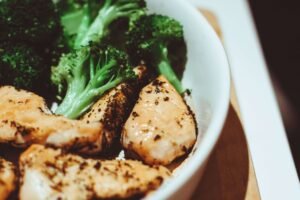
A strong evidence-based target for healthy adults performing resistance training is approximately 1.6 grams of protein per kilogram of body weight per day. A large meta-analysis found that consuming more than roughly 1.6 g/kg/day did not produce additional average gains in fat-free mass, although individual needs and measurement uncertainty vary (Morton et al., 2018).
The International Society of Sports Nutrition describes 1.4–2.0 g/kg/day as sufficient for most exercising adults (Jäger et al., 2017).
Helpful protein sources include:
- Chicken or turkey
- Fish and seafood
- Eggs
- Lean beef
- Milk, cottage cheese, and Greek yogurt
- Tofu, tempeh, and fortified soy milk
- Beans, lentils, and peas
- Seitan
- Protein powder when ordinary food is inconvenient
Protein powder is optional. It is simply a convenient food product, not a requirement for lean muscle gain.
Distributing protein across three or four meals is generally more practical than eating most of it at dinner. Each meal can contain a meaningful protein source rather than relying on exact timing or a narrowpost-workoutt window.
5. Keep Carbohydrates in Your Muscle-Gain Diet
Carbohydrates do not automatically cause belly fat. Consistently consuming more total energy than the body can use is the larger concern. Carbohydrate-rich foods support demanding resistance workouts and help replenish muscle glycogen. Useful options include:
- Rice
- Potatoes and sweet potatoes
- Oats
- Wholegrain bread and pasta
- Beans and lentils
- Fruit
- Quinoa
- Dairy or fortified soy milk
Place a carbohydrate-containing meal within a few hours before training when possible. After training, combine carbohydrates with protein to support recovery. There is no need to rush to eat within a few minutes of finishing a workout if you already consume regular meals.
6. Include Dietary Fat and Nutrient-Dense Foods
Extremely low-fat diets are unnecessary and can make a muscle-building diet difficult to sustain. Include moderate servings of foods such as:
- Olive oil
- Nuts and seeds
- Nut or seed butter
- Avocado
- Eggs
- Fatty fish
Vegetables, fruits, whole grains, beans, dairy or fortified alternatives, and varied protein foods provide fiber and micronutrients that a supplement-heavy diet may lack. “Clean bulking” should mean building a balanced eating pattern, rn not labeling foods as morally good or bad.
Sample Lean Muscle Gain Meal Plan
This example is for general education and can be adjusted for food preferences, allergies, culture, and medical needs.
Breakfast
- Oatmeal prepared with milk or fortified soy milk
- Greek yogurt or eggs
- Berries or a banana
- Nuts or seeds
Lunch
- Grilled chicken, fish, tofu, or beans
- Rice, potatoes, or wholegrain bread
- A large serving of vegetables
- Olive oil-based dressing
Pre Workout Snack
- Fruit with Greek yogurt
or - A turkey, tuna, hummus, or tofu sandwich
Dinner
- Salmon, lean meat, lentils, or tempeh
- Potatoes, pasta, quinoa, or rice
- Salad or cooked vegetables
Optional Evening Snack
- Cottage cheese with fruit
or - Fortified soy yogurt with oats
The portion sizes should support energy, training performance, comfortable fullness, and gradual progress, not forced eating.
How to Know Whether Your Lean Bulk Is Working
Do not judge the program from a single weigh-in or mirror check. Fluid intake, sodium, stored carbohydrates, digestion, and time of day can all influence body weight.
Review several indicators together:
Training performance
Are repetitions, resistance, technique, or total productive training gradually improving?
Recovery
Do you generally feel prepared for the next workout? Persistent fatigue, declining performance, or unusually prolonged soreness may indicate problems with programming, sleep, nutrition, or health.
Long term weight trend
A rapid increase is more likely to contain unnecessary fat. If body weight rises quickly while gym performance changes little, reduce the added food rather than eliminating entire food groups.
Fit and function
Consider how clothing fits, how exercises feel, and whether daily energy is improving. These indicators may be more useful than repeatedly estimating body fat percentage.
Tracking should remain neutral and manageable. Anyone who becomes anxious, compulsive, or highly restrictive around food, exercise, or measurements should stop detailed tracking and seek guidance from a qualified healthcare professional.
Recovery Habits That Support Lean Muscle Gain
Prioritize sleep
Adults ages 18–60 should generally get at least seven hours of sleep per night. Teenagers usually need 8–10 hours and should follow age-appropriate guidance (CDC).
Keep a fairly consistent sleep schedule and allow enough recovery between demanding sessions for the same muscle groups.
Manage training fatigue
More exercise is not always more productive. Reduce training volume temporarily if performance consistently declines, technique deteriorates, or normal soreness does not resolve.
Keep cardio in the program.
Moderate cardiovascular exercise supports heart health and work capacity. It does not automatically prevent muscle growth. Schedule demanding cardio so it does not repeatedly interfere with lower-body strength sessions, and ensure that overall recovery remains adequate.
Common Lean Bulking Mistakes
Eating as much as possible
A dirty bulk may raise scale weight quickly, but rapid weight gain should not be confused with rapid muscle growth. Muscle tissue develops slowly, especially in experienced lifters.
Believing healthy foods cannot cause fat gain.
Chicken, rice, nuts, smoothies, and other nutritious foods still provide energy. Food quality matters for health, but it does not make the quantity irrelevant.
Changing the plan every week
Muscle growth is difficult to assess over a few days. Keep the main exercises and eating pattern consistent long enough to identify a meaningful trend.
Training without recording performance
Without a basic workout log, it is difficult to know whether progressive overload is occurring. Record exercises, resistance, repetitions, and sets.
Performing excessive isolation exercises
Curls and lateral raises can be useful, but they should complement, not replace, presses, rows, squats, hinges, lunges, and other major movement patterns.
Ignoring sleep
Adding food will not fully correct poor recovery caused by inadequate sleep or an unrealistic training schedule.
Depending on supplements
Supplements cannot replace a productive workout program, adequate food, sleep, or patience. Multi-ingredient muscle-building products may also contain inadequately tested combinations or undisclosed amounts. The NIH advises evaluating performance supplements carefully, as safety and effectiveness can vary (NIH Office of Dietary Supplements).
Frequently Asked Questions
How can a man gain muscle without gaining belly fat?
Use progressive resistance training, adequate protein, balanced meals, and only a modest increase in food when necessary. If body weight or waist size rises quickly without comparable improvement in training performance, the surplus is probably larger than needed.
Fat cannot be directed to or away from a particular body area. Where someone tends to store fat is influenced partly by genetics and individual physiology.
Is clean bulking the same as lean bulking?
The terms are often used interchangeably, but they describe different ideas. Lean bulking focuses on controlling the rate of weight gain. Clean bulking usually refers to choosing minimally processed, nutrient-dense foods.
A diet can contain nutritious foods and still provide an excessive amount of energy. Therefore, “clean” food choices do not guarantee minimal fat gain.
Can I gain muscle while maintaining the same weight?
Possibly. If muscle increases while fat decreases, total body weight may change very little. This is more common among beginners, returning lifters, and people substantially improving their training and eating habits.
Do I need a calorie surplus to build muscle?
Not always. Muscle growth can occur at maintenance intake, particularly in less experienced lifters. However, a small surplus may make muscle gain and recovery easier for healthy, trained adults whose progress has stalled.
How quickly should I gain weight?
There is no perfect rate for everyone. Training experience, starting condition, genetics, measurement error, and program quality all affect the result. The available evidence favors a conservative rate, particularly for experienced lifters, because faster gain is more reliably associated with increased fat accumulation than increased hypertrophy.
Should I eliminate carbohydrates to prevent fat gain?
No. Carbohydrates support resistance training performance and recovery. Total dietary intake and the size of the surplus matter more than blaming one macronutrient.
Are supplements necessary for building lean muscle?
No. Adequate protein and other nutrients can come from ordinary foods. A supplement should address a specific need or provide convenience, not replace the foundations of training, nutrition, and recovery.
Safety Considerations
This guide is intended for generally healthy adults. People with kidney disease, diabetes, digestive conditions, food allergies, a history of disordered eating, or other medical concerns should speak with a physician or registered dietitian before making substantial dietary changes.
Anyone under 18 should avoid adult bulking or cutting plans and work with a parent or guardian, pediatric healthcare professional, and qualified coach. Stop exercising and seek medical attention for chest pain, fainting, severe shortness of breath, or sudden injury.
Final Takeaway
The best way to gain muscle without gaining excessive fat is to give your body a clear training reason to grow while supplying enough but not unlimited energy.
Train each major muscle group consistently, use progressive overload, consume adequate protein, build meals around nutritious foods, and protect your sleep. If additional food is necessary, increase it conservatively and evaluate progress over several weeks.
Some fat gain may occur during a lean bulk, especially for experienced lifters. That does not mean the plan has failed. The goal is not perfect control over every pound; it is sustainable strength and muscle development without unnecessary extremes.