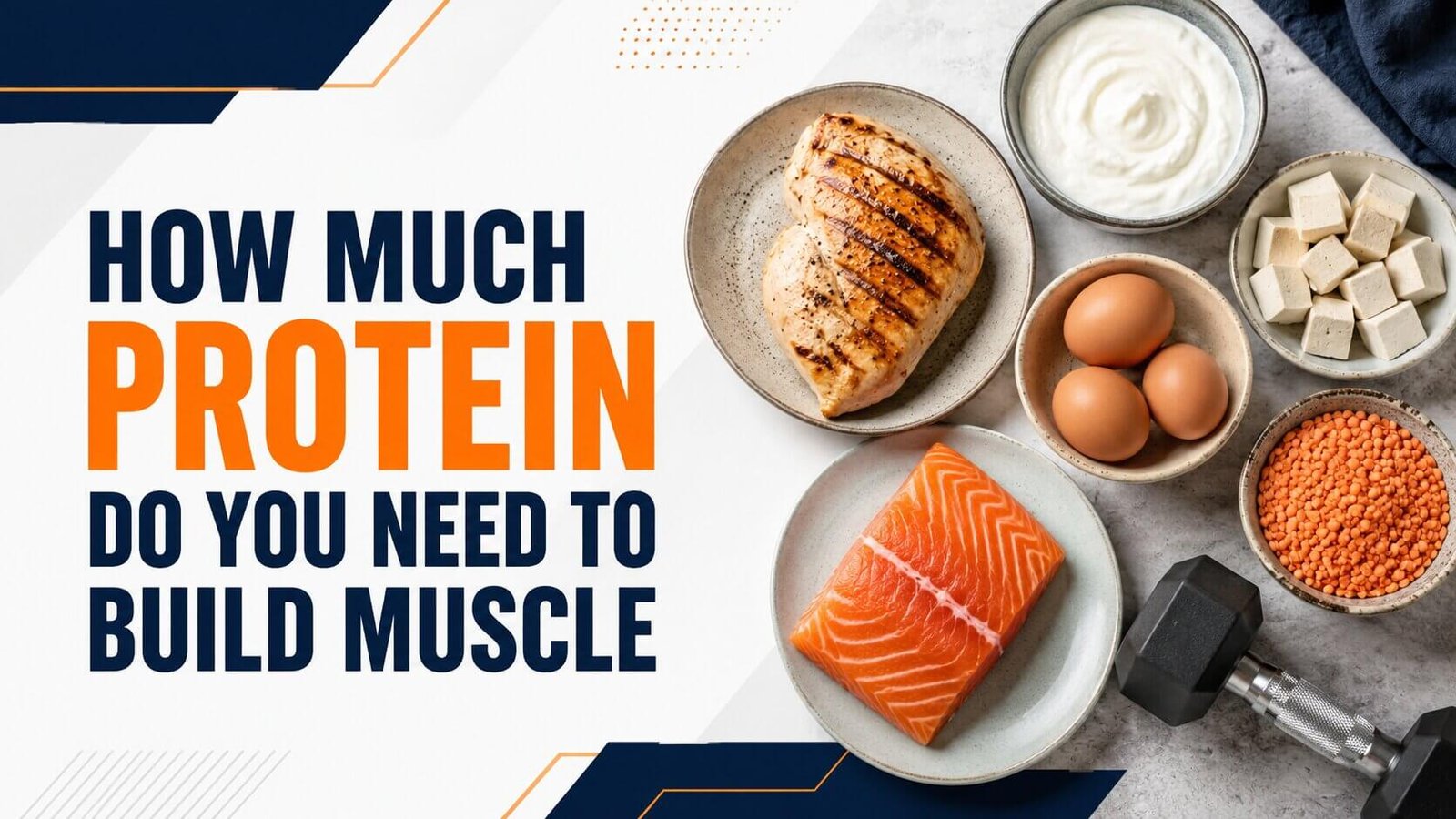
Most people who lift weights can support muscle growth with about 1.6 grams of protein per kilogram of body weight per day, or roughly 0.7 grams per pound. A practical range is 1.4–2.0 g/kg/day (0.6–0.9 g/lb/day), while 2.2 g/kg, or 1 g/lb, can serve as an optional upper target rather than a requirement.
Protein matters, but eating more of it does not automatically create more muscle. You still need progressive resistance training, enough total food, and consistent recovery. This guide will help you calculate a realistic target and meet it without turning every meal into a math problem.
How Much Protein Should You Eat to Build Muscle?
Aim for about 1.6 g/kg/day (0.7 g/lb/day) if you are a healthy adult following a consistent resistance-training program. This target is high enough for most lifters without requiring an unnecessarily restrictive or expensive diet.
A large meta-analysis of 49 resistance-training studies found that protein supplementation improved gains in muscle size and strength. Its statistical breakpoint occurred at approximately 1.62 g/kg/day, meaning additional protein did not produce clearly greater average fat-free-mass gains beyond that point. However, the upper end of the confidence interval was about 2.2 g/kg/day, so 1.6 should not be treated as an exact biological ceiling for every person. Morton et al., 2018
The International Society of Sports Nutrition recommends 1.4–2.0 g/kg/day for most exercising adults who want to build or maintain muscle. That range accounts for differences in training volume, energy intake, protein quality, and individual response. ISSN position stand
The simple recommendation
Use these numbers as a decision framework rather than competing rules:
| Target | Grams per kilogram | Grams per pound | Best use |
|---|---|---|---|
| Lower practical target | 1.4 g/kg | 0.64 g/lb | Recreational lifting, maintenance calories, easier adherence |
| Strong default target | 1.6 g/kg | 0.73 g/lb | Most people are actively trying to gain muscle. |
| Higher practical target | 2.0 g/kg | 0.91 g/lb | Hard training, dieting, or preference for a larger buffer |
| Optional upper buffer | 2.2 g/kg | 1.0 g/lb | Individual variation; rarely necessary for beginners |
If you are unsure, choose 1.6 g/kg. You can reach that amount with ordinary meals, and there is usually little reason for a beginner to chase the highest possible number.
Protein Calculator for Muscle Gain
Multiply your body weight in kilograms by 1.6, or multiply pounds by 0.7, to estimate a straightforward daily target. The result does not need to be exact; consistently landing within about 10 grams is usually more practical than trying to hit the same number perfectly every day.
Kilogram formula:
Body weight in kilograms × 1.6 = grams of protein per day
Pound formula:
Body weight in pounds × 0.7 = grams of protein per day
For example, a 180-pound person could start at approximately 126 grams using the simple pound formula. The more precise kilogram calculation gives about 131 grams. Either target is reasonable.
Daily protein targets by body weight
| Body weight | Practical range: 1.4–2.0 g/kg | Simple target: 1.6 g/kg |
|---|---|---|
| 120 lb (54 kg) | 76–109 g | 87 g |
| 140 lb (64 kg) | 89–127 g | 102 g |
| 160 lb (73 kg) | 102–145 g | 116 g |
| 180 lb (82 kg) | 114–163 g | 131 g |
| 200 lb (91 kg) | 127–181 g | 145 g |
| 220 lb (100 kg) | 140–200 g | 160 g |
These estimates assume that current body weight is a useful basis for the calculation. That is not always true for people carrying a large amount of excess body fat.
What if you have a higher body-fat level?
If multiplying your current weight creates an unrealistic target, using a reasonable goal weight can provide a more manageable starting estimate. Protein needs are influenced partly by lean tissue, so total body weight may overestimate needs when a large portion of that weight is body fat.
This goal-weight method is a practical planning tool, not a universal clinical formula. A registered dietitian can provide a better estimate when obesity, rapid weight loss, diabetes, kidney concerns, bariatric surgery, or another medical issue affects your diet.
Why Is the Muscle-Building Target Higher Than the RDA?
The Recommended Dietary Allowance of 0.8 g/kg/day was designed to cover the basic protein needs of nearly all healthy adults, not to maximize muscle gain from resistance training. Lifting creates an additional remodeling demand, which is why sports-nutrition targets are higher. National Academies Dietary Reference Intakes
The RDA remains an important reference point, but it answers a different question: how much protein is needed to avoid inadequacy in the general population? It does not identify the intake that produces the greatest training adaptation.
The Current Dietary Guidelines for Americans, 2025–2030, set a broader general protein target of 1.2–1.6 g/kg/day and recommend a variety of animal- and plant-sourced protein foods. For a lifter, the top of that general range aligns closely with the 1.6 g/kg muscle-building target. Dietary Guidelines for Americans, 2025–2030
The important distinction is that a dietary guideline, an adequacy standard, and a sports-performance recommendation can all provide different numbers without necessarily contradicting one another.
How Should You Choose Your Personal Protein Target?
Start at 1.6 g/kg/day, then adjust only when your goals or circumstances provide a good reason. The most useful target is one you can meet consistently while still eating enough carbohydrates, fats, fiber, fruits, and vegetables.
Beginners and recreational lifters
Most beginners can use 1.4–1.6 g/kg/day. Training quality and progression will usually matter more than raising protein from an already adequate intake to the top of the range.
If you are new to lifting, focus on learning exercises, training each major muscle group consistently, and gradually adding repetitions, resistance, sets, or harder variations. Protein supports that training stimulus; it does not replace it.
Experienced lifters
Experienced lifters may prefer 1.6–2.0 g/kg/day because their training can be more demanding and small improvements matter more to them. A higher target also provides a margin for imperfect food tracking.
This does not mean an advanced lifter automatically benefits from 2.0 g/kg more than 1.6 g/kg. The expected difference is small and may be nonexistent for many people. Use the higher intake when it fits your appetite and diet rather than forcing it.
Building muscle while losing fat
During a calorie deficit, aiming toward 1.8–2.2 g/kg/day can be reasonable, especially for lean, resistance-trained adults trying to preserve muscle. Energy restriction raises the risk of losing lean tissue, while protein also helps with fullness.
The best amount depends on the size of the calorie deficit, current body composition, training experience, and how lean you are. People with higher body-fat levels should be cautious about calculating a very high target from total body weight.
Men and women
Men and women can use the same protein recommendation relative to body weight. A woman may have a lower absolute target because she weighs less, but she does not need a separate low-protein formula simply because she is female.
Individual factors—including body size, training, energy intake, age, pregnancy, and health—are more useful than sex alone for setting a target.
Adults over 40
Adults over 40 can generally start with the same 1.6 g/kg target when muscle gain is the goal. Aging muscle may respond less strongly to a small protein serving, so including a substantial protein source in each main meal becomes especially useful.
Training remains essential. Extra protein without resistance exercise cannot reproduce the muscle-building stimulus created by progressively challenging the muscles.
Plant-based lifters
Plant-based lifters can build muscle with a well-planned diet that supplies enough total protein and essential amino acids. Aiming near the middle or upper part of the practical range can make planning easier when most foods have lower digestibility or less leucine per serving.
In a 12-week trial, an exclusively plant-based diet and an omnivorous diet produced similar muscle and strength adaptations when both supplied about 1.6 g/kg/day and participants followed the same resistance-training program. The vegan group used soy protein to help reach the target, so the result supports a properly planned high-protein vegan diet rather than proving that every unplanned plant-based diet performs identically. Hevia-Larraín et al., 2021
How Much Protein Should You Eat Per Meal?
A practical meal target is about 0.3–0.4 g/kg, which works out to roughly 20–40 grams for many adults. Spread your daily intake across three to five eating occasions when that pattern fits your schedule.
A review of protein distribution proposed approximately 0.4 g/kg per meal across at least four meals to reach 1.6 g/kg/day. It also emphasized that this is an optimization strategy, not proof that protein above a certain amount is wasted. Schoenfeld and Aragon, 2018
| Body weight | Approximate target at 0.3–0.4 g/kg per meal |
|---|---|
| 120 lb (54 kg) | 16–22 g |
| 140 lb (64 kg) | 19–25 g |
| 160 lb (73 kg) | 22–29 g |
| 180 lb (82 kg) | 24–33 g |
| 200 lb (91 kg) | 27–36 g |
| 220 lb (100 kg) | 30–40 g |
You do not need to eat every three hours or carry a protein shake everywhere. If your schedule allows only three meals, divide your target across those meals. Four meals may create a more even distribution, but adherence and daily intake come first.
Example: dividing 130 grams across the day
| Eating occasion | Protein target |
|---|---|
| Breakfast | 30 g |
| Lunch | 35 g |
| Snack or shake | 25 g |
| Dinner | 40 g |
| Daily total | 130 g |
This pattern is often easier than trying to recover from a low-protein breakfast and lunch with an enormous dinner.
Can Your Body Absorb Only 20 or 30 Grams of Protein at Once?
No. Your digestive system can absorb far more than 20–30 grams of protein from a meal. The confusion comes from mixing up absorption with the amount that maximizes the short-term muscle protein synthesis response.
After digestion, amino acids enter circulation and can support enzymes, hormones, immune proteins, connective tissue, and other tissues—not only skeletal muscle. Some may also be oxidized for energy. A larger meal therefore does not become useless simply because it contains more protein than needed to maximize one short-term muscle response.
Research cannot give every person a single, fixed per-meal ceiling. Age, body size, meal composition, protein source, exercise, and the length of the measurement period all affect the result. Treat 0.3–0.4 g/kg per meal as a useful planning target, not an absorption limit.
Does Protein Timing Matter for Muscle Growth?
Total daily protein matters more than consuming a shake within a narrow post-workout window. Eating a protein-containing meal within a few hours before or after training is a sensible approach for most people.
Resistance exercise increases the muscle’s sensitivity to protein for many hours. The ISSN notes that protein before or after training can support muscle protein synthesis, while the effect of exercise remains elevated for at least 24 hours and gradually declines. This evidence does not support the claim that a workout is wasted if you miss a 30-minute window. ISSN position stand
Use these practical rules:
- If you ate a mixed meal containing protein one to three hours before training, eat your next normal protein-rich meal afterward.
- If you trained after a long fast, eating protein reasonably soon afterward is more useful.
- If a shake is the easiest option after work or a late session, use one. It is convenient, not uniquely anabolic.
- Do not interrupt sleep or structure your entire day around exact protein timestamps.
Do you need protein before bed?
Pre-sleep protein can help increase overnight muscle protein synthesis, but it is optional. It is most useful when it helps you reach your daily target or when dinner is early and the overnight fasting period will be long.
A serving of Greek yogurt, cottage cheese, milk, soy milk, tofu, or a protein shake can work. If you already meet your target and prefer not to eat before bed, you do not need to add calories solely for theoretical optimization.
Do You Need the Same Protein on Rest Days?
Yes. Keep approximately the same daily protein target on rest days because muscle repair and remodeling continue after the workout ends.
Your total calorie or carbohydrate intake may change slightly based on activity and appetite, but there is little reason to cycle protein sharply up on training days and down on rest days. A steady intake is also easier to plan and track.
What Are the Best Protein Sources for Muscle Growth?
The best protein sources provide enough protein, essential amino acids, and useful nutrients while fitting your budget, preferences, and overall health needs. Both animal and plant foods can contribute effectively.
Animal-based options
- Fish and seafood
- Chicken and turkey
- Eggs and egg whites
- Milk, Greek yogurt, and cottage cheese
- Lean beef or pork
- Whey or casein protein when convenient
Animal proteins generally contain all essential amino acids in favorable proportions. That does not mean every meal must contain meat or that protein foods high in saturated fat and sodium are required for muscle gain.
Plant-based options
- Tofu, tempeh, edamame, and soy milk
- Lentils, beans, chickpeas, and split peas
- Seitan, if gluten is suitable for you
- Pea, soy, or blended plant protein powder
- Nuts and seeds
- Whole grains paired with legumes and other protein foods
Soy foods are especially useful because they provide a complete amino acid profile. Other plant foods can complement one another across the day; you do not need to combine specific proteins at every meal.
Protein quality without overcomplication
Muscle protein synthesis requires essential amino acids, including leucine, which helps signal the muscle-building process. Dairy, eggs, meat, fish, and soy tend to provide substantial essential amino acids per serving.
You usually do not need to count leucine grams. Eat varied protein-rich foods, reach an appropriate daily total, and include a meaningful protein source at each main meal. Plant-based lifters can use slightly larger servings or a soy, pea, or blended protein product when food alone makes the target difficult.
What Does a 130-Gram Protein Day Look Like?
A 130-gram day can be built from four ordinary eating occasions without constant shakes or unusually large portions. The numbers below are estimates; brands, serving sizes, and cooking methods change the actual protein content.
| Meal | Example | Approximate protein |
|---|---|---|
| Breakfast | Greek yogurt, two eggs, and fruit | 30–32 g |
| Lunch | Chicken or tofu grain bowl with vegetables | 33–37 g |
| Snack | Cottage cheese or a soy/whey shake | 23–27 g |
| Dinner | Salmon or tempeh with lentils, rice, and vegetables | 36–42 g |
| Daily total | Approximately 125–138 g |
For accurate tracking, use the Nutrition Facts label and weigh or measure portions for a short learning period. You may discover that you need only one simple adjustment, such as adding Greek yogurt at breakfast or increasing the main protein portion at lunch.
A simple meal-building method
At each main meal:
- Choose a primary protein source.
- Select a portion that supplies roughly 25–40 grams, adjusted for body size.
- Add carbohydrates that support training, such as potatoes, rice, oats, fruit, beans, or whole grains.
- Include vegetables or fruit and an appropriate fat source.
- Check the end-of-day total before adding a supplement.
Protein is one part of a muscle-building diet. Carbohydrates help fuel demanding training, dietary fat supports health, and fruits, vegetables, legumes, and whole grains provide fiber and micronutrients.
Do You Need Protein Powder to Build Muscle?
No. Protein powder can help you reach your target, but it does not build more muscle than an equally useful amount of protein from a balanced diet.
A typical powder provides around 20–30 grams per serving and can be convenient when you have little time, a low appetite, or limited high-protein options. Whole foods offer additional nutrients and often provide greater fullness, so supplements should fill a gap rather than automatically replace meals.
Before buying a product, consider:
- Protein per serving and serving size
- Added sugar and total calories
- Allergens and digestive tolerance
- Whether the product fits a vegan, dairy-free, or gluten-free diet
- Independent third-party testing, especially for competitive athletes
BCAAs are generally unnecessary when you already consume enough complete protein. A complete protein food or powder supplies the essential amino acids needed to build new muscle tissue.
Can You Eat Too Much Protein?
Yes, protein can become excessive when it displaces other nutrients, creates digestive problems, makes the diet unnecessarily expensive, or conflicts with a medical condition. More protein is not automatically better once you already meet an effective target.
Research summarized by the ISSN reports no harmful changes in common kidney or liver markers in healthy, resistance-trained adults consuming high-protein diets in controlled studies lasting up to one year. That evidence applies to screened, healthy participants and does not prove that every very high-protein diet is ideal for every person over a lifetime. Food choices and overall dietary pattern still matter. ISSN position stand
Kidney disease requires different guidance.
People with chronic kidney disease should not adopt a bodybuilding protein target without clinical advice. Protein recommendations differ by disease stage and dialysis status; the National Kidney Foundation advises people with CKD to work with a healthcare professional or renal dietitian. National Kidney Foundation
Get individualized guidance if you have kidney or liver disease, are pregnant or breastfeeding, have gout or a history of kidney stones, take medication that affects kidney function, or have been instructed to follow a medically controlled diet.
Common Protein Mistakes
Avoiding a few common errors will do more for your progress than chasing an exotic supplement or perfect nutrient timing.
Treating 1 gram per pound as the minimum
One gram per pound is an optional upper buffer, not the entry requirement for muscle growth. Starting near 0.7 g/lb is more practical and is supported by resistance-training research.
Ignoring progressive resistance training
Protein supplies building material, but training provides the signal to build muscle. Your program should gradually become more challenging through additional resistance, repetitions, sets, range of motion, or harder variations.
Eating too few total calories
Muscle gain becomes harder when you chronically undereat. Beginners and people returning to training may gain muscle at maintenance or even during a modest deficit, but a small calorie surplus can help when muscle gain is the main goal.
Saving nearly all your protein for dinner
A high-protein dinner can help you reach the daily total, but including protein at breakfast and lunch produces a more balanced pattern and usually makes the goal easier to meet.
Obsessing over the post-workout window
A shake consumed immediately after training cannot compensate for an inadequate daily diet. Place protein near the workout when convenient, then focus on your total intake.
Assuming more protein means faster results
Increasing intake from 0.8 to 1.6 g/kg may be useful for a lifter. Increasing it from 1.6 to 3.0 g/kg is unlikely to double muscle growth and may crowd out carbohydrates, fats, and fiber.
Relying on shakes and bars for most meals
Supplements are convenient but usually provide a narrower range of nutrients than meals. Build the diet around varied foods and use supplements to cover genuine gaps.
Using current body weight blindly
For someone with substantial excess body fat, a total-body-weight formula can create an impractical target. A goal-weight estimate or professional assessment may be more appropriate.
A Practical Five-Step Protein Plan
Use this process to set a target without making your entire diet revolve around protein.
- Calculate your starting target. Multiply kilograms by 1.6 or pounds by 0.7.
- Review your current intake. Track three to seven typical days rather than judging from one unusually good day.
- Divide the target across meals. Use three to five protein-containing eating occasions according to your schedule.
- Fix the easiest gap first. Add a protein-rich breakfast, increase lunch portions, or use one convenient snack.
- Evaluate the whole plan. Check training progression, calories, sleep, digestion, budget, and adherence before raising protein further.
You do not need to change the target because your body weight moved by one or two pounds. Recalculate after a meaningful weight change or when your goal shifts from gaining to losing weight.
Frequently Asked Questions
Is 100 grams of protein enough to build muscle?
One hundred grams may be enough for a smaller person but too low for a larger lifter. At 1.6 g/kg, 100 grams covers someone weighing about 138 pounds. Use body weight, training, and total diet rather than treating 100 grams as a universal threshold.
Is 200 grams of protein too much?
Two hundred grams may fit a large athlete but is unnecessary for many adults. It equals about 2.2 g/kg for a 200-pound person and 2.9 g/kg for a 150-pound person. If 200 grams is far above your calculated range, the extra food may be better allocated to carbohydrates, fats, fruits, vegetables, and fiber.
Is 1 gram of protein per pound necessary?
No. Research supports about 0.7 g/lb as a strong default target, while 1 g/lb provides an easy upper buffer. You can build muscle without reaching 1 g/lb every day.
Should I calculate protein from current or goal weight?
Use current weight when it reasonably reflects the body mass you are supporting. If substantial excess body fat produces an extreme target, goal weight can provide a more practical starting estimate. Seek individualized advice when a health condition or major weight change is involved.
How much protein should I eat after a workout?
Roughly 20–40 grams works for many adults, or use about 0.3–0.4 g/kg as a size-adjusted target. The meal does not need to occur immediately if you ate protein within a few hours before training.
Can I build muscle with two meals per day?
You can build muscle if two meals allow you to meet your calorie and protein needs, but distributing protein across three or four meals may be easier and potentially more favorable for muscle protein synthesis. Choose a pattern you can sustain before pursuing small theoretical advantages.
Do I need more protein on workout days?
No. Keeping a similar daily target on training and rest days is simple and supports the repair process between workouts. Your carbohydrate or calorie intake may vary more with activity.
Can plant protein build muscle as effectively as animal protein?
It can when the diet provides enough total protein, energy, and essential amino acids. Use varied plant foods, emphasize protein-dense options such as soy, and consider the upper part of your target range if most of your protein comes from less concentrated plant sources.
Will eating protein build muscle without lifting weights?
Adequate protein helps maintain body tissues, but meaningful muscle growth generally requires progressive resistance exercise. Protein and training work together; neither replaces the other.
Conclusion
Most healthy adults trying to build muscle can start with 1.6 g/kg/day, or about 0.7 g/lb/day. A practical range of 1.4–2.0 g/kg offers flexibility, while 2.2 g/kg should be viewed as an optional upper buffer rather than a minimum.
Divide the target across a few protein-rich meals, keep it steady on rest days, and choose foods that support the rest of your diet. Then direct most of your attention to the factors that create the reason for muscle to grow: progressive training, sufficient energy, and consistent recovery.
Next step: Calculate your target, track your usual intake for several days, and improve the meal with the largest protein gap. Pair that plan with a structured home resistance workout so you can progress over time.