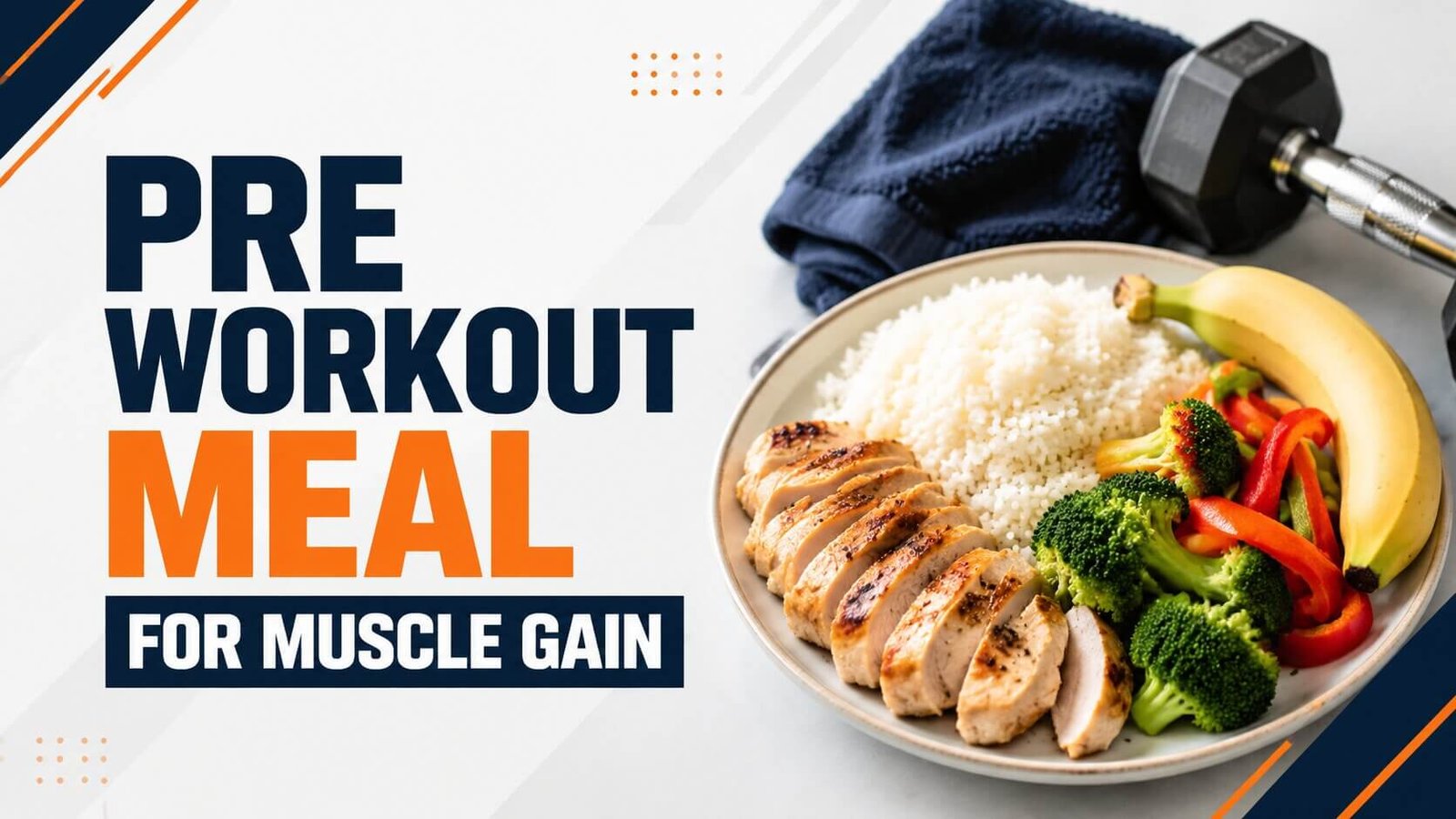
A good pre-workout meal for muscle gain combines a useful serving of protein with enough carbohydrates to support the planned workout. Eat a normal mixed meal about two to three hours before lifting, or choose a smaller, easier-to-digest snack when you have only 30–90 minutes.
There is no single food, macro ratio, or narrow timing window that guarantees more muscle. Your total daily protein and calorie intake, progressive resistance training, and recovery matter more. Pre-workout nutrition is a supporting tool: it can reduce hunger, provide amino acids, and help you train productively without leaving you uncomfortably full.
What Makes a Good Pre-Workout Meal for Muscle Gain?
A useful pre-workout meal provides fuel without creating digestive discomfort. For most lifters, that means a carbohydrate source, a moderate serving of protein, a portion size matched to the available digestion time, and enough fluid to begin training well hydrated.
The meal supports muscle gain indirectly. Carbohydrates can help you sustain training volume under some conditions, while protein provides essential amino acids around the training session. Neither nutrient replaces the mechanical stimulus created by progressively challenging your muscles.
Carbohydrates support demanding training.
Carbohydrates help supply energy for repeated hard sets. Your muscles store carbohydrate as glycogen, although a normal resistance workout does not necessarily empty those stores. The value of extra pre-workout carbohydrate therefore depends on what you have eaten, how long you have fasted, and how demanding the session will be.
A systematic review and meta-analysis found that acute carbohydrate intake improved total resistance-training volume on average. The benefit was more apparent when workouts lasted longer than 45 minutes or participants had fasted for at least eight hours. This does not mean everyone needs a large carb meal before every short session. Someone who ate a balanced lunch two hours before a 40-minute workout may already be adequately fueled.
Practical carbohydrate choices include:
- Rice, pasta, potatoes, oats, cereal, bread, bagels, or tortillas
- Bananas, applesauce, grapes, melon, dried fruit, or other tolerated fruit
- Milk, yogurt, or fortified soy milk, which provide both carbohydrate and protein
- Honey, jam, juice, or a sports drink when rapid digestion is more useful than fullness
Whole grains, beans, and fibrous produce are nutritious foods. They simply may not be the most comfortable choices in a large amount immediately before intense exercise. The U.S. Anti-Doping Agency recommends emphasizing lower-fiber carbohydrate sources within roughly 60–90 minutes of high-intensity training to reduce digestive burden.
Protein supplies amino acids.
Including protein before lifting places amino acids in circulation during and after the session. A serving of approximately 20–40 grams of high-quality protein works as a practical planning range for many healthy adults. The International Society of Sports Nutrition uses a broader body-size guideline of about 0.25–0.40 grams per kilogram per feeding.
This is not a pre-workout requirement or a hard absorption limit. A smaller person may need less, a larger person may prefer more, and a substantial meal eaten several hours earlier continues to digest during training. Your total daily protein target has a larger influence on long-term progress than hitting an exact number in this one meal.
Convenient protein choices include:
- Chicken, turkey, lean beef, fish, eggs, or egg whites
- Greek yogurt, cottage cheese, milk, or whey protein
- Tofu, tempeh, edamame, seitan, or fortified soy milk
- A plant-protein blend or soy protein powder when food is inconvenient
Peanut butter, nuts, and seeds contain protein, but much of their energy comes from fat. They can fit a meal eaten well before training, yet they are less efficient as the only protein source and may feel heavy when eaten close to the session.
Fat and fiber depend on timing and tolerance.
Fat and fiber belong in a healthy diet, but both can slow digestion or increase fullness. That is often helpful during the rest of the day and less helpful immediately before squats, deadlifts, or a high-repetition circuit.
You do not need to remove them from every pre-workout meal. A moderate amount of olive oil, avocado, nuts, beans, or vegetables may be comfortable three hours before training. As the workout gets closer, reduce the portion if you experience reflux, gas, cramping, or sluggishness. Individual tolerance matters more than an arbitrary gram limit.
Fluids complete the meal.
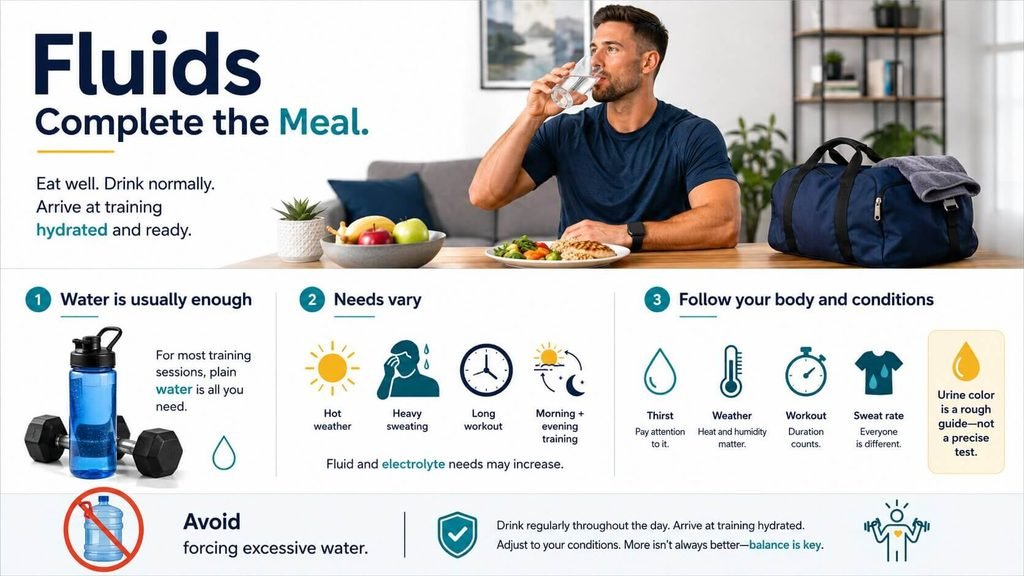
Start the session normally hydrated rather than trying to drink a large amount at the gym door. Water is sufficient for most ordinary lifting sessions. Hot conditions, heavy sweating, long workouts, and two-a-day training may increase fluid and electrolyte needs.
Urine color, thirst, weather, workout duration, and sweat rate can help guide intake. Pale-yellow urine is a useful everyday sign, but it is not a precise hydration test. Avoid forcing excessive water, which can also be unsafe.
How Long Before a Workout Should You Eat?
Meal timing should follow a simple rule: the closer you are to training, the smaller and easier to digest the food should be. A large mixed meal generally needs more time than a banana, yogurt, or shake.
| Time before lifting | Practical approach | Emphasize | Reduce if sensitive. |
|---|---|---|---|
| 2–4 hours | Normal meal | Carbs, protein, fluids, and normal vegetables | Very greasy or unusually large portions |
| 1–2 hours | Small meal or substantial snack | Easy-to-digest carbs and moderate protein | Large amounts of fat, fiber, and spicy food |
| 30–60 minutes | Light snack | Familiar quick carbs; optional easy protein | Heavy solid food, large shakes, nuts, fried food |
| Less than 30 minutes | Optional small top-up | Banana, applesauce, a few crackers, juice, or sports drink | Anything that sits heavily in your stomach |
These windows are starting points, not physiological deadlines. Some people can eat a turkey sandwich 60 minutes before lifting, while others need two hours. Test changes during normal training, not before an important event or a personal-record attempt.
If you have two to four hours
Eat a balanced meal with a clear protein source and a generous carbohydrate portion. You have enough time to include moderate fat, fiber, and vegetables if you digest them comfortably.
Examples include chicken with rice and vegetables, eggs with toast and fruit, a turkey sandwich with yogurt, or tofu with noodles. This meal may simply be breakfast, lunch, or dinner; it does not require special “fitness” foods.
If you have one to two hours
Choose a smaller meal with less fat and fiber. Oatmeal with protein powder, Greek yogurt with cereal and fruit, or a modest turkey sandwich can provide useful fuel without the volume of a full plate.
Liquid or semi-solid foods can be easier when your appetite is low. However, a large smoothie containing nut butter, seeds, oats, fruit, milk, and multiple scoops of protein may digest like a full meal rather than a light drink.
If you have 30–60 minutes
Keep the snack familiar, relatively small, and carbohydrate-led. Add a modest protein source only if it feels comfortable or your previous protein meal was several hours ago.
A banana and whey shake, low-fat yogurt with applesauce, or toast with jam and a small glass of milk can work. If you already ate a protein-containing meal within the previous few hours, fruit or another carbohydrate snack alone may be enough.
How Much Protein and Carbohydrate Should You Eat?
There is no universal pre-workout macro target. For a typical muscle-building workout, many adults can begin with roughly 20–40 grams of protein and 25–60 grams of carbohydrate, then adjust the carbohydrate portion for body size, prior meals, workout length, and total calorie needs.
Treat those numbers as a meal-building range, not a scientific threshold. The Academy of Nutrition and Dietetics gives a more specific example for resistance-training athletes: a snack with 15–20 grams of high-quality protein and about 25 grams of carbohydrate one hour before lifting. Larger meals and longer training sessions may justify more food.
A simple way to choose your portion
Use these four questions:
- When did you last eat? If lunch was two hours ago, you may need little or nothing. After an overnight fast, a snack is more likely to help.
- How demanding is the workout? A long leg session with many hard sets usually requires more fuel than a short technique session.
- Are you trying to gain body weight? A larger pre-workout meal can help someone struggling to reach a calorie surplus. It should still fit the full-day plan.
- What can you digest comfortably? The theoretically perfect macro target is useless if it causes nausea or reduces training quality.
Sample starting points
| Situation | Protein | Carbohydrate | Example |
|---|---|---|---|
| Full meal, 2–3 hours before | 25–40 g | 40–80 g | Chicken, rice, fruit, and vegetables |
| Small meal, 1–2 hours before | 20–30 g | 30–60 g | Greek yogurt, cereal, and banana |
| Quick snack, 30–60 minutes before | 0–25 g | 15–40 g | Banana and an optional small shake |
| Short session after a recent meal | No extra target | Optional | Water may be all you need. |
The ranges intentionally overlap. They should not be converted into a mandatory carbohydrate-to-protein ratio. Muscle gain depends on whether the entire day supplies sufficient energy and protein, not whether one meal achieves a 2:1 or 3:1 ratio.
Pre-Workout Meal Ideas for Muscle Gain
The best meal is one that fits your schedule, helps you meet daily nutrition needs, and lets you train without hunger or stomach discomfort. The estimates below are broad because brands, recipes, and serving sizes vary.
Full meals for two to three hours before training
| Meal | Typical protein | Typical carbohydrate | Why it can work |
|---|---|---|---|
| 4–5 oz chicken, 1–1½ cups cooked rice, vegetables, and fruit | 35–45 g | 70–105 g | High-carb, lean, and easy to scale for calorie needs |
| Turkey sandwich on two slices of bread, low-fat yogurt, and fruit | 30–40 g | 60–90 g | Portable and requires little preparation |
| Three eggs, extra egg whites, toast, and a banana | 30–40 g | 55–80 g | Practical pre-workout breakfast with complete protein |
| Lean ground beef, potatoes, and cooked vegetables | 30–40 g | 45–75 g | Balanced meal for afternoon or evening training |
| Tofu, white rice, cooked vegetables, and a light sauce | 25–35 g | 60–90 g | Plant-based and easy to modify |
| Pasta with lean turkey or lentil-based tomato sauce | 25–40 g | 60–100 g | Useful when higher calorie intake is needed |
Cooked vegetables may be more comfortable than a large raw salad. White rice, regular pasta, or white bread are not inherently “better” for muscle growth than whole-grain versions. They may simply digest more easily close to training. Choose higher-fiber foods elsewhere in the day if lower-fiber pre-workout options help performance.
Smaller meals for one to two hours before training
| Meal | Typical protein | Typical carbohydrate | Adjustment |
|---|---|---|---|
| Oatmeal with whey or soy protein and banana | 25–35 g | 50–75 g | Use quick oats or a smaller serving if fiber feels heavy. |
| Low-fat Greek yogurt with cereal, berries, and honey | 20–30 g | 40–70 g | Choose lactose-free yogurt if needed |
| Turkey on a bagel or English muffin | 25–35 g | 45–70 g | Use a smaller sandwich closer to training. |
| Cottage cheese with fruit and toast | 20–30 g | 35–60 g | Best for people who tolerate dairy well |
| Smoothie with milk or soy milk, protein powder, and banana | 25–40 g | 35–65 g | Keep nut butter and seeds modest near training. |
| Tofu scramble with toast and fruit | 20–30 g | 45–70 g | A dairy-free breakfast option |
Quick snacks for 30–60 minutes before training
- Banana with a small whey, soy, or plant-protein shake
- Applesauce pouch with low-fat Greek yogurt
- Toast or rice cakes with jam, plus a small glass of milk or soy milk
- Low-fiber cereal with milk
- Pretzels and a small drinkable yogurt
- Fruit smoothie made without a large amount of fat or fiber
- A banana, dates, or crackers alone if you recently ate protein
Quick snacks do not need to resemble balanced meals. Their purpose is to solve an immediate problem—usually hunger or inadequate carbohydrate availability—while remaining comfortable during training.
How to Eat Before Morning and Evening Workouts
The clock changes the practical strategy more than it changes human physiology. Morning lifters may have a limited appetite and an overnight fast to consider, while evening lifters often train after several normal meals.
Early-morning training
If you have 60–90 minutes, try oatmeal with milk and protein powder, yogurt with cereal and fruit, or eggs with toast. If you train almost immediately after waking, a banana, applesauce, toast with jam, or a small shake is more realistic.
You do not have to force a full breakfast. A small carbohydrate snack before training followed by a protein-rich breakfast afterward can work well. If solid food makes you nauseated, test a liquid option or reduce the serving.
Lunchtime training
Breakfast can act as the main pre-workout meal. Add a small snack midmorning if breakfast was early or light. Examples include yogurt and fruit, a half sandwich, cereal with milk, or a banana.
Plan the post-workout lunch in advance. Skipping it because of meetings may make it harder to reach daily calories and protein, even if the pre-workout meal was well designed.
Evening training
Lunch and an afternoon snack normally provide adequate preparation. A full second “pre-workout meal” may be unnecessary. Try a small snack 60–90 minutes before lifting if you feel hungry or notice your performance fading.
People who experience reflux should leave more time after dinner-sized meals and avoid lying down soon after a late post-workout dinner. Smaller portions before and after training may be more comfortable than one very large evening meal.
Vegetarian, Vegan, and Dairy-Free Pre-Workout Meals
Plant-based diets can support muscle gain when they provide enough energy, total protein, and essential amino acids. Choose protein-dense foods and use portions that do not create an excessive fiber load immediately before training.
Useful options include:
- Tofu with rice or noodles
- Tempeh with a bagel or potatoes
- Seitan sandwich with fruit
- Soy yogurt with cereal and banana
- Fortified soy milk, oats, fruit, and soy or blended plant protein
- A bean-and-rice bowl eaten several hours before training
Beans and lentils supply carbohydrate, protein, and fiber. They work well in a meal two to four hours before exercise but may cause discomfort closer to training. Tofu, seitan, soy milk, soy yogurt, or a plant-protein powder can provide protein with less fiber.
Milk alternatives vary widely. Almond, oat, and coconut drinks may contain very little protein unless the product is fortified or specifically formulated as a high-protein beverage. Check the Nutrition Facts label rather than assuming every milk alternative replaces dairy or soy nutritionally.
Can You Build Muscle While Training Fasted?
Yes, fasted resistance training can still produce muscle and strength gains when the full diet and training program are appropriate. Current long-term evidence does not establish a clear hypertrophy advantage for either fasted or fed lifting, but the evidence is limited.
A 2025 systematic review found no statistically significant differences in fat-free mass, hypertrophy, or strength between fasted and fed resistance training. Only four studies qualified, and three had a high risk of bias, so the result should not be treated as proof that feeding never matters.
Fasted training may be reasonable when:
- You prefer exercising without food in your stomach
- The session is short or moderate in volume
- Your performance remains stable
- You can eat a protein-containing meal afterward
- You still meet daily calorie and protein needs
A pre-workout snack may be the better option when:
- You feel dizzy, weak, distracted, or unusually hungry
- Repetitions or training volume consistently decline
- The session is long and demanding
- You struggle to consume enough calories for muscle gain
- Training occurs after an overnight fast, and breakfast will also be delayed
Do not interpret greater fat use during an individual fasted workout as greater long-term fat loss. Body composition is influenced by the broader energy balance and training program.
Do You Need a Protein Shake or Pre-Workout Supplement?
No supplement is required to create an effective pre-workout meal. Protein powder is convenient when you lack time or appetite, while stimulant-based “pre-workout” products serve a different purpose and do not replace food.
Whey, soy, or a well-formulated plant blend can help you reach a protein target. Choose a product based on tolerance, dietary preference, cost, and third-party testing—not promises of faster muscle growth. The National Institutes of Health notes that athletes can generally obtain adequate protein from food, although supplements may be useful for convenience.
Caffeine can improve some aspects of exercise performance, but it can also disrupt sleep, cause anxiety or palpitations, and interact with medications. A late stimulant dose that reduces sleep may work against recovery. People who are pregnant, sensitive to caffeine, managing a heart condition, or taking relevant medication should seek individualized guidance.
Avoid proprietary “muscle-building” supplements with unclear doses or extreme claims. Competitive athletes should be especially careful because supplements can contain prohibited or undeclared ingredients.
How to Personalize Your Pre-Workout Meal
Start with a simple meal, keep the rest of the routine reasonably consistent, and assess the result over several comparable workouts. One good or bad session does not prove that food caused the outcome.
Record four details:
- What and how much you ate
- Time between eating and the first working set
- Hunger, energy, and stomach comfort during training
- Whether performance matched the planned repetitions and loads
Then make one change at a time:
- Hungry halfway through: Increase carbohydrates or meal size, or eat slightly closer to training.
- Full or nauseated: Reduce the portion, fat, or fiber, or allow more digestion time.
- Energy drops during a long workout: Add carbohydrates before training and review hydration.
- Struggling to gain weight: Increase the pre-workout meal or add calories elsewhere in the day.
- Uncomfortably sleepy: Reduce meal size and very high-fat foods; check sleep rather than blaming carbohydrates automatically.
- No noticeable difference: Keep the simplest option. You do not need a special ritual when normal meals already work.
Common Pre-Workout Meal Mistakes
Treating the meal as the main driver of muscle growth
A well-timed meal cannot compensate for inconsistent training, inadequate daily protein, too few calories, or poor sleep. Fix the overall program before optimizing small timing details.
Eating a large meal too close to lifting
More food does not always mean more energy during the session. A heavy meal can cause fullness, reflux, and sluggishness. Move it earlier or reduce the serving.
Avoiding all carbohydrates
Low-carbohydrate diets can be compatible with some training preferences, but carbohydrates are a useful fuel for repeated hard efforts. Lifters who train after fasting or perform high-volume sessions have the strongest reason to test a pre-workout carbohydrate serving.
Using peanut butter as the main protein source
Peanut butter is primarily a fat-rich food with some protein. It can add calories for muscle gain but may not supply a substantial protein serving without also adding considerable fat.
Copying a bodybuilder’s exact meal
Their body size, calorie intake, drug use, training volume, schedule, and digestion may differ from yours. Use examples as templates, then scale them to your needs.
Assuming “clean” foods are always better before training
Brown rice, beans, raw vegetables, and high-fiber bread are nutritious, but white rice, a bagel, or low-fiber cereal may be easier to digest close to exercise. Judge the full diet rather than a single meal.
Introducing several new foods at once
If discomfort occurs, you will not know which ingredient caused it. Test unfamiliar foods and serving sizes during ordinary training.
Forgetting the next meal
Pre-workout nutrition is only one part of the day. If the session ends many hours after your last substantial protein serving, arrange a normal protein-rich meal afterward. A 2025 meta-analysis found no meaningful lean-mass advantage from taking protein specifically before rather than after training, reinforcing the value of a flexible peri-workout window.
A Simple Pre-Workout Meal Checklist
Before training, ask:
- Did I eat a protein-containing meal within the last three to five hours?
- Have I eaten enough carbohydrate for the planned workload?
- Is the portion appropriate for the time available to digest it?
- Am I choosing familiar foods that normally sit well?
- Have I consumed fluids normally throughout the day?
- Does this meal fit my daily calorie and protein targets?
If most answers are yes, the meal is probably good enough. Consistency is more useful than endlessly changing foods in search of a small theoretical advantage.
Frequently Asked Questions
What is the best pre-workout meal for muscle gain?
There is no single best meal. A reliable template is lean protein, a carbohydrate-rich food, and a small amount of fat eaten two to three hours before lifting. Chicken with rice and fruit, Greek yogurt with cereal and banana, or tofu with noodles can all work.
What should I eat 30 minutes before lifting weights?
Choose a small, familiar, rapidly digested snack. A banana, applesauce, toast with jam, a few dates, or a small protein shake with fruit are practical options. Avoid forcing food if you recently ate and are not hungry.
Is a banana enough before a workout?
A banana can be enough for a short session when you ate a balanced meal earlier. It supplies carbohydrate but very little protein, so pair it with yogurt, milk, or a shake if your previous protein meal was several hours ago.
Is it better to eat protein before or after a workout?
Neither timing is universally superior for long-term muscle gain. Meeting your daily target and placing protein within a broad window around training are more important. Eat afterward sooner when you trained fasted; there is less urgency when you ate protein before lifting.
How much protein should I eat before a workout?
Approximately 20–40 grams is a practical range for many adults, or use about 0.25–0.40 g/kg as a body-size guide. This is not a required dose or absorption limit. Review your protein-per-meal plan in the context of the whole day.
How many carbohydrates should I eat before lifting?
There is no universal amount. Roughly 25–60 grams is a reasonable starting range for many recreational lifters, while larger athletes and longer sessions may require more. A short workout after a recent meal may not require additional carbohydrate.
Should I avoid fat before a workout?
No. A modest amount can fit a meal eaten several hours before training. Limit high-fat meals closer to exercise if they cause fullness, nausea, or reflux.
Are oats or rice better before a workout?
Both can work. Oats provide more fiber and may be satisfying when eaten earlier. White rice is lower in fiber and may feel lighter for people eating closer to training. Personal tolerance and the rest of the meal matter more than declaring one universally superior.
Can I drink a smoothie before lifting?
Yes. A smoothie made with milk or soy milk, fruit, and protein powder can provide carbohydrate, protein, and fluid. Keep the serving moderate and limit large amounts of nut butter, seeds, and fiber when training soon afterward.
Do I need a calorie surplus to gain muscle?
A calorie surplus can make muscle gain easier, especially for trained or naturally lean people who struggle to gain weight. Beginners and people returning to training may gain muscle near maintenance, and some people with higher body-fat levels can gain muscle while losing fat. Use body-weight trends, gym performance, and measurements to adjust intake gradually.
What if I have diabetes or digestive problems?
Generic meal examples may not be appropriate. Blood-glucose responses, medication timing, gastroparesis, reflux, irritable bowel syndrome, food allergies, and other conditions can change food and timing needs. Work with a physician or registered dietitian for an individualized plan.
Conclusion
A practical pre-workout meal for muscle gain contains protein and carbohydrates in a portion you can digest comfortably. Eat a full meal two to three hours before lifting, a smaller meal one to two hours before, or a light carbohydrate-focused snack when training begins within an hour.
Do not let precision distract from the larger plan. Meet an appropriate daily protein target, consume enough total energy, follow a progressive resistance program, and sleep consistently. Use pre-workout nutrition to make those habits easier—not as a replacement for them.
Next step: Choose one meal from the timing window that fits your schedule. Repeat it for three comparable workouts, record energy and digestion, and change only one variable if it needs improvement.
Safety Note
This article is intended for generally healthy adults and is not individualized medical advice. People with kidney disease, liver disease, diabetes, gastrointestinal disorders, food allergies, or medically prescribed dietary restrictions should obtain guidance from an appropriate healthcare professional. The National Kidney Foundation advises people with chronic kidney disease to work with a clinician or renal dietitian because protein needs differ by disease stage and treatment.