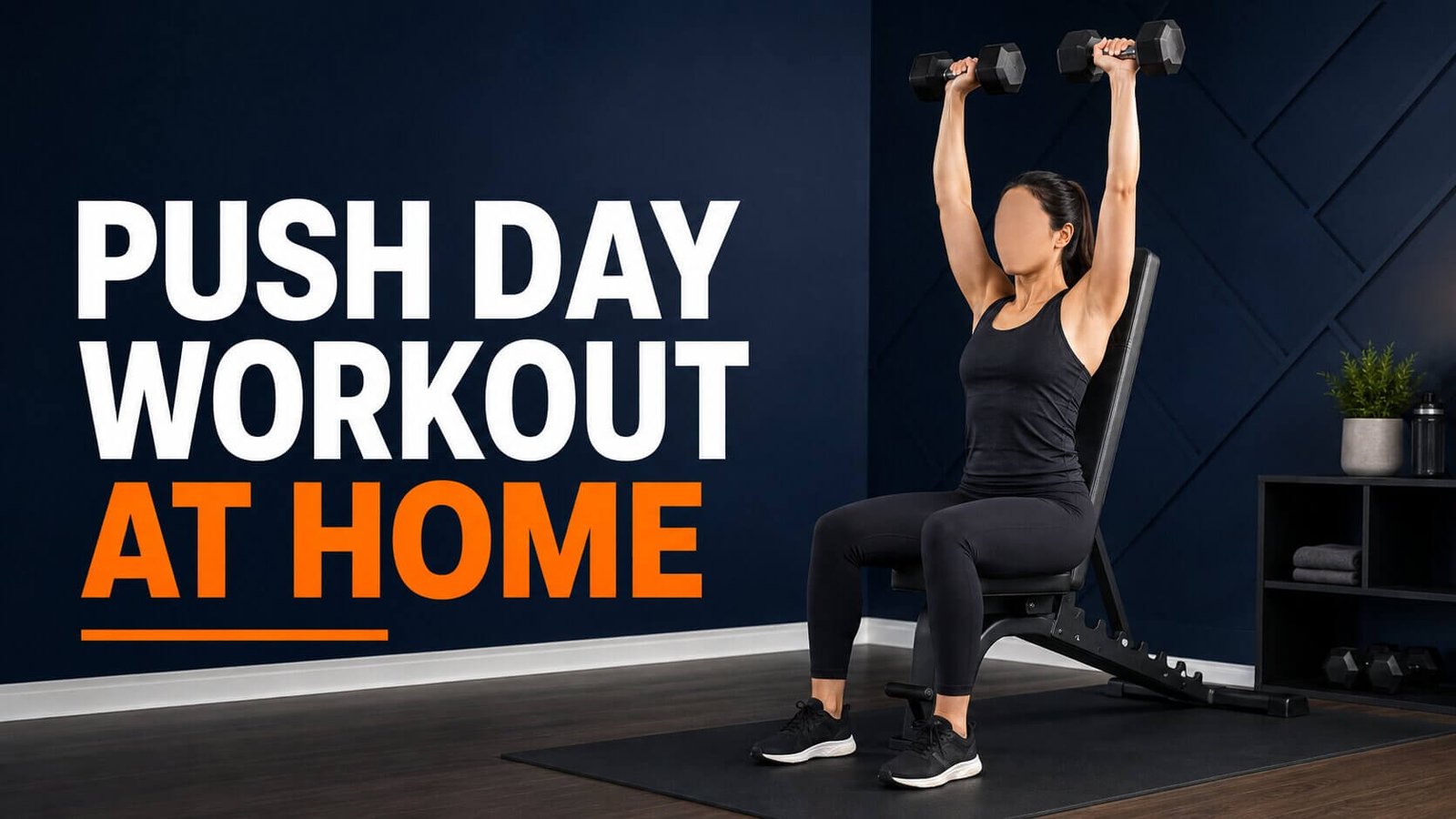
An effective push day workout at home should include a horizontal press for the chest, a more vertical press for the shoulders, and an elbow-extension movement for the triceps. Push-up variations can cover all three patterns without gym machines, while dumbbells, a resistance band, or a secure backpack make progression and side-delt training easier.
Below are two complete routines: a no-equipment plan and a minimal-equipment plan. Choose one based on your current strength and available equipment rather than combining both into an oversized workout.
What Is a Push Day Workout?
A push day groups upper-body exercises in which you press resistance away from your body or extend your elbows. In a traditional push-pull-legs split, push day trains the chest, shoulders, and triceps; pull day covers the back and biceps; and leg day focuses on the lower body.
This organization can make exercise selection simple and give the trained muscles time to recover before the next push session. It is not inherently better than full-body or upper-lower training. The best split is one that trains all major muscle groups, fits your schedule, and allows consistent progression.
Push day usually includes four movement roles:
- Horizontal press: Push-up or floor press
- Shoulder-focused press: Pike push-up or overhead press
- Lateral-delt accessory: Lateral raise when resistance is available
- Triceps-focused press or extension: Close-grip push-up or overhead extension
You do not need a separate exercise for every small region of every muscle. Compound presses already train several pushing muscles at the same time.
What Muscles Does Push Day Train?
Push day primarily trains the pectoralis major, deltoids, and triceps brachii. Your serratus anterior, core, and other stabilizing muscles also contribute during push-ups and overhead movements.
Chest
The chest is the main target of horizontal pressing. Push-ups and floor presses emphasize the pectoralis major while the triceps and front deltoids assist. A high incline makes a push-up easier; elevating the feet makes it harder, but neither creates perfect isolation.
Shoulders
Push workouts train the front deltoids through push-ups and overhead pressing. Pike push-ups make the press more vertical. Regular push-ups give the lateral deltoids little direct resistance, so light lateral raises are a practical addition. Rear delt work normally belongs on pull or upper-body days.
Triceps
The triceps extend the elbow and assist every press. Close-grip push-ups increase their demand, while overhead extensions provide direct work. Isolation is optional when compound presses already create enough fatigue.
Can You Do an Effective Push Day at Home?
Yes. Bodyweight, elastic-band, and home-based resistance training can improve strength and support muscle growth when the exercises are sufficiently challenging and become harder over time.
The American College of Sports Medicine’s 2026 resistance-training update identifies bodyweight exercises, elastic bands, and home routines as effective options for strength, hypertrophy, and physical function. It also emphasizes individualization and consistency over unnecessarily complex methods.
Push-ups can be more than a warm-up. In a small eight-week study of young men, push-ups and a low-load bench press produced comparable chest and triceps muscle growth and strength improvements when the resistance levels were similar. This does not prove that every push-up program equals every bench-press program, but it supports progressively challenging push-ups as a legitimate resistance exercise. See the study indexed by PubMed.
Home training has two practical limitations:
- Loading: Regular push-ups eventually become too easy for some people.
- Exercise selection: Direct lateral-delt work is difficult without an external object or band.
Both problems have simple solutions. Progress from incline to floor, feet-elevated, or loaded push-ups, and use inexpensive household objects or bands for lateral raises when appropriate.
How to Choose Your Push-Up Level
Choose a push-up variation that lets you complete at least five or six controlled repetitions while keeping your body aligned. The final repetitions should feel difficult without your hips sagging, shoulders shrugging, or range becoming progressively shorter.
Use this progression ladder:
- Wall push-up
- High-incline push-up on a stable counter
- Lower-incline push-up
- Bent-knee push-up
- Standard floor push-up
- Feet-elevated push-up
- Backpack or band-resisted push-up
An incline push-up is often the most useful beginner modification because it preserves the straight-body position while reducing the percentage of bodyweight being pressed. Lower the surface gradually as you become stronger.
The American Council on Exercise push-up guide provides a basic movement reference. Regardless of variation, place your hands on a secure surface, brace your trunk, and move through a pain-free range you can control.
10 Push Day Exercises at Home
The following exercises cover chest, shoulder, and triceps training with no equipment or simple home resistance. Select movements that fill different roles instead of choosing five nearly identical push-ups.
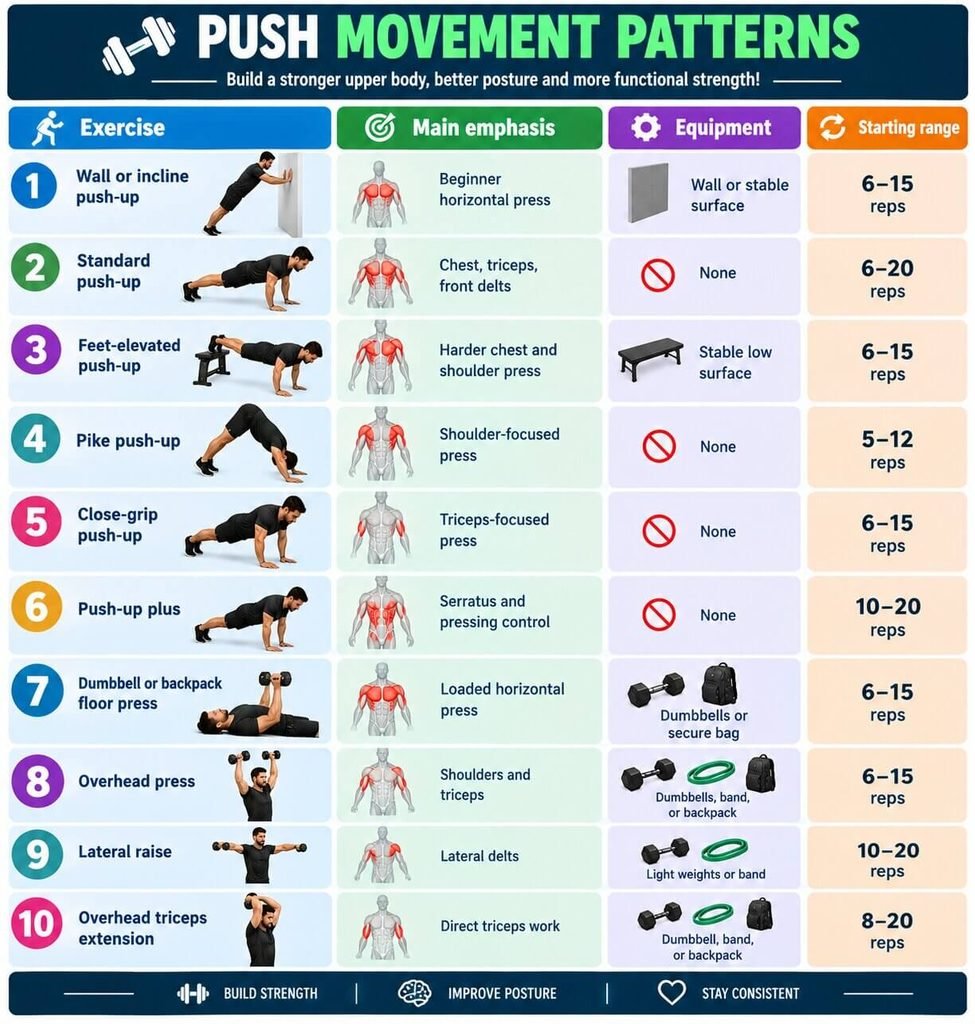
The repetition ranges are practical starting points, not fixed scientific thresholds. Use a variation or load that makes the set challenging while your technique remains consistent.
1. Wall or Incline Push-Up
The incline push-up is the best starting press when floor push-ups are too difficult. Place your hands on a stable surface, walk your feet back, and maintain a straight body as you lower and press. Use a higher surface to make it easier and lower it gradually.
2. Standard Push-Up
The standard push-up is the main no-equipment horizontal press. Start in a high plank, brace your trunk, and lower your body as one unit. Let your shoulder blades move naturally and angle your elbows back instead of flaring them directly sideways.
3. Feet-Elevated Push-Up
The feet-elevated push-up increases the bodyweight supported by your upper body. Place your feet on a secure low surface and keep your trunk rigid. Start with a small elevation; higher is not automatically better.
4. Pike Push-Up
The pike push-up provides shoulder-focused pressing without weights. Lift your hips into an inverted V, lower your head toward the floor between your hands, and press back up. Use a shallow range or raised hand position if needed.
5. Close-Grip Push-Up
The close-grip push-up increases the triceps demand. Place your hands around shoulder width or slightly narrower and keep your elbows near your torso. Your hands need not form a diamond; use an incline if the floor version is too difficult.
6. Push-Up Plus
The push-up plus adds shoulder-blade protraction at the top. With straight elbows, push the floor farther away so your upper back rounds slightly, then return. Use a wall, incline, knees, or full plank and avoid shrugging.
7. Dumbbell or Backpack Floor Press
The floor press loads the chest and triceps without a bench. Lie with bent knees, lower the weights until your upper arms touch the floor gently, and press up. Use a backpack only if it can be gripped securely; otherwise choose loaded push-ups.
8. Overhead Press
The overhead press directly trains the shoulders and triceps. Begin with the resistance near shoulder level, brace your trunk, and press without leaning excessively backward. Use a range and grip that feel stable.
9. Lateral Raise
The lateral raise gives the side delts direct resistance. Raise light dumbbells, bottles, or band handles outward to a comfortable height. Keep soft elbows and avoid swinging the torso.
10. Overhead Triceps Extension
The overhead triceps extension adds direct work after compound presses. Lower a dumbbell, band, or secure backpack behind your head by bending the elbows, then extend your arms. Reduce the load or change the exercise if the position is uncomfortable.
No-Equipment Push Day Workout
This routine trains the chest, shoulders, triceps, and serratus with four bodyweight movements. It is suitable for beginners when each exercise is modified to the correct level.
| Exercise | Sets | Repetitions | Rest |
|---|---|---|---|
| Incline or standard push-up | 3 | 6–15 | 75–120 seconds |
| Pike push-up | 2–3 | 5–12 | 75–120 seconds |
| Close-grip incline or floor push-up | 2 | 6–15 | 60–90 seconds |
| Push-up plus | 2 | 10–20 | 45–75 seconds |
Begin with two sets per exercise if you are new to structured resistance training. Use an incline for both regular and close-grip push-ups when necessary. The goal is not to use the hardest variation; it is to accumulate controlled repetitions and create a progression path.
This session takes approximately 20–30 minutes. Perform the larger presses first because they train the most muscle and require the most coordination. The push-up plus comes last as a lighter accessory exercise.
Dumbbell or Backpack Push Day Workout
This routine makes load progression easier and adds direct lateral-delt work. Dumbbells are the most convenient option, but resistance bands, water bottles, or a securely loaded backpack can replace some exercises.
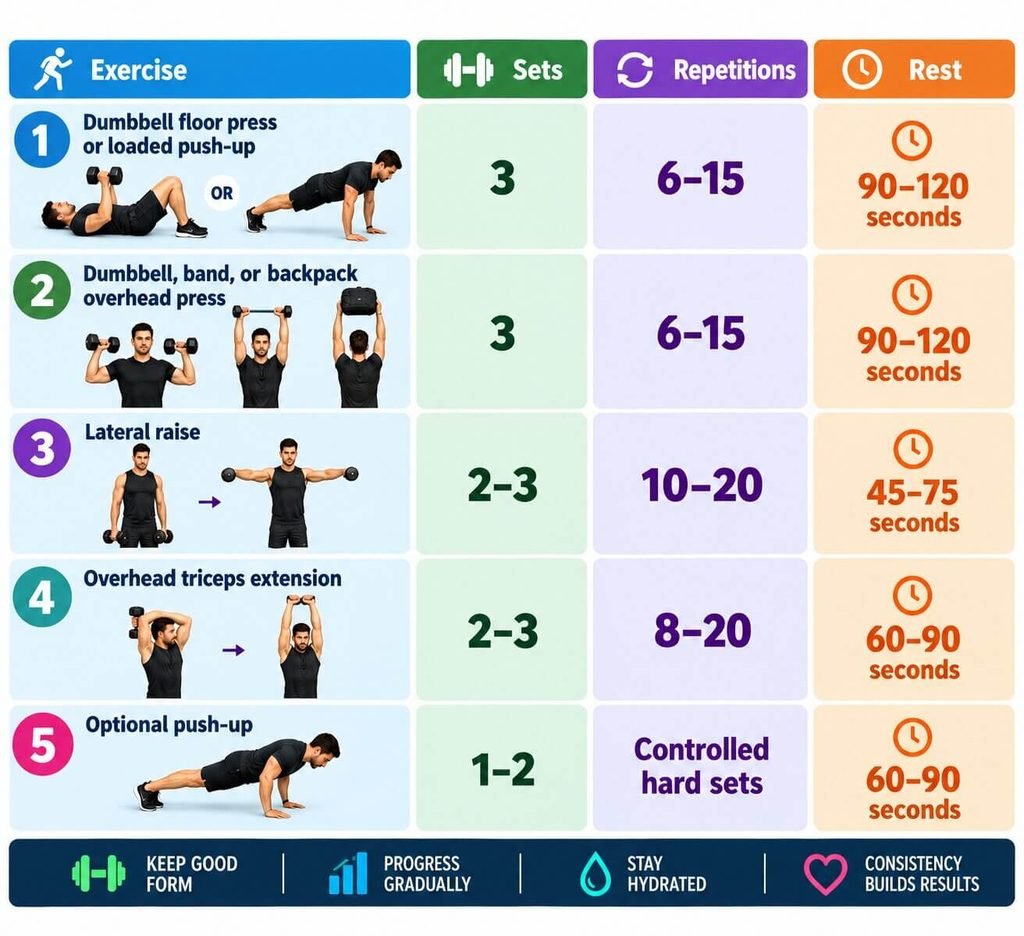
The optional push-up is unnecessary if the first four exercises already provide enough work. Use it only when you recover well and want more chest volume.
If shoulder development is your main goal, perform the overhead press before the floor press. Otherwise, keep the floor press first. Exercise order should reflect your priority, provided the session still includes both movement patterns.
Sets, Reps, Rest, and Effort
Most beginners can start with two or three sets per exercise and broad ranges of approximately 6–20 repetitions. Compound presses usually benefit from longer rest than lateral raises and triceps accessories.
The exact number is less important than effort and progression. Select a level that leaves roughly one to three controlled repetitions available at the end of most sets. You do not need to force every set to failure; the ACSM’s current guidance identifies routine momentary failure as optional for the average healthy adult.
Use these practical rest periods:
- Hard compound presses: 90–120 seconds
- Moderate bodyweight sets: 60–90 seconds
- Lateral raises and lighter accessories: 45–75 seconds
Rest longer if your next set loses several repetitions because you are still breathing hard rather than because the target muscles are fatigued.
How to Progress Your Home Push Workout
Progress by improving repetitions first and then increasing resistance or exercise difficulty. Changing one variable at a time makes your results easier to track.
Use double progression:
- Choose a range, such as 6–15 repetitions.
- Keep the same exercise and resistance while adding controlled reps.
- When every set reaches 15 reps in two sessions, make the exercise slightly harder.
- Return to the lower part of the range and build up again.
Ways to make the workout harder include:
- Lowering the incline for push-ups
- Moving from bent-knee to standard push-ups
- Elevating the feet slightly
- Adding a secure backpack or resistance band
- Increasing dumbbell or backpack load
- Adding a pause or slower lowering phase
- Adding one set when more weekly volume is appropriate
Do not add load, sets, a slower tempo, and a harder variation simultaneously. A small change that you can sustain is more useful than a dramatic increase that disrupts technique or recovery.
Where Push Day Fits Into Your Week
Push day usually appears once or twice per week within a balanced program. Your schedule should also include pulling movements and lower-body training rather than repeating only chest, shoulder, and triceps work.
Three-Day Push-Pull-Legs Schedule
This schedule trains each category once weekly. It can work, although many beginners prefer full-body training because it practices each movement more often.
| Day | Workout |
| Monday | Push |
| Wednesday | Pull |
| Friday | Legs |
Six-Day Push-Pull-Legs Schedule
This schedule trains each category twice weekly and suits people who already tolerate more volume. Beginners do not need it.
| Day | Workout |
| Monday | Push |
| Tuesday | Pull |
| Wednesday | Legs |
| Thursday | Rest |
| Friday | Push |
| Saturday | Pull |
| Sunday | Legs |
The Physical Activity Guidelines for Americans recommend strengthening all major muscle groups on at least two days weekly. This does not require two dedicated push days; full-body and upper-lower routines can meet the guideline.
If you train only two or three days per week, consider a full-body bodyweight workout rather than forcing every muscle group into a separate day.
Common Push-Day Mistakes
The most common problems are using variations that are too difficult, repeating the same pressing angle, and neglecting pulling movements. A shorter, balanced session usually works better than a long list of redundant exercises.
Starting With Floor Push-Ups Too Soon
Use an incline if your hips sag, your range shortens, or you cannot complete at least five controlled floor repetitions. Modifying the exercise supports better practice and progression.
Performing Only Standard Push-Ups
Standard push-ups are valuable but provide limited vertical pressing and side-delt work. Add pike push-ups for a shoulder-focused pattern and lateral raises when simple resistance is available.
Doing Too Much Triceps Work
Your triceps already work during push-ups, floor presses, and overhead presses. One direct triceps exercise is usually enough after several compound sets.
Using Unstable Furniture
Do not perform incline push-ups, feet-elevated push-ups, or dips on furniture that can slide or tip. Use a wall, fixed counter, or stable platform.
Flaring the Elbows Directly Sideways
Avoid creating a straight line from elbow to elbow during push-ups. Let the elbows travel back at a comfortable angle and keep your forearms controlled.
Neglecting Pull Training
Push day does not train the back and biceps adequately. Include rows, pull-ups, or band pulls on another day to create a balanced upper-body program.
Safety and Exercise Modifications
Push exercises should produce muscular effort without sharp wrist, elbow, or shoulder pain. Modify the exercise, resistance, or range instead of pushing through worsening joint symptoms.
- Warm up with easy arm movements and one or two light sets.
- Use a wall or incline if floor push-ups exceed your current ability.
- Keep the wrists under or near the hands rather than letting them collapse inward.
- Use push-up handles or hold stable hex dumbbells if a neutral wrist feels better; never use round dumbbells that may roll.
- Reduce pike-push-up depth if the overhead position feels uncomfortable.
- Secure bands, backpacks, and household weights before each set.
- Stop for sudden, sharp, or increasing pain.
If you have a current shoulder, elbow, wrist, or chest injury, recent surgery, or a condition that affects exercise tolerance, obtain individualized guidance from an appropriate healthcare professional.
Frequently Asked Questions
What exercises should be included in a push day?
Include a horizontal press, shoulder-focused press, and triceps movement. Add lateral raises when resistance is available. Three to five exercises are usually enough.
Can I do push day at home without equipment?
Yes. Regular or incline, pike, close-grip, and push-up-plus variations form a useful session. Direct lateral-delt loading remains limited.
Are four exercises enough for push day?
Yes, when their movement roles differ and the sets are challenging. More exercises are not automatically better.
Can push-ups alone be a complete push workout?
Several variations can work, but standard push-ups alone provide limited vertical pressing and side-delt work. Add pike push-ups and lateral raises when possible.
Should chest or shoulders come first?
Train your priority first: chest presses for chest emphasis or pike and overhead presses for shoulder emphasis.
How often should I perform push day?
One or two weekly sessions can work. Allow soreness and performance to recover before repeating a hard workout.
How long should a home push workout take?
Most take 20–40 minutes, depending on exercises, sets, and rest periods.
Are chair dips necessary?
No. Close-grip push-ups and overhead extensions train the triceps without a dip setup.
How can beginners make push-ups easier?
Use a wall or stable raised surface, then lower the incline gradually. Bent-knee push-ups are another option.
How do I train side delts without weights?
Use water bottles, cans, or a band for lateral raises. Direct side-delt training is difficult with zero external resistance.
Is a push-pull-legs split suitable for beginners?
It can be, but three-day full-body training lets beginners practice each movement more often. Choose the schedule you can follow.
What should I do if push-ups hurt my wrists?
Try an incline, reduced range, or stable neutral-grip handles. Stop for sharp or increasing pain and seek guidance if it persists.
Conclusion
A useful push day workout at home does not require a bench press or a long list of advanced calisthenics. Combine one chest-focused press, one shoulder-focused press, and one triceps movement, then add lateral-delt work when light resistance is available.
Start with the no-equipment routine if you are learning push-ups. Choose the dumbbell or backpack plan when you want simpler load progression. Record your variations, sets, repetitions, and resistance, then make one small progression after reaching the top of the target range.
Most importantly, treat push day as one part of a balanced program. Pair it with pulling exercises and lower-body training rather than training only the muscles you can see in the mirror.