One dumbbell is enough to train your legs, chest, back, shoulders, arms, and core at home. The key is choosing movements that work one side at a time and adjusting each exercise when the same weight feels too light for one muscle group but too heavy for another.
The workout below uses six movements, requires no bench, and takes about 30 minutes when you begin with two sets per exercise. You will squat, hinge, push, pull, press overhead, and resist side-bending. Together, those patterns create a practical full-body session without relying on fast, complicated combination exercises.
You will also find instructions for 10 single-dumbbell exercises, a 15-minute option, progression methods for a fixed dumbbell, and clear rules for training both sides evenly.
Safety note: This routine is written for generally healthy adults. Stop if an exercise causes sharp, radiating, or worsening pain, numbness, dizziness, chest pain, or unusual shortness of breath. If you have an injury, recent surgery, balance problem, or a health condition that affects exercise, seek individualized guidance from a qualified professional.
Can One Dumbbell Provide a Full-Body Workout?
Yes. One dumbbell can provide a complete strength workout when the routine covers the major movement patterns and each working set is challenging enough. You do not need matching dumbbells to begin resistance training.
The 2026 American College of Sports Medicine position stand emphasizes that moving from no resistance training to consistent resistance training produces meaningful benefits. It also supports training all major muscle groups regularly rather than chasing an unnecessarily complex “perfect” program.
One dumbbell does create a programming problem: your legs and back can usually handle more load than your shoulders and arms. A 15-pound dumbbell may challenge an overhead press but feel easy in a two-leg Romanian deadlift. A 40-pound dumbbell may work well for rows but be too heavy for a beginner’s press.
Instead of treating that mismatch as a reason to skip training, adjust the movement:
- Use one leg instead of two
- increase the safe range of motion;
- add repetitions within a practical range;
- slow the lowering phase;
- pause where the exercise is difficult;
- Use both hands when one hand cannot control the weight; or
- Choose a more stable exercise when the weight is heavy.
Unilateral exercises—movements that train one side at a time—are not an inferior substitute. A 2025 systematic review and meta-analysis found that unilateral and bilateral resistance training can both support muscle growth, while strength improvements tend to favor the specific type of movement used in training and testing. [2] You do not need to declare one style universally better. With one dumbbell, unilateral work is simply practical.
What one dumbbell cannot do perfectly
One dumbbell offers fewer loading choices than an adjustable set. It may be difficult to make every exercise land in the same rep range, and advanced trainees may outgrow a light fixed weight for large muscle groups.
It also cannot reproduce every cable, machine, or barbell movement. For example, a one-arm row can train the back well, but it does not create the same overhead pulling pattern as a pull-up or lat pulldown. A complete home program can eventually add a resistance band or pull-up option, but that is not required for your first workout.
What Muscles Does a Single Dumbbell Workout Train?
A well-designed one-dumbbell routine trains all major muscle groups through a small number of compound movements. Each exercise has a primary emphasis, but several muscles work together.
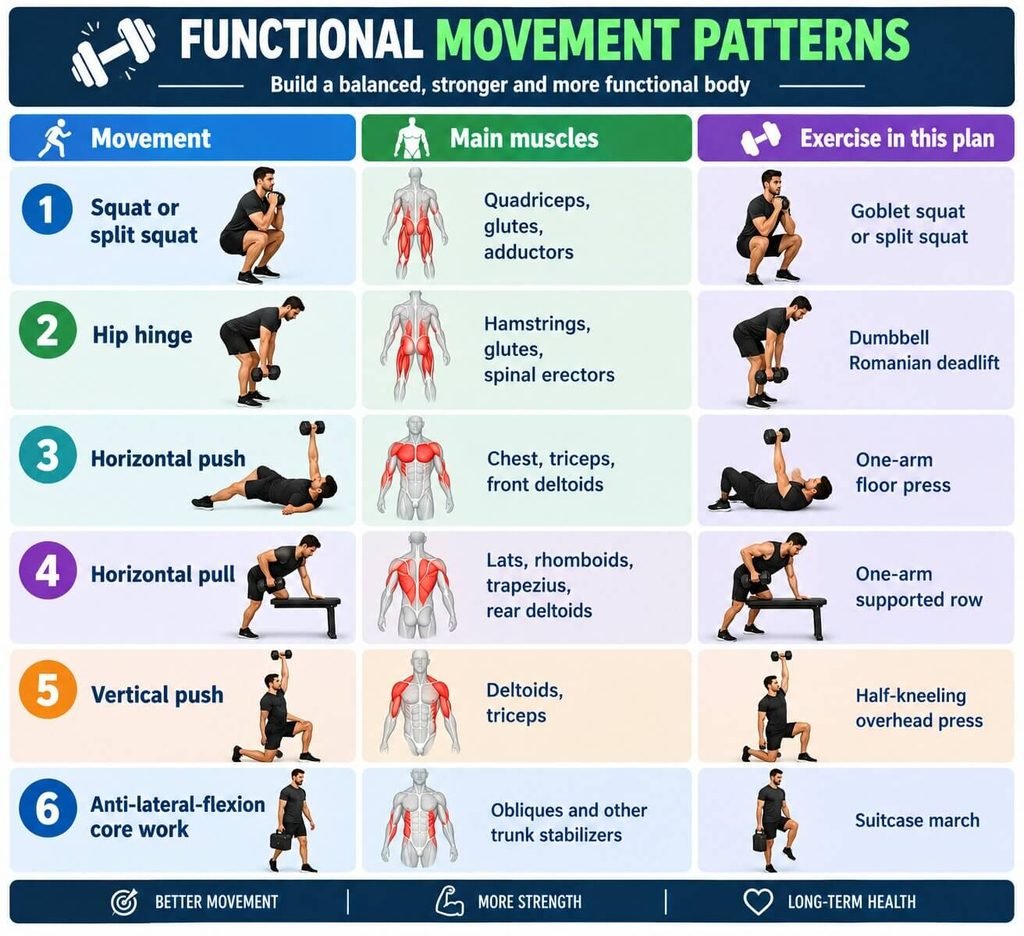
Your forearms and grip also work whenever you hold the dumbbell. The biceps assist in rows, while the abdominal muscles help stabilize squats, hinges, presses, and unilateral movements.
No single exercise isolates only one muscle. That overlap is useful when equipment and time are limited.
How to Choose the Right Dumbbell Weight
Choose a weight that allows the intended repetitions with full range, stable technique, and approximately 2–3 clean repetitions in reserve. If you own only one fixed dumbbell, evaluate the weight separately for each exercise instead of labeling it “light,” “medium,” or “heavy” for the whole workout.
Use the Rep–Range–Form Test.
Perform a practice set and check five points:
- Repetitions: You can reach at least the bottom of the target range.
- Range: You can complete the intended movement without shortening the final repetitions.
- Control: You can lower the weight smoothly instead of dropping or swinging it.
- Position: Your wrists, trunk, and working joints remain stable.
- Effort: You finish with about 2–3 technically sound repetitions left.
Repetitions in reserve, or RIR, means the number of additional good reps you believe you could complete before technique fails. It is an estimate, not an exact measurement. Research in young novice men found RIR reliable for prescribing loads at 1 RIR in bench presses and deadlifts, but the findings do not make every beginner’s estimate perfectly accurate in every exercise.
You will improve at judging effort with practice. At first, use conservative estimates and focus on whether your form changes near the end of a set.
If you own an adjustable dumbbell
Adjust the load between movements when possible. Your row and lower-body exercises will often use more weight than your overhead press, curl, or triceps extension.
Changing weight is not cheating or interrupting the workout. It is sensible programming. Record the setting used for each exercise so you can repeat or progress it later.
If you own one fixed-weight dumbbell
Keep the weight and change the exercise demands. Use the following decision guide:
| Problem | Adjustment |
|---|---|
| Too light for goblet squats | Use split squats, add a pause, or use 1½ reps |
| Too light for Romanian deadlifts | Use a staggered stance, slower lowering, or single-leg variation |
| Too light for rows | Add reps, pause at the top, or slow the return |
| Too heavy for overhead presses | Use both hands, half-kneel for stability, or skip direct overhead work temporarily |
| Too heavy for curls | Hold it with both hands or omit curls; rows already train the biceps |
| Too heavy for a one-arm floor press | Use a two-hand press or a bodyweight incline push-up instead |
Do not force a movement simply because it appears in the plan. The correct variation is the one you can control.
Are light dumbbells still useful?
Light dumbbells can build muscle when a set becomes sufficiently challenging, especially across moderate or higher repetitions. A network meta-analysis found that muscle growth can occur across low, moderate, and high resistance-training loads when sets in the included research were performed to volitional failure; heavier loads produced greater maximal-strength gains. [4]
That does not mean every light set must reach failure. It means a light weight has to create meaningful muscular effort. If you can perform many repetitions without local fatigue, use a harder variation, more range, a slower tempo, or a heavier load when available.
Five-Minute Warm-Up
Warm up by rehearsing the movements you will train, not by exhausting yourself. Five minutes is enough for most healthy beginners before a moderate home session.
Complete one round:
- March in place: 60 seconds.
- Bodyweight squat to a comfortable depth: 8 reps.
- Unloaded hip hinge: 8 reps.
- Alternating reverse step or supported split squat: 5 per side.
- Wall push-up: 8 reps.
- Arm circles: 6 in each direction.
- Light practice set of the first exercise: 6–8 reps.
Move within a comfortable range. A warm-up should make the workout feel more prepared, not provoke pain or leave the legs tired.
30-Minute Single Dumbbell Workout at Home
This full-body routine uses six exercises and exactly one dumbbell. Start with two sets per movement, rest as needed, and use the lower end of the rep ranges while learning the technique.
Workout at a glance
| Exercise | Sets | Repetitions | Rest |
|---|---|---|---|
| Goblet squat or supported split squat | 2 | 8–15 | 60–120 sec |
| One-arm dumbbell floor press | 2 per side | 8–15 | 60–90 sec |
| One-arm supported dumbbell row | 2 per side | 8–15 | 60–90 sec |
| Dumbbell Romanian deadlift | 2 | 10–15 | 60–120 sec |
| Half-kneeling one-arm overhead press | 2 per side | 8–12 | 60–90 sec |
| Suitcase march | 2 per side | 30–45 sec | 45–75 sec |
The session takes about 30 minutes when transitions are organized and you use two sets. It may take closer to 35–40 minutes if you need longer rests or practice time. Good technique matters more than finishing against a stopwatch.
How to organize the workout
Use straight sets while learning: complete both sets of one exercise before moving to the next. This makes it easier to adjust technique and record performance.
After you know the movements, you may alternate exercises that do not compete heavily:
- goblet squat, then floor press;
- row, then Romanian deadlift; and
- overhead press, then suitcase march.
Complete the first exercise, transition calmly, complete the second, then rest. Alternating exercises can save time, but it should not turn the workout into rushed cardio.
10 Single-Dumbbell Exercises for Home
These 10 exercises let you build or modify a one-dumbbell program without a bench. The first six form the main workout; the final four provide alternatives or optional arm work.
1. Goblet Squat
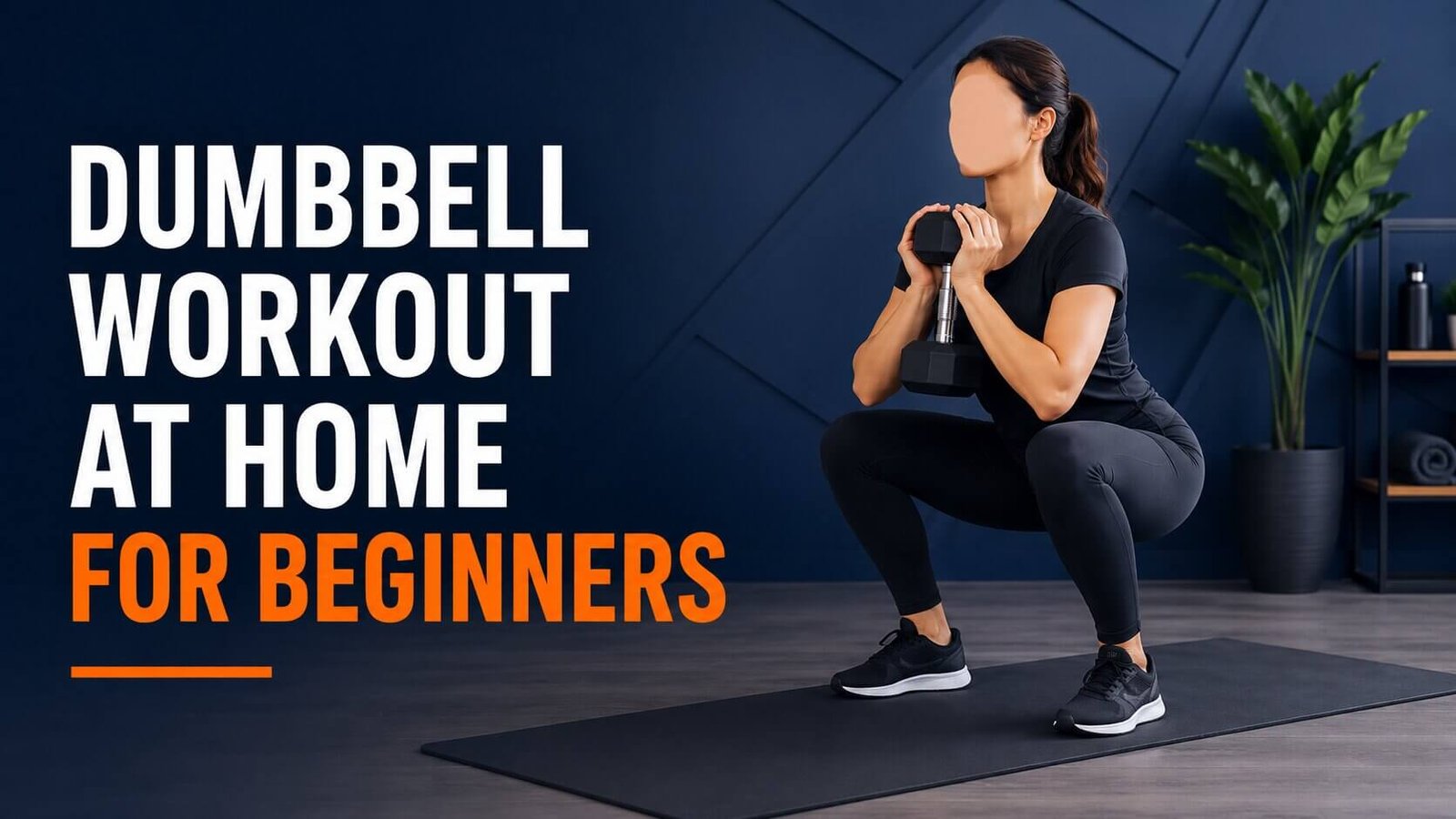
The goblet squat trains the quadriceps, glutes, and inner thighs while keeping the dumbbell close to your center. It is a good first choice when the weight is challenging enough for both legs.
Main muscles: quadriceps, glutes, and adductors; calves and trunk assist.
How to do it:
- Stand with your feet around shoulder-width apart and toes turned slightly outward as comfortable.
- Hold one end of the dumbbell with both hands at chest height. Keep it close to your body.
- Brace gently and keep your feet flat.
- Bend your knees and hips together, allowing the knees to track in the same general direction as the toes.
- Descend only as far as you can maintain balance and a comfortable trunk position.
- Push the floor away and stand tall without leaning backward.
Make it easier: Squat to a sturdy chair or reduce the depth.
Make it harder: Pause for 2 seconds near the bottom, lower for 3 seconds, or use 1½ reps—down, halfway up, down again, then stand.
Common mistakes: Holding the weight away from the chest, lifting the heels, forcing a specific foot angle, and dropping into the bottom position.
Your knees may travel forward during a squat. That is not automatically an error. Focus on balanced feet, comfortable tracking, and a range you can control.
2. Dumbbell Split Squat
The split squat makes one dumbbell more demanding for the legs because the front leg does most of the work. It is often a better choice than a goblet squat when the available weight feels too light.
Main muscles: quadriceps and glutes; adductors, hamstrings, calves, and trunk assist.
How to do it:
- Stand beside a wall or sturdy support if balance is uncertain.
- Step one foot backward into a long, comfortable stance. Keep both feet about hip-width apart from side to side rather than standing on a tightrope.
- Hold the dumbbell at your chest or in the hand opposite the front leg.
- Lower straight down by bending both knees. Let the front foot stay fully planted.
- Stop before the back knee touches the floor or when you reach your comfortable depth.
- Push through the front foot to rise. Complete the set, then switch sides.
Make it easier: Hold a support with the free hand, use body weight only, or shorten the range.
Make it harder: Add a pause, slow the lowering phase, or hold the dumbbell in the hand opposite the front leg.
Common mistakes: Placing the feet too close together, bouncing the back knee, letting the front foot roll inward, and turning the movement into a step on every rep.
Use a static stance while learning. A reverse lunge adds a stepping and balance demand but does not automatically produce a better strength stimulus.
3. Dumbbell Romanian Deadlift
The Romanian deadlift trains the glutes and hamstrings through a hip hinge. Hold one dumbbell with both hands so the weight stays centered and close to your legs.
Main muscles: hamstrings and glutes; spinal erectors, adductors, forearms, and trunk assist.
How to do it:
- Stand with feet about hip-width apart and hold the dumbbell vertically with both hands in front of your thighs.
- Soften your knees without squatting down.
- Brace your trunk and push your hips backward.
- Let the dumbbell travel close to your thighs and shins as your torso inclines forward.
- Stop when you feel strong hamstring tension or before your back position changes.
- Drive the hips forward and stand tall. Do not lean backward at the top.
Make it easier: Practice the hip hinge without weight or shorten the range.
Make it harder: Lower for 3–4 seconds, use a staggered stance, or progress to a supported single-leg Romanian deadlift.
Common mistakes: Squatting instead of hinging, reaching the dumbbell toward the floor, rounding to gain depth, locking the knees, and hyperextending at the top.
The dumbbell does not need to touch the floor. Your hip motion and hamstring flexibility determine the range.
4. One-Arm Dumbbell Floor Press
The one-arm floor press trains the chest and triceps, while the floor limits how far the upper arm can travel behind the torso. It is a practical bench-free pushing exercise, but setup and exit should remain controlled.
Main muscles: pectorals, triceps, and front deltoids; trunk stabilizers resist rotation.
How to do it:
- Sit on the floor with the dumbbell beside one hip.
- Hold it close with both hands, roll onto your side, then onto your back. Guide the dumbbell to the working hand at chest level.
- Bend both knees and plant your feet. Position the working upper arm roughly 30–60 degrees from your torso rather than straight out to the side.
- Stack the wrist over the elbow and keep the forearm close to vertical.
- Press the dumbbell upward without letting your torso twist.
- Lower slowly until the upper arm contacts the floor gently. Pause, then repeat.
- After the set, bring the dumbbell toward your chest, use both hands, and roll to your side before sitting up.
Make it easier: Use a two-hand dumbbell press or perform an incline push-up against a stable surface.
Make it harder: Pause with the upper arm lightly touching the floor, lower for 3 seconds, or add repetitions.
Common mistakes: Flaring the elbow to 90 degrees, bouncing the upper arm off the floor, allowing the wrist to bend backward, twisting the torso, and trying to sit straight up with the weight held overhead.
Never drop the dumbbell beside your head or shoulder. If it is too heavy to position safely, choose a different push exercise.
5. One-Arm Supported Dumbbell Row
The supported row trains the lats and upper back, while the free hand helps stabilize the torso. Use your thigh or a genuinely stable surface for support; lightweight furniture can shift or tip.
Main muscles: lats, rhomboids, middle trapezius, and rear deltoids; biceps and forearms assist.
How to do it:
- Hold the dumbbell in your right hand and step your left foot forward.
- Hinge at the hips and place your left hand on your left thigh above the knee. Keep both feet secure.
- Let the right arm hang with the shoulder relaxed and the dumbbell below the shoulder.
- Brace your trunk and pull your right elbow toward your hip or lower ribs.
- Stop before the shoulder rolls forward or the torso rotates open.
- Lower the dumbbell under control until the arm is long. Complete the set and switch sides.
Make it easier: Use a more upright torso or support the free hand on a stable counter.
Make it harder: Pause for 1–2 seconds at the top, slow the return, or use a longer comfortable range.
Common mistakes: Twisting to lift the weight, shrugging, curling the wrist, pulling the elbow far behind the body, and dropping the dumbbell quickly.
Feeling the biceps during a row is normal. To place more emphasis on the back, lead with the elbow, keep the wrist neutral, and avoid squeezing the handle harder than necessary.
6. Half-Kneeling One-Arm Overhead Press
The half-kneeling press trains the shoulders and triceps with a stable base that discourages excessive lower-back movement. Skip or modify overhead pressing if the available dumbbell cannot be controlled.
Main muscles: deltoids and triceps; upper back, serratus anterior, glutes, and trunk assist.
How to do it:
- Kneel on a folded mat with your right knee down and left foot forward.
- Hold the dumbbell at your right shoulder. Keep the wrist stacked over the elbow.
- Gently squeeze the right glute and keep the ribs stacked over the pelvis.
- Press the dumbbell upward in a comfortable path until the elbow straightens without forcing the shoulder.
- Keep your head neutral; do not chase the weight with your chin.
- Lower slowly to the shoulder. Complete the set, then switch to the kneeling stance and working arm.
Make it easier: Use both hands to press one dumbbell, perform a seated press with back support, or omit the movement until a lighter load is available.
Make it harder: Add reps, pause overhead, or use a slower return.
Common mistakes: Leaning sideways, arching the lower back, pressing around a bent wrist, losing balance, and forcing the arm behind the head.
Place the dumbbell down with both hands between the sides if needed. Do not pass a heavy weight around your head while kneeling.
7. Suitcase March
The suitcase march trains your trunk to resist leaning while one hand carries the dumbbell. It also challenges grip and single-leg balance without requiring much floor space.
Main muscles: obliques and other trunk stabilizers; forearms, upper back, glutes, and hip stabilizers assist.
How to do it:
- Stand tall with the dumbbell in one hand at your side.
- Keep your shoulders level and avoid leaning away from or toward the weight.
- Brace as if preparing for a gentle bump.
- Lift one foot a few inches, place it down quietly, then switch feet.
- Continue marching slowly while keeping the dumbbell still.
- Complete the time, set the weight down safely, and switch hands.
Make it easier: Hold a wall lightly with the free hand or perform a suitcase hold without marching.
Make it harder: march more slowly, increase the knee lift without losing position, or extend the set modestly.
Common mistakes: leaning, hiking one shoulder, rushing the feet, holding the breath, and letting the dumbbell swing.
This is an anti-lateral-flexion exercise: the goal is to prevent side-bending, not to perform repeated weighted side bends.
8. Dumbbell Pullover
The floor pullover trains shoulder extension with help from the lats, chest, triceps, and trunk. It is optional because the available weight and your comfortable overhead range may not match.
Main muscles: lats and chest; triceps and trunk assist.
How to do it:
- Lie on your back with knees bent and feet planted.
- Hold one end of the dumbbell securely with both hands above your chest.
- Keep a small bend in the elbows and gently brace your trunk.
- Lower the dumbbell in an arc toward the floor behind your head.
- Stop before your ribs flare, your lower back arches noticeably, or the shoulders feel uncomfortable.
- Pull the dumbbell back over your chest under control.
Make it easier: Reduce the range or use a lighter dumbbell.
Make it harder: Slow the lowering phase or add reps before increasing range.
Common mistakes: Forcing the dumbbell to the floor, bending and straightening the elbows like a triceps extension, losing grip, and allowing the weight to drift over the face.
Keep a secure two-hand grip. If the dumbbell has loose plates or an awkward end shape, choose another exercise.
9. One-Arm Dumbbell Curl
The curl directly trains the biceps, but it is optional because rows already involve elbow flexion. Include it when arm development is a priority and the dumbbell suits your strength.
Main muscles: biceps, brachialis, and brachioradialis; forearms assist.
How to do it:
- Stand tall with the dumbbell at your side and palm facing forward or inward.
- Keep the upper arm close to the torso.
- Bend the elbow and curl without swinging the body.
- Stop at a comfortable top position rather than pushing the elbow far forward.
- Lower until the arm is long under control.
- Complete the set, then switch sides.
Make it easier: Hold one dumbbell with both hands or perform fewer controlled reps.
Make it harder: Slow the lowering phase or use a concentration curl with the elbow supported against the inner thigh.
Common mistakes: Leaning backward, swinging, curling the wrist, and allowing the stronger side to do extra repetitions.
10. Two-Hand Overhead Triceps Extension
The two-hand overhead extension trains the triceps while both hands share control of one dumbbell. It is optional and should be skipped if the available weight or overhead position feels unsafe.
Main muscles: triceps; shoulders and trunk stabilize.
How to do it:
- Sit on the floor, kneel, or stand in a stable position.
- Hold one end of the dumbbell securely with both hands and bring it overhead.
- Keep the ribs controlled and point the elbows generally forward.
- Bend the elbows and lower the weight behind your head only as far as you can control.
- Straighten the elbows without throwing the dumbbell upward.
- Use both hands to return the weight to your shoulder before setting it down.
Make it easier: Reduce the range or use a close-grip incline push-up instead.
Make it harder: Add reps or slow the lowering phase.
Common mistakes: Flaring the ribs, forcing the elbows together, lowering too far, moving the upper arms excessively, and using a loose grip.
15-Minute One-Dumbbell Workout
When time is limited, perform one quality set of six movements rather than racing through many rounds. This short plan covers the same major patterns as the longer session.
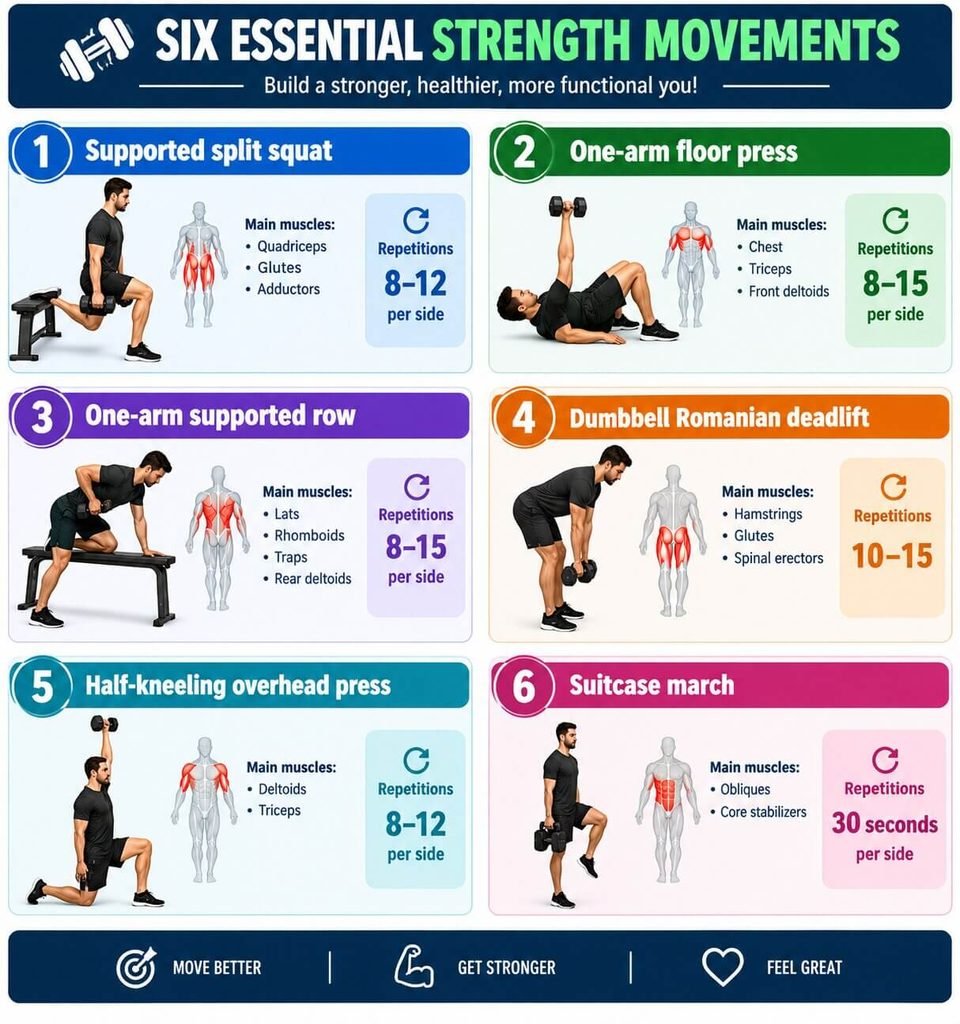
Warm up for 3–5 minutes first. Rest enough to keep the repetitions controlled. If 15 minutes is not enough to finish safely, complete four movements today and the remaining two at your next session. A short workout remains useful; it does not need to become frantic.
Sets, Reps, Rest, and Weekly Frequency
Beginners can start with two sets per exercise, mostly 8–15 repetitions, and two full-body sessions per week. Add a third session only when technique, recovery, and schedule support it.
U.S. physical activity guidance recommends muscle-strengthening activity involving all major muscle groups on at least two days per week. [5] This is a broad public-health target, not a requirement to perform the exact same workout or isolate every muscle twice.
Starting guidelines
- Frequency: Two nonconsecutive days per week.
- Main exercises: Two sets each.
- Squats, presses, rows, and hinges: Usually 8–15 reps.
- Light-load leg exercises: Up to 15–25 reps when technique remains stable.
- Suitcase march: 30–45 seconds per side.
- Rest: 60–120 seconds between demanding sets.
- Effort: About 2–3 repetitions in reserve for most sets.
Rest longer when breathing or grip prevents good technique. Short rest periods are not inherently better for muscle or strength. The next set should begin when you can control the weight and maintain the intended position.
How to count unilateral sets
If you perform two sets of one-arm rows on the right and two on the left, each side receives two sets. You do not describe that as four sets for each lat.
For workout timing, however, you performed four individual work bouts. This is why unilateral training can make a session longer even when the muscle-level set count remains moderate.
Do you need to train to failure?
No. You do not need to reach the point where another repetition is impossible on every set. A systematic review and meta-analysis found no clear requirement to train to momentary failure for strength or hypertrophy. [6]
Stopping with 2–3 clean reps in reserve gives beginners room to practice technique and manage fatigue. As you gain experience, an occasional final set of a stable exercise can finish closer to failure, but safety and form still determine when the set ends.
How to Progress With One Dumbbell
Progress by improving one measurable variable at a time. A heavier dumbbell is one option, but it is not the only form of progressive overload.
Use double progression.
Select a rep range, such as 8–15. Keep the exercise and setup consistent while adding repetitions over several sessions.
Example for a one-arm row:
- Session 1: 11 and 10 reps per side
- Session 2: 12 and 11 reps
- Session 3: 14 and 13 reps
- Session 4: 15 and 15 reps with about 2 RIR
At that point, use a heavier setting if available or choose another progression method. Do not increase difficulty when the final reps require twisting or shortened range.
Progression options for a fixed dumbbell
- Add repetitions: Stay within a range that challenges the muscle before grip or breathing becomes the main limitation.
- Add a set: Move from two to three sets only when recovery is good.
- Slow the lowering phase: Use 3–4 seconds without turning every rep into a prolonged endurance test.
- Add a pause: Pause at the bottom of a squat, top of a row, or floor position of a press.
- Improve range: Use a more comfortable range without losing balance or position.
- Use 1½ reps: Useful for goblet squats and split squats when the load is light.
- Choose a unilateral variation: Progress from a two-leg hinge to a staggered-stance or supported single-leg hinge.
- Reduce support carefully: Use less hand assistance only when balance is no longer limiting technique.
Do not add reps, sets, tempo, and a harder variation simultaneously. One change makes the effect easier to track.
When the dumbbell is truly too light
A weight is probably too light for a movement when you can complete the top of the practical rep range with full control, use a harder safe variation, and still finish far from muscular fatigue.
At that point, a heavier or adjustable dumbbell is the clearest solution. Very high repetitions can work, but they may become limited by discomfort, time, breathing, or boredom before the target muscle receives a useful stimulus.
When to add a third weekly workout
Add a third session only after two weekly sessions feel consistent. Use at least one recovery day between full-body workouts, and begin the third day with fewer sets or lower effort.
More sessions are not automatically better. If performance declines, soreness persists, or joints become increasingly irritated, return to two days and review your exercise choices.
How to Train Both Sides Evenly
Start unilateral exercises with the weaker or less coordinated side, then match its repetitions on the stronger side. This prevents the stronger side from setting a target the weaker side cannot complete cleanly.
Use these rules:
- perform the same variation on both sides;
- use the same range of motion;
- Match repetitions rather than adding “bonus reps” to the stronger side;
- rest between sides if grip or breathing would reduce the second side’s quality;
- record side-specific reps when performance differs; and
- Keep the same support and stance setup.
A small difference between sides is common. The goal is not mathematical perfection in every repetition. Watch the trend across several weeks.
Should you hold the dumbbell on the same or opposite side?
Either can be appropriate, but the position changes the stability demand. In a split squat, holding the dumbbell opposite the front leg generally creates more cross-body stabilization. Holding it on the same side can feel different and may be easier or harder depending on balance and technique.
Beginners should choose the position that allows stable leg movement. Consistency matters more than using the supposedly “hardest” loading pattern.
Should you rest between sides?
Rest when the first side leaves you too winded or fatigued to train the second side well. A 15–30-second transition is often enough for moderate sets; demanding split squats or rows may require longer.
Switching sides immediately is convenient, not mandatory. Both sides deserve comparable effort and control.
What to Do When the Weight Does Not Match the Exercise
The best one-dumbbell program accepts that the same load creates different challenges across the body. Modify the exercise instead of forcing every movement into 10 repetitions.
Too light for your legs
Use a split squat before adding endless goblet-squat reps. Other options include a longer pause, slower lowering, 1½ reps, a staggered-stance Romanian deadlift, or a supported single-leg variation.
Do not add jumping solely to make a lightweight feel harder. Loaded jumping increases speed, landing, and coordination demands and is unnecessary for a beginner strength session.
Too heavy for your upper body
Use two hands where the exercise permits it, reduce the rep target, or substitute a stable bodyweight movement. An incline push-up can replace a floor press, and rows already train the biceps if curls are not controllable.
Never turn an overhead press or curl into a full-body heave to make the dumbbell move. That changes the exercise and can make the load harder to manage.
Right for one side but not the other
Let the weaker side set the reps. If the difference is large or appeared suddenly, use a lighter setting or an easier variation when available. Sudden weakness accompanied by pain, numbness, or loss of function needs professional evaluation rather than more training volume.
Common Mistakes
Most one-dumbbell workout mistakes come from trying to make one load behave like an entire rack. Good programming changes the variation, reps, or tempo while keeping the movement controlled.
1. Using the same rep target for every exercise
Ten reps may be difficult for an overhead press and easy for a Romanian deadlift. Use exercise-specific ranges and judge effort separately.
2. Rushing because the workout is labeled “30 minutes”
The time estimate is not a deadline. Take longer rests, practice the setup, and extend the session when needed.
3. Combining too many movements
A squat-to-curl-to-press may raise your heart rate, but the press usually limits a weight that is too light for the squat. Separate exercises make progression and technique easier to measure.
4. Letting the stronger side do more
Extra reps on the stronger side reinforce the performance difference. Start with the weaker side and match it.
5. Counting unilateral work incorrectly
Two sets per side means each side receives two sets. Do not double the muscle-level count when planning weekly volume.
6. Turning strength work into balance practice
Unstable positions can prevent the target muscles from working hard. Use a wall or stable support during split squats and single-leg hinges when needed.
7. Swinging a weight that is too heavy
Momentum can hide a load mismatch. Substitute the exercise, use both hands, or wait until a different weight is available.
8. Moving the dumbbell carelessly between positions
The transition into a floor press or overhead movement deserves the same attention as the repetitions. Keep the weight close and use both hands to position it.
9. Progressing several variables at once
Adding reps, sets, pauses, and a harder variation together makes recovery and technique problems difficult to diagnose. Change one variable.
10. Ignoring the pull-to-push balance
Many quick dumbbell circuits include several presses and arm exercises but only one rushed row. Keep a controlled horizontal pull in the program.
Single Dumbbell Workout Safety
Use a dumbbell you can grip, position, and set down without losing control. Inspect the equipment and training area before every session.
Before the workout
- Check adjustable plates, locking mechanisms, or collars.
- Inspect the handle for damage, moisture, or slippery residue.
- Clear enough floor space to lie down and move the dumbbell safely.
- Keep children and pets away from the training area.
- Wear stable footwear for standing exercises or use a secure nonslip surface.
- Move fragile objects away from the dumbbell’s path.
During the workout
- Keep the dumbbell close when lifting it from the floor.
- Use both hands to position or lower it when one-hand control is uncertain.
- Do not drop the dumbbell near your head, chest, hands, or feet.
- Do not use a chair, table, or bench that can slide or tip as row support.
- Keep the wrist reasonably stacked during presses.
- Control the lowering phase instead of relying on gravity.
- Stop a set when your range or balance changes significantly.
Pain and warning signs
Muscular effort, warmth, and fatigue are expected. Sharp pain, radiating symptoms, numbness, sudden weakness, loss of balance, chest pain, or unusual shortness of breath are reasons to stop.
This routine cannot diagnose or treat shoulder, knee, or back pain. Persistent, worsening, traumatic, or neurological symptoms need appropriate clinical assessment.
Practical Recommendations
Use the six-exercise plan twice weekly for four weeks before changing it. Begin with two sets, keep 2–3 repetitions in reserve, and log the dumbbell weight, repetitions, variation, and any side-to-side difference.
Follow this simple workflow:
- Warm up for five minutes.
- Perform the main workout with straight sets.
- Start unilateral exercises with the weaker side.
- Record reps and estimated RIR.
- Add reps within the range at the next session.
- Increase only one difficulty variable after reaching the top of the range.
If you also own a pair or several weights, the broader Dumbbell Workout at Home for Beginners offers more loading options. For equipment decisions, compare adjustable dumbbells vs. fixed dumbbells or review dumbbells vs. resistance bands.
Frequently Asked Questions
Can you get a full-body workout with one dumbbell?
Yes. Combine a squat or lunge, hip hinge, floor press, row, overhead press, and loaded carry or march. Those movements train the major muscle groups even though only one dumbbell is available.
The load may not suit every exercise equally, so adjust the variation, reps, tempo, or hand position rather than using identical prescriptions.
Is one dumbbell enough to build muscle?
One dumbbell can support muscle growth when the exercises create sufficient effort and become more challenging over time. It works particularly well for beginners and for unilateral movements.
Eventually, a light fixed dumbbell may stop challenging the legs and back even after reasonable progressions. A heavier or adjustable option then becomes useful.
How heavy should my single dumbbell be?
There is no universal beginner weight. Choose a load that allows the target reps with full motion, stable joints, a controlled return, and about 2–3 good reps remaining.
The same dumbbell can be heavy for an overhead press and light for a squat. Evaluate each exercise separately.
How often should I do a one-dumbbell workout?
Two nonconsecutive full-body sessions per week are a practical starting point. A third session can be added when technique and recovery are good.
Count other strength training in your schedule. You may already train the same muscles through bodyweight, band, or gym exercises.
Should beginners use a circuit or straight sets?
Straight sets are usually easier for learning technique and tracking progress. Complete both sets of one movement before continuing.
Once the exercises are familiar, alternate noncompeting movements to save time. Avoid rushing or treating every session as an all-out conditioning circuit.
How do I count reps for one-arm exercises?
“10 reps per side” means 10 with the right arm and 10 with the left. Start with the weaker side, then match its rep count on the stronger side.
Do not count 10 total alternating reps as 10 per side unless the program specifically says so.
Should I switch hands during goblet squats and Romanian deadlifts?
Not when you hold the dumbbell centrally with both hands. A goblet squat and centered Romanian deadlift train both sides together.
Switch sides only when using a suitcase, offset, staggered, or single-limb version.
What if the dumbbell is too heavy for overhead pressing?
Do not use momentum to force it overhead. Try a two-hand press if the dumbbell shape allows a secure grip, use an easier pressing variation, or omit overhead work until a lighter load is available.
The floor press still trains the chest, front shoulders, and triceps, so one omitted exercise does not invalidate the workout.
What if the dumbbell is too light for squats?
Use a supported split squat, slower lowering, pauses, 1½ reps, or a higher rep range. A unilateral leg exercise can make a light dumbbell much more challenging.
If you can perform these options well beyond a practical rep range without meaningful fatigue, use a heavier weight when possible.
Can I do this workout every day?
Daily full-body strength training is unnecessary for most beginners. Use at least one recovery day between sessions at first.
Walking, gentle mobility, and other light activity can be performed on rest days when comfortable. Recovery needs depend on total activity, sleep, training effort, and individual response.
Is a single dumbbell better than resistance bands?
Neither is universally better. A dumbbell provides consistent gravity-based load and simple setup, while bands offer more resistance directions and portable tension levels.
One dumbbell is convenient for floor presses, rows, squats, hinges, and loaded carries. Bands make pulldowns and some standing pulls easier to reproduce. The detailed comparison is available in Dumbbells vs. Resistance Bands.
Conclusion
One dumbbell is enough to start a balanced home strength program. Use a squat or split squat, Romanian deadlift, floor press, supported row, overhead press, and suitcase march to train the major muscle groups without a bench or complicated circuit.
Begin with two sets twice per week. Let the weaker side determine unilateral reps, finish most sets with 2–3 clean repetitions in reserve, and progress one variable at a time. When the same weight feels different across exercises, change the variation or rep range instead of sacrificing control.
For a broader routine using more weight options, continue with the Dumbbell Workout at Home for Beginners.