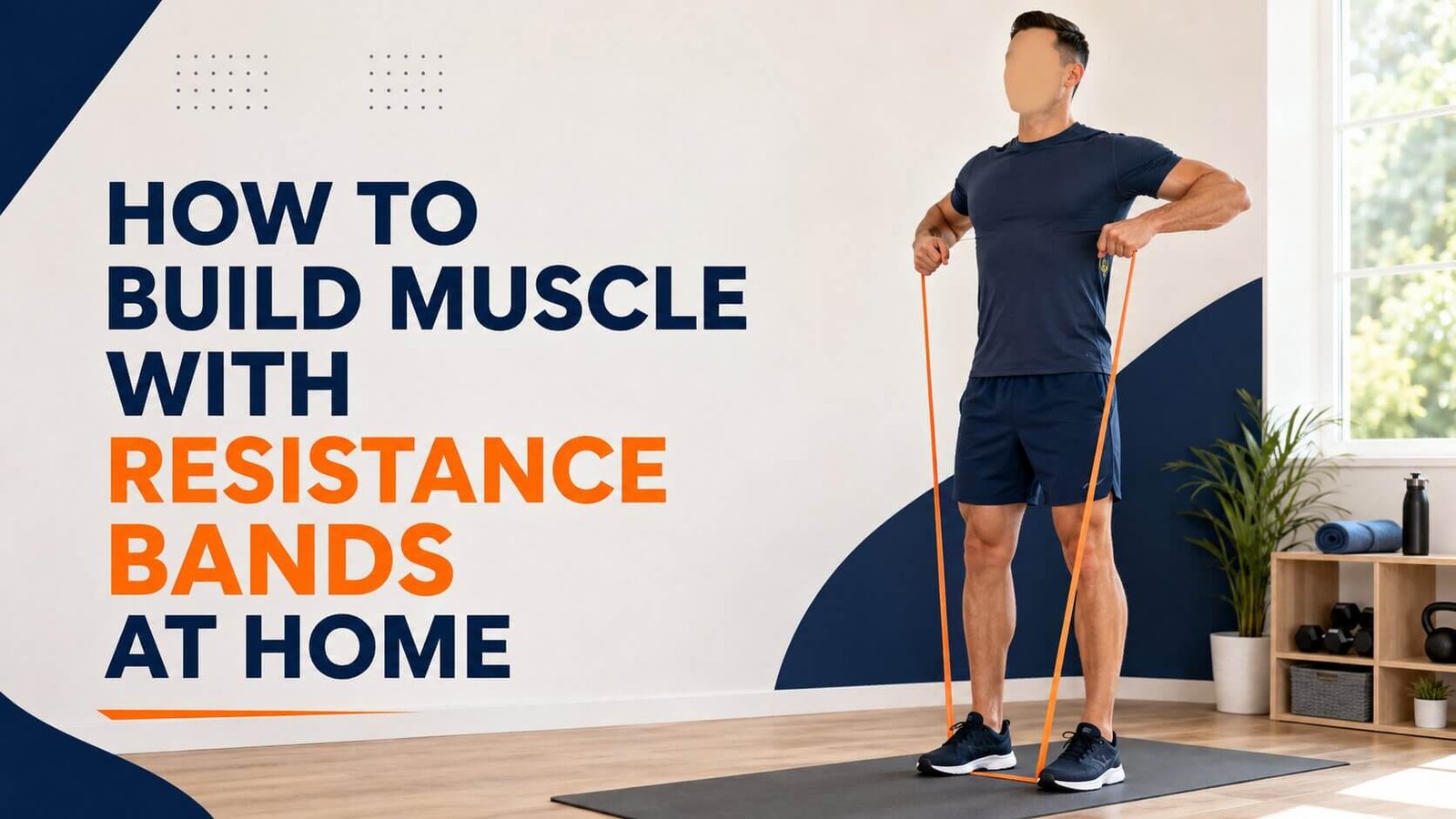
You can build muscle with resistance bands at home if your exercises become progressively more challenging. The type of equipment matters less than applying enough resistance, training each major muscle group consistently, using controlled technique, and recovering between sessions.
Bands are inexpensive, portable, and suitable for beginners. However, simply repeating the same light routine will eventually stop producing progress. You need a structured way to increase band tension, repetitions, sets, range of motion, or exercise difficulty.
Can You Build Muscle With Resistance Bands at Home?
Yes. Resistance bands can build muscle when they provide enough tension and your working sets are sufficiently challenging. Bands do not make muscle growth automatic, but neither do dumbbells, barbells, or machines.
A 2019 systematic review and meta-analysis found that elastic resistance training produced strength improvements comparable to conventional resistance equipment across the included studies. The analysis primarily examined strength rather than muscle size, so it should not be interpreted as proof that every band routine produces identical hypertrophy. Still, it shows that elastic resistance can provide a meaningful training stimulus. Lopes et al., 2019
The American College of Sports Medicine’s 2026 resistance-training guidance also recognizes elastic bands, bodyweight exercises, and home-based training as effective options. Its main message is that regular training, sufficient effort, and progressive programming matter more for most healthy adults than using one particular type of equipment. American College of Sports Medicine
Bands may not be ideal for every goal. Free weights and machines make exact loading easier to measure and often provide simpler progression for very strong lifters. For general strength, health, and muscle development at home, however, bands can be a practical primary training tool.
How Resistance Bands Stimulate Muscle Growth
Resistance bands help build muscle by creating mechanical tension—the force your muscles produce while working against resistance. Repeated exposure to challenging tension, followed by adequate recovery, encourages the muscles to adapt.
Unlike a dumbbell, which has a fixed mass, a band usually becomes more resistant as it stretches. This is called variable resistance. The exercise may feel relatively easy near the beginning and considerably harder near the end.
That resistance curve has practical consequences:
- The starting position must contain enough tension to challenge the muscle.
- You should control both the lifting and returning portions of each repetition.
- Some exercises may need a different anchor position to keep tension where you want it.
- A stronger band is not always better if it prevents a comfortable, controlled range of motion.
Research comparing training loads indicates that muscle growth can occur across a broad range of resistance levels when sets are challenging. Heavier loads remain more specific to developing maximum one-repetition strength. Lopez et al., 2021
What Resistance Bands Do You Need?
A long loop band or a set of tube bands with handles can cover most full-body exercises. A purpose-built door anchor expands your options for rows, presses, pulldowns, and arm exercises.
| Band type | Best uses | Main limitation |
|---|---|---|
| Tube bands with handles | Chest presses, rows, curls, shoulder presses | Handles, clips, and stitching require regular inspection |
| Long loop bands | Squats, hinges, presses, pulldowns, assisted exercises | Hand comfort may become an issue with heavy tension |
| Mini loop bands | Hip abduction, glute work, warmups | Usually too short for a complete full-body program |
| Fabric bands | Glute and lower-body exercises | Limited exercise variety |
| Flat therapy bands | Rehabilitation-style movements and light resistance | Often too light or awkward for advanced progression |


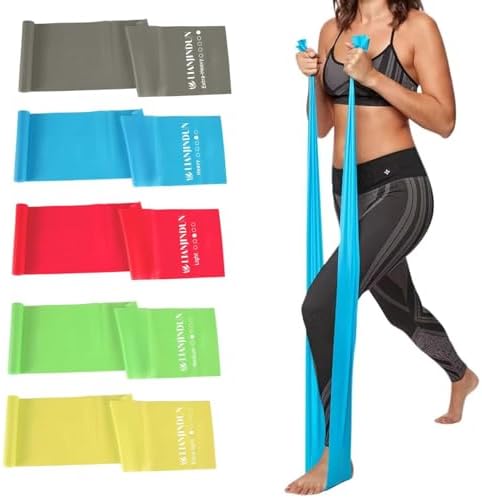
Band colors are not standardized. A “heavy” band from one manufacturer may not match a heavy band from another, so follow the manufacturer’s resistance chart rather than relying on color alone.
For a versatile home band workout, consider:
- Several resistance levels
- One long loop band
- Tube bands with handles
- A purpose-built door anchor
- An exercise mat
- An ankle strap, if supplied by the manufacturer
Do not combine bands, handles, carabiners, or anchors unless their instructions confirm that they are compatible.
The Training Principles That Matter Most
Make Every Working Set Challenging
A working set should become noticeably difficult near the end while your movement remains controlled. If you could easily complete another ten repetitions, the resistance is probably too light to provide an efficient muscle-building stimulus.
A practical target is to finish most sets with one to three repetitions in reserve, commonly abbreviated as RIR:
- 3 RIR: You estimate that you could perform three more controlled repetitions.
- 1 RIR: You could probably complete one more repetition.
- Technical failure: You cannot perform another repetition without changing your technique.
You do not need to reach complete muscular failure on every set. A systematic review and meta-analysis found no clear requirement to train to failure for strength or hypertrophy when training volume was considered. Grgic et al., 2022
Estimating RIR takes practice. Beginners can stop a set when repetitions slow substantially or technique begins to change, rather than testing absolute failure.
Use a Practical Repetition Range
Approximately 8–20 repetitions per set works well for many resistance band exercises. This is a practical range, not a biological boundary.
Different exercises may fit different ranges:
- Compound exercises: approximately 8–15 repetitions
- Isolation exercises: approximately 10–20 repetitions
- Small-band glute and shoulder exercises: approximately 12–25 repetitions
A set of 20 repetitions can be more productive than a set of 10 if the 20-repetition set is challenging and controlled. Conversely, performing 50 easy repetitions usually signals that you need more tension or a harder variation.
Perform Enough Weekly Sets
Beginners can start with roughly six to ten challenging sets per major muscle group each week, including relevant work from compound exercises. You do not need to start at the top of that range.
The 2026 ACSM guidance identifies approximately ten weekly sets per muscle group as a useful hypertrophy target, while emphasizing that training should be individualized and built gradually. American College of Sports Medicine
More sets are not automatically better. Add volume only when you are recovering well and your performance has stopped improving.
Train Each Major Muscle Group Regularly
Two or three full-body sessions per week are practical for most beginners. This schedule distributes the work without requiring daily hard training.
US physical activity guidelines recommend muscle-strengthening activity involving all major muscle groups on at least two days per week. Physical Activity Guidelines for Americans
Training frequency mainly helps organize weekly volume. When total volume is matched, higher frequency does not appear to produce substantially greater hypertrophy by itself. Schoenfeld et al., 2019
Rest Long Enough Between Sets
Rest until you can perform the next set with stable technique and useful effort. Most people can start with:
- 90–180 seconds after demanding squats, presses, rows, and hinges
- 60–120 seconds after curls, lateral raises, triceps work, and core exercises
Short rest periods are not required for muscle growth. If limited rest causes your repetitions or range of motion to drop sharply, wait a little longer.
How to Apply Progressive Overload With Resistance Bands
Progressive overload means gradually increasing the training challenge as your body adapts. With bands, progression involves more than switching colors.
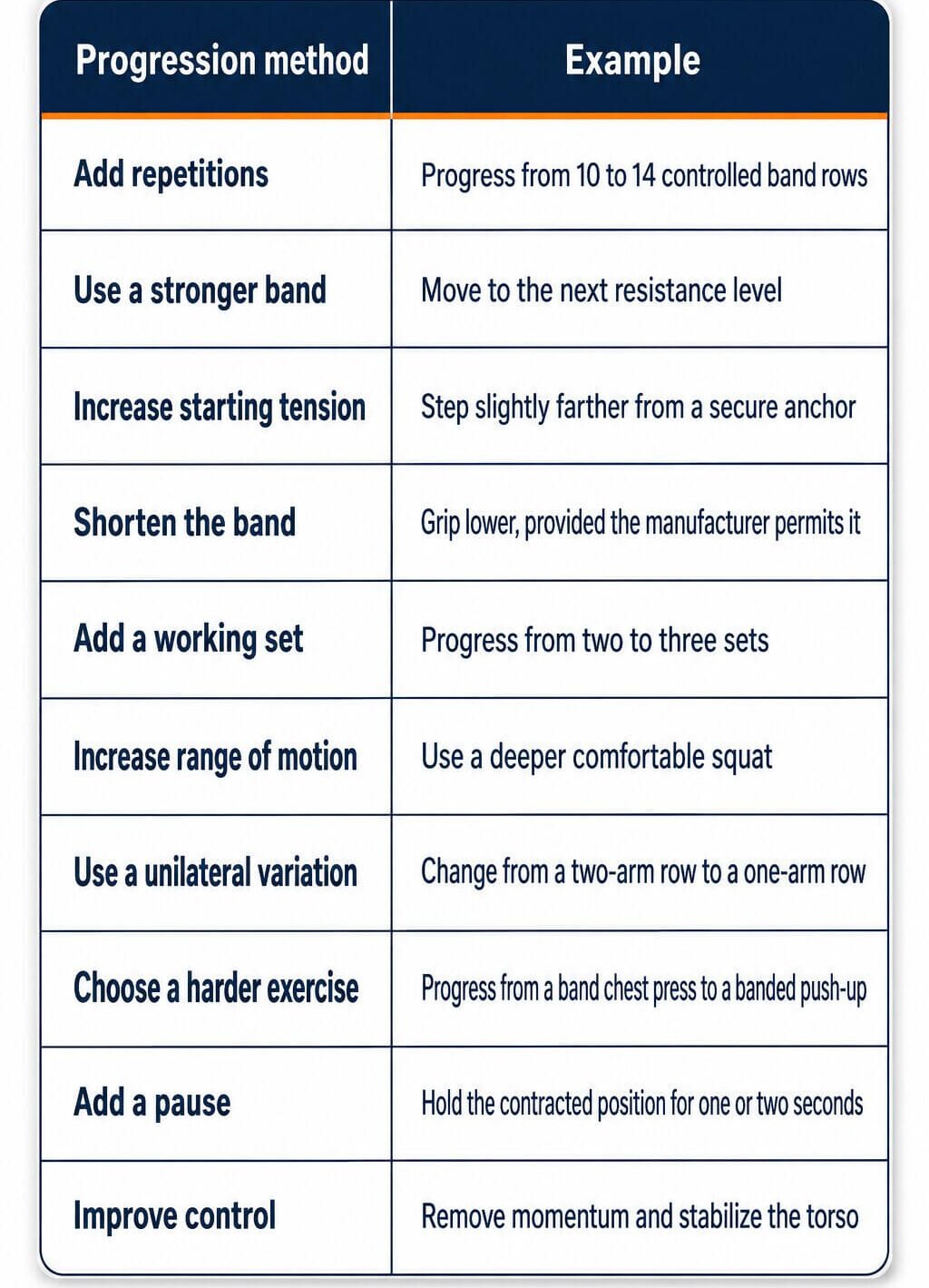
Use one or two changes at a time. Adding tension, sets, repetitions, and difficult techniques simultaneously makes progress hard to measure and may create unnecessary fatigue.
A Simple Double-Progression Method
Double progression is one of the easiest ways to organize resistance band training:
- Choose a repetition range, such as 8–15.
- Select a band that allows at least eight controlled repetitions.
- Keep the same band and setup while gradually adding repetitions.
- When you can perform 15 repetitions on every set with approximately two repetitions remaining, increase the tension.
- Return to the lower end of the range and repeat.
For example:
- Session 1: 12, 11, 10 repetitions
- Session 2: 13, 12, 11 repetitions
- Session 3: 14, 13, 12 repetitions
- Session 4: 15, 15, 14 repetitions
- Session 5: 15, 15, 15 repetitions
- Next session: use more tension and aim for at least eight controlled repetitions
The sessions may not progress this neatly in real life. Sleep, stress, illness, and exercise order can affect performance. Look for improvement across several weeks rather than expecting a personal record every workout.
Best Resistance Band Exercises for Muscle Growth
The best resistance band exercises collectively cover pushing, pulling, squatting, hinging, single-leg work, and core stabilization.
| Movement | Exercise | Main muscles |
|---|---|---|
| Squat | Resistance band squat | Quadriceps, gluteus maximus, core |
| Single-leg | Band split squat | Quadriceps, glutes, hamstrings |
| Hip hinge | Band Romanian deadlift | Hamstrings, glutes, spinal erectors |
| Hip extension | Band glute bridge | Glutes, hamstrings |
| Horizontal push | Standing band chest press | Pectoralis major, triceps, front deltoids |
| Horizontal pull | Seated or anchored band row | Latissimus dorsi, rhomboids, trapezius, biceps |
| Vertical push | Band overhead press | Deltoids, triceps |
| Vertical pull | Kneeling band lat pulldown | Latissimus dorsi, upper back, biceps |
| Elbow flexion | Band biceps curl | Biceps and other elbow flexors |
| Elbow extension | Band triceps pressdown | Triceps |
| Shoulder isolation | Band lateral raise | Side deltoids |
| Core stabilization | Pallof press | Abdominals and other trunk stabilizers |
Resistance Band Squat
Band squats train the quadriceps and glutes. Stand on the middle of a long band, hold the ends near your shoulders, and squat through a comfortable range.
Keep your feet planted and knees moving generally in the same direction as your toes. If the band becomes difficult to hold, use a long loop placement recommended by its manufacturer or select a split-squat variation.
Band Romanian Deadlift
The Romanian deadlift trains the hamstrings, glutes, and spinal erectors. Stand securely on the band, soften your knees, and move your hips backward while keeping your spine controlled.
Stop when you feel tension in the hamstrings or when further movement would cause your lower back to round. Stand by driving the hips forward, not by leaning backward.
Standing Band Chest Press
A band chest press trains the chest, triceps, and front shoulders. Anchor the band securely behind you at approximately chest height and press forward without letting your shoulders rise.
If you do not have a suitable anchor, perform a banded push-up or wrap a long band behind your upper back for an anchor-free pressing option.
Resistance Band Row
Rows train the back and biceps. Attach the band to a secure point in front of you, begin with your arms extended, and pull your elbows toward your torso.
Avoid turning the exercise into a backward lean. If an anchor is unavailable, sit on the floor and place the band around the midfoot, provided the band cannot slip.
Band Overhead Press
The overhead press trains the shoulders and triceps. Stand on the band and press the handles or loop overhead while keeping your ribs and pelvis controlled.
Use a lighter band if you need to arch your lower back or cannot move through a comfortable range.
Kneeling Band Lat Pulldown
A pulldown emphasizes the latissimus dorsi and biceps. Attach a band to a properly installed overhead anchor, kneel far enough away to create initial tension, and pull your elbows down toward your sides.
If you cannot create a secure overhead setup, replace this exercise with another row rather than improvising an unsafe anchor.
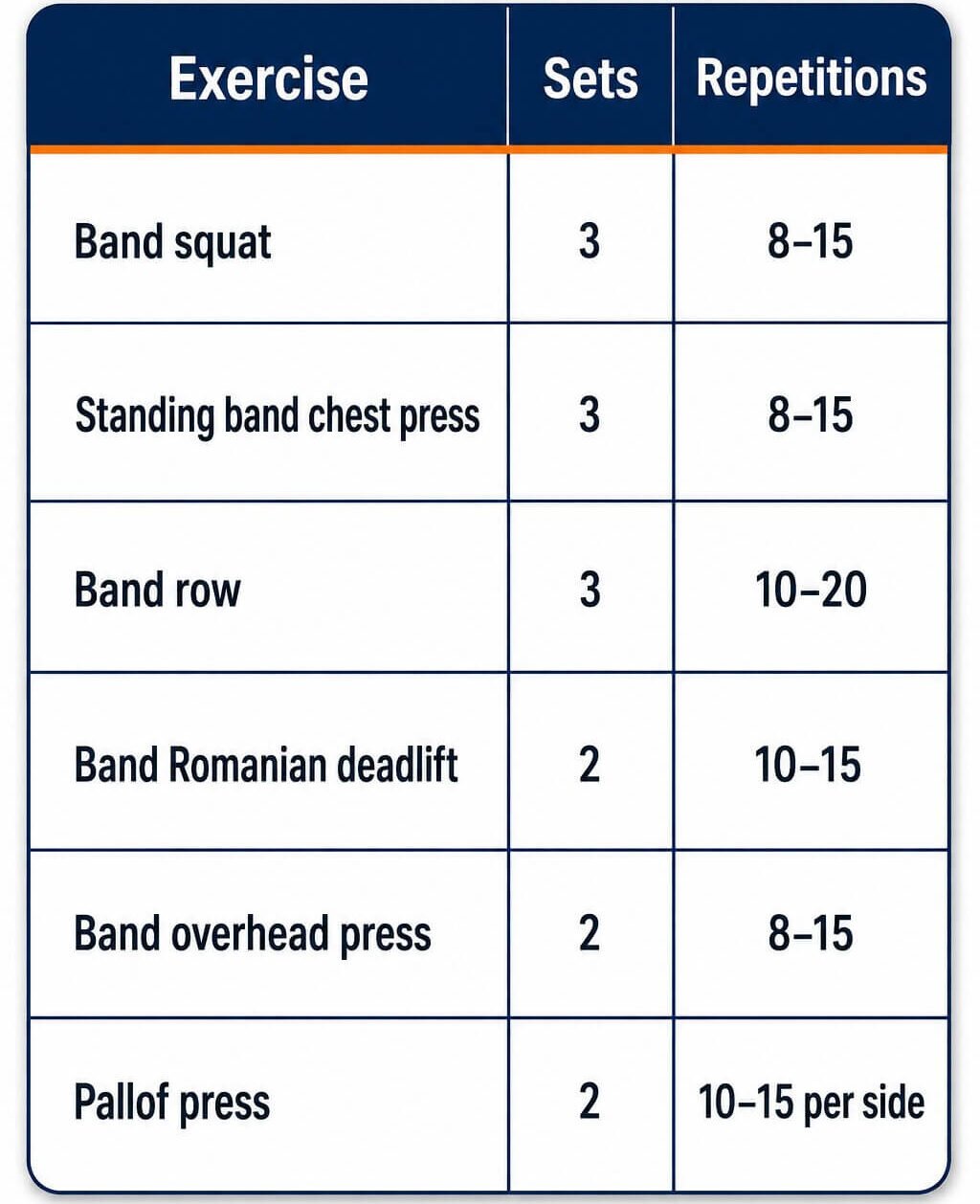
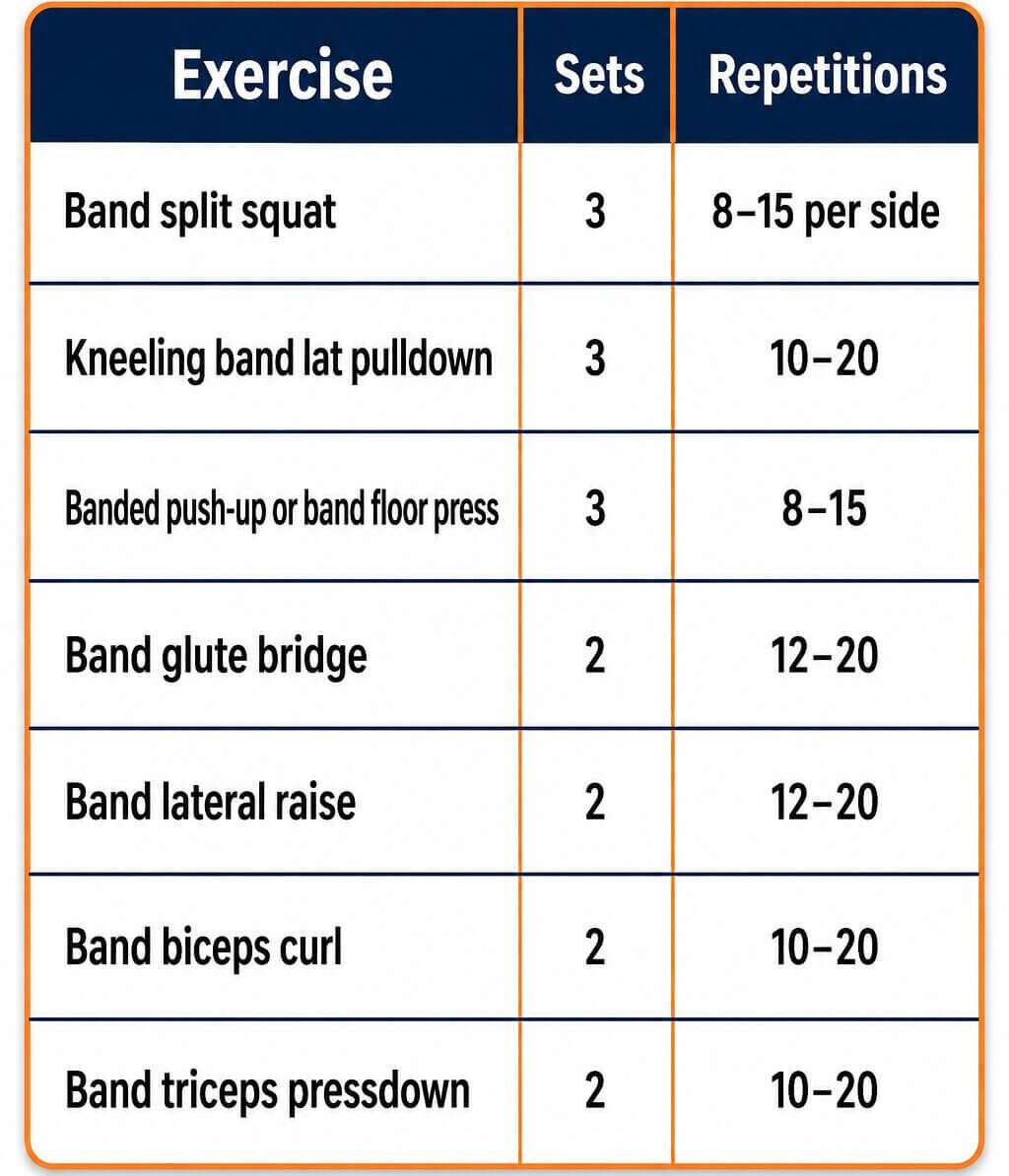
Beginner Full-Body Resistance Band Workout for Muscle Gain
Alternate Workout A and Workout B two or three days per week. Leave at least one recovery day between sessions when possible.
Workout A
Workout B
Two-Day Schedule
- Monday: Workout A
- Thursday: Workout B
- Following week: begin with Workout B
Three-Day Schedule
- Monday: Workout A
- Wednesday: Workout B
- Friday: Workout A
- Following week: Workout B, Workout A, Workout B
Start with two sets per exercise if you are completely new to resistance training. Add the final set after two or three weeks if your technique is stable and you are recovering well.
How to Perform Each Session
- Warm up for five to ten minutes with comfortable movement.
- Perform one light practice set for the first few exercises.
- Complete all working sets of one exercise before moving to the next.
- Stop most sets with one to three controlled repetitions remaining.
- Rest long enough to maintain your technique.
- Record the band, setup, sets, repetitions, and estimated RIR.
- Inspect your equipment again if anything shifted during the workout.
Circuits can save time, but completing straight sets makes it easier for beginners to judge effort and track progression.
How to Make the Workout Harder Over Time
Progress the workout when you reach the top of the repetition range on every set for two sessions while maintaining approximately two repetitions in reserve.
Use this order:
- Improve technique and range of motion.
- Add repetitions within the target range.
- Increase starting tension slightly.
- Use a stronger band or compatible band combination.
- Add a set if more weekly volume is needed.
- Choose a harder unilateral or compound variation.
Do not stretch a band beyond the manufacturer’s stated limit. If a stronger band dramatically shortens your range of motion, return to the lighter band and use another progression method.
When Progress Stalls
A short plateau does not automatically mean your routine has failed. First check:
- Are you recording the exact band and setup?
- Are your working sets genuinely challenging?
- Are you training each major muscle group consistently?
- Has your range of motion become shorter?
- Are you sleeping and eating regularly?
- Are you doing more work than you can recover from?
- Has the band lost elasticity?
If several exercises decline for two or more weeks, consider an extra recovery day or temporarily remove one set from each exercise. Persistent pain, unexplained fatigue, or declining health warrants guidance from a qualified healthcare professional.
Resistance Band Safety at Home
Resistance bands are useful only when the band and anchor remain secure. A damaged band can recoil suddenly, so inspect the complete setup before every session.
TheraBand’s equipment instructions advise checking bands for nicks, tears, and punctures before use and discarding damaged equipment. TheraBand Resistance Band and Tubing Instructions
Use this safety checklist:
- Inspect bands for cuts, cracks, thinning, discoloration, and fraying.
- Check handles, stitching, clips, carabiners, and anchor attachments.
- Use only purpose-built anchors installed according to their instructions.
- Test the setup with light tension before beginning a working set.
- Keep your face and other people outside the band’s recoil path.
- Remove sharp jewelry that could damage the band.
- Avoid wrapping bands around rough, sharp, hot, or unstable objects.
- Do not attach a band to lightweight furniture, loose railings, door handles, or unverified hooks.
- Stop using a band that feels brittle, sticky, unusually thin, or permanently stretched.
- Follow the manufacturer’s replacement and maximum-stretch guidance.
For a door anchor, the door must be structurally sound and fully closed. Position the anchor so your pulling direction does not open the door. If you cannot verify the door and anchor setup, use an anchor-free exercise.
Stop exercising if you experience sharp pain, dizziness, chest discomfort, or unusual shortness of breath. People returning from injury or managing a medical condition should ask an appropriate healthcare or exercise professional about suitable movements and resistance.
Nutrition and Recovery for Muscle Growth
Training provides the stimulus, while food and recovery give the body the resources and time needed to adapt. Supplements cannot compensate for an inconsistent program or inadequate meals.
Eat Regular, Balanced Meals
Build meals around:
- A protein-rich food
- Whole grains, potatoes, fruit, or another carbohydrate source
- Vegetables or fruit
- A source of dietary fat
- Water or another appropriate beverage
Examples of protein-rich foods include eggs, dairy products, fish, poultry, lean meat, tofu, tempeh, beans, lentils, and soy foods.
For healthy adults who train regularly, approximately 1.4–1.6 grams of protein per kilogram of body weight per day is a reasonable evidence-based planning range. A large meta-analysis found that protein intake above roughly 1.6 g/kg/day did not produce additional average gains in fat-free mass during resistance training. Morton et al., 2018
That adult research figure is not an individual prescription and should not be applied to children or teenagers without guidance from a pediatric clinician or registered dietitian. People with kidney disease or other medical conditions should also seek individualized nutrition advice.
Protein powder is optional. It can be convenient, but ordinary foods can provide enough protein.
Do You Need a Special Post-Workout Meal?
No special supplement is required immediately after training. A normal meal or snack containing protein and carbohydrates within the surrounding hours is practical for most recreational lifters.
Total daily nutrition and consistent training matter more than chasing a narrow “anabolic window.” Examples include yogurt with fruit, eggs with toast, tofu with rice, or chicken with potatoes and vegetables.
Prioritize Recovery
Allow a muscle group time to recover before training it hard again. Mild temporary soreness can occur after unfamiliar exercise, but soreness is not required for growth and should not be used as the main measure of workout quality.
Regular sleep, hydration, balanced meals, and manageable training volume support better performance. Avoid repeatedly training through joint pain or performing hard sessions for the same muscles every day.
What Home Trainees Commonly Struggle With
Community discussions about resistance bands repeatedly raise three practical concerns: measuring resistance, creating enough tension at the beginning of an exercise, and securing anchor points. These are user observations rather than scientific evidence, but they highlight genuine programming and safety problems.
The solution is to standardize your setup:
- Record the band brand, model, and resistance level.
- Use the same foot position or distance from the anchor.
- Note where you grip the band.
- Record repetitions and estimated RIR.
- Photograph or mark a safe floor position if appropriate.
- Use the same controlled range of motion.
This makes resistance band progressive overload more measurable, even when you cannot assign an exact weight to each repetition.
Common Resistance Band Muscle-Building Mistakes
1. Using a Band That Is Too Light
An easy set may improve movement practice, but it provides a limited muscle-building stimulus. Increase tension or choose a harder exercise when you exceed your repetition range comfortably.
2. Starting With No Band Tension
A loose band may provide almost no resistance during the first part of the movement. Adjust your position so the band has mild tension at the start without forcing the joint into an awkward position.
3. Stretching the Band Excessively
More stretch creates more tension, but it also places more stress on the material. Stay within the manufacturer’s limits and use a stronger band when necessary.
4. Performing Every Set to Complete Failure
Constant failure training can increase fatigue and make technique less predictable. Stop most sets with one to three repetitions remaining and use failure sparingly, if at all.
5. Performing Repetitions Too Quickly
Fast, uncontrolled repetitions can allow momentum to replace muscular effort. Lift deliberately and control the band as it shortens.
6. Shortening the Range of Motion
Do not reduce movement depth simply to claim more repetitions. Use a comfortable, repeatable range that you can control.
7. Training Only the Arms and Shoulders
A complete program also needs leg, hip, chest, back, and core exercises. Prioritize compound movements before adding curls, pressdowns, and lateral raises.
8. Changing the Setup Every Session
Different anchor distances and hand positions make progress difficult to evaluate. Standardize the setup before comparing your repetitions.
9. Adding Too Much Volume Too Quickly
More sets can create more fatigue without improving results. Begin with a manageable amount and add work gradually.
10. Ignoring Equipment Damage
A small nick can grow as the band stretches. Replace damaged bands instead of trying to repair or continue using them.
How to Track Progress With Resistance Bands
Track performance rather than relying only on appearance or soreness. Useful signs of progress include:
- Completing more controlled repetitions with the same band
- Using greater tension within the same repetition range
- Performing an exercise through a larger comfortable range
- Improving stability and technique
- Completing more total quality work
- Recovering more predictably between sessions
- Performing a harder exercise variation
Use a simple workout log:
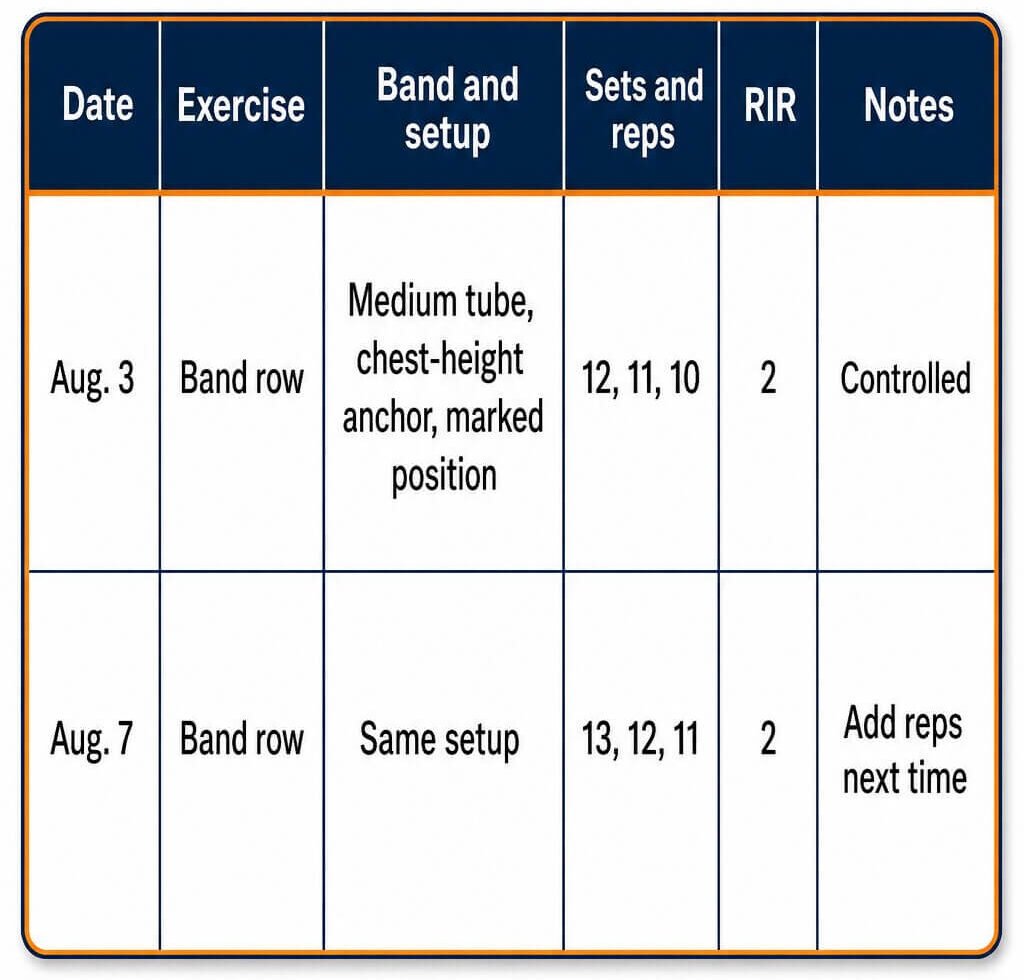
| Date | Exercise | Band and setup | Sets and reps | RIR | Notes |
|---|---|---|---|---|---|
| Aug. 3 | Band row | Medium tube, chest-height anchor, marked position | 12, 11, 10 | 2 | Controlled |
| Aug. 7 | Band row | Same setup | 13, 12, 11 | 2 | Add reps next time |
Take several weeks of records before judging whether the program is working.
How Long Does It Take to Build Muscle With Resistance Bands?
There is no reliable universal timeline. Training history, exercise effort, nutrition, sleep, genetics, health, and program consistency all affect the rate of adaptation.
Beginners may notice improvements in coordination and exercise performance before obvious physical changes. Review your training log over at least eight to twelve consistent weeks rather than judging the program after a few workouts.
A lack of soreness does not mean the workout failed. Increasing repetitions, tension, control, or exercise difficulty provides more useful evidence of progress.
Frequently Asked Questions
Are resistance bands effective for hypertrophy?
Yes, bands can support muscle hypertrophy when they provide sufficiently challenging resistance and the program includes progressive overload. Equipment alone does not determine the outcome.
Can resistance bands replace weights for muscle growth?
Bands can replace weights for many beginners and home exercisers. Advanced lifters may find that free weights and machines make precise heavy-load progression easier, particularly for lower-body exercises.
How many repetitions should I do with resistance bands?
Approximately 8–20 controlled repetitions works well for many exercises. Higher or lower ranges may also build muscle when the resistance is appropriate and the set is challenging.
How many sets should beginners perform?
Start with two or three working sets per exercise. Use the lower amount if you are new, unusually sore, or having difficulty maintaining technique.
How often should I use resistance bands to build muscle?
Two or three full-body workouts per week are practical for beginners. Avoid hard training for the same muscles every day.
Should every band set reach failure?
No. Most sets can end with approximately one to three controlled repetitions remaining. Complete failure is not required for muscle growth.
Can light resistance bands build muscle?
A light band can work if the exercise becomes challenging within a practical repetition range. If you can perform many effortless repetitions, increase the tension or choose a harder variation.
Are tube bands or loop bands better?
Neither is universally better. Tube bands with handles are convenient for presses and curls, while long loops are versatile for squats, hinges, rows, and pulldowns. Many home programs use both.
Do I need a door anchor?
No, but a door anchor increases exercise variety. Squats, hinges, curls, overhead presses, banded push-ups, and some rows can be performed without one.
Why am I not gaining muscle with resistance bands?
Common causes include insufficient tension, easy working sets, inconsistent training, no planned progression, incomplete movement selection, inadequate recovery, or constantly changing the setup.
Can beginners gain muscle with resistance bands?
Yes. Beginners often have many suitable progression options, including additional repetitions, stronger bands, improved range of motion, and more challenging variations.
Can I train with resistance bands every day?
Light mobility or technique work may be possible on consecutive days, but hard daily training for the same muscles is unnecessary. A two- or three-day full-body schedule provides more recovery.
Can resistance-band squats build the legs?
They can train the quadriceps and glutes, especially for beginners. As strength improves, split squats and other single-leg variations may provide a greater challenge without requiring extreme band tension.
Do resistance-band colors mean the same thing across brands?
No. Resistance colors and ratings vary among manufacturers. Use the product’s resistance chart and record the exact band used.
Conclusion
Learning how to build muscle with resistance bands at home comes down to five essentials: choose balanced exercises, make the working sets challenging, train consistently, apply progressive overload, and recover properly.
Start with two full-body sessions each week. Record every workout and add repetitions before increasing band tension. This approach is easier to maintain—and more useful—than constantly changing exercises or copying an advanced routine.
Choose Workout A or Workout B for your next session, record your starting resistance, and use that entry as the baseline for your first eight weeks of training.