
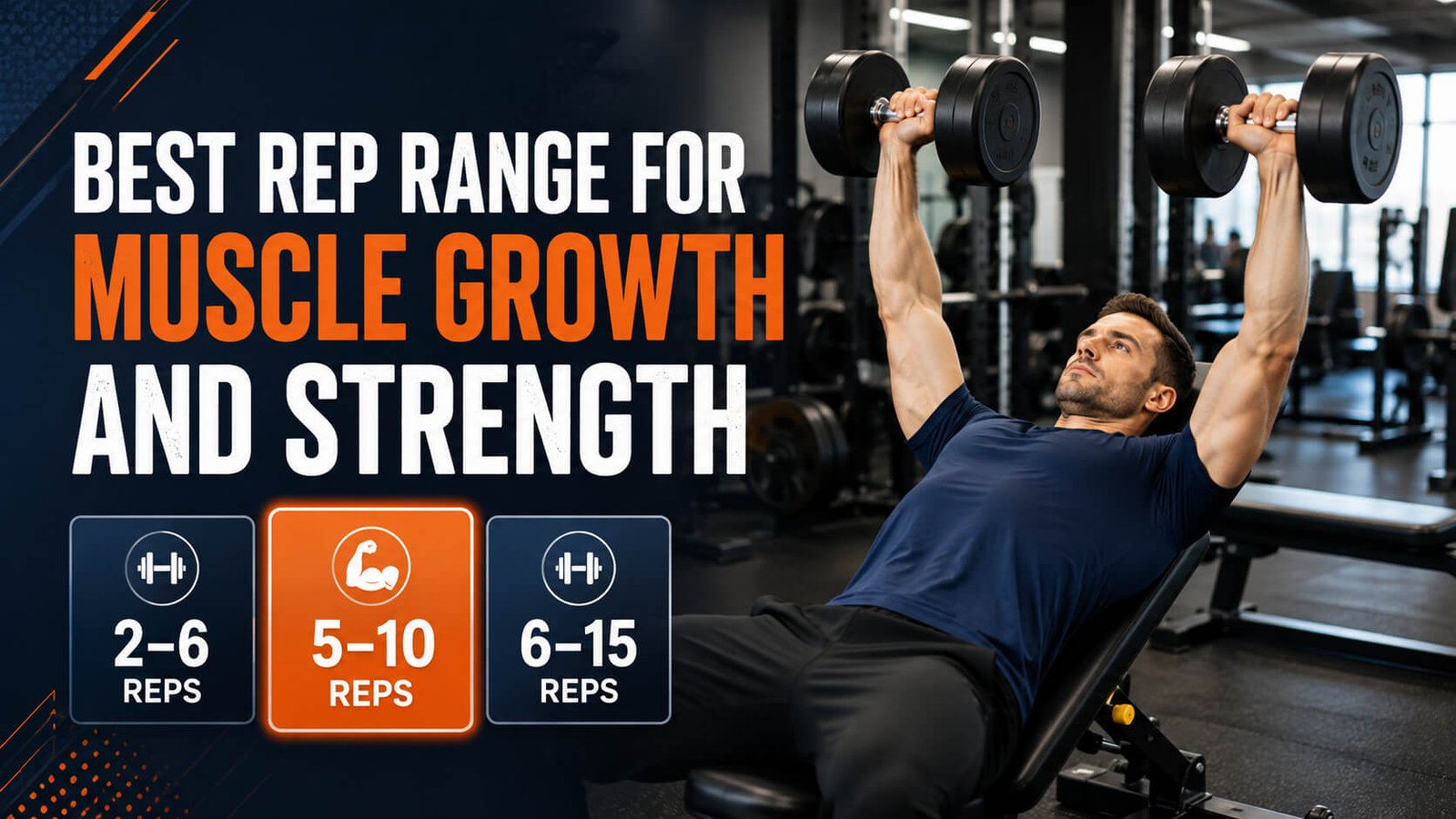
There is no single best rep range for both muscle growth and strength. Muscle can grow across a broad range of roughly 5–30 repetitions per set when sets are performed with sufficient effort, while heavier, lower-repetition training is generally more specific for maximizing strength.
If your goal is to build both muscle and strength, the 5–10 rep range is a practical middle ground for many compound exercises. It allows you to use relatively heavy loads while still accumulating enough training volume to support hypertrophy.
That does not mean 5–10 reps is a magical zone. Lower-rep work—often around 2–6 reps—is more specific to maximal strength, while moderate and higher-rep sets can also be effective for muscle growth when they are challenging enough and performed with good technique.
A practical program can therefore use lower reps for strength-focused compound lifts, moderate reps for most hypertrophy work, and higher reps for selected accessory exercises.
What Is the Best Rep Range for Muscle Growth and Strength?
If you want one simple target, perform most compound exercises for 5–10 controlled repetitions per set. Use the lower end when strength is more important and the upper end when muscle growth and training volume are the priorities.
Research supports using heavier loads to maximize one-repetition maximum strength. A large network meta-analysis found that programs using loads above 80% of 1RM ranked highest for strength, while many different resistance-training prescriptions produced muscle hypertrophy. This suggests that strength is more dependent on heavy-load practice than muscle growth is on one exact rep range. (Currier et al., 2023)
The 2026 American College of Sports Medicine position stand reached a similar conclusion. It recommends heavier loads around or above 80% of 1RM when maximizing strength is the goal, while higher weekly volume is particularly important for hypertrophy. (ACSM, 2026)
Practical RepRange Guide
| Training goal | Practical reps per set | Main programming emphasis |
| Maximal strength | 1–5 | Heavy resistance, long rests, lift-specific practice |
| Strength with some muscle growth | 3–6 | Heavy compound movements and controlled technique |
| Balanced strength and hypertrophy | 5–10 | Moderate to heavy loads and enough weekly volume |
| General muscle hypertrophy | 6–15 | Challenging sets, progressive overload, manageable fatigue |
| Hypertrophy with lighter resistance | 15–30 | High effort and proximity to failure |
| Local muscular endurance | Usually 15+ | Sustained repetitions and fatigue resistance |
These zones overlap. A set of five can stimulate muscle growth, and a set of 12 can improve strength. The ranges describe which adaptation receives the strongest emphasis rather than determining the only possible outcome.
Why 5–10 Reps Work Well for Both Goals
The 5–10rep range combines meaningful resistance with enough repetitions to accumulate productive training volume. It is usually heavy enough for strength development but less fatiguing and technically demanding than repeatedly performing singles, doubles, or triples.
This overlap range has several practical advantages:
- The resistance is substantial enough to practice force production.
- The set provides enough repetitions to create a useful hypertrophy stimulus.
- Progress is easy to measure through additional repetitions or resistance.
- Technique is often easier to maintain than during repeated nearmaximal attempts.
- Sets are generally more comfortable than very high-repetition compound exercises.
- A wide selection of free-weight, machine, and bodyweight exercises fits the range.
The relationship between repetitions and percentage of 1RM varies among people and exercises. Two lifters using 80% of their 1RM may complete different numbers of repetitions. Treat percentage charts as estimates, not exact conversions.
Strength Versus Hypertrophy Rep Ranges
Strength and muscle growth are related, but they are not identical adaptations. More muscle can increase long-term strength potential, while maximal strength also depends on neural adaptations, coordination, exercise technique, and experience producing force against heavy resistance.
Best Rep Range for Strength
Use approximately 2–6 repetitions for major compound lifts when maximal strength is the main objective. Most sets should stop before technique breaks down rather than continuing to complete failure.
Heavy resistance develops the specific skill of lifting heavy weights. Research comparing high-gh and low-load training consistently shows that higher loads produce larger improvements in 1RM strength, even when both approaches produce similar muscle growth. (Lopez et al., 2021)
Appropriate strength-focused exercises include:
- Squats
- Bench presses
- Deadlifts
- Overhead presses
- Weighted pullups
- Rows
Heavy training does not mean testing your maximum every week. Singles and doubles may help experienced strength athletes practice near-maximal lifting, but beginners can develop strength effectively with controlled sets of approximately 4–8 reps.
Longer rest periods also help preserve performance and technique during heavy sets. Rest approximately two to five minutes after demanding compound exercises, depending on the load and how recovered you feel.
Best Rep Range for Muscle Growth
Use approximately 6–15 repetitions for most muscle-building work. This range is not the only effective hypertrophy rep range, but it is convenient for accumulating challenging repetitions without requiring extremely heavy resistance or lengthhigh-repep sets.
Muscle hypertrophy can occur across a broad range of training loads. Reviews generally find comparable growth from lighter and heavier training when the sets provide sufficient effort, while heavier training retains an advantage for maximal strength. (Schoenfeld et al., 2017)
Practical hypertrophy ranges include:
- 5–8 reps: Heavy muscle-building work that also supports strength
- 8–15 reps: Efficient general hypertrophy training
- 15–30 reps: Lighter training that can work well for isolation, machine, band, and bodyweight exercises. Higher-repetition sets must become genuinely challenging. Performing 20 repetitions with a resistance you could lift 50 times is unlikely to provide the same stimulus as stopping within a few repetitions of failure.
Can High Reps Build Strength?
High repetitions can increase strength, especially in beginners, but they are generally less effective for maximizing heavy-lifting performance. Strength is specific to the movement and load being trained.
For example, high-rep push-ups may improve pressing strength and muscular endurance. However, someone who wants to maximize a heavy bench press should also practice bench pressing with relatively heavy resistance.
Best Rep Range for Different Exercises
Different exercises suit different rep ranges because they create different technical, cardiovascular, stability, and local muscle demands. Use lower repetitions for heavy, technically demanding lifts and moderate or higher repetitions for stable exercises and isolation movements.
| Exercise category | Practical range | Examples |
| Strength-focused compound lifts | 3–6 | Squat, bench press, deadlift, overhead press |
| General compound exercises | 5–10 | Dumbbell press, Romanian deadlift, weighted pullup, barbell row |
| Supported compound exercises | 8–15 | Leg press, chest press machine, lat pulldown, seated row |
| Isolation exercises | 10–20 | Biceps curl, triceps extension, lateral raise, leg curl |
| Bodyweight and resistance band exercises | 8–30 | Pushup, band row, split squat, band curl |
Squat Rep Range for Strength and Muscle
Use approximately 3–6 reps for strength-focused squats and 5–10 reps for squats that combine strength and hypertrophy. Higher-repetition squats can build muscle, but breathing, bracing, and whole-body fatigue may end the set before the legs receive the intended stimulus.
Beginners can use goblet squats and machine-based squat variations in a moderate repetition range while learning control and technique.
Bench Press Rep Range
Use approximately 3–6 reps for bench press strength and 5–10 reps for a balance of size and strength. Dumbbell and machine presses also work well in the 8–15rep range.
A spotter or correctly positioned safety equipment is important during challenging barbell pressing.
Deadlift Rep Range
Deadlifts are commonly performed for 2–6 repetitions because fatigue can make it harder to maintain a stable starting position. Romanian deadlifts, trapbar deadlifts, and some machine hip hinges may be comfortable in the 6–10rep range.
There is little reason for a beginner to perform repeated maximal singles. Controlled submaximal sets provide more opportunities to practice technique.
Row and Pulldown Rep Range
Rows and pulldowns usually work well for 6–15 repetitions. Heavy supported rows can develop strength, while moderate repetitions often make it easier to control the weight and keep the intended back muscles involved.
Biceps Curl and Lateral Raise Rep Range
Use approximately 10–20 repetitions for curls, triceps extensions, and lateral raises. These exercises can technically be performed for fewer reps, but moderate resistance often makes it easier to control the movement and train the target muscles comfortably.
Bodyweight and Resistance Band Rep Range
Aim for approximately 8–30 challenging repetitions. Adjust the exercise variation, leverage, range of motion, or band tension so that the set becomes difficult within your intended range.
If you can perform more than 30 controlled repetitions comfortably, consider:
- Using a stronger resistance band
- Choosing a harder bodyweight variation
- Increasing the range of motion
- Slowing uncontrolled repetitions to improve technique
- Adding resistance when it can be done safely
How Close Should You Train to Failure?
Most working sets should finish with approximately 1–3 repetitions in reserve, or RIR. This means you could probably complete one to three additional controlled repetitions before reaching muscular failure.
A 202 meta-regression found that strength improved across a broad range of distances from failure, while muscle growth tended to increase as sets ended closer to failure. The precise optimal distance remains uncertain. (Robinson et al., 2024)
A useful framework is:
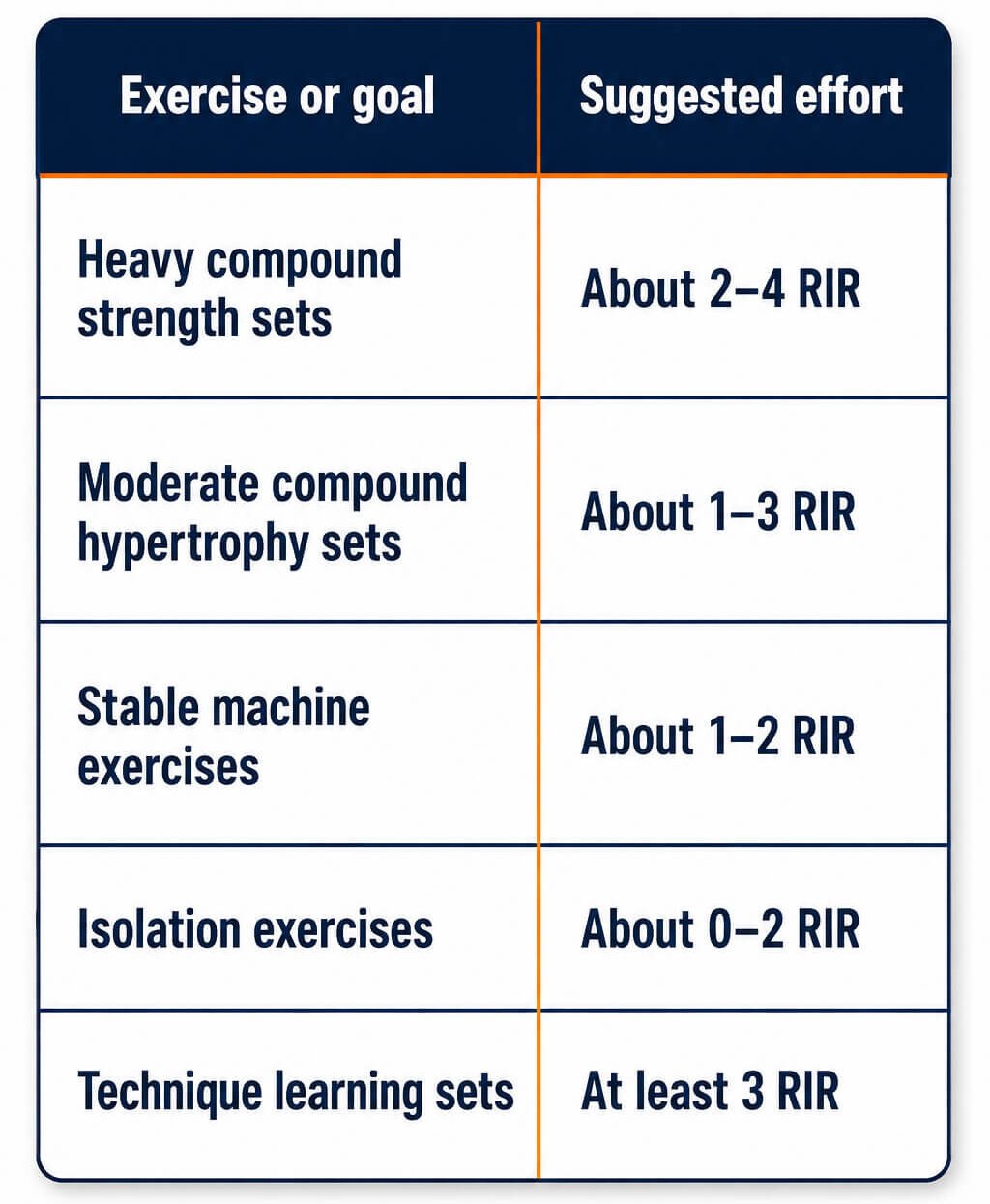
These are practical starting points, not requirements. Beginners may not estimate RIR accurately at first. Workout logging and consistent exercise technique make the estimate more useful over time.
Is Muscular Failure Necessary?
No. Taking every set to complete failure is not necessary for either strength or muscle growth.
A systematic review found no clear overall advantage for failure training over nonfailure training for strength or hypertrophy. The review also noted limitations in the available research, including the concentration of studies among young adults. (Grgic et al., 2022)
Failure training is most practical during controlled exercises such as:
- Biceps curls
- Leg extensions
- Leg curls
- Machine presses
- Pushups with a safe setup
- The final set of a stable isolation exercise
It is less suitable for frequent heavy squats, deadlifts, or unsupported presses. On these exercises, excessive fatigue may disrupt technique before the target muscles receive additional useful work.
How Many Sets Should You Perform?
A rep range cannot compensate for inadequate or excessive training volume. Count the number of challenging working sets performed for each muscle group across the week.
The 2026 ACSM position stand reports that hypertrophy is enhanced by higher weekly volume, with approximately 10 sets per muscle group per week serving as a useful general target for healthy adults. It also emphasizes that the largest improvement occurs when someone moves from no resistance training to performing it consistently. (ACSM, 2026)
Beginners do not need to start at 10 sets immediately. A practical starting point is approximately four to eight challenging weekly sets for each major muscle group. Add sets gradually only if technique remains stable, recovery is adequate, and progress has slowed.
This starting range is a programming suggestion rather than a universal scientific threshold.
How Long Should You Rest Between Sets?
Rest long enough to repeat the planned number of repetitions with good technique. Strength-focused compound exercises generally need more rest than isolation movements.
Use these starting points:
- Heavy compound exercises: 2–5 minutes
- Moderate compound exercises: 2–3 minutes
- Machine and isolation exercises: 1–2 minutes
- Very demanding high-rep sets: As long as needed to recover your breathing and control
A 2024 systematic review found a small potential hypertrophy advantage from resting longer than 60 seconds, possibly because longer rests help preserve training volume. The authors also noted uncertainty about the exact optimal duration. (Singer et al., 2024)
Do not shorten rest simply to make a workout feel harder. If short rest reduces your repetitions, resistance, or technique substantially, it may interfere with the purpose of the set.
Example Beginner Strength and Hypertrophy Workout
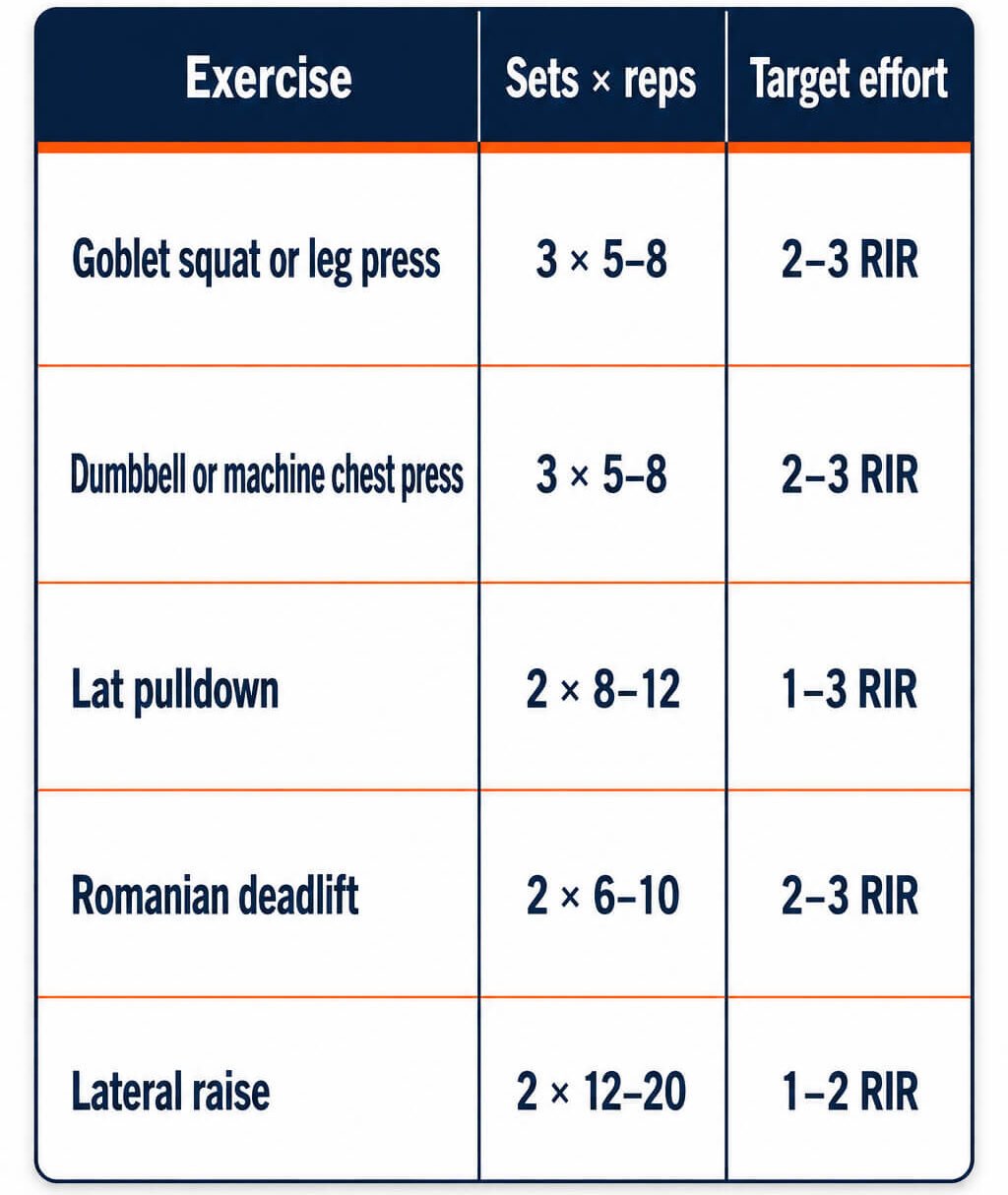
A beginner can train the major muscle groups twice per week while using multiple repetition ranges. The following is a general example for healthy adults who have learned the exercises correctly.
Workout A
Workout B
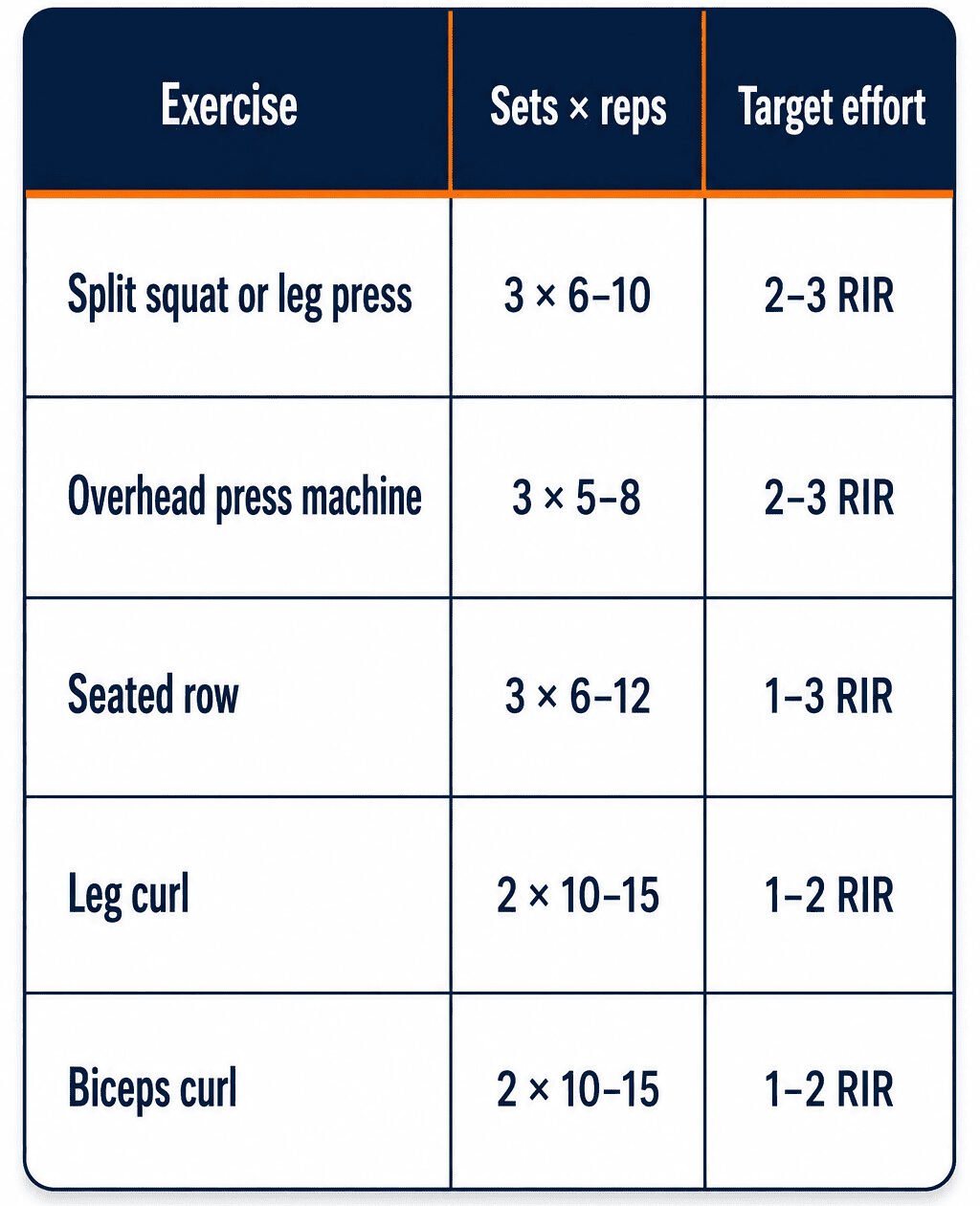
Leave at least one recovery day between these sessions. Beginners may start with fewer sets and add work gradually.
This program is an example, not a personalized prescription. People with an injury, medical condition, dizziness, chest symptoms, or unexplained pain should seek guidance from an appropriate healthcare professional before continuing.
Safety Guidance for Teenagers
Properly designed resistance training can be appropriate for teenagers when technique, gradual progression, and qualified supervision receive priority. The American Academy of Pediatrics recommends age-appropriate instruction and supervision rather than unsupervised maximal lifting. (AAP clinical report, 2020)
Teen beginners should generally:
- Learn each movement with light resistance first.
- Train under the supervision of a qualified adult or coach.
- Avoid repeated maximal attempts.
- Stop sets when technique begins to break down.
- Progress gradually rather than copying advanced lifters.
- Allow adequate recovery between sessions.
How to Increase Weight or Repetitions
Use double progression: increase repetitions within a target range before increasing the resistance. This provides a simple way to build strength without forcing weight increases before you are ready.
Suppose your target is three sets of 5–8 reps:
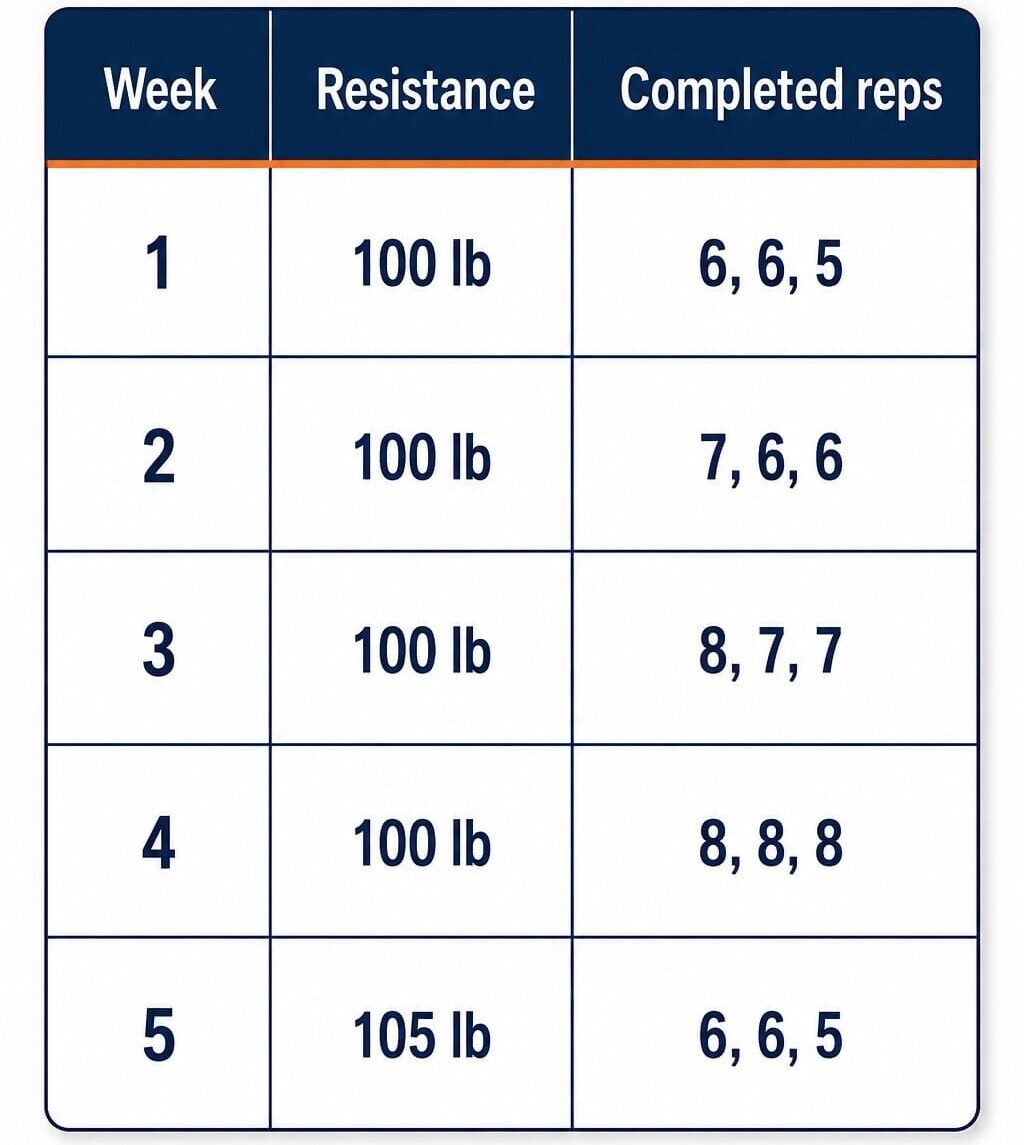
When every working set reaches the top of the range with controlled technique and the intended RIR, add a small amount of resistance. Your repetitions will usually return to the lower part of the range.
For dumbbells, resistance bands, or machines with large weight jumps, you can also progress by:
- Adding one repetition
- Improving range of motion
- Using cleaner technique
- Reducing unnecessary assistance
- Selecting a slightly harder variation
- Adding a set when recovery supports it
Change one variable at a time so you can identify what caused progress or excessive fatigue.
Common Rep Range Mistakes
Treating Rep Ranges as Separate Adaptation Zones
Strength, muscle growth, and endurance do not switch on at exact repetition cutoffs. Five reps can build muscle, and 15 reps can improve strength. The primary difference is the degree of emphasis.
Taking Every Set to Failure
Failure is not required for results. Repeated failure can create unnecessary fatigue and reduce the quality of later sets, especially during heavy compound exercises.
Using High Reps Without Enough Effort
Light resistance can build muscle, but the set must become challenging. Ending a high-rep set far from failure may provide little hypertrophy stimulus.
Testing Strength Instead of Building It
Frequent maximal singles show how strong you are on that day, but they provide limited practice volume. Most strength development should come from controlled submaximal sets.
Using the Same Range for Every Exercise
Heavy sets of three may suit a squat or bench press but are often unnecessary for lateral raises or curls. Match the repetition target to the exercise.
Sacrificing Technique to Reach a Rep Target
The set should end when you can no longer perform another controlled repetition with acceptable technique. A repetition completed through excessive momentum or a shortened range of motion may not represent genuine progress.
Adding Too Much Volume at Once
More sets can support hypertrophy, but the benefit shows diminishing returns and must be balanced with recovery. Increase volume gradually rather than doubling it suddenly.
Changing the Program Too Frequently
Rep ranges need time to produce measurable progress. Keep the main exercises and progression system consistent long enough to evaluate changes in repetitions, load, and technique.
Practical Recommendations
Use the following framework to select your sets and reps:
- Choose your main goal. Emphasize 2–6 reps for maximal strength, 6–15 for hypertrophy, or 5–10 for both.
- Match the range to the exercise. Use lower reps for demanding compound lifts and moderate or higher reps for stable accessories.
- Keep most sets shy of failure. Approximately 1–3 RIR works well for general training.
- Rest long enough to maintain performance. Heavy compound exercises often require at least two minutes.
- Record every working set. Track the exercise, resistance, repetitions, and estimated RIR.
- Use double progression. Reach the top of the rep range before adding resistance.
- Increase volume gradually. Add sets only when progress and recovery indicate that more training may help.
- Prioritize repeatable technique. A controlled rep is more useful than an extra rep completed with poor form.
- Review progress over several weeks. Avoid judging a program from one workout.
- Get appropriate supervision. This is especially important for beginners and anyone under 18.
Frequently Asked Questions
What is the best rep range for muscle growth and strength?
The best general overlap range is 5–10 reps per set. Use more work near five reps when strength is the priority and more work near 8–10 reps when hypertrophy and training volume are more important.
Is 8–12 reps best for muscle growth?
Eight to 12 reps is an effective and convenient hypertrophy range, but it is not the only one that works. Muscle growth can occur with heavier or lighter resistance when sets provide enough effort and weekly volume.
Can five reps build muscle?
Yes. Sets of five can build muscle, particularly when multiple challenging sets are performed. However, relying exclusively on low reps may make it harder to accumulate hypertrophy volume without additional joint, technical, or overall fatigue.
Can 20 reps increase muscle size?
Yes. A challenging set of 20 reps can stimulate muscle growth, especially with isolation, machine, bodyweight, or resistance-band exercises. It will usually be less effective than heavy training for maximizing 1RM strength.
Are 8–12 reps good for strength?
They can improve strength, particularly for beginners. However, someone who wants to maximize heavy lifting performance should include some lower-repetition work with heavier resistance.
Is a 5×5 workout good for strength and muscle?
A 5×5 routine can improve both strength and muscle size. It provides substantial practice with moderately heavy resistance, but it may not supply the most practical rep range for every exercise. Accessories often work better with moderate or higher repetitions.
Should every set be taken to failure?
No. Most sets can stop with one to three repetitions in reserve. Complete failure may be used occasionally on stable isolation or machine exercises, but it is not required.
When should you add weight?
Add resistance when you reach the top of your target range on every working set with controlled technique and the intended repetitions in reserve. Use the smallest practical increase.
What rep range works with resistance bands?
Approximately 8–30 reps can work well. Choose a band and exercise setup that makes the target muscles approach fatigue within that range without losing control.
How often should you train each muscle group?
Training all major muscle groups at least twice per week is a practical general target for healthy adults. Weekly volume and consistency appear more important than forcing one exact frequency. Beginners can start with two full-body sessions.
Do low reps build muscle or only strength?
Low reps can build muscle, but they emphasize strength more strongly. Moderate repetitions often make it easier to accumulate muscle-building volume with less heavy-load fatigue.
Should compound exercises come before isolation exercises?
Usually, yes. Perform the exercises most important to your goals early in the session, while you are less fatigued. If improving a squat or bench press is the priority, complete it before curls or lateral raises.
Conclusion
The best rep range for muscle growth and strength is usually 5–10 reps, but no single number is optimal for every goal and exercise. Heavy sets of approximately 2–6 reps provide a stronger maximal-strength emphasis, while 6–15 reps is a practical range for most muscle-building work. Higher-repetition sets can also build muscle when they finish close enough to failure.
A productive program combines appropriate rep ranges with controlled technique, sufficient weekly volume, adequate rest, and gradual progressive overload. Choose ranges you can perform consistently, record your workouts, and increase repetitions or resistance only when your current work is controlled and repeatable.
Choose a target range for each exercise and track your repetitions, resistance, and RIR for the next six weeks. Use those results,s not one isolated workout, to decide when to progress.