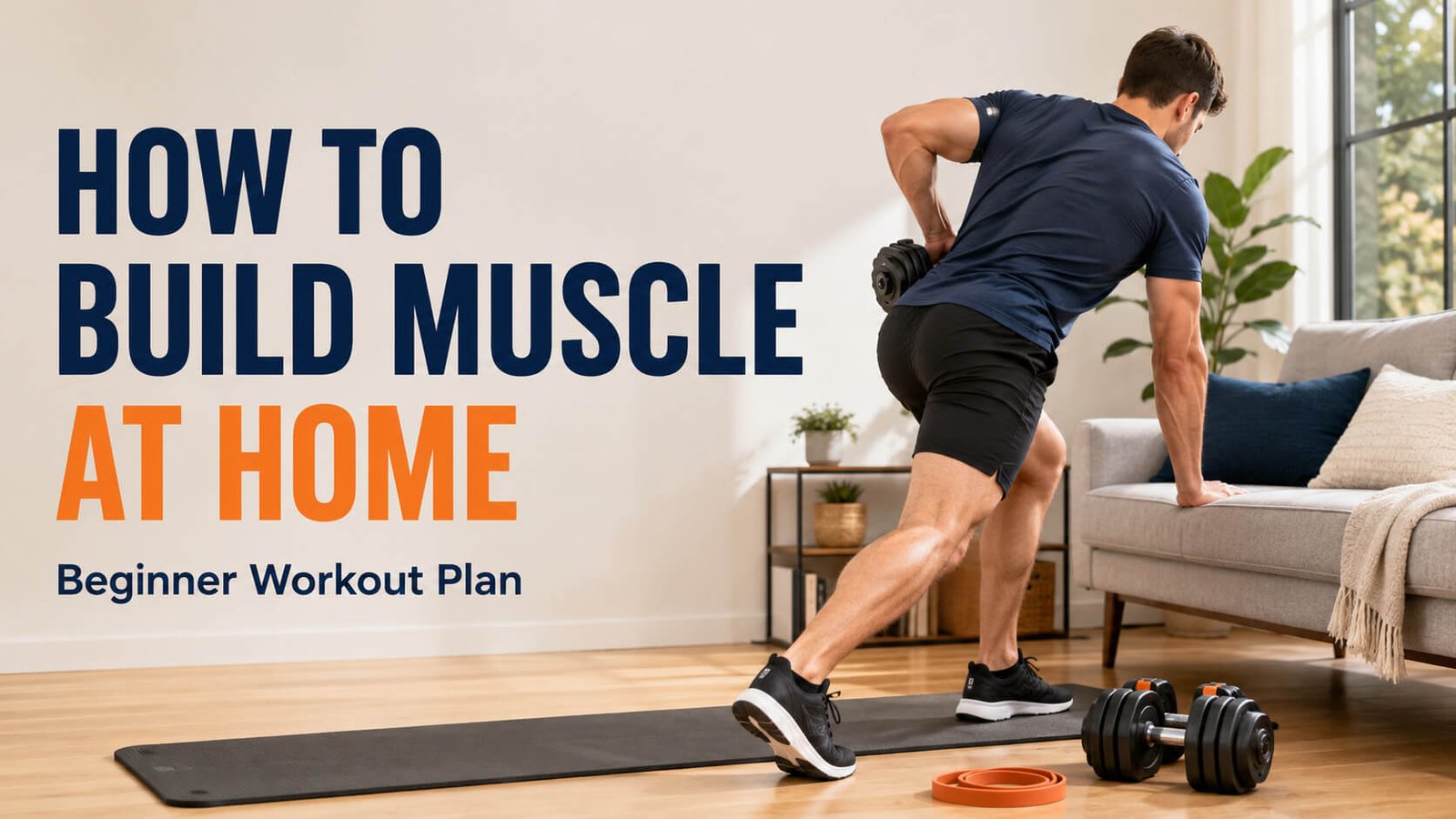
You can build muscle at home without a gym. The requirements are the same wherever you train: challenge each major muscle group with resistance, perform enough hard sets, gradually make the work more demanding, and recover with adequate food and sleep. Bodyweight exercises, resistance bands, dumbbells, and safely loaded household items can all work.
The main limitation is not the location. It is whether your routine stays challenging as you become stronger. A seven-minute circuit may feel difficult, but muscle gain becomes more predictable when you repeat a small set of exercises, record your performance, and apply progressive overload.
This guide explains how to build muscle at home for beginners, including a 3-day full-body plan, no-equipment alternatives, an exact progression method, nutrition basics, and safety guidance.
Can You Build Muscle at Home?
Yes. Healthy adults can increase muscle size and strength with progressive resistance training at home, using bodyweight, bands, free weights, or other suitable resistance. The 2026 American College of Sports Medicine position stand specifically reports that bodyweight, elastic resistance, and home-based training can improve strength, hypertrophy, and physical function.
Muscle hypertrophy means an increase in the size of skeletal muscle fibers. Resistance training supports this adaptation by exposing muscle to repeated, sufficiently demanding contractions. Over time, the body adapts by becoming better able to handle that work.
Home training is not automatically easier than gym training. A split squat while holding a heavy backpack may challenge the legs more than an easy machine set. Conversely, 50 relaxed bodyweight squats may do little for muscle growth once you can perform them comfortably. The decisive factor is the challenge relative to your current ability.
A small 8-week study in young men found that low-load push-ups and a comparably loaded bench press produced similar gains in chest and triceps muscle thickness and strength.[2] That does not prove every bodyweight movement equals every weight exercise. Still, it supports the practical point: a muscle responds to an adequate training stimulus, not to the building in which the exercise occurs.
The Five Principles That Make Home Muscle Building Work
An effective home muscle workout follows five principles: meaningful resistance, progressive overload, enough weekly work, appropriate effort, and recovery. If progress stalls, one of these areas usually needs attention.
1. Use resistance that makes the set challenging
Choose a resistance level or exercise variation that makes the final few repetitions challenging and noticeably slower without causing your technique to break down. For most beginners training at home, about 6–20 repetitions per set is a practical range. Lighter resistance and higher repetitions can build muscle too, but those sets often take longer and may feel more uncomfortable.
Do not treat the repetition range as a magic formula. Ten easy repetitions do not stimulate the same adaptation as ten demanding repetitions. The set needs to challenge the target muscles.
2. Apply progressive overload
Progressive overload means gradually increasing the training demand as your body adapts. At home, you can progress by:
- adding repetitions within a target range;
- adding load to a backpack or using heavier dumbbells;
- moving to a stronger resistance band;
- increasing the range of motion you can control;
- choosing a harder variation;
- reducing assistance;
- using a unilateral version, such as moving from a squat to a split squat;
- adding a working set when other progression options are limited.
Slower lowering phases and pauses can make an exercise harder, but they are tools rather than endless progression systems. Once a slow tempo set becomes easy, you still need more resistance, a harder leverage position, or more work.
3. Accumulate enough quality work
Training volume is commonly estimated as the number of challenging working sets performed for a muscle group each week. The 2026 ACSM review found that higher weekly volume around 10 sets per muscle group can enhance hypertrophy in healthy adults.
That number is a useful destination, not a requirement for a beginner’s first week. Start with about 4 to 8 direct sets per muscle group each week. After several weeks, add sets selectively if you are recovering well, but progress has slowed. This gradual approach makes soreness and technique breakdown less likely.
4. Train hard without forcing failure
Most sets should end close enough to failure that the target muscles are clearly challenged, but you do not need to fail a repetition. A useful target is one to three repetitions in reserve, often shortened to 1–3 RIR. This means you believe you could complete only one to three more clean repetitions.
Research comparing failure and nonfailure training has not shown that taking every set to failure is necessary for muscle growth. The latest ACSM position stand also found that momentary muscle fatigue did not consistently improve outcomes for the average healthy adult. Stopping slightly short of failure helps beginners preserve technique and manage fatigue.
RIR is an estimate, and beginners may not judge it accurately at first. Use it alongside objective progress; if the same variation produces more controlled repetitions over time, you are getting more muscular.
5. Recover and repeat
Muscle develops between training sessions, not during a single workout. A right plan therefore includes rest days, sufficient sleep, adequate food, and a schedule you can maintain. Random hard sessions separated by long gaps are less useful than steady training for months.
What Equipment Do You Need?
You can start with no formal exercise equipment, but one or two simple tools make balanced progression much easier. A resistance band or adjustable dumbbells offer the most flexibility for a small space.
| Setup | What it does well | Main limitation |
| Bodyweight only | Pushups, split squats, lunges, glute bridges, calf raises, and core work | Progressive back and biceps training is difficult without something safe to pull |
| Loaded backpack | Rows, squats, split squats, Romanian deadlifts, curls, and carries | Load may shift; the bag and straps must be strong and undamaged |
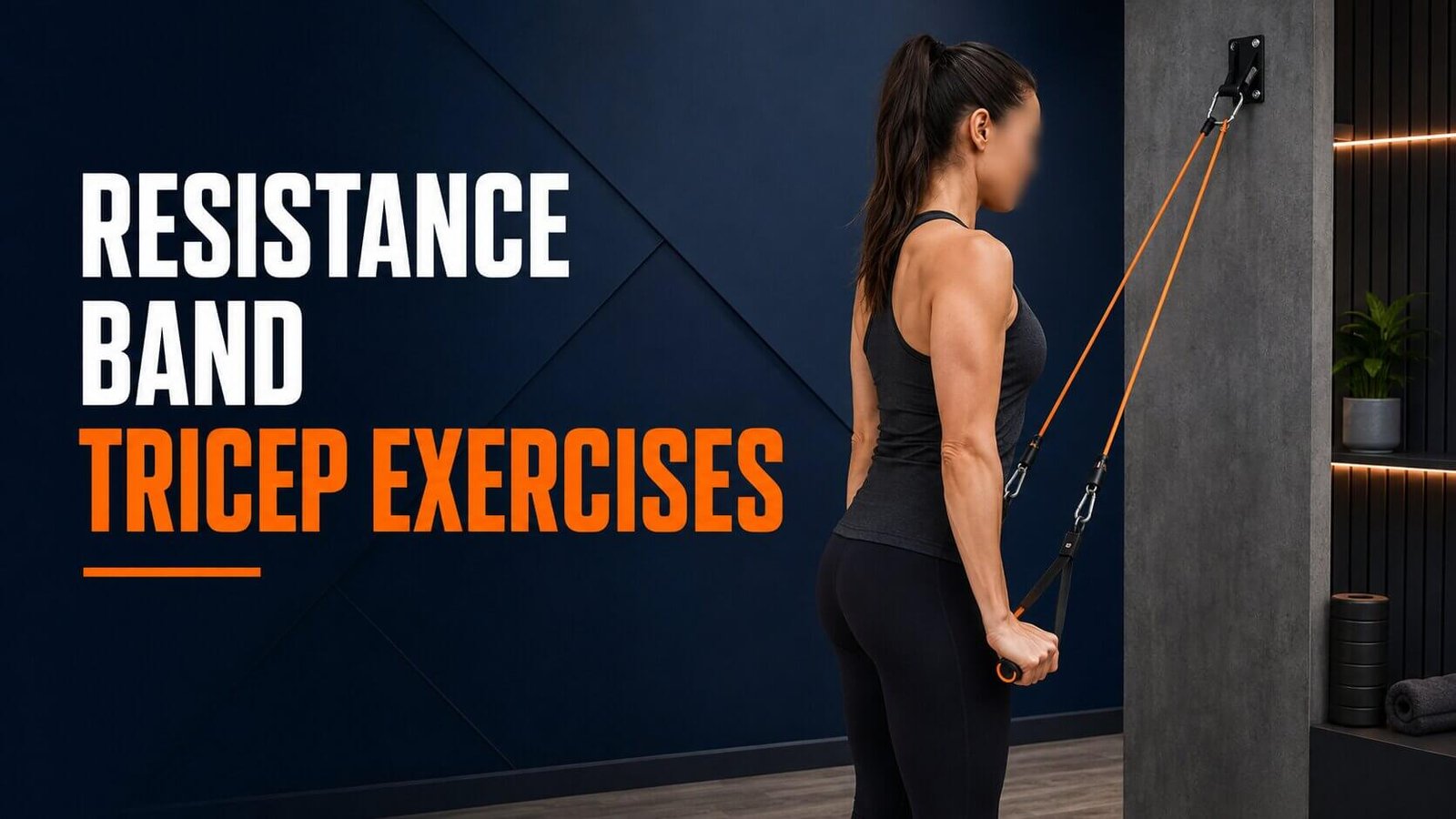
| Resistance bands | Rows, pulldowns, presses, curls, triceps extensions, and leg work | Resistance is hardest near the stretched end of many band setups; anchors must be secure |
| Dumbbells | Easy load tracking and a wide range of upper and lower body exercises | Fixed pairs can become too light; adjustable models cost more initially |
| Pullup bar | Effective vertical pulling for the back and arms | It must be installed correctly and rated for the user and doorway |
A systematic review found that elastic resistance and conventional resistance produced similar strength gains across the included studies, although the evidence covered varied populations and protocols.[3] For muscle gain, bands still need to provide a challenging and progressively increasing load.
The honest limitation of no equipment training
A bodyweight-only routine can train the chest, shoulders, triceps, quadriceps, glutes, calves, and core effectively. The back is the weak point. Safe, hard pulling exercises usually require a band, a properly installed bar, a weight, or a stable piece of equipment made for specific exercises.
Do not crawl under an ordinary dining table or hang from a door because a video shows it. Furniture can tip, slide, or break. If your budget is limited, a long resistance band is generally a more useful first purchase than adding more pushup variations.
Best Home Exercises for Muscle Growth
The best home exercises are movements you can perform safely, feel in the intended muscles, and progress for weeks or months. Build the routine around six movement patterns rather than collecting dozens of exercises.
| Movement pattern | Bodyweight option | Band, backpack, or dumbbell option | Main muscles |
| Knee dominant leg exercise | Squat, split squat, reverse lunge, step up | Goblet squat, loaded split squat | Quadriceps, glutes |
| Hip dominant exercise | Glute bridge, single leg glute bridge | Romanian deadlift, hip thrust | Hamstrings, glutes, spinal erectors |
| Horizontal push | Incline, floor, or decline pushup | Dumbbell floor press, band chest press | Chest, triceps, front shoulders |
| Horizontal or vertical pull | Pullup or chinup on a rated bar | One-arm row, band row, band pulldown | Upper back, lats, biceps |
| Vertical push | Pike pushup | Dumbbell or band overhead press | Shoulders, triceps |
| Core stability | Dead bug, plank, side plank | Loaded carry or band anti rotation press | Abdominals and trunk stabilizers |
Pushups
Pushups can build the chest, triceps, and front shoulders when the variation is challenging. Start with a wall or high incline if a floor pushup is too difficult. Progress toward a lower incline, floor pushup, feet elevated pushup, or safely loaded pushup.
Keep your body in a straight line, lower under control, and use the deepest comfortable range that does not cause joint pain. Full range of motion resistance training generally produces better strength outcomes and may improve lower body hypertrophy compared with partial repetitions. However, the best range can vary by exercise and individual.
Rows and pullups
Rows and pullups train muscles that pushups miss, especially the lats, upper back, and biceps. Use a one arm dumbbell or backpack row, a band row anchored according to the manufacturer’s directions, or a pullup bar installed and tested correctly.
Pullups are not required. If you cannot perform one, use a row or band pulldown that allows controlled repetitions. If pullups are already easy, add repetitions, slow the lowering phase, or eventually add load with suitable equipment.
Squats, split squats, and lunges
Bodyweight squats help beginners learn the movement, but they often become too easy for muscle gain. Split squats and reverse lunges place more demand on each leg without requiring much external load. Hold a backpack or dumbbells at the top of your repetition range.
Use a stance that keeps your foot planted and your knee tracking comfortably in the same direction as your toes. Depth should be the greatest range you can control without pain or losing position.
Romanian deadlifts and glute bridges
A hip hinge trains the hamstrings and glutes through a different action than a squat. A dumbbell or backpack Romanian deadlift is a practical home option. Push the hips back while keeping the load close, then stand by driving the hips forward without overextending the lower back.
If you have no load, begin with glute bridges and progress to single leg versions. Eventually, most people need external resistance to keep hip-dominant training challenging.
Pike pushups and overhead presses
Pike pushups shift more work toward the shoulders than standard pushups. Keep the head moving forward and down between the hands rather than turning the exercise into a short range pushup. Use a raised hand position if needed.
Band or dumbbell overhead presses are easier to adjust in small load increments. Stop if overhead movement causes sharp shoulder pain, and use a pain-free pushing variation instead.
Core exercises
Core training helps you control the trunk while the arms and legs produce force. Dead bugs, side planks, and planks are good starting exercises. Progress by increasing control, extending the lever, adding a small load, or choosing a harder variation, not by holding an easy plank for several minutes.
Beginner Home Workout Plan for Muscle Gain
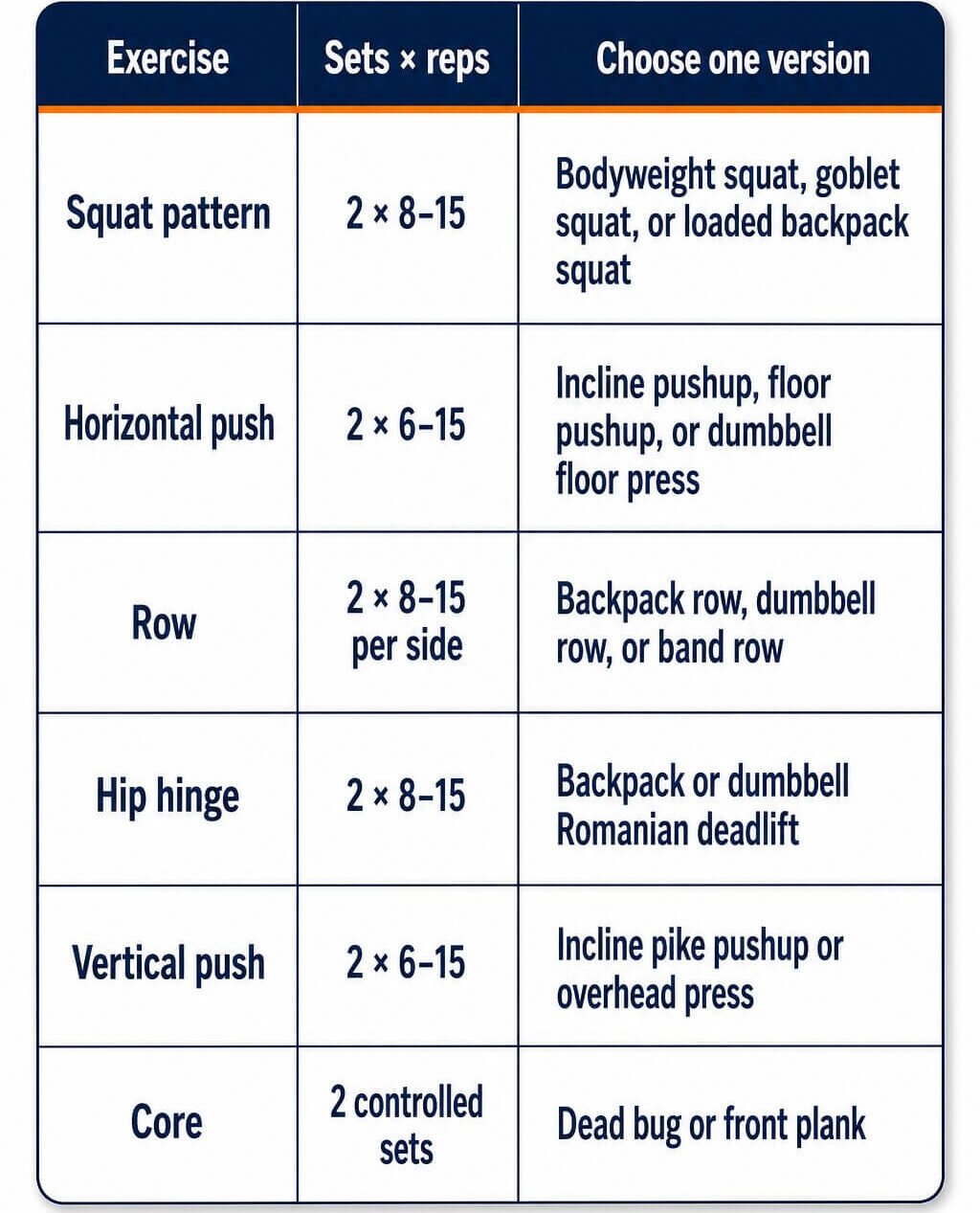
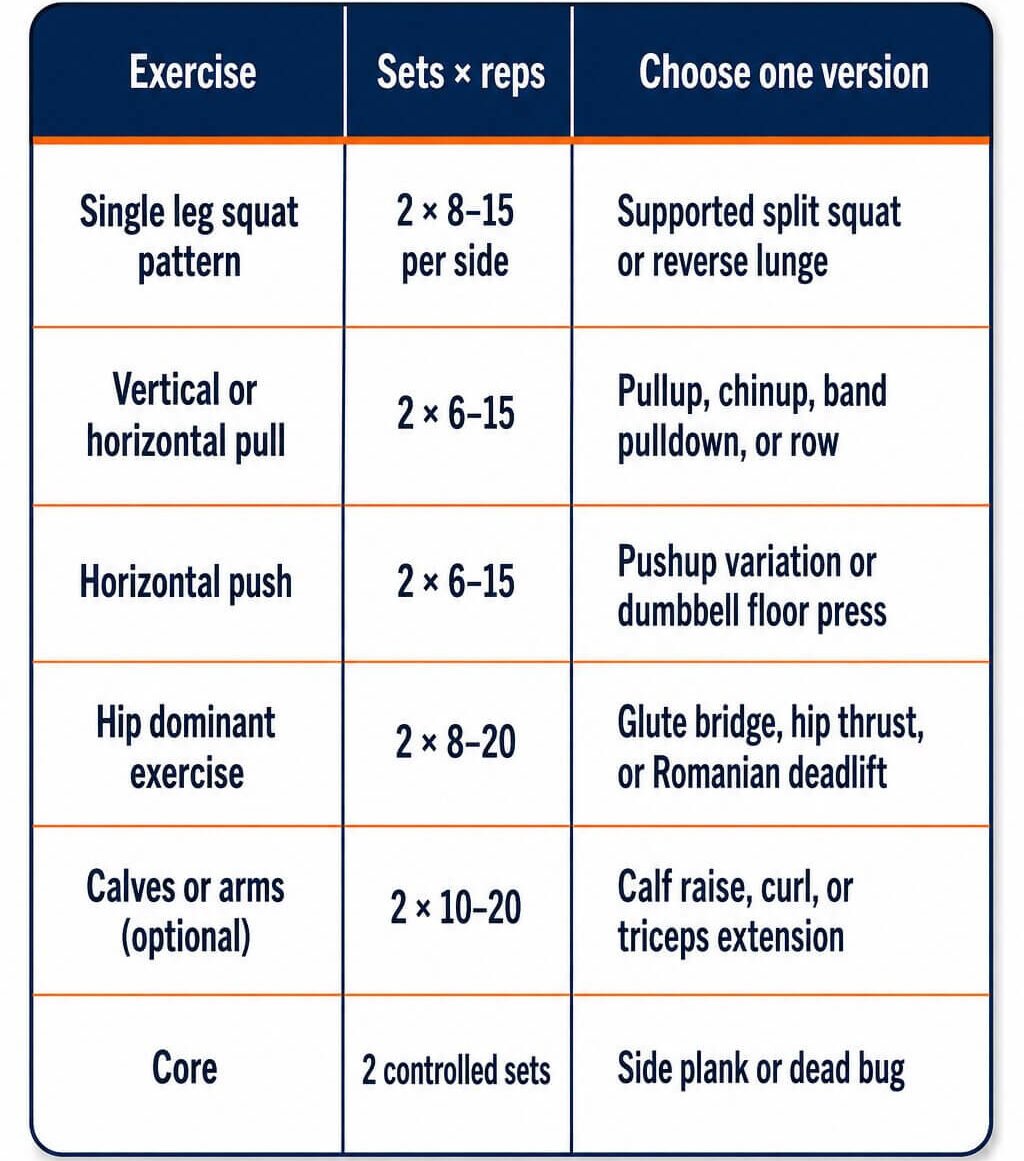
Train three nonconsecutive days per week and alternate Workout A and Workout B. In week one, perform A/B/A; in week two, perform B/A/B. Start with two working sets per exercise and keep one to three good repetitions in reserve.
Before each session, spend about five minutes raising your body temperature and moving the joints you will train. Then perform one easier practice set of the first few exercises.
Workout A
Workout B
Rest about 90 seconds to three minutes after demanding compound exercises and around 60 to 90 seconds after smaller isolation or core movements. Longer and shorter rest intervals can both support hypertrophy; the practical goal is to rest long enough that the next set is productive.[8]
How to choose your starting variation
Use a version that lets you reach the bottom of the listed range with clean technique and approximately two or three repetitions left. If you cannot reach the minimum, make the movement easier. If you exceed the maximum comfortably, increase the resistance or choose a harder version.
The workout should usually take about 35 to 55 minutes after you learn the exercises. There is no benefit to rushing between sets if short rest reduces your repetitions or technique.
How to expand the plan
Stay with two sets for the first two to four weeks. If soreness is manageable, technique is stable, and you are recovering between sessions, add a third set to one or two priority movements. Build gradually toward roughly 8 to 10 challenging weekly sets for the muscles you most want to develop rather than adding sets everywhere at once.
How to Progressively Overload at Home
Use double progression: add repetitions first, then increase the difficulty. This method works with bodyweight exercises, bands, backpacks, and dumbbells.
Pick a target range, such as 8 to 15 repetitions.
Select a load or variation that allows at least 8 controlled repetitions with about 2 RIR.
Over several workouts, add one repetition where possible while keeping the same technique.