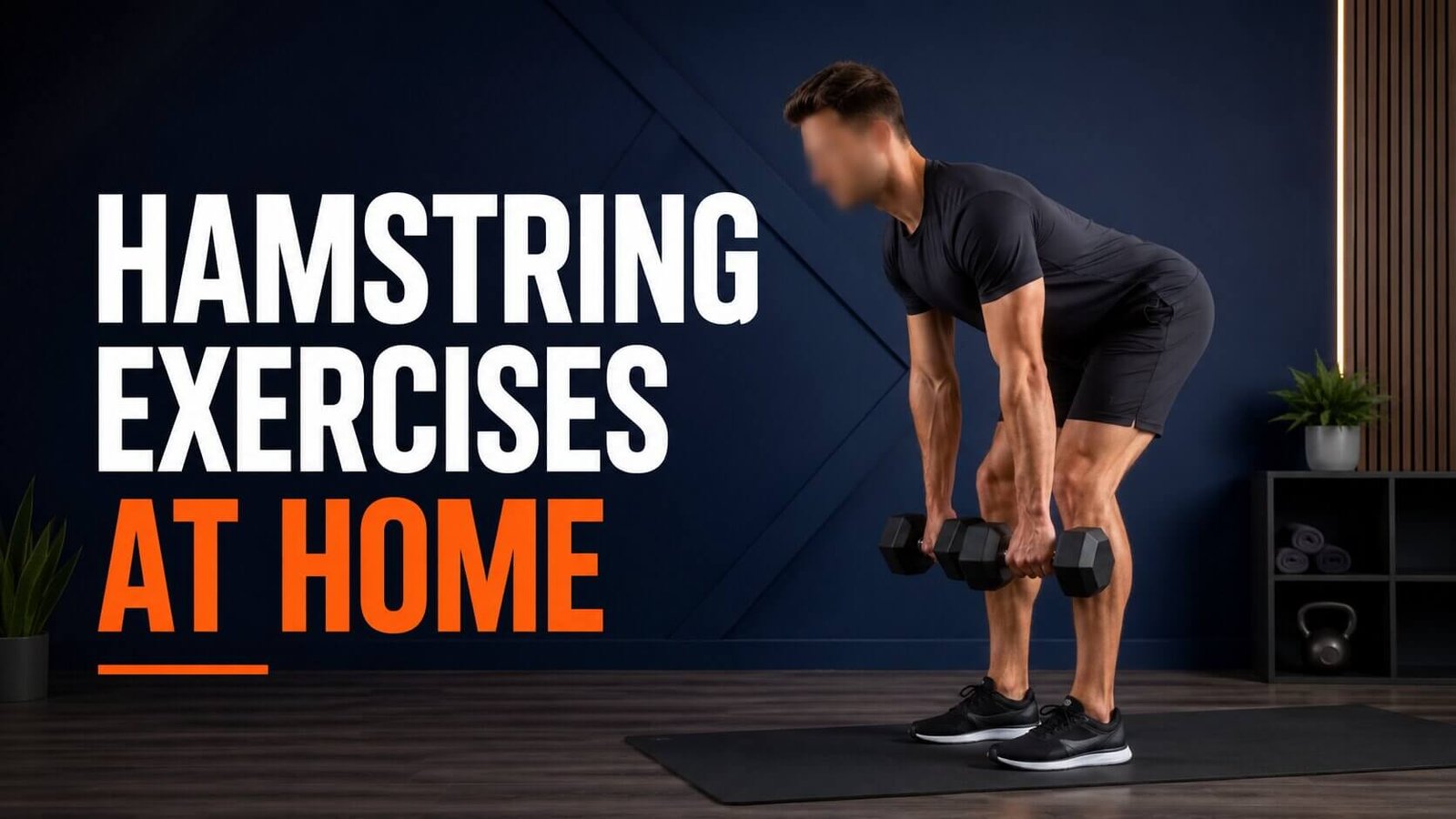
You can strengthen your hamstrings at home with hip-hinge, bridge, and leg-curl movements. Start with bodyweight exercises to learn the positions, then progress with a longer lever, a one-leg variation, a slower tempo, towel sliders, a resistance band, or a loaded backpack.
A complete hamstring workout should include both hip extension and knee flexion. The 10 exercises below cover both patterns and range from beginner bodyweight options to more demanding home variations.
Safety note: This guide is for generally healthy adults, not rehabilitation after a hamstring injury. Stop if you feel sharp or increasing pain. Sudden pain with a popping sensation, swelling, bruising, marked weakness, or difficulty bearing weight warrants assessment by a healthcare professional.
What Are the Hamstrings?
The hamstrings are three muscles along the back of each thigh: the biceps femoris, semitendinosus, and semimembranosus. They help extend the hip and flex the knee, although the short head of the biceps femoris crosses only the knee.
Those actions appear in walking, running, hinging, climbing stairs, and lifting. The glutes, calves, spinal muscles, and adductors often assist, so hamstring exercises rarely feel completely isolated.
ACE’s hamstring overview identifies hip extension and knee flexion as their primary actions. Exercise research also finds different activation patterns, although muscle activity alone cannot prove superior long-term growth. Peer-reviewed study
Can You Strengthen Your Hamstrings at Home?
Yes. Home exercises can strengthen the hamstrings when the movement is challenging enough, performed with control, and progressed over time. Heavy gym equipment is useful but not essential.
Bodyweight can teach a hinge or bridge but may eventually become too easy. Add difficulty by:
- Using one leg at a time
- Increasing the controlled range of motion
- Slowing the lowering phase
- Pausing or slowing the lowering phase
- Changing leverage or adding single-leg work
- Adding a backpack, dumbbells, band, sliders, or stability ball
ACSM’s 2026 resistance-training update reports that home-based and bodyweight programs can improve strength and physical function. It also emphasizes consistent participation and individualization rather than one universally perfect program. ACSM resistance-training guidance
The Two Main Hamstring Movement Patterns
A well-rounded plan uses at least one hip-dominant exercise and one knee-flexion exercise. The hamstrings cross both joints, so the two patterns challenge them differently.
| Pattern | What Happens | Home Exercise Examples |
|---|---|---|
| Hip extension | The thigh moves backward relative to the pelvis | Good morning, RDL, bridge, single-leg RDL |
| Knee flexion | The heel moves toward the back of the thigh | Sliding curl, band curl, stability-ball curl |
Hip hinges challenge the hamstrings as the hips move backward. Curls emphasize knee bending. Bridges combine hip extension with bent knees and substantial glute work.
You do not need equal numbers of every exercise. One hinge and one curl or bridge pattern in a session is a practical starting point.
10 Effective Hamstring Exercises at Home
Choose exercises that match your equipment and current ability. You do not need to perform all 10 in one session.
1. Bodyweight Good morning.
The bodyweight good morning teaches the hip hinge without load. Experienced trainees may need more resistance.
How to do it:
- Stand hip-width with softly bent knees and hands across your chest.
- Push your hips backward while keeping your spine controlled.
- Lower until you feel hamstring tension, then drive your hips forward to stand.
Start with: 2–3 sets of 10–15 reps
Easier: Reduce the range and practice with your hips moving toward a wall.
Harder: Use a three-second lowering phase or progress to a backpack RDL.
2. Glute Bridge
The glute bridge trains hip extension through the glutes and hamstrings. Foot placement affects leverage and comfort.
How to do it:
- Lie on your back with knees bent and feet flat.
- Brace gently, press through your feet, and lift your hips.
- Pause without arching your back, then lower slowly.
Start with: 2–3 sets of 10–15 reps
Easier: Use a smaller range.
Harder: Move the feet slightly farther away, slow the descent, or use a single-leg variation.
If a hamstring cramps, lower your hips, rest, and move your feet slightly closer.
3. Heel-Dig Bridge
The heel-dig bridge adds isometric knee-flexion effort by pulling the heels toward you without moving them.
How to do it:
- Lie on your back with knees bent, heels down, and toes raised.
- Imagine dragging the heels toward your hips.
- Lift into a small bridge while maintaining that effort.
Start with 2 sets of 8–12 reps or 15–25 seconds
Easier: Keep the hips low and practice only the heel-dig tension.
Harder: Move the heels farther away or alternate lifting one foot slightly.
4. Supported Single-Leg Romanian Deadlift
The supported single-leg RDL trains one side while a chair or wall reduces balance demands.
How to do it:
- Hold a stable chair or wall lightly and shift onto one leg.
- Soften that knee and reach the other leg back as your hips hinge.
- Keep the pelvis level, then drive through the standing foot to return.
Start with: 2–3 sets of 6–10 reps per side
Easier: Keep the rear toes on the floor in a kickstand position.
Harder: Use less hand support or hold a backpack or dumbbell.
5. Bridge Walkout
The bridge walkout lengthens the lever from a bridge and is more demanding than a standard bridge.
How to do it:
- Lift into a bridge and take a small step forward with each heel.
- Continue for two to four steps without losing hip control.
- Walk the feet back and lower.
Start with: 2 sets of 3–6 walkouts
Easier: Take one step out and back with each foot.
Harder: Add steps or pause with the feet farther away.
Stop before your hips drop or your hamstrings cramp. Complete beginners should master bridges first.
6. Sliding Hamstring Curl
The sliding curl challenges knee flexion using towels or sliders. Begin with a limited range.
How to do it:
- Lie on your back with heels on sliders and lift into a bridge.
- Slowly slide the heels away while controlling the hips.
- Pull the heels back toward you.
Start with: 2–3 sets of 5–10 reps
Easier: Slide one heel out while the other foot stays planted, or lower the hips between reps.
Harder: Keep the hips elevated throughout or use one leg.
Test the floor first. The sliders should move smoothly without accelerating uncontrollably.
7. Backpack Romanian Deadlift
A backpack RDL adds adjustable resistance after bodyweight hinges become easy.
How to do it:
- Load a strong backpack evenly, close it, and hold it near your thighs.
- Soften your knees and push your hips backward while keeping the load close.
- Stop at your controllable depth, then drive your hips forward.
Start with: 2–4 sets of 8–15 reps
Easier: Use a lighter load or smaller range.
Harder: Add weight gradually, slow the lowering phase, or use a staggered stance.
Avoid fragile or shifting contents and a backpack that may tear.
8. Single-Leg Glute Bridge
The single-leg bridge increases unilateral demand without weights and requires level hips.
How to do it:
- Set up for a bridge and lift one foot.
- Press through the planted foot and raise your hips.
- Keep the pelvis level and lower with control.
Start with: 2–3 sets of 6–12 reps per side
Easier: Use a kickstand bridge with the nonworking heel lightly touching the floor.
Harder: Pause at the top or place the working foot on a stable low step.
9. Resistance-Band Hamstring Curl
A band curl provides knee-flexion resistance without a machine. Use a secure low anchor behind your feet.
How to do it:
- Attach the band securely around one or both ankles and lie face down.
- Keep your hips down and bend the knee toward your glutes.
- Return slowly without letting the band snap the leg straight.
Start with: 2–3 sets of 10–15 reps
Easier: Use a lighter band or work one leg at a time.
Harder: Add resistance or slow the return.
Inspect the anchor and band, and stay out of the recoil path. See this guide to anchoring resistance bands at home.
10. Stability-Ball Hamstring Curl
The stability-ball curl combines a bridge with knee flexion and is an intermediate option.
How to do it:
- Lie on your back with heels on a ball and raise your hips.
- Bend your knees to roll the ball toward you.
- Control your hips as you extend the legs.
Start with: 2–3 sets of 6–12 reps
Easier: Hold a bridge with the ball still or use a partial curl.
Harder: Slow the extension or progress to one leg only after mastering the two-leg version.
ACE lists the two-leg stability-ball hamstring curl as an intermediate movement and the single-leg version as advanced.
No-Equipment Beginner Hamstring Workout
This routine uses four exercises to teach the hinge, hip extension, isometric knee flexion, and single-leg control. Complete two rounds at first, then build to three.
| Exercise | Sets | Repetitions |
|---|---|---|
| Bodyweight good morning | 2–3 | 10–15 |
| Glute bridge | 2–3 | 10–15 |
| Heel-dig bridge | 2–3 | 8–12 or 15–25 seconds |
| Supported single-leg RDL | 2–3 | 6–10 per side |
Rest 45–75 seconds between exercises and up to two minutes between rounds. Keep about two controlled reps in reserve.
Use it twice weekly on nonconsecutive days. Return to two sets if soreness disrupts your next session.
Progressive Hamstring Workout With Home Equipment
This routine adds external resistance and a direct curl pattern. Perform all sets of one exercise before moving to the next.
| Exercise | Sets | Repetitions |
|---|---|---|
| Backpack or dumbbell RDL | 3 | 8–15 |
| Sliding hamstring curl | 2–3 | 6–12 |
| Single-leg glute bridge | 2–3 | 8–12 per side |
| Band or stability-ball curl | 2–3 | 10–15 |
Rest 60–120 seconds and keep at least one recovery day between sessions.
Choose the band or ball curl; a hinge plus one curl pattern is a practical base.
How to Perform a Hip Hinge Correctly
A hip hinge moves through the hips with a controlled spine and slightly bent knees. It is not a squat or a contest to reach the floor.
Use these cues:
- Stand about one foot away from a wall with your back facing it.
- Soften your knees.
- Reach your hips backward until they touch the wall.
- Keep your weight balanced across the whole foot.
- Stand by pressing the floor away and bringing your hips forward.
During an RDL, stop at your available hip range. Depth varies with limb length, mobility, and control. Tension is expected; sharp pain is not.
Four-Week Hamstring Progression Plan
Progress by changing one variable at a time. Complete the current target with stable form in two sessions before increasing the challenge.
| Week | Training Plan | Main Goal |
|---|---|---|
| 1 | 2 sets per exercise, lower rep targets | Learn each position |
| 2 | 2 sets, add 1–2 reps where controlled | Build consistency |
| 3 | Add a third set to one or two exercises | Increase weekly work |
| 4 | Add modest load, range, or a harder variation | Create progressive overload |
If you add backpack weight in week four, keep the sets and repetitions unchanged. If you choose a harder single-leg variation, reduce the reps while learning it.
Progress may mean a smoother hinge, less support, more curl range, or a heavier backpack—not only more reps.
How Often Should You Train Your Hamstrings?
Two weekly sessions are a practical start; a third is optional if lower-body volume and recovery allow. Count hinges and curls already performed in full-body workouts.
The U.S. Physical Activity Guidelines for Americans recommend muscle-strengthening activity for all major muscle groups on at least two days per week. That is a general health recommendation, not a rule that every muscle needs a separate workout.
In a three-day full-body program, RDLs on day one and curls on day three may remove the need for a separate hamstring day.
How to Make Bodyweight Hamstring Exercises Harder
Add difficulty only after the current version feels controlled across every set. Use the smallest effective change.
| Progression Method | Example |
|---|---|
| Longer lever | Move heels farther from the hips during a bridge |
| Unilateral work | Progress from bridge to single-leg bridge |
| Slower tempo | Lower an RDL for three seconds |
| Pauses | Hold the stretched hinge position for one second |
| More range | Extend farther during a slider curl |
| External load | Add books or weight plates to a secure backpack |
| Additional set | Increase from two to three sets |
Do not combine every method at once. Adding load, range, and sets in the same week makes recovery and technique harder to evaluate.
Common Hamstring Training Mistakes
Common mistakes include squatting with a hinge, forcing range, and choosing a curl that is too advanced.
Bending the Knees Too Much During a Hinge
Keep a soft knee bend and move the hips backward rather than squatting down.
Reaching for the Floor
Stop an RDL when the hips can no longer move backward without losing position.
Rounding or Overarching the Back
Reduce load or range if you must round to go lower or overextend to finish.
Progressing to Single-Leg Work Too Soon
Use wall support or a kickstand stance so balance does not limit the hinge.
Letting Slider Curls Accelerate
Test the surface and prevent towels or sliders from shooting away.
Treating Every Rep Like a Stretch
Use a controlled range; strength training should not force maximum flexibility.
Ignoring Knee-Flexion Exercises
Add a heel dig, slider, band, or ball curl instead of relying only on hinges.
Should You Strengthen or Stretch Tight Hamstrings?
Strengthening and stretching address different qualities, and tightness alone does not reveal its cause. Persistent symptoms may need individual assessment.
Strengthen to build force and control; stretch gently to practice range. Do not stretch into pain, numbness, tingling, or throbbing symptoms.
Warm up with five to eight unloaded hinges, easy leg swings, and one light set. Comfortable static stretching can follow training or sit in a separate mobility session.
If “tightness” follows a sudden injury or comes with bruising, swelling, marked weakness, or difficulty walking, do not treat it as a flexibility problem. Mayo Clinic lists sudden sharp posterior-thigh pain, a popping sensation, swelling, bruising, weakness, and difficulty bearing weight among signs associated with hamstring injury. Mayo Clinic hamstring injury overview
Practical Recommendations
- Choose one hip hinge and one curl or bridge pattern per session.
- Begin with two sets and leave about two controlled reps in reserve.
- Use a stable chair or wall while learning single-leg hinges.
- Inspect backpacks, bands, anchors, balls, towels, and floor surfaces before training.
- Add only one progression variable at a time.
- Keep at least one recovery day between demanding hamstring sessions.
- Combine direct hamstring work with a balanced home strength program.
- Record the exercise, load, variation, sets, reps, and any discomfort.
Frequently Asked Questions
What is the best hamstring exercise to do at home?
There is no single best option. Pair a backpack RDL for hip extension with a sliding or band curl for knee flexion.
Can you strengthen your hamstrings without weights?
Yes. Use bridges, heel digs, supported single-leg RDLs, and walkouts, then add unilateral work, sliders, tempo, range, or household load.
Do squats train the hamstrings?
Hamstrings contribute during squats, but a hinge or curl is more direct.
Are glute bridges good for the hamstrings?
Bridges train the glutes and hamstrings together. Heel digs or walkouts increase the hamstring challenge.
Why do my hamstrings cramp during bridges?
If cramping occurs, stop, relax, move the feet closer, and use a simpler bridge. Seek advice for repeated or unexplained cramping.
What is the difference between an RDL and a hamstring curl?
An RDL challenges hip extension; a curl bends the knee against resistance. They train the hamstrings differently.
Can I train my hamstrings every day?
Daily hard training is unnecessary. Use two or three weekly sessions with recovery.
Are Nordic hamstring curls suitable for beginners?
Full Nordic curls are highly demanding. Begin with heel digs, walkouts, or assisted slider curls.
How do I know when to add weight?
Add a small load after reaching the top rep target with stable technique. Return to the lower end of the range afterward.
Conclusion
Effective hamstring exercises at home should cover both hip extension and knee flexion. Begin with good mornings, bridges, heel-dig bridges, and supported single-leg RDLs. Progress later to loaded RDLs, sliding curls, band curls, or stability-ball curls.
Train two or three times per week, use controlled repetitions, and increase only one difficulty factor at a time. You do not need all 10 exercises in one workout; one hinge and one curl or bridge pattern create a useful foundation.
For a complete lower-body plan, add these exercises to a balanced guide on building leg muscle at home without equipment rather than training the hamstrings in isolation indefinitely.