Home strength training for beginners can be simple: train your major muscle groups twice per week, use five or six basic movements, and gradually increase the challenge. You can begin with body weight, a securely loaded backpack, resistance bands, dumbbells, or a combination of these options.
The two-day plan below is designed for generally healthy adults who are new to resistance training. It explains what equipment to use, how to choose a starting resistance, when to add weight, and how to avoid turning a productive strength workout into an exhausting daily circuit.
What Is Home Strength Training?
Home strength training is exercise that makes your muscles produce force against resistance in a home setting. The resistance can come from your body weight, elastic bands, dumbbells, a weighted backpack, or another purpose-built training tool.
Strength training is also called resistance training or weight training. A session usually involves repeated exercises organized into sets and repetitions:
- A repetition is one complete performance of an exercise.
- A set is a group of consecutive repetitions.
- Resistance is the load your muscles work against.
- Progressive overload means gradually increasing the training challenge as you adapt.
The American College of Sports Medicine’s 2026 resistance-training guidance recommends training all major muscle groups at least twice per week and building gradually. It also recognizes bodyweight exercises, elastic bands, and home-based training as effective options. ACSM, 2026
Can Beginners Build Strength at Home?
Yes. Beginners can build meaningful strength at home if their exercises become progressively more challenging and their program includes the major muscle groups. A gym provides convenient loading options, but it is not required for basic strength development.
Home training works best when you can answer three questions:
- Which movement patterns does the routine train?
- How challenging are the working sets?
- How will the exercises progress next month?
A workout can feel difficult because it is fast, unfamiliar, or leaves you out of breath. That does not automatically make it effective strength training. Strength improves more predictably when you repeat suitable exercises, rest long enough to perform them well, record your work, and gradually increase resistance or exercise difficulty.
Strength Training Versus Muscle Building
Strength and muscle growth overlap, but they are not identical goals. Strength refers to your ability to produce force, while hypertrophy refers to an increase in muscle size.
Beginners often gain both strength and muscle from the same well-designed resistance program. Early strength improvements also come from better coordination and greater skill with the exercises, so performance may improve before visible muscular changes occur.
ACSM’s 2026 review reports that heavier loads—around or above 80% of one-repetition maximum—are particularly useful when maximizing strength is the goal. Beginners do not need to test a one-repetition maximum at home, however. A moderate repetition range allows you to learn technique and build a training base before gradually using heavier resistance. ACSM, 2026
If your main priority is hypertrophy rather than general strength, this guide to building muscle at home covers weekly volume, muscle-building progression, nutrition, and recovery in more detail.
What Equipment Do Beginners Need?
Beginners do not need a complete home gym, but some form of adjustable resistance makes balanced training and long-term progression easier. Choose equipment that suits your space, budget, and ability to set it up safely.
| Exercise | Sets | Repetitions | Rest |
|---|---|---|---|
| Goblet squat, backpack squat, or chair squat | 2 | 6–10 | 1–2 minutes |
| Incline push-up or dumbbell floor press | 2 | 6–10 | 1–2 minutes |
| One-arm dumbbell, backpack, or band row | 2 | 8–12 per side | 1–2 minutes |
| Dumbbell or backpack Romanian deadlift | 2 | 8–12 | 1–2 minutes |
| Dead bug | 2 | 6–10 per side | 45–90 seconds |
Bodyweight Training
Bodyweight exercises are a practical starting point for squats, split squats, push-ups, glute bridges, and trunk work. You can change leverage, range of motion, tempo, or assistance to adjust the challenge.
The main limitation is pulling. The upper back is difficult to load safely without a band, weight, pull-up bar, or purpose-built suspension system. Avoid improvised bodyweight rows from doors, sheets, or furniture that has not been designed and verified to hold your weight.
Loaded Backpack
A backpack can add resistance to squats, split squats, hip hinges, bridges, rows, and carries. Load it with soft, nonbreakable items, close every compartment, and check that the straps and seams are undamaged.
Keep the load stable and close to your body. Stop using the backpack if its contents shift unpredictably or make it difficult to maintain your position.
Resistance Bands
Bands provide portable resistance for most major movement patterns and are especially useful for rows. Long loop bands and tube bands with handles have different setups, so follow the manufacturer’s instructions and inspect the material before each use.
Do not assume that band colors represent the same resistance across brands. Record the exact band and setup you used. For band-specific exercise selection and progression, see this resistance-band home training guide.
Dumbbells
Dumbbells make resistance easy to measure and can support squats, presses, rows, hinges, lunges, and loaded carries. Adjustable dumbbells usually offer more progression than a single light pair.
A bench is convenient but not essential. Floor presses can replace bench presses, and standing or supported exercises can cover the rest of a beginner full-body program.
How to Choose Your Starting Resistance
Choose a resistance that lets you perform the minimum target repetitions with steady technique while leaving several good repetitions available. Your first session should establish a baseline, not test your maximum strength.
Use this process:
- Select the easiest suitable exercise variation or a conservative load.
- Perform six controlled repetitions.
- Continue only while your range of motion, pace, and position remain consistent.
- Stop when you estimate that another two to four good repetitions would be possible.
- Record the load, variation, and repetitions.
The resistance is probably too heavy if you cannot reach the bottom of the repetition range without twisting, shortening the movement substantially, holding your breath, or losing control. It is probably too light if you reach the top of the range and could easily continue for many more repetitions.
You do not need to calculate a percentage of your one-repetition maximum. Beginners can select resistance using technique, repetition range, and repetitions in reserve, then adjust from one workout to the next.
Start With a Five-Minute Warm-Up
A brief warm-up should increase movement gradually and rehearse the patterns you will train. It should prepare you for the working sets without creating significant fatigue.
Complete one easy round:
- March in place for 60 seconds.
- Perform 8 slow bodyweight squats or chair sit-to-stands.
- Perform 8 unweighted hip hinges.
- Perform 6 wall push-ups.
- Perform 6 light rows per side or 8 standing arm pulls without resistance.
- Perform 6 bird dogs per side using a small range.
Before the first loaded set of a new exercise, perform a few repetitions with less resistance. This practice set helps you check the setup and movement before the work becomes challenging.
Beginner Home Strength Workout A
Workout A trains a squat, horizontal push, horizontal pull, hip hinge, and trunk-control exercise. Complete all sets of one movement before proceeding to the next so fatigue does not force you to rush.
| Exercise | Sets | Repetitions | Rest |
|---|---|---|---|
| Goblet squat, backpack squat, or chair squat | 2 | 6–10 | 1–2 minutes |
| Incline push-up or dumbbell floor press | 2 | 6–10 | 1–2 minutes |
| One-arm dumbbell, backpack, or band row | 2 | 8–12 per side | 1–2 minutes |
| Dumbbell or backpack Romanian deadlift | 2 | 8–12 | 1–2 minutes |
| Dead bug | 2 | 6–10 per side | 45–90 seconds |
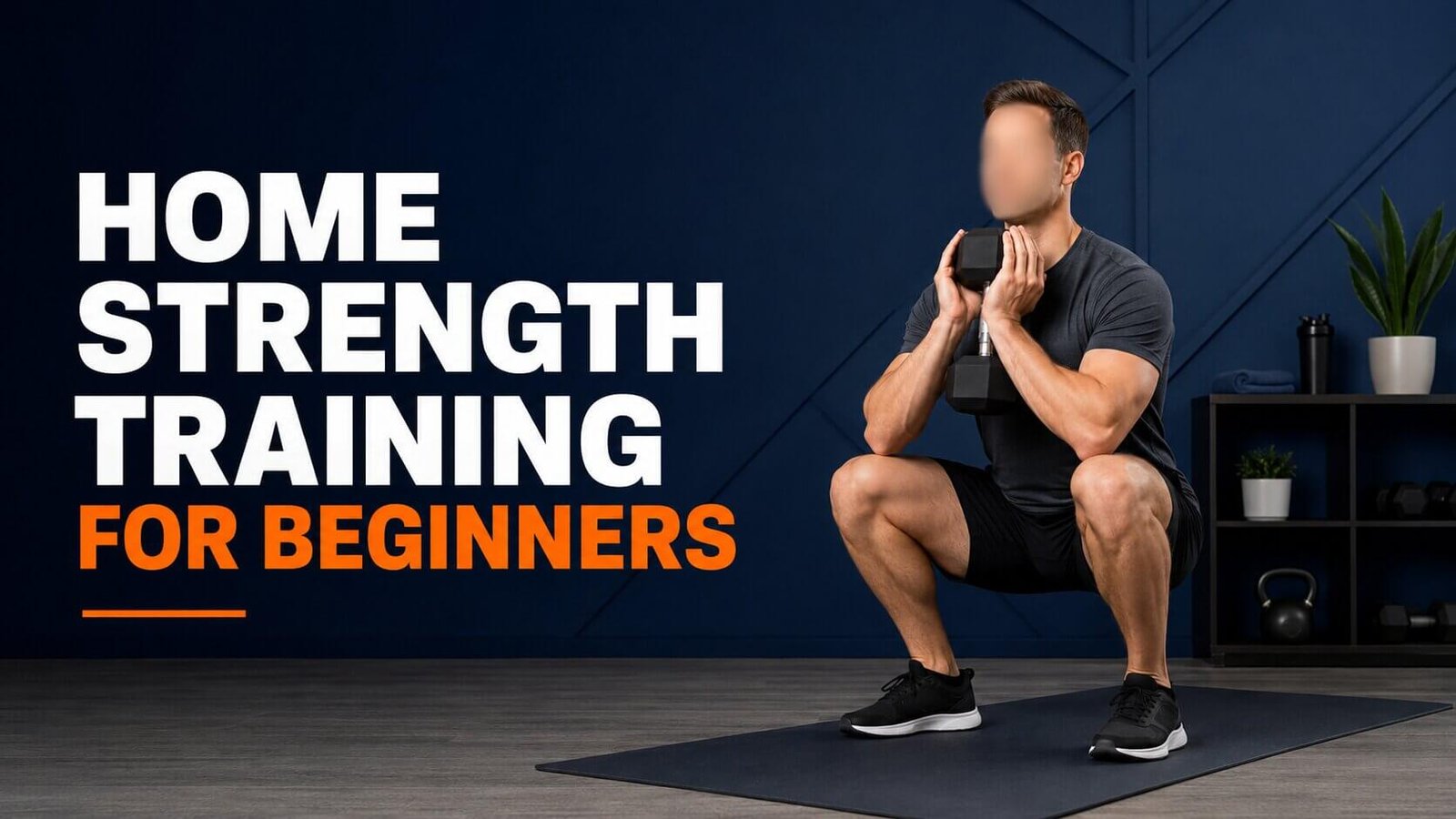
Goblet, Backpack, or Chair Squat
The squat trains the quadriceps, glutes, and other muscles that help you stand, sit, and climb. Use a chair as a depth guide if you are still learning the movement.
Hold the load close to your torso, set your feet in a comfortable position, and lower by bending at the hips and knees. Keep your whole foot supported and let your knees travel generally in the same direction as your toes. Stand without bouncing or shifting onto one side.
Incline Push-Up or Dumbbell Floor Press
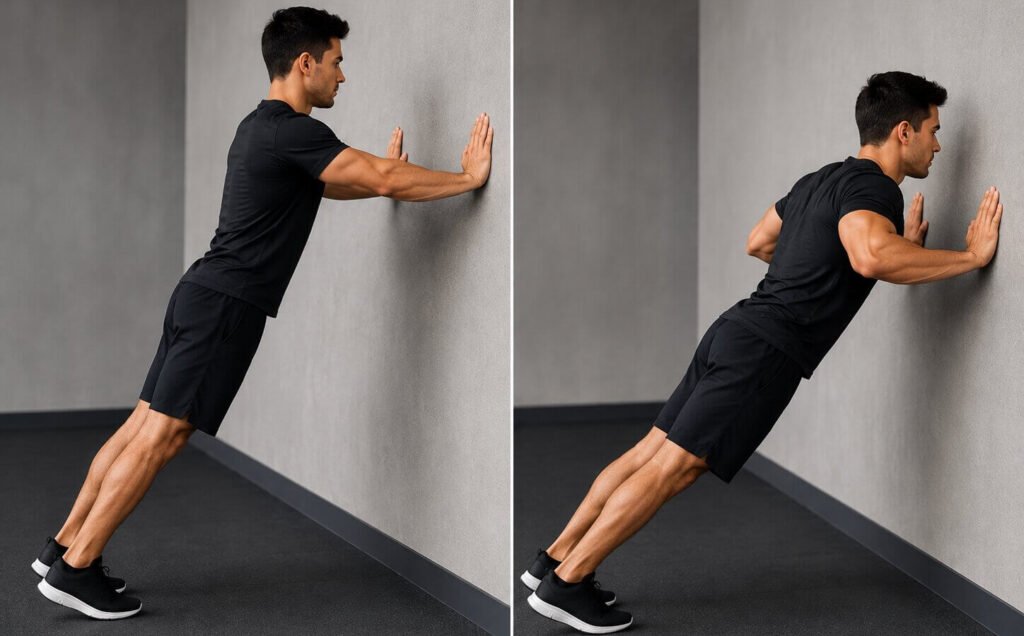
Both exercises train the chest, shoulders, and triceps. Use incline push-ups if you have no weights; use the floor press if dumbbells provide a more convenient progression.
For an incline push-up, place your hands on a stable surface and maintain a straight body position. Lower your chest toward the support and press away. For a floor press, lie on the floor with your knees bent, lower the dumbbells with control until your upper arms gently contact the floor, and press them upward without bouncing.
One-Arm Row or Band Row
Rows train the upper back and arms and balance the pressing work. Keep the resistance controlled rather than twisting your torso to move a heavier load.
For a one-arm loaded row, support one hand on a stable surface, hinge at the hips, and pull the weight toward the side of your torso. For a band row, use a secure setup intended for the product and pull the handles or band toward you while keeping your shoulders controlled.
Romanian Deadlift
The Romanian deadlift trains the hips and the back of the legs. The movement should come mainly from the hips rather than turning into a squat or rounding to reach the floor.
Hold the load close to your legs, soften your knees, and move your hips backward. Stop when you reach a depth you can control, then press through your feet and bring your hips forward to stand. The load does not need to touch the floor.
Dead Bug
The dead bug trains trunk control while your arms and legs move. It should feel controlled rather than fast or exhaustive.
Lie on your back with your hips and knees bent. Slowly lower one heel or extend the opposite arm and leg while maintaining a comfortable trunk position. Reduce the range or move one limb at a time if your back position changes.
Beginner Home Strength Workout B
Workout B uses different lower-body and trunk exercises while repeating the essential push and pull patterns. This provides practice without making both weekly sessions identical.
| Exercise | Sets | Repetitions | Rest |
|---|---|---|---|
| Supported split squat or reverse lunge | 2 | 6–10 per side | 1–2 minutes |
| Push-up variation or dumbbell floor press | 2 | 6–10 | 1–2 minutes |
| Band row or one-arm loaded row | 2 | 8–12 | 1–2 minutes |
| Glute bridge or loaded hip thrust | 2 | 8–12 | 1–2 minutes |
| Optional dumbbell or band overhead press | 1–2 | 6–10 | 1–2 minutes |
| Suitcase hold or bird dog | 2 | 20–30 seconds or 6–10 per side | 45–90 seconds |
Supported Split Squat or Reverse Lunge
These exercises train one leg at a time and challenge balance. Hold a stable counter or chair if support lets you use a smoother, more controlled range.
For a split squat, keep your feet in place and lower vertically through a comfortable range. For a reverse lunge, step one foot backward, lower under control, and return by pushing through the front foot. Use chair squats instead if neither variation is currently manageable.
Glute Bridge or Loaded Hip Thrust
Bridges and hip thrusts train hip extension without requiring a standing hinge. Begin with a bodyweight bridge, then add a stable load across the hips only when the movement is controlled and comfortable.
Press through your feet, lift your hips, pause briefly, and lower slowly. Avoid forcing an exaggerated lower-back arch at the top.
Optional Overhead Press
The overhead press adds direct shoulder and triceps work. It is optional because the push-up or floor press already trains these muscles, and five exercises may be enough for a new trainee.
Press light dumbbells or a suitable band overhead without leaning backward. If you cannot raise your arms comfortably overhead, omit the exercise rather than forcing the range.
Suitcase Hold or Bird Dog
A suitcase hold trains the trunk to resist side bending. Stand tall while holding one dumbbell or a securely loaded bag at your side, then repeat on the other side. side bending.
Use a bird dog if you have no suitable weight. From hands and knees, extend one limb or an opposite arm and leg without rotating your torso.
A Simple Weekly Training Schedule
Start with Workout A and Workout B on nonconsecutive days. This schedule gives you time to recover while allowing each major region of the body to receive strength work twice during the week.
| Day | Activity |
|---|---|
| Monday | Workout A |
| Tuesday | Rest or easy aerobic activity |
| Wednesday | Rest or mobility |
| Thursday | Workout B |
| Friday | Rest or easy aerobic activity |
| Saturday | Optional third session or recreational activity |
| Sunday | Rest |
If you add a third strength day, alternate the sessions. Perform A–B–A in one week and B–A–B in the next. Do not add the third day until two weekly sessions feel repeatable and your recovery is comfortable.
The CDC recommends that adults perform muscle-strengthening activities involving all major muscle groups on at least two days per week. Adults should also work toward at least 150 minutes of moderate-intensity aerobic activity per week, which can be divided into smaller sessions. CDC Adult Activity Guidelines
How Many Sets and Repetitions Should Beginners Use?
Two working sets per exercise and roughly 6–12 repetitions are a practical starting structure. This is not a magical strength range; it is simply manageable for learning technique, measuring progress, and using common home equipment.
Use approximately 6–10 repetitions for squats and presses and 8–12 for rows, hinges, and bridges. Trunk exercises may use repetitions or short timed holds. Different ranges can work, so the quality and challenge of the set matter more than forcing every exercise into one number.
Readers comparing strength and hypertrophy ranges can review this detailed guide to the best rep range for muscle growth and strength.
How Hard Should Each Set Feel?
Finish most beginner sets with approximately two to four controlled repetitions in reserve. The final repetitions should require attention, but your movement should not become jerky or substantially shorter.
Training to momentary muscular failure is not required. ACSM’s 2026 review reports that routinely training to failure and using complex advanced programming did not consistently improve results for the average healthy adult. ACSM, 2026
How Long Should You Rest?
Rest about one to two minutes between most working sets. Take longer after demanding squats, hinges, or loaded unilateral exercises if you cannot begin the next set with steady breathing and good concentration.
Very short rest periods make a session feel harder, but they can reduce the resistance or repetitions you can perform. For strength training, rest long enough to repeat high-quality work.
How to Apply Progressive Overload at Home
Progressive overload means increasing the training challenge as your current program becomes easier. The safest useful progression is usually small, measurable, and applied to one variable at a time.
Use a double-progression method:
- Select a resistance you can perform at the bottom of the target range.
- Keep the same resistance while adding repetitions over several sessions.
- Reach the top of the range for every set with controlled technique.
- Repeat that performance in a second workout.
- Increase the resistance by the smallest practical amount.
- Return toward the lower end of the repetition range.
For example, a dumbbell floor press may progress from two sets of six to two sets of ten. After you repeat two controlled sets of ten with at least two repetitions in reserve, select the next manageable dumbbell weight and begin again near six repetitions.
With a backpack, add one small stable item rather than several at once. With bands, use a slightly stronger band or a setup that provides more tension. With bodyweight exercises, adjust leverage or range—for example, move incline push-ups to a slightly lower stable surface.
Do not add resistance when your range of motion is shrinking, your balance is unreliable, or discomfort is increasing. Improving technique with the same load is also progress.
Exercise Substitutions for Limited Equipment
Use substitutions that preserve the same general movement pattern. Randomly replacing an exercise with an unrelated movement can leave gaps in the routine.
| Movement | Primary option | Alternatives |
|---|---|---|
| Squat | Goblet squat | Backpack squat, chair squat, supported split squat |
| Hip hinge | Dumbbell Romanian deadlift | Backpack hinge, glute bridge, hip thrust |
| Horizontal push | Dumbbell floor press | Wall, counter, or floor push-up |
| Pull | One-arm dumbbell row | Backpack row, resistance-band row |
| Vertical push | Dumbbell overhead press | Band press; optional if unsuitable |
| Trunk | Suitcase hold | Dead bug, bird dog |
No substitution is universally best. Choose the option you can set up safely, perform through a comfortable range, and progress over time.
How to Track Strength Progress
Track the variables that show whether the same exercise is becoming easier or more productive. A simple notebook or spreadsheet is sufficient.
Record:
- Exercise and variation
- Resistance or band used
- Sets and repetitions
- Estimated repetitions in reserve
- Important technique or discomfort notes
Compare several weeks rather than one unusually good or difficult workout. Signs of progress include performing more repetitions with the same resistance, using more resistance for the same repetitions, completing a harder variation, or controlling a larger comfortable range of motion.
Avoid changing the program every time progress looks slow. Day-to-day performance varies with sleep, stress, schedule, and familiarity. Review trends across at least three or four consistent weeks.
Common Home Strength-Training Mistakes
The most common mistakes are using unsuitable resistance, training without a progression plan, and confusing exhaustion with strength development. Each can be corrected without making the program more complicated.
Doing Fast Circuits Instead of Strength Work
Circuits can improve conditioning, but rushing every exercise may limit resistance and technique. Complete controlled sets and take enough rest when strength is the main goal.
Using Resistance That Is Always Too Light
Light resistance can work initially, but repeating effortless sets indefinitely provides little reason to adapt. Increase repetitions, resistance, range, or exercise difficulty when the current work is no longer challenging.
Starting Too Heavy
A heavy load is not useful when it prevents you from learning the movement. Start conservatively and increase only after your current technique is repeatable.
Skipping Pulling Exercises
Squats and push-ups are easy to perform without equipment, but they do not replace rows. Add a band, dumbbell, or safely loaded backpack so the upper back receives direct work.
Taking Every Set to Failure
Failure is not required for beginner progress and can make technique less consistent. Keep several repetitions available during most sets and stop when form begins to change.
Changing Exercises Every Week
Constant variety makes improvement difficult to measure. Keep the main movement patterns stable for at least four weeks unless an exercise is unsafe, uncomfortable, or impossible with your equipment.
Using Unsafe Household Setups
Do not hang your body from ordinary doors, unstable tables, loose sheets, or furniture that is not rated for training. Inspect bands, chairs, backpacks, and floor space before each workout.
Recovery and Safety Guidance
Recovery is part of the program, not time lost between workouts. Leave at least one day between full-body sessions during the beginner phase and reduce the next session if soreness makes normal movement difficult.
Support recovery with regular sleep, balanced meals, and ordinary hydration. Supplements are not required to begin strength training, and extra workouts cannot replace adequate recovery.
Inspect every home setup before use. Move loose rugs and obstacles, use a stable surface, secure backpack compartments, and check resistance bands for cracks or damage. Breathe continuously rather than intentionally holding your breath during repetitions.
This article is general education for healthy adults, not rehabilitation or medical care. The CDC advises people with chronic health conditions to discuss suitable types and amounts of activity with a healthcare professional. CDC: Adding Physical Activity as an Adult
Stop training and seek appropriate care if you experience chest pain, fainting, severe or unusual shortness of breath, or sudden significant pain. Persistent joint or muscle symptoms should not be diagnosed through an online routine.
Frequently Asked Questions
Can Beginners Build Strength at Home?
Yes. Beginners can build strength at home using body weight, bands, dumbbells, or loaded household equipment when the exercises cover the major muscle groups and progress over time.
How Many Days per Week Should Beginners Strength Train?
Start with two nonconsecutive full-body sessions per week. Add an optional third session after the two-day schedule feels manageable and recovery remains comfortable.
Can Bodyweight Exercises Build Strength?
Yes, particularly for beginners. Push-ups, squats, split squats, bridges, and harder bodyweight variations can develop strength, but upper-back pulling and long-term lower-body loading are easier with external resistance.
Do Beginners Need Dumbbells?
No. Bands, a securely loaded backpack, and bodyweight variations can provide a useful starting program. Dumbbells make resistance easier to measure and often simplify long-term progression.
How Heavy Should a Beginner Lift?
Use a resistance that allows the minimum target repetitions with controlled technique and approximately two to four good repetitions remaining. Avoid maximal testing and adjust the load based on your recorded performance.
How Many Exercises Should a Home Strength Workout Include?
About five or six exercises are enough for a beginner full-body session. Include a lower-body knee-dominant movement, a hip movement, a push, a pull, and a trunk exercise.
Should Beginners Train to Failure?
No. Failure is not required for general strength progress. Stop most sets with two to four controlled repetitions available, especially while learning technique.
When Should Resistance Be Increased?
Increase resistance after reaching the top of the target repetition range for every set in two consecutive workouts with controlled technique. Use the smallest practical increase.
Can Strength Training and Cardio Be Done in the Same Week?
Yes. Perform two weekly strength sessions and add walking, cycling, or another aerobic activity on separate days or after shorter strength sessions. Build gradually toward the federal aerobic-activity guidelines.
Practical Recommendations
Start with the minimum program you can repeat consistently. Two weekly workouts, two sets per exercise, and a written training log provide enough structure to learn the movements and begin progressing.
For your first week:
- Choose one safe option for every movement pattern.
- Complete one practice set before each new loaded exercise.
- Perform two controlled working sets.
- Finish each set before technique breaks down.
- Record the exercise, resistance, repetitions, and estimated repetitions in reserve.
- Wait at least one day before the next full-body workout.
Repeat Workout A and Workout B for four to six weeks. Then review your log and change only what needs to change: resistance, repetitions, an exercise variation, or the optional third training day.
Conclusion
Home strength training for beginners does not require a complicated program or a room full of equipment. Two full-body sessions, balanced movement patterns, appropriate resistance, and gradual progression provide a practical foundation.
Begin with Workout A this week using conservative resistance. Record every set, complete Workout B after at least one rest day, and increase the challenge only when your current work is controlled and repeatable.