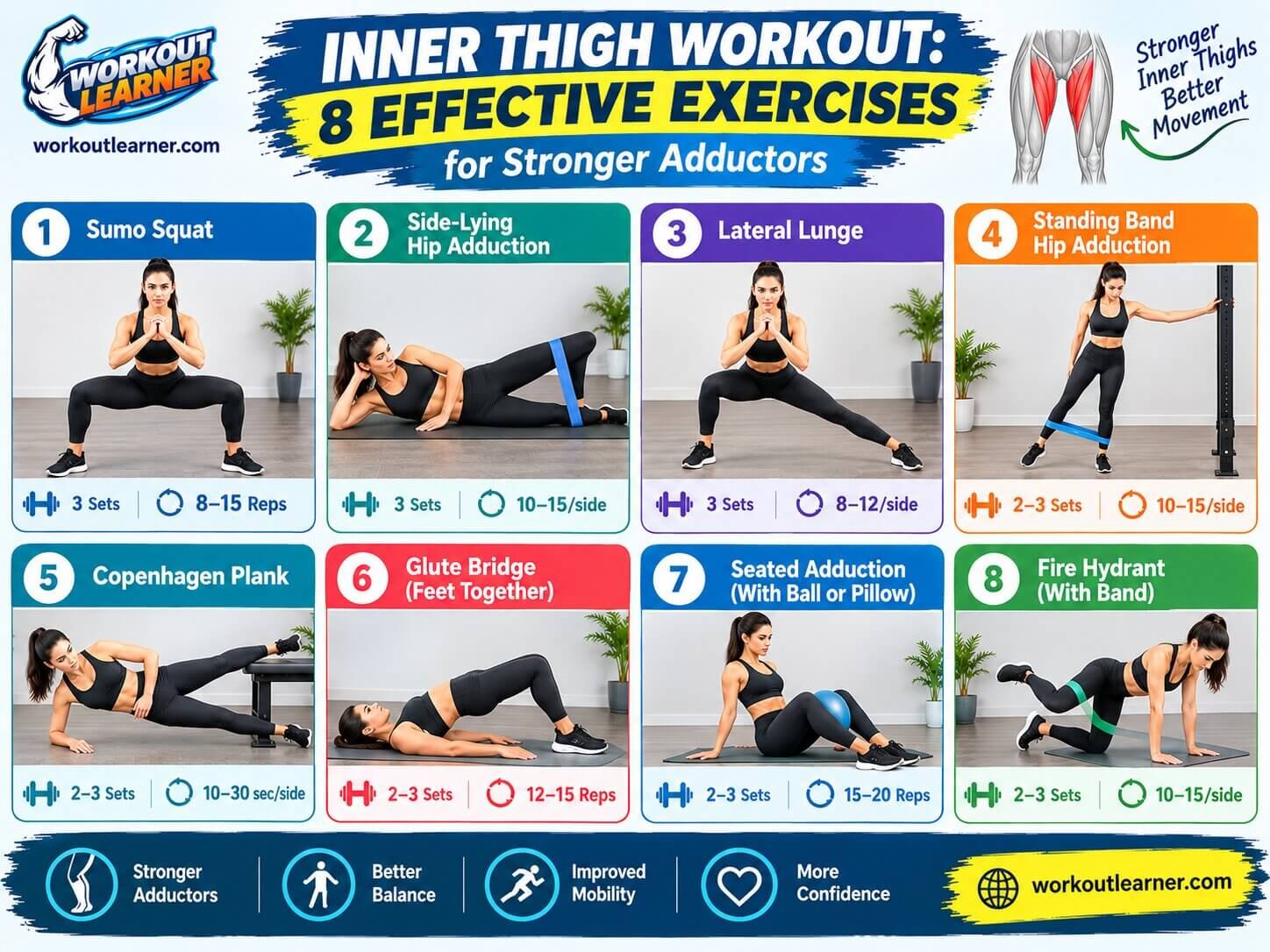
A good inner thigh workout should train the hip adductors—the muscles along the inside of your thighs—through both direct adduction exercises and larger lower-body movements. You do not need a special machine, either. Bodyweight, a resistance band, a dumbbell, and even a pillow can provide useful options.
For beginners, start with simple movements such as side-lying hip adduction, sumo squats, and lateral lunges. As you get stronger, resistance-band adduction and Copenhagen planks can provide a bigger challenge.
These exercises can strengthen and develop your inner-thigh muscles. They should not, however, be treated as a guaranteed way to remove fat specifically from the inner thighs.
Inner Thigh Workout at a Glance
For a simple inner-thigh workout, choose four or five exercises and perform 2–3 sets of each. Beginners can usually start with controlled bodyweight movements before progressing to bands, dumbbells, or harder variations.
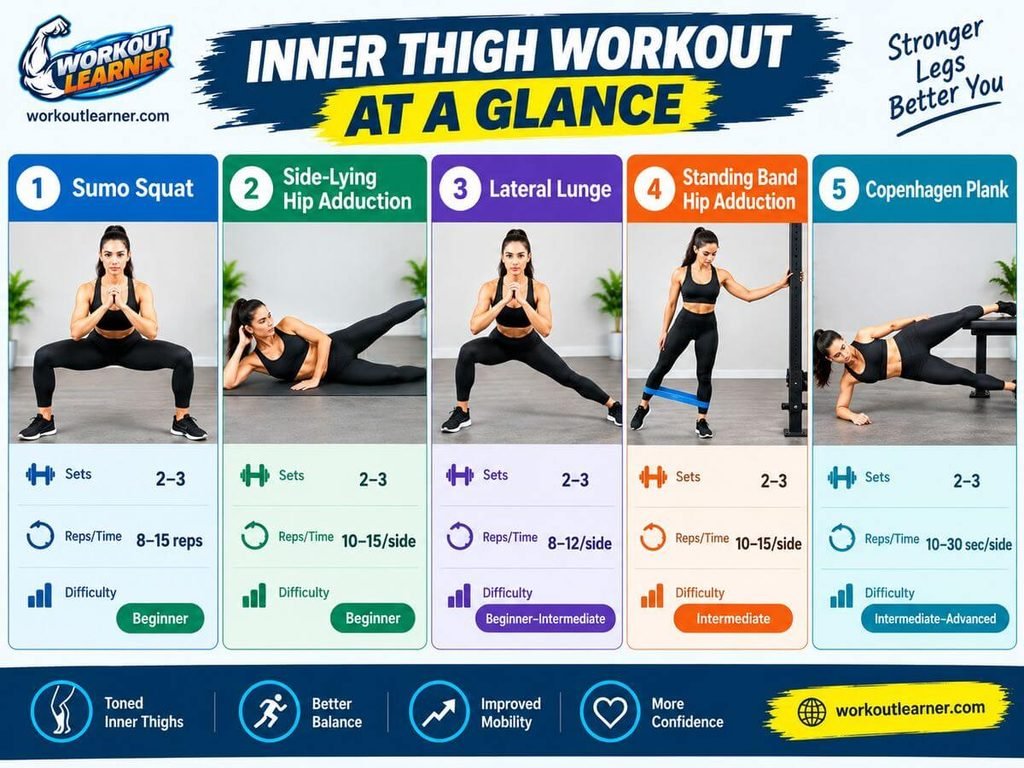
Rest roughly 60–120 seconds between sets when needed. You may need more rest for demanding movements such as loaded squats or Copenhagen planks.
The goal is not to make the workout as fast or painful as possible. Use a resistance and variation that let you maintain good technique while making the final repetitions of each set reasonably challenging.
What Muscles Does an Inner Thigh Workout Target?
An inner-thigh workout primarily trains the hip adductors, a group of muscles that help move your thigh toward the midline of your body. They also contribute to hip stability and several lower-body movements.
The main muscles commonly included in the adductor region are
- Adductor magnus
- Adductor longus
- Adductor brevis
- Gracilis
- Pectineus
Think about bringing your legs toward each other. That movement is called hip adduction, and exercises that load it directly provide one straightforward way to train the inner thighs.
The adductors are not limited to that single action, however. They also contribute during movements such as squatting, lunging, walking, running, and changing direction.
That is why a balanced workout can include both direct adductor exercises and compound leg exercises.
8 Effective Inner Thigh Exercises
The most useful inner thigh exercises range from simple hip-adduction movements to squats, lunges, and Copenhagen variations. You do not need to use every exercise in one session—choose movements appropriate for your experience, mobility, and available equipment.
1. Side-Lying Hip Adduction
The side-lying hip adduction is one of the simplest ways to directly train the inner thigh. It requires no equipment and is especially useful for beginners learning what hip adduction feels like.
How to Do It
- Lie on one side with your bottom leg straight.
- Bend your top knee and place that foot on the floor in front of or behind the bottom leg.
- Keep your hips stacked rather than rolling backward.
- Lift your bottom leg several inches from the floor.
- Pause briefly.
- Lower it slowly and repeat.
Suggested Starting Point
Perform 2–3 sets of 10–15 repetitions per side.
Make It Easier
Use a smaller range of motion and focus on keeping your pelvis still.
Make It Harder
Add an ankle weight or slow the lowering portion of each repetition.
Common Mistake
Do not roll your torso backward just to lift the leg higher. A controlled, smaller movement usually makes it easier to keep the work where you want it.
2. Standing Resistance Band Hip Adduction
Standing band hip adduction directly loads the movement of bringing your leg toward your body’s midline. It also makes progressive resistance easier than most bodyweight-only adduction exercises.
How to Do It
- Anchor a resistance band to a secure point close to floor level.
- Attach or loop the band around the ankle closest to the anchor.
- Stand tall and hold a stable object if necessary.
- Begin with the working leg slightly out to the side.
- Pull it inward and slightly across your body.
- Return slowly against the band’s resistance.
Suggested Starting Point
Try 2–3 sets of 10–15 controlled repetitions per leg.
Technique Tip
Keep your torso relatively still. If your entire body swings during each repetition, use a lighter resistance.
Progression
Move slightly farther from the anchor or use a stronger resistance band once you can perform your current sets with consistent technique.
3. Sumo Squat
A sumo squat, or wide-stance squat, trains several lower-body muscles at once while the adductors help contribute to hip movement and control. Treat it as a compound leg exercise rather than an inner-thigh isolation exercise.
How to Do It
- Stand with your feet wider than approximately shoulder width.
- Turn your toes outward slightly to a comfortable angle.
- Brace your torso.
- Bend your hips and knees together.
- Lower only as far as you can while maintaining control and keeping your feet planted.
- Push through your feet to stand.
Start with your own body weight.
Once that becomes easy, hold a dumbbell or kettlebell in front of your body.
Suggested Starting Point
Perform 2–3 sets of 8–15 repetitions.
Research comparing full and half squats found that 10 weeks of full-squat training increased adductor muscle volume more than half-squat training in a small sample of 17 men. That does not prove that everyone needs to squat as deeply as possible, but it suggests that the adductors can make a meaningful contribution during squatting and that training range of motion can influence muscular adaptations.
Use the deepest range you can control comfortably rather than forcing depth.
4. Lateral Lunge
The lateral lunge trains the lower body in a side-to-side movement pattern and can challenge the adductors as you move into and out of the position.
How to Do It
- Stand tall with your feet together or about hip-width apart.
- Step one foot out to the side.
- Shift your hips toward the stepping leg.
- Bend that knee while keeping the other leg relatively straight.
- Keep the working foot planted.
- Push through the bent leg to return to the starting position.
Suggested Starting Point
Perform 2–3 sets of 8–12 repetitions per side.
Beginner Modification
Do not step as far to the side.
A shorter stance and shallower depth can make the movement easier while you develop mobility, balance, and control.
Common Mistake
Avoid collapsing the knee far inward. Let the knee track naturally in line with the foot.
5. Copenhagen Plank
The Copenhagen plank is a challenging adductor-strengthening exercise in which one leg supports much of your body weight from a bench or similar surface.
It should usually be introduced after easier adductor exercises.
A 2021 systematic review found that Copenhagen adduction training increased eccentric hip-adductor strength in the studies reviewed. Importantly, the evidence primarily involved athletes—particularly male soccer players—so those results should not automatically be applied to every beginner or rehabilitation situation.
Beginner Short-Lever Copenhagen Plank
- Lie on your side next to a sturdy bench.
- Place your top knee rather than your foot on the bench.
- Support your upper body on your forearm.
- Lift your hips from the floor.
- Hold the position while maintaining a straight torso.
- Lower under control.
Suggested Starting Point
Try 2 sets of 10–20 seconds per side.
Progression
Gradually increase the hold time before progressing to a longer-lever version with the ankle or lower leg supported on the bench.
Important
Do not jump immediately to the hardest Copenhagen variation just because you already perform regular planks. The demand on the adductors can be substantially different.
6. Cossack Squat
The Cossack squat combines side-to-side lower-body strength with considerable hip and ankle mobility. It can be useful for experienced exercisers but is not necessary for beginners.
How to Do It
- Take a wide stance.
- Shift your weight toward one side.
- Bend that knee while keeping the opposite leg straighter.
- Sit your hips down and back as far as comfortably possible.
- Keep your working foot firmly on the floor.
- Push back to the center.
- Repeat on the opposite side.
Suggested Starting Point
Perform 2–3 sets of 6–10 repetitions per side.
Beginner Modification
Use a support such as a sturdy post or suspension trainer and reduce the depth.
Never force yourself into a deep position simply to match someone else’s range of motion.
7. Adductor Squeeze
An adductor squeeze is an accessible isometric exercise that requires you to press your knees together against a ball, pillow, or similar object.
It is particularly useful when you are learning how to intentionally contract the inner-thigh muscles.
How to Do It
- Lie on your back with your knees bent.
- Place a small ball or firm pillow between your knees.
- Gently squeeze your knees toward each other.
- Hold the contraction.
- Relax without letting the object fall.
Suggested Starting Point
Perform 2–3 sets of 15–30-second holds.
Progression
Rather than squeezing as hard as possible immediately, gradually increase the effort while remaining comfortable.
For long-term strength development, eventually combine this movement with exercises that allow greater progressive resistance.
8. Dumbbell Sumo Squat
The dumbbell sumo squat gives you a simple way to progressively overload the wide-stance squat once bodyweight repetitions are no longer challenging enough.
How to Do It
- Set up in a comfortable wide stance.
- Hold one dumbbell vertically in front of your body.
- Brace your midsection.
- Squat under control.
- Keep your feet planted throughout the movement.
- Stand by driving on your feet.
Suggested Starting Point
Use 2–4 sets of 8–12 repetitions with a weight you can control.
You do not need to increase the dumbbell every workout. First aim to improve your repetitions and technique. Add load once the top end of your chosen repetition range becomes consistently manageable.
Beginner Inner Thigh Workout at Home
A beginner inner-thigh workout should be simple enough to perform consistently while still giving the adductors a reason to become stronger. Four exercises are enough to start.
Beginner Routine
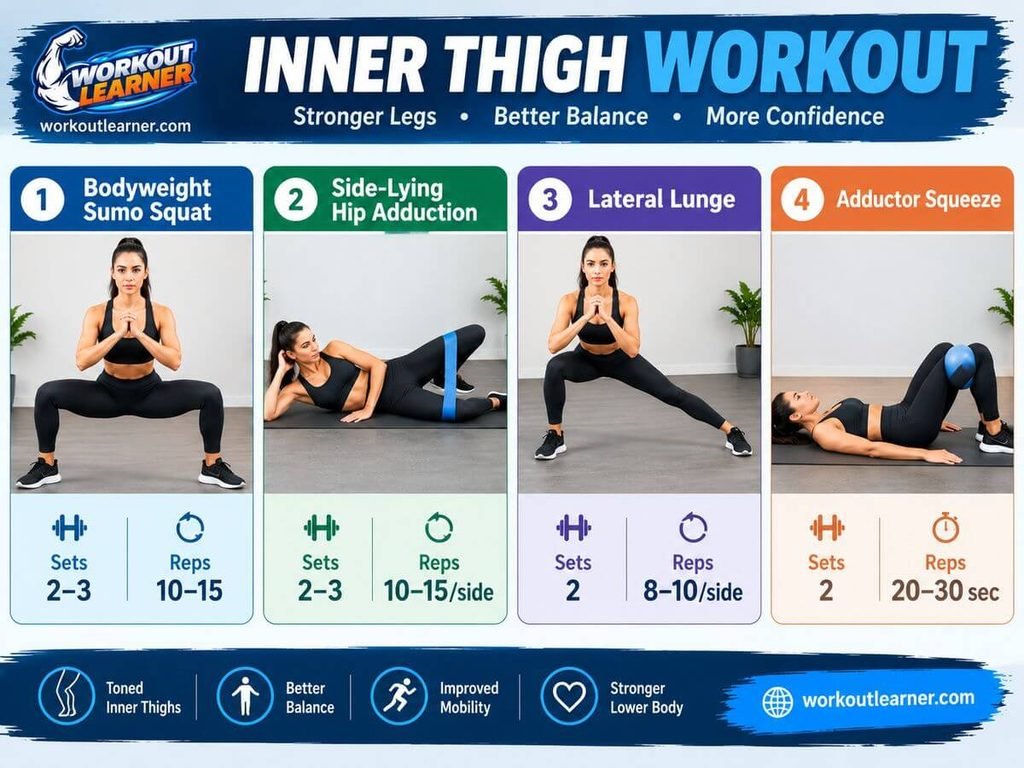
Rest for about 60–90 seconds between sets, or longer if necessary.
How to Start
During your first few sessions, stay toward the lower end of the recommended sets and repetitions.
For example:
- Week 1: 2 sets per exercise
- Week 2: 2 sets with a few more repetitions
- Week 3: Add a third set to selected exercises
- Week 4+: Add resistance or move to a harder variation when appropriate
You do not need to become extremely sore for the workout to be effective.
Intermediate Inner Thigh Workout
An intermediate workout can use greater resistance and more demanding adductor exercises. The goal is still controlled progressive training—not simply making every session harder than the last.
Intermediate Routine
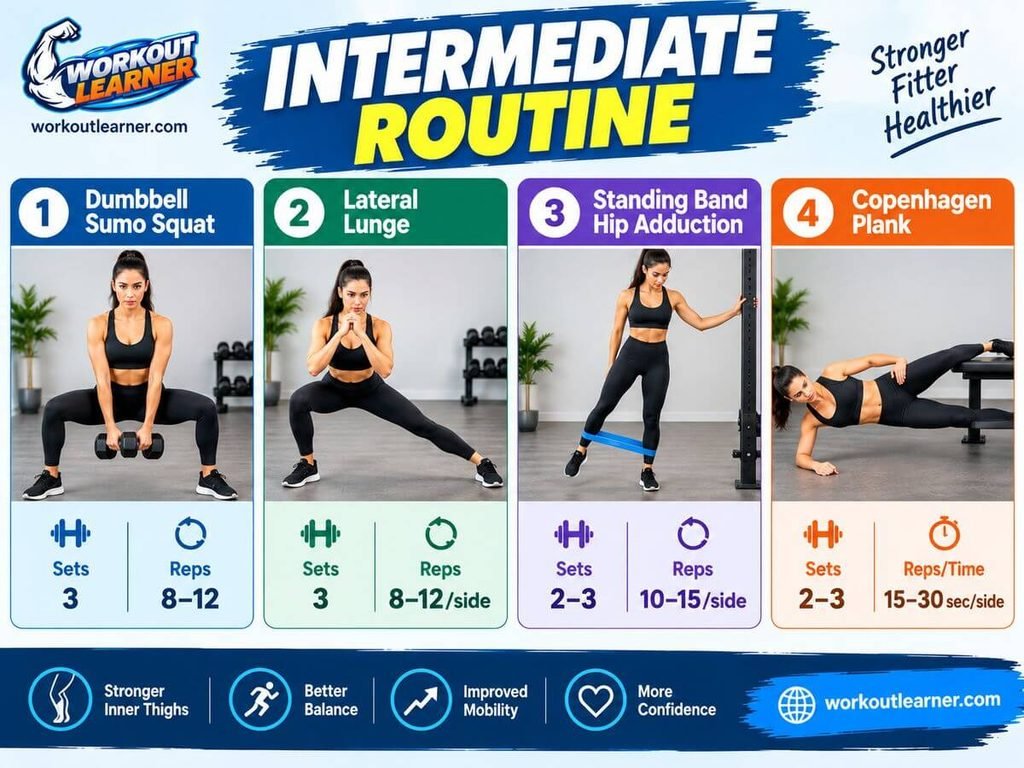
If Copenhagen planks create too much adductor stress, substitute side-lying or band hip adduction.
You can also split these exercises across your regular lower-body sessions instead of creating a separate inner-thigh day.
How Often Should You Train Your Inner Thighs?
For most people, 1–3 inner-thigh training exposures per week is a reasonable practical range. How often you need direct adductor exercises depends on how much work those muscles already receive from squats, lunges, sports, and other lower-body training.
Current U.S. physical activity guidelines recommend muscle-strengthening activity involving the major muscle groups on at least 2 days per week.
ACSM’s 2026 resistance-training guidance similarly emphasizes regularly training the major muscle groups at least twice weekly while prioritizing consistency and individualized programming over unnecessary complexity.
That does not mean your adductors require two dedicated workouts.
For example, you might train them like this:
Monday: Squats + lateral lunges
Thursday: Band adduction + Copenhagen plank
That provides two exposures without creating an entire workout around one small region.
Do You Need to Train Inner Thighs Every Day?
Usually not.
Muscles need time to recover from challenging resistance training. Daily gentle movement is different from performing hard adductor work every day.
If the muscles remain noticeably sore or your performance has dropped, give them additional recovery before another hard session.
How to Progress an Inner Thigh Workout
Progress your inner-thigh workout by gradually making the exercises more demanding while maintaining good form. More repetitions are only one option.
ACSM’s updated resistance-training guidance emphasizes consistent, goal-appropriate resistance training and notes that complicated programming or routine training to complete momentary muscle failure is not necessary for most healthy adults.
Use the following progression order.
1. Improve Exercise Technique
Before adding resistance, make sure you can control the movement without excessive swinging, twisting, or loss of balance.
2. Increase Repetitions
Suppose you start with:
2 sets × 8 lateral lunges per side
Over several workouts, work toward:
2 sets × 12 lateral lunges per side
Once that feels manageable, add another form of progression.
3. Add Resistance
You could:
- Hold a dumbbell during sumo squats
- Add a resistance band to hip adduction
- Use an ankle weight for side-lying adduction
Increase resistance gradually.
4. Increase Range of Motion When Appropriate
A larger comfortable range can increase the challenge of exercises such as squats and lateral lunges.
Do not increase range simply for the sake of going deeper.
Your mobility and control determine an appropriate depth.
5. Add a Set
Going from two sets to three can increase training volume without changing the exercise.
You do not need endless sets, though. More training is useful only when you can recover from it.
6. Use a Harder Variation
Examples include:
- Bodyweight sumo squat → dumbbell sumo squat
- Side-lying adduction → standing band adduction
- Short-lever Copenhagen plank → long-lever Copenhagen plank
- Shallow lateral lunge → deeper or loaded lateral lunge
Progress one variable at a time whenever possible. That makes it easier to tell whether you are actually getting stronger.
Can Inner Thigh Workouts Reduce Inner Thigh Fat?
Inner-thigh workouts can strengthen the muscles beneath the area, but they should not be presented as a guaranteed way to selectively remove inner-thigh fat.
Muscle growth and fat loss are different adaptations.
Training your adductors can make them stronger and potentially increase their muscular development. Changes in body fat, however, depend much more broadly on factors such as total energy intake, physical activity, genetics, and individual fat distribution.
The research around “spot reduction” is more nuanced than the common claim that localized fat loss is absolutely impossible.
For example, a small 2023 randomized trial involving 16 overweight men reported greater trunk fat loss after a program combining abdominal endurance exercise with running than after running alone. However, the study examined the abdomen, involved a very small and specific population, and does not establish that inner-thigh exercises will selectively reduce inner-thigh fat.
So the practical message remains straightforward:
Train your inner thighs to improve the muscles. Use overall nutrition and physical activity strategies when the goal is reducing body fat.
Avoid workouts that promise to “melt,” “burn,” or “erase” inner-thigh fat in a few days.
Common Inner Thigh Workout Mistakes
Most inner-thigh workout problems come from doing too much too soon, relying on very easy exercises indefinitely, or prioritizing sensation over progression.
1. Assuming More Burn Means More Results
A strong burning sensation does not automatically mean an exercise will produce more strength or muscle growth.
Track actual progress instead:
- More repetitions
- More resistance
- Better control
- Greater comfortable range
- Harder exercise variations
2. Only Doing Adductor Squeezes
Squeezes are useful, especially for beginners, but they become difficult to progress precisely.
Combine them with movements such as band adduction, lateral lunges, or loaded squats as you become stronger.
3. Doing Too Much Too Soon
Your adductors can become quite sore after unfamiliar side-to-side or Copenhagen-style training.
Start with modest training volume.
You can always add more later.
4. Letting Your Knees Collapse Inward
During squats and lunges, maintain control and let your knees track naturally with your feet rather than allowing them to collapse uncontrollably toward each other.
5. Forcing Range of Motion
Cossack squats and deep lateral lunges require more mobility than many beginners have.
Use a comfortable depth and build range gradually.
6. Training Inner Thighs Every Day
Harder is not automatically better.
Allow recovery between challenging sessions rather than repeating a demanding adductor workout simply because the muscles are small.
7. Expecting Exercise to Selectively Remove Inner-Thigh Fat
Strength training can improve the underlying musculature. It cannot guarantee where your body will lose fat first.
Inner Thigh Workout Safety Tips
Inner-thigh exercises should create muscular effort, but sudden sharp groin pain is a reason to stop the exercise and reassess.
Groin strains can involve the adductor muscles. Common symptoms can include pain or tenderness along the groin or inner thigh, swelling, bruising, weakness, reduced movement, or difficulty walking.
Stop or Modify the Exercise If You Experience:
- Sudden sharp inner-thigh or groin pain
- A pulling or tearing sensation
- Significant swelling
- Bruising
- Noticeable weakness
- Pain that changes the way you walk
- Symptoms that become progressively worse
Severe pain, substantial swelling or bruising, difficulty bearing weight, or symptoms that do not improve deserve medical evaluation.
If you already have a groin, hip, pelvic, or adductor injury, use guidance from an appropriate healthcare professional rather than treating a general fitness workout as rehabilitation.
Practical Recommendations
For most beginners, inner-thigh training does not need to be complicated.
Use this framework:
- Choose one direct adductor exercise
Example: side-lying or band hip adduction. - Choose one squat or lunge movement
Example: sumo squat or lateral lunge. - Perform 2–3 controlled sets
Keep the first sessions conservative. - Repeat 1–3 times per week
Account for your other lower-body training. - Track one progression variable
Repetitions, resistance, sets, range, or variation. - Give the muscles time to adapt
Do not change your entire program because one workout did not produce a visible difference.
For general health, adults should also include broader physical activity rather than focusing exclusively on one muscle group. Current U.S. guidance recommends 150–300 minutes of moderate-intensity aerobic activity per week plus muscle-strengthening activity on at least two days per week for the greatest health benefits.
Frequently Asked Questions
What Exercise Targets the Inner Thigh Best?
Exercises that directly load hip adduction, such as side-lying hip adduction and standing resistance-band adduction, provide a straightforward way to target the inner-thigh muscles.
There is no single exercise everyone needs.
Compound exercises such as lateral lunges and squats can complement direct adductor work by training the muscles as part of larger lower-body movements.
Do Squats Work Your Inner Thighs?
Yes. The hip adductors contribute during squatting, although squats also train several other lower-body muscles and should not be considered an inner-thigh isolation exercise.
A small 10-week study found increases in adductor muscle volume after squat training, with larger increases in the full-squat group than the half-squat group.
Your squat depth should still be based on your mobility, control, comfort, and training goals.
Do Sumo Squats Work the Inner Thighs?
Sumo squats can involve the adductors while also training the quadriceps, glutes, and other lower-body muscles.
They are useful as part of an inner-thigh program, but direct hip-adduction exercises make sense if specifically strengthening the adductors is a priority.
Can I Train My Inner Thighs at Home?
Yes. You can build an effective home inner-thigh workout with bodyweight exercises such as side-lying hip adduction, sumo squats, lateral lunges, adductor squeezes, and Copenhagen plank progressions.
A resistance band or dumbbell can make progression easier but is not mandatory when starting.
Can You Train Inner Thighs Without Equipment?
Yes. Side-lying adduction, lateral lunges, bodyweight sumo squats, Cossack squats, and certain Copenhagen plank variations require little or no dedicated exercise equipment.
Bodyweight training can still improve strength when the movements provide enough challenge.
How Often Should I Do an Inner Thigh Workout?
A practical starting range is 1–3 times per week, depending on your experience and the amount of adductor work already included in your regular leg training.
You do not necessarily need a dedicated inner-thigh session. Adding one or two exercises to your lower-body workouts is often enough.
Are Copenhagen Planks Good for the Adductors?
Copenhagen planks can strongly challenge the adductors, and research supports their use for improving adductor strength in athletic populations.
They are relatively demanding, however.
Beginners should start with an easier short-lever version or choose a simpler adduction exercise first.
How Long Does It Take to Strengthen Your Inner Thighs?
Strength changes occur gradually, and the timeline varies with your starting level, exercise selection, training consistency, recovery, and progression.
Rather than expecting a specific result by a specific week, track measurable improvements such as
- More repetitions
- More resistance
- Longer Copenhagen holds
- Better control
- Improved range of motion
Those provide better evidence that your training is progressing than soreness or appearance alone.
Can Inner Thigh Exercises Reduce Thigh Fat?
Inner-thigh exercises can strengthen the muscles in the area but cannot guarantee selective inner-thigh fat loss.
Although some small studies have reported localized changes in fat after targeted exercise, the evidence is not strong enough to promise that training one body part will meaningfully reduce fat specifically from that area.
For fat loss, focus on overall physical activity and an appropriate nutrition strategy while using resistance training to maintain or build muscle.
Should Beginners Do Copenhagen Planks?
Beginners do not need Copenhagen planks to build stronger inner thighs.
Start with side-lying hip adduction, squeezes, squats, or band adduction. If those movements become comfortable, a short-lever Copenhagen plank can be introduced gradually.
Conclusion
An effective inner thigh workout does not require dozens of exercises. Train the adductors directly with movements such as side-lying or band hip adduction, then combine them with lower-body exercises such as sumo squats and lateral lunges.
Beginners can start with two or three sets of a few exercises and gradually increase repetitions, resistance, range of motion, or exercise difficulty. More experienced exercisers can add Copenhagen planks and loaded variations for a greater challenge.
Most importantly, train for measurable strength progress rather than chasing soreness or promises of rapid inner-thigh fat loss.
Try This Next
Choose the beginner routine above and use it 1–2 times per week for the next several weeks alongside your regular training. Record your repetitions and exercise variations so you can see whether you are actually progressing.