Resistance bands can train your biceps effectively at home. Start with standing curls, hammer curls, and single-arm curls; use controlled repetitions, keep the band taut, and gradually increase the challenge as you improve.
Bands are not merely a temporary substitute for dumbbells. The American College of Sports Medicine (ACSM) recognizes elastic band and home-based resistance training as effective options for improving strength and muscle size. Bands do feel different from free weights, however: tension generally rises as the band stretches, so good setup and resistance selection matter.
Can Resistance Bands Build Biceps?
Yes. Resistance bands can build biceps because they create external resistance that the elbow flexors must overcome. Muscle growth depends more on sufficient effort, progressive training, and weekly volume than on whether the resistance comes from a band, dumbbell, cable, or machine.
A systematic review comparing elastic resistance with conventional resistance found similar strength improvements across the populations studied. More recent ACSM guidance also concludes that elastic bands and home-based routines can produce meaningful strength and hypertrophy benefits. The research directly comparing band and free-weight biceps growth is limited, so it is more accurate to say bands are a valid training tool, not that they are always better or identical in every situation.
Bands provide variable resistance. A curl usually feels easier when the band is short and less stretched, then harder near the top as the band lengthens. That resistance profile can be useful, but a loose band at the bottom may provide little challenge in the lengthened position. You can improve the setup by shortening the band, widening your stance, or moving farther from the anchor while preserving a comfortable range of motion.
Know the Muscles You Are Training
Band curls mainly train the biceps brachii, with help from the brachialis and brachioradialis. Changing your grip shifts the contribution of these muscles, although all three can remain active during elbow flexion.
- Biceps brachii: The two-headed muscle on the front of the upper arm. It flexes the elbow and helps turn the palm upward, a motion called forearm supination.
- Brachialis: A strong elbow flexor beneath the biceps brachii. It works in all curl variations.
- Brachioradialis: A forearm muscle that assists elbow flexion, particularly with a neutral or palms-down grip.
How grip changes a band curl
| Grip | Hand position | Common exercise | Main practical effect |
|---|---|---|---|
| Supinated | Palms forward or up | Standard biceps curl | Makes full use of the biceps’ elbow flexion and supination roles |
| Neutral | Palms face each other | Hammer curl | Adds substantial brachialis and brachioradialis involvement |
| Pronated | Palms face down | Reverse curl | Increases the challenge for the brachioradialis and forearm muscles |
Shoulder position can also change how a curl feels. A behind-the-body curl starts the biceps in a more lengthened position, while a high-anchor curl places the upper arm near shoulder height. These are useful variations, but claims that a particular hand width or arm angle completely isolates the “long head” or “short head” are too strong. Individual anatomy, comfort, band direction, and technique all influence the exercise.
9 Best Resistance Bands Bicep Exercises
The best band exercises for biceps include a basic supinated curl, a neutral-grip movement, unilateral work, and an optional forearm-focused variation. You do not need all nine exercises in one workout; select two or three that you can perform with stable form.
1. Standing Resistance-Band Curl
The standing resistance-band curl is the best starting point for beginners. It is simple to set up, easy to adjust, and directly trains elbow flexion with a palms-forward grip.
How to do it:
- Place the middle of a tube band or long loop band under both feet.
- Hold the handles or ends with your palms facing forward.
- Stand tall with your ribs and pelvis in a comfortable, stacked position.
- Keep your elbows near your sides and curl your hands toward your shoulders.
- Pause briefly without bending your wrists backward.
- Lower your hands under control until your elbows are comfortably extended.
Form cue: Imagine that your upper arms are resting against the sides of your torso. A small amount of natural elbow movement is not automatically wrong, but avoid driving the elbows forward to finish every repetition.
Make it easier: Use a lighter band or stand on it with one foot.
Make it harder: Widen your stance or grip lower on the band.
2. Resistance Band Hammer Curl
The resistance band hammer curl uses a neutral grip to train the biceps, brachialis, and brachioradialis. It is a useful second exercise in a home arm workout with bands.
How to do it:
- Stand in the center of the band.
- Hold the ends with your palms facing each other and thumbs pointing upward.
- Keep your wrists straight and shoulders relaxed.
- Bend your elbows and curl until you reach a strong but controlled contraction.
- Lower slowly without allowing the band to pull your hands down.
If the band rubs against your hands, use a tube band with handles or hold a folded towel around the band. Do not wrap a band tightly around your hands, because it can make releasing it difficult.
3. Single-Arm Band Curl
A single-arm band curl lets each side work independently. It can help you notice side-to-side technique differences and makes small resistance adjustments easier.
How to do it:
- Secure the band beneath one foot and hold the other end in the hand on the same side.
- Stand upright and create light starting tension.
- Keep the upper arm steady as you curl your palm toward the shoulder.
- Lower with control and finish all repetitions before changing sides.
Begin with the side that feels less coordinated, then perform the same number of good repetitions on the other side. The goal is balanced practice, not forcing both arms to feel identical.
4. Resistance Band Concentration Curl
The concentration curl supports the upper arm against the inner thigh, reducing the opportunity to swing. It is a good choice when you struggle to keep a standard curl controlled.
How to do it:
- Sit near the front of a sturdy chair with your feet apart.
- Place one end of the band under the working-side foot.
- Hold the other end with your palm facing up.
- Rest the back of your upper arm lightly against your inner thigh.
- Curl without lifting the upper arm away from its support.
- Lower until the elbow reaches a comfortable extended position.
Adjust the working length before starting. A band that is completely loose at the bottom or overwhelmingly heavy at the top will make smooth repetitions difficult.
5. Behind-the-Body Band Curl
The behind-the-body band curl trains the biceps from a more lengthened starting position. Use a secure low anchor behind you and begin with modest tension.
How to do it:
- Attach a band to a purpose-built low anchor or a stable post.
- Face away from the anchor and hold the band in one hand.
- Step forward until the band is taut with your arm slightly behind your torso.
- Use a staggered stance and keep your shoulder stable.
- Curl without letting the elbow travel far forward.
- Return slowly to the starting position without forcing the shoulder backward.
Only use a range that feels comfortable at the shoulder and elbow. More stretch is not automatically better. If this setup causes discomfort, use a standing or seated curl instead.
6. High Anchor Band Curl
The high anchor band curls the elbow flexion with the upper arm elevated. It adds variety without requiring heavier equipment.
How to do it:
- Secure the band at or slightly above shoulder height.
- Stand side-on to the anchor and hold the band with the nearer hand.
- Raise the upper arm to a comfortable position near shoulder height.
- Curl the hand toward the side of your head while keeping the upper arm relatively still.
- Extend the elbow slowly without allowing the shoulder to twist.
Use a light band at first. If you cannot keep the anchor side shoulder stable, reduce the tension or choose a different variation.
7. Reverse Curl With a Resistance Band
The reverse curl uses a palms-down grip and places more emphasis on the brachioradialis and forearm muscles, while the biceps continues to assist. Treat it as a complementary exercise, not your only biceps movement.
How to do it:
- Stand on the band and hold the ends with your palms facing down.
- Keep the knuckles in line with the forearms rather than letting your wrists fold.
- Curl by bending the elbows.
- Stop at the highest point you can reach without losing wrist position.
- Lower the band under control.
Reverse curls often require less resistance than standard curls. If your wrists repeatedly bend or the movement feels uncomfortable, lighten the band.
8. Seated Resistance Band Curl
The seated band curl can reduce lower body momentum and make technique easier to monitor. It works well in a small workout space.
How to do it:
- Sit on a stable chair and place the band beneath both feet.
- Hold the ends with your palms facing forward.
- Sit tall without leaning backward.
- Curl both hands toward your shoulders.
- Pause briefly, then lower through a comfortable range.
For alternating resistance band curls, lift one hand at a time while the other arm stays extended. Keep even tension beneath your feet so the band does not slide.
9. Isometric Band Curl Hold
An isometric curl hold develops control and elbow flexor endurance at one joint angle. Use it as a short finisher rather than a replacement for full-range resistance band curls.
How to do it:
- Set up a standing band curl.
- Curl until your elbows are bent to roughly 90 degrees.
- Hold that position for 10–30 seconds while breathing normally.
- End the hold if your shoulders rise, wrists collapse, or you cannot control the band.
- Lower slowly.
A challenging hold can create a strong burning sensation from fatigue, but that sensation is not proof that a workout will produce more growth. Progress still depends on repeatable training, adequate recovery, and gradually increasing demands.
A Beginner Resistance Band Bicep Workout
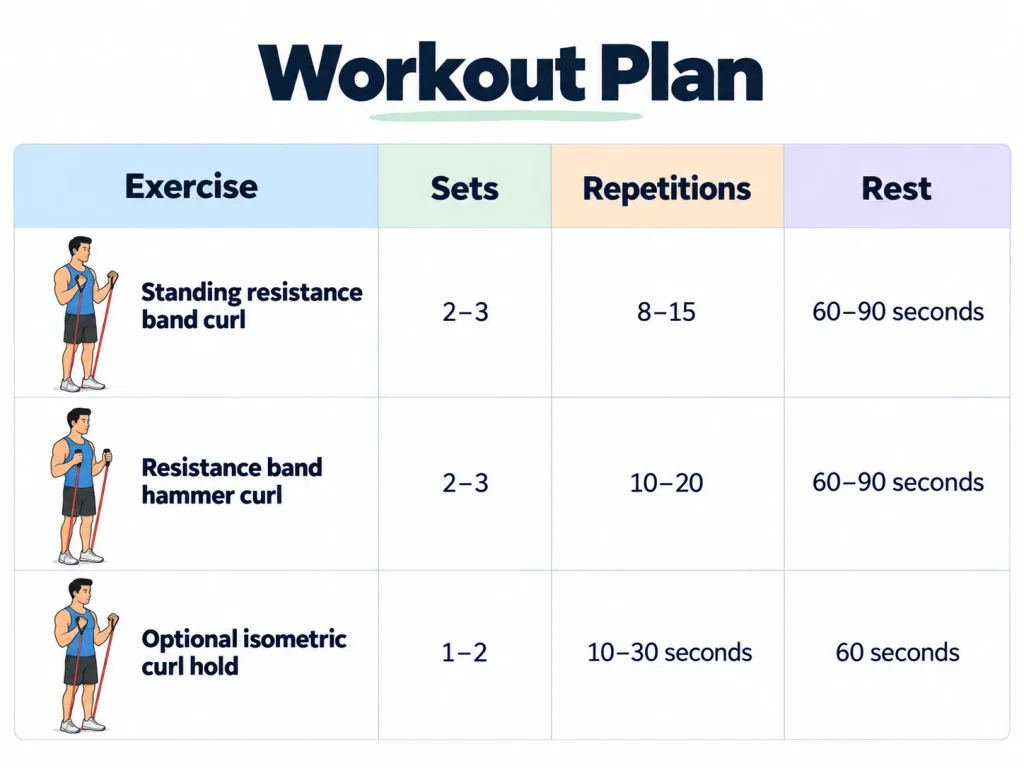
A simple beginner resistance band bicep workout needs only two or three curl variations. Perform it twice per week on nonconsecutive days, leaving time for recovery.
Workout A
Workout B
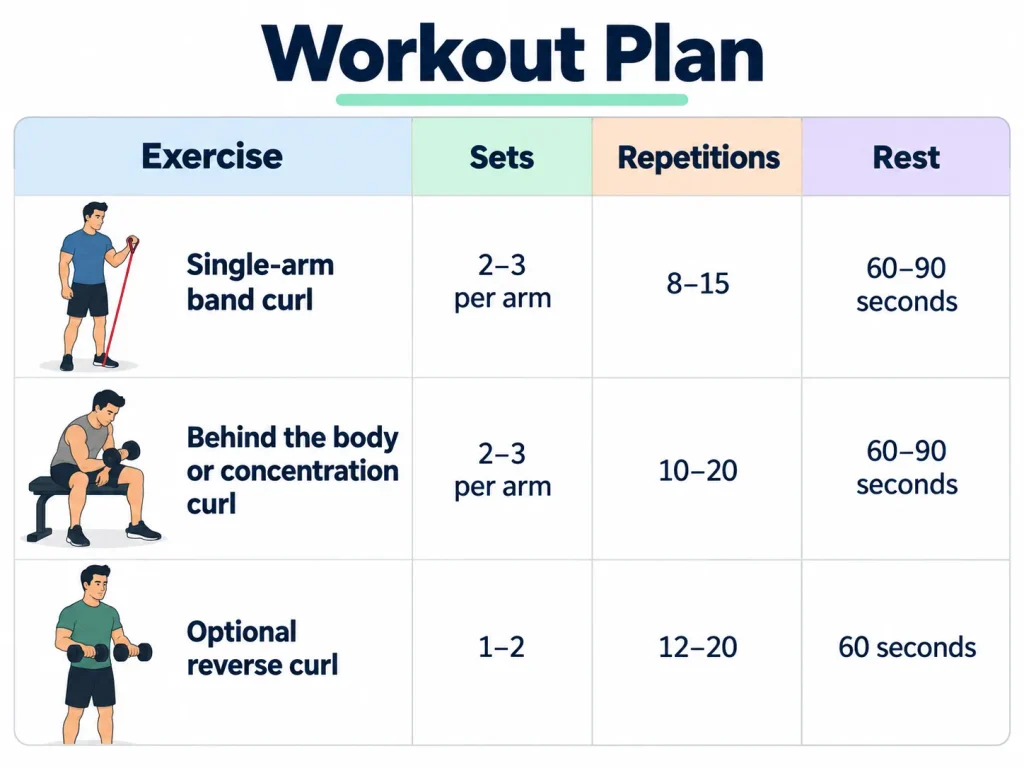
Start with the lower end of the set ranges. If you already perform rows, pulldowns, or chin-up variations, remember that these movements also indirectly train the biceps. You may need fewer direct curl sets.
The 2026 ACSM position stand reports that higher weekly volume around 10 sets per muscle group can optimize hypertrophy for many healthy adults. That is a broad evidence-based target, not a required starting dose or a guarantee of better results for every person. Beginners can make progress with less, then add volume only when they are recovering well and performance has stopped improving.
How hard should each set feel?
Most working sets should end when you could perform approximately one to three more controlled repetitions. This is called one to three repetitions in reserve, or 1–3 RIR.
Stopping at technical failure means ending the set when another repetition would require swinging, substantially shortening the range, or losing wrist and elbow control. You do not need to reach complete muscular failure on every set. Metaanalyses have not found that momentary failure is consistently superior to nonfailure training for muscle growth.
How to Choose the Right Resistance Band
Choose a band that allows a comfortable range of motion while making the final few repetitions noticeably challenging. Color is not a universal measure of resistance, so use the manufacturer’s specifications and your performance rather than assuming every “red” or “heavy” band is equal.
The band is probably too light if:
- You can perform many repetitions beyond your target.
- The final repetitions feel almost the same as the first.
- You stop from boredom rather than muscle fatigue.
- The band remains loose through much of the movement.
The band is probably too strong if:
- You cannot reach a comfortable range of motion.
- You must lean back or swing on most repetitions.
- Your wrists bend substantially to finish the curl.
- The band pulls your hands down during the lowering phase.
- Your elbows or shoulders hurt.
Light bands can still support muscle growth when the set becomes sufficiently challenging. Research on resistance training load suggests hypertrophy can occur across a wide range of loads, although very light resistance may require many repetitions and can be less practical. Heavier resistance is generally more specific to maximizing high-load strength.
How to Perform Resistance Band Curls Correctly
Correct band curls combine a stable setup, a comfortable range of motion, and controlled effort. Use this checklist before adding more resistance.
- Begin with tension in the band, but not so much that you cannot extend the elbow comfortably.
- Keep your feet fully on the band when using a floor setup.
- Hold the wrists mostly straight.
- Curl by bending the elbows rather than leaning backward.
- Use the largest pain-free range you can control.
- Lower deliberately instead of letting the band recoil.
- Breathe continuously; exhale during the hard part if that feels natural.
Full range of motion is a sound default for beginners. Research generally supports a full range of training that includes the lengthened part of a movement for hypertrophy, but the ideal range can differ with the exercise and the individual. Do not force elbow lockout or shoulder extension if it is uncomfortable.
Progressive Overload With Resistance Bands
Progressive overload means gradually making training more demanding as your body adapts. With bands, progress is not limited to changing band colors.
Use one change at a time:
- Add repetitions within your target range.
- Use a slightly stronger band.
- Shorten the working length by widening your stance or gripping lower.
- Move farther from a secure anchor.
- Combine compatible bands according to the manufacturer’s instructions.
- Add one working set.
- Use a single-arm version.
- Improve range of motion and reduce unwanted movement.
- Add a brief pause near the hardest part.
- Slow the lowering phase enough to maintain control.
A simple progression example
Suppose your target is 2 sets of 10–15 standing curls:
- Session 1: 12 and 10 controlled repetitions
- Session 2: 13 and 11
- Session 3: 15 and 13
- Session 4: 15 and 15
Once you reach 15 good repetitions in both sets, increase the tension slightly. Your repetitions may return to 10–12, giving you room to build again.
Track the exercise, band, stance width, repetitions, and sets. Descriptions such as “medium tube band, feet hip-width apart” are often more useful than color alone.
Common Resistance Band Biceps Mistakes
Most band curl problems come from an unsuitable resistance level or a setup that allows momentum. Correcting those issues usually improves the exercise immediately.
Starting with no tension
A loose band can make the bottom of a curl almost effortless. Shorten the band or widen your stance until there is light tension at the start without restricting a comfortable range.
Using the torso to finish each repetition
Leaning backward shifts some of the work away from the elbow flexors. Reduce the resistance, brace gently, and stop the set when you can no longer curl without repeated swinging.
Letting the wrists bend
Excessive wrist extension often means the band is too strong or the grip is insecure. Keep your knuckles roughly aligned with your forearms and use handles when available.
Allowing the band to snap back
The lowering phase is part of the repetition. Control it for about two seconds as a practical cue; exact timing is less important than avoiding a sudden recoil.
Doing every curl variation in one workout
More exercises do not automatically produce better results. Two complementary variations performed well are usually more useful than nine rushed movements.
Training biceps hard every day
Daily direct training is unnecessary for most beginners and may irritate the elbows or interfere with recovery. Two well-spaced sessions are a practical starting point.
Changing exercises but never progressing.
A pump is a temporary sensation, not a record of long-term progress. Track repetitions, tension, sets, and technique so you know whether the workout is improving.
Resistance Band Safety at Home
Inspect the band and every attachment before each workout. Cuts, cracks, punctures, thinning, damaged handles, or a slipping anchor are reasons to stop using the equipment.
- Use a purpose-built door anchor or a genuinely immovable attachment point.
- Follow the band and anchor manufacturer’s instructions.
- When using a door anchor, position it so the exercise pulls the door toward its frame rather than pulling it open.
- Lock the door when possible and make sure nobody can open it during the set.
- Do not use a lightweight chair, table, or other object that could slide or tip.
- Keep your face out of the band’s line of recoil.
- Avoid stretching a band beyond the manufacturer’s stated limit.
- Wear eye protection if the manufacturer recommends it.
Stop the exercise if you feel sharp pain, sudden pain, numbness, or tingling. Persistent elbow, wrist, or shoulder pain deserves assessment by a qualified health professional. People returning from injury or managing a medical condition should ask an appropriate clinician how to modify resistance training.
Practical Recommendations
For an effective home bicep workout without dumbbells:
- Choose one supinated curl and one neutral-grip curl.
- Perform two controlled sets of each exercise twice per week.
- Use a resistance that leaves about one to three good repetitions in reserve.
- Record the band setup and repetitions.
- Add repetitions before making a small increase in tension.
- Include rows or another pulling exercise in a balanced full-body program.
- Review recovery before adding more sets.
The biceps are only one part of the upper body. A balanced resistance program should also train the back, chest, shoulders, triceps, legs, and trunk rather than focusing on curls alone.
Frequently Asked Questions
What are the best bicep exercises with resistance bands?
The best choices for most people are standing band curls, hammer curls, single-arm curls, concentration curls, and behind-the-body curls. A standard curl plus a hammer curl provides a simple and effective starting combination.
Can resistance bands build bigger biceps?
Resistance bands can promote biceps hypertrophy when you train with sufficient effort, complete enough weekly work, recover, and progressively increase the challenge. Results vary with training history, genetics, sleep, nutrition, and consistency, so no routine can guarantee a particular arm size.
How many resistance band curls should I do?
Begin with two or three sets of 8–20 controlled repetitions per exercise. The exact number depends on band tension: lighter bands generally require more repetitions. End the set when only a few technically sound repetitions remain.
How often should I train biceps with bands?
Twice per week on nonconsecutive days is a practical starting point. Biceps also work during rows, pulldowns, and chinups, so count that pulling work when planning direct curls.
Can I train biceps with bands every day?
You can do very light skill practice frequently, but hard daily biceps sessions are not necessary for growth and may limit recovery. Two focused weekly sessions better serve most beginners.
Which resistance band should a beginner use?
Use the lightest band that makes the last few repetitions challenging without shortening your comfortable range or disrupting technique. Because band colors are not standardized, choose by performance rather than color.
What should I do when 20 repetitions become easy?
Increase the challenge slightly. Use a stronger band, shorten its working length, widen your stance, move farther from the anchor, or switch to a single-arm curl. Then return to the lower end of your repetition range.
Are bands as effective as dumbbells?
Both can improve strength and muscle size. Elastic resistance has produced strength gains comparable with conventional resistance in systematic review evidence, and ACSM recognizes both as valid tools. Dumbbells provide a predictable external load, while bands become harder as they stretch; those differences affect exercise feel and progression but do not make either tool universally superior.
Why do I feel band curls mainly in my forearms?
A neutral or pronated grip naturally involves the brachioradialis and other forearm muscles. With a standard curl, check that your palms turn upward, your wrists stay straight, and the band is not too heavy. Forearm effort is still normal because the hands must grip the band.
Why are my biceps not growing with resistance bands?
Common reasons include using a band that is too light, stopping sets too early, failing to progress, performing too little repeatable weekly work, or changing exercises too often to track improvement. Growth also takes time and varies among individuals. Review your training log before adding more exercises.
How long does it take to see results?
There is no reliable universal timeline. Coordination and strength can improve before visible muscle size changes, while measurable hypertrophy usually requires consistent training over time. Evaluate progress across several weeks using workout performance rather than expecting a specific visual change by a fixed date.
What should I do if band curls cause elbow pain?
Stop the painful variation rather than training through it. Try a lighter band, neutral grip, and comfortable range only if these changes are pain-free. Seek guidance from a qualified clinician if pain is sharp, worsening, recurrent, or affects daily activity.
Conclusion
The most useful bicep exercises with resistance bands at home are the ones you can perform safely, control through a comfortable range, and progress over time. Start with standing curls and hammer curls, add a single-arm or lengthened-position variation when appropriate, and keep the routine simple enough to track.
Consistency matters more than collecting endless bicep curl variations. Train the rest of your body as well, allow time for recovery, and increase resistance only after you can complete your current sets with stable technique.
Next step: Try Workout A for four weeks and record your band setup, sets, and repetitions. Then review whether you can add repetitions or a small amount of tension without losing control.