Women can build muscle after 40 by strength training consistently, making exercises gradually harder, eating enough protein and overall food, and allowing time for recovery. Two or three full-body workouts per week are enough for most beginners to make meaningful progress.
Age 40 is not a deadline or a sudden physiological cliff. Muscle gain may become more challenging with age, inactivity, disrupted sleep, or the menopausal transition, but skeletal muscle remains responsive to resistance training. A systematic review of adults ages 40 to 60 found that resistance training improved strength in middle-aged women, although the size of muscle gains differed across studies and menopausal groups (Isenmann et al., 2023).
The goal is not to train like a competitive bodybuilder. It is to give each major muscle group a repeatable growth stimulus, then support that work with food and recovery.
Can Women Build Muscle After 40?
Yes. Women can increase strength and muscle mass after age 40, including during and after menopause. Progress depends more on the training stimulus, nutrition, recovery, health status, and consistency than on a birthday.
Muscle hypertrophy is the enlargement of muscle fibers after repeated training and recovery. Resistance exercise creates mechanical tension; the body then repairs and remodels the trained tissue. With sufficient protein and energy, that cycle can gradually increase lean mass.
Women should not assume they are inherently poor responders. A systematic review found that men and women achieved similar relative increases in muscle size after resistance training, although individual responses varied (Roberts et al., 2020). Women may begin with less absolute muscle mass than men on average, but that does not prevent meaningful relative growth.
Age-related loss of muscle mass and strength, known as sarcopenia, becomes more relevant later in life. Inactivity can accelerate that decline. The National Institute on Aging identifies strength training as an important way to help maintain muscle and physical function as people age (NIA, 2022). Building muscle after 40 is therefore about more than appearance: it supports everyday strength, balance, joint function, and long-term independence.
The Muscle-Building Framework After 40
An effective plan has four parts: challenging resistance training, gradual progression, adequate nutrition, and enough recovery to repeat the work. None needs to be extreme.
Train at Least Twice per Week
Two full-body sessions per week are a strong starting point. Three sessions can provide more practice and distribute weekly work, but a higher frequency is not automatically better.
The Physical Activity Guidelines for Americans recommend muscle-strengthening activity for all major muscle groups on at least two days each week (U.S. Department of Health and Human Services). That is a health recommendation rather than a complete hypertrophy prescription, but it provides a useful minimum.
Use this progression:
| Experience and recovery | Practical schedule |
|---|---|
| New beginner | 2 full-body sessions per week |
| Beginner recovering well | 3 full-body sessions per week |
| Intermediate | 3–4 sessions using full-body or upper/lower training |
| Poor sleep, high stress, or symptom flare | Temporarily reduce sets or train twice weekly |
Leave at least one day between full-body workouts at first. Walking, mobility work, and ordinary daily activity can continue on non-lifting days.
Use Enough Weekly Sets but Build Up Gradually
Begin with about 6 to 8 challenging sets per major muscle group each week. Over time, many women can progress toward approximately 8 to 12 sets if performance and recovery are good.
The American College of Sports Medicine’s 2026 resistance-training guidance identifies about 10 weekly sets per muscle group as a useful general target for hypertrophy, while emphasizing that programs should be individualized (ACSM, 2026). Beginners do not need to start at that total on day one.
Compound exercises count for several muscles. A chest press trains the chest, triceps, and front of the shoulders; a row trains the upper back and biceps. Counting every compound set as a full set for every assisting muscle can overestimate how much work those smaller muscles receive, but it is still important to recognize the overlap.
Research in postmenopausal and older women suggests that higher training volume can produce more hypertrophy than a very low-volume program. However, more sets also create more fatigue, so volume should rise only when current work is no longer producing progress and recovery remains good (Nunes et al., 2024).
Choose a Useful Rep Range
Muscle can grow across a broad range of repetitions when a set is sufficiently challenging. For most beginners, moderate rep ranges are efficient, comfortable to learn, and easy to progress.
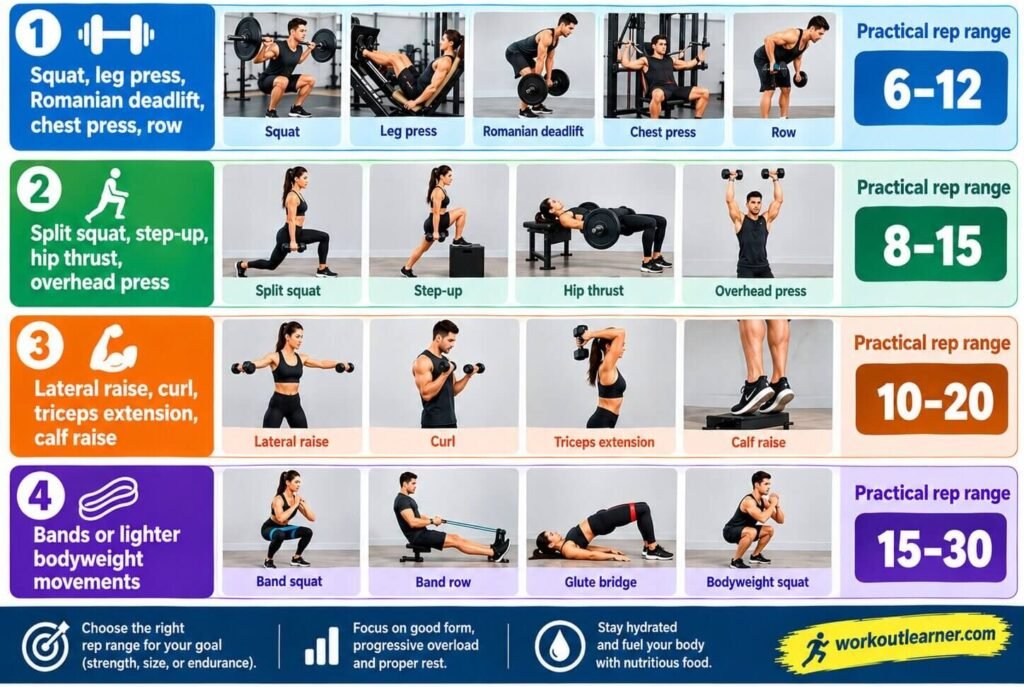
A meta-analysis found similar hypertrophy with lower and higher loads when training was sufficiently demanding, although heavier loads tended to produce greater improvements in maximal strength (Lopez et al., 2021). This means a woman does not need maximal weights to build muscle, but endlessly easy repetitions are unlikely to provide enough stimulus.
Train Hard Without Chasing Failure
Finish most working sets with roughly two or three good repetitions left. The final repetitions should feel slower and demanding, while technique and range of motion remain controlled.
This approach is often described as leaving two or three repetitions in reserve. Training to complete muscular failure is not required on every set. It can add fatigue and make technique harder to maintain, particularly during squats, hip hinges, and unsupported presses. A beginner can occasionally work closer to failure on a stable movement such as a machine curl or band lateral raise. However, it should not be the default for every exercise.
Prioritize Major Movement Patterns
A balanced female muscle-building workout should cover the whole body rather than focusing only on the abs, arms, or glutes.
Include these patterns:
- Knee-dominant: squat, leg press, split squat, or step-up
- Hip-dominant: Romanian deadlift, hip thrust, or glute bridge
- Horizontal push: chest press or push-up
- Horizontal pull: cable, machine, dumbbell, or band row
- Vertical push: overhead press
- Vertical pull: lat pulldown or assisted pull-up
- Supporting work: calf raise, lateral raise, curl, triceps extension, and loaded carry
No single exercise is mandatory. Choose variations that fit available equipment, skill, mobility, and joint comfort.
Beginner Strength-Training Plan for Women Over 40
This three-day, full-body plan trains every major muscle group and can be performed in a gym or adapted for home. New beginners should complete Workout A and Workout B on separate days for the first two to four weeks. Add Workout C only when soreness is manageable and performance is stable.
Workout A
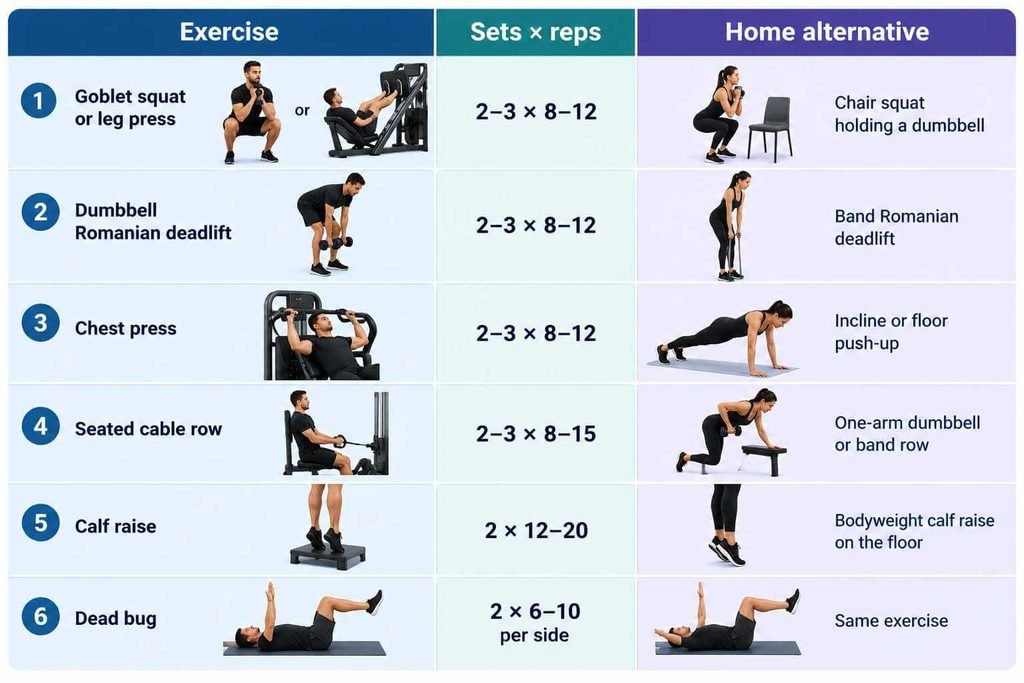
Workout B
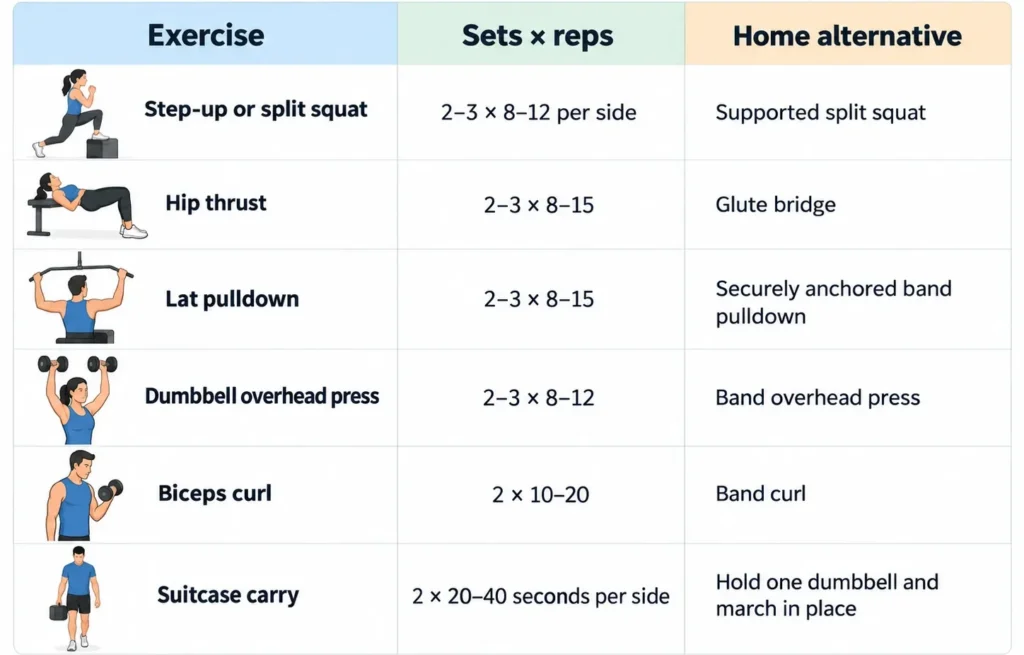
Workout C
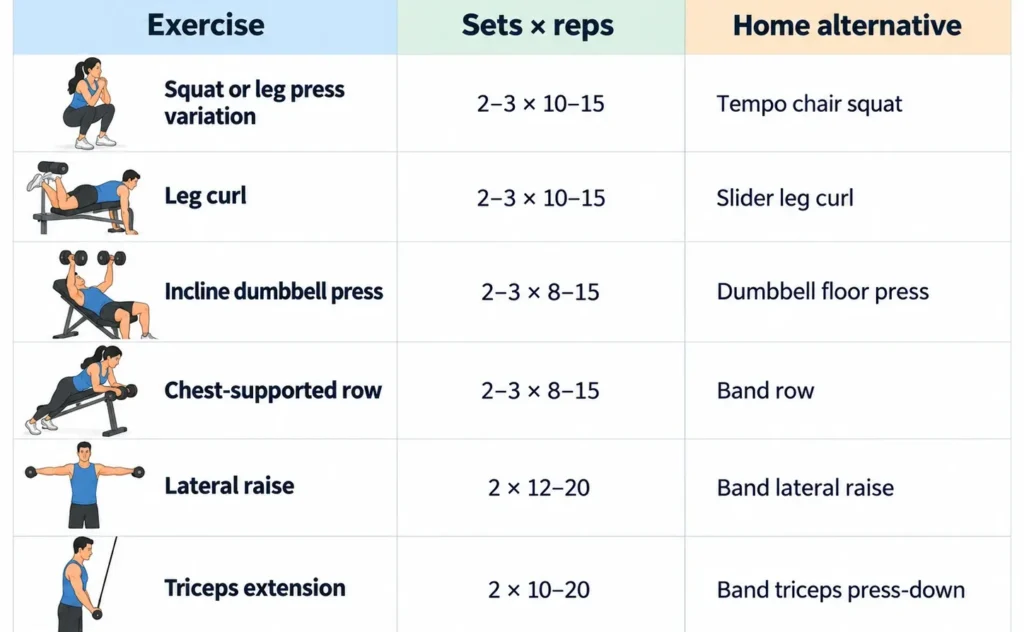
How to Use the Plan
Warm up for five to ten minutes with easy movement, followed by one or two lighter practice sets of the first major exercises. A warm-up should improve readiness, not create fatigue.
Rest about one to two minutes after smaller movements and two to three minutes after demanding compound sets. Longer rest is acceptable if breathing or technique has not recovered.
For a two-day schedule, alternate A and B. For example:
- Week 1: Monday A, Thursday B
- Week 2: Monday B, Thursday A
For a three-day schedule, perform A, B, and C with at least one recovery day between sessions, such as Monday, Wednesday, and Friday.
How to Apply Progressive Overload After 40
Progressive overload means increasing the training challenge as the body adapts. It does not require adding weight every workout or testing maximal lifts.
The simplest method is double progression:
- Choose a resistance that allows the bottom of the target rep range with good technique.
- Keep that resistance until every set reaches the top of the range.
- Increase the resistance by the smallest practical amount.
- Allow repetitions to drop toward the bottom of the range, then build them up again.
Suppose a dumbbell row is programmed for 3 sets of 8 to 12. A log might show 10, 9, and 8 repetitions in the first session. Over several workouts, that may become 12, 12, and 12. The next session, use a slightly heavier dumbbell and begin again around 8 to 10 repetitions.
Other valid forms of progression include
- Using a stronger resistance band
- Increasing range of motion
- Moving from an incline push-up to a lower surface
- Improving control and reducing momentum
- Adding one productive set when recovery is good
- Using less assistance on a split squat or pull-up
If performance falls for several sessions, do not add more work automatically. Review sleep, food intake, exercise technique, stress, and total training volume first.
Nutrition for Building Muscle After 40
Muscle-building nutrition should provide enough protein, carbohydrates, dietary fat, and total energy to support training and recovery. Supplements are optional; ordinary foods can meet the essential needs.
How Much Protein Do Women Over 40 Need?
A practical range for healthy, active midlife women is about 1.2 to 1.6 grams of protein per kilogram of body weight per day. The lower end is a reasonable general target for preserving muscle in midlife, while the upper end aligns with resistance-training research on maximizing lean-mass gains.
The Menopause Society recommends approximately 1.2 g/kg/day for midlife women who want to preserve muscle (The Menopause Society). A large meta-analysis found that protein supplementation produced small additional gains during resistance training, with benefits leveling off around a total intake of 1.6 g/kg/day for healthy adults on average (Morton et al., 2018).
For context, a 150-pound woman weighs about 68 kilograms. A range of 1.2 to 1.6 g/kg equals roughly 82 to 109 grams of protein per day. This is an educational example, not a prescription.
Women with kidney disease or another condition that changes protein requirements should ask a physician or registered dietitian for individualized guidance.
Spread Protein Across the Day
Include a meaningful protein source at breakfast, lunch, and dinner, with a protein-containing snack when useful. This is often easier than trying to catch up with a very large evening meal.
Useful options include:
- Eggs, poultry, fish, lean meat, milk, Greek yogurt, and cottage cheese
- Tofu, tempeh, edamame, lentils, beans, and soy milk
- A protein shake when convenience makes it difficult to meet needs through meals
Protein does not need to be consumed the moment a workout ends. A randomized trial in postmenopausal women found no long-term advantage in lean mass or strength from taking protein immediately after exercise rather than several hours later (de Branco et al., 2020). Total daily protein and consistent training matter more than a narrow “anabolic window.”
Eat Enough to Support Training
Not every woman needs a deliberate calorie surplus. Beginners and women returning after a long break may gain strength and muscle while eating around their usual energy needs, especially when protein intake and training improve together.
A small increase in food may help if a relatively lean trainee stops progressing, feels persistently depleted, or cannot recover despite sensible training and sleep. Instead of aggressive bulking, add a modest serving of nutrient-dense food such as yogurt and fruit, an extra portion of rice with chicken and vegetables, or oatmeal with milk and review performance over several weeks.
Carbohydrates such as oats, rice, potatoes, pasta, fruit, beans, and whole grains support hard training by replenishing muscle glycogen. Dietary fats from olive oil, nuts, seeds, avocado, eggs, and fatty fish supply energy and essential nutrients. Neither carbohydrates nor fats should be treated as the automatic cause of midlife body composition changes.
Simple Muscle-Building Meal Pattern
| Meal | Example |
|---|---|
| Breakfast | Greek yogurt, oats, berries, and nuts |
| Lunch | Chicken or tofu bowl with rice, beans, and vegetables |
| Snack | Cottage cheese and fruit, or soy milk and a sandwich |
| Dinner | Salmon, lean meat, or lentils with potatoes and vegetables |
Portions should match appetite, training demands, health needs, and personal preferences. Hydration also matters, particularly when hot flashes, warm environments, or long workouts increase fluid loss.
Are Supplements Necessary?
No. Protein powder can be convenient, but it does not outperform a diet that already supplies adequate high-quality protein.
Creatine monohydrate is one optional supplement with evidence for improving some strength and performance outcomes when combined with resistance training. Research specifically in women is promising, but evidence varies by age and reproductive stage; data for perimenopausal women remain limited (Smith-Ryan et al., 2025). Adults considering creatine should choose a third-party-tested product and discuss it with a clinician if they have kidney disease, take medications that affect kidney function, are pregnant, or have another relevant medical concern.
Building Muscle During Perimenopause and Menopause
Women can build muscle during perimenopause and after menopause. Hormonal changes may affect body composition, bone density, sleep, joint symptoms, and recovery, but resistance training still improves strength and physical function.
Experiences differ widely. Not every woman over 40 is perimenopausal, and not every menopausal woman needs a special training program. The best adjustment is usually symptom-based rather than age-based.
Consider these practical changes:
- Train earlier or in a cooler room if hot flashes make certain times uncomfortable.
- Reduce one set per exercise during periods of poor sleep or unusual fatigue.
- Choose stable variations—such as a supported split squat or machine press—when joint discomfort affects confidence or technique.
- Keep the training habit during difficult weeks, even if the session is shorter.
- Return to normal volume gradually once performance and recovery improve.
Resistance training has shown beneficial effects on strength and several health-related outcomes in postmenopausal women, although study quality and program design vary (González-Gálvez et al., 2024). It should complement, not replace, medical care for disruptive menopausal symptoms.
Muscle and Bone Health
Resistance training is valuable for both muscle and bone, but bone conditions change how exercise should be selected. A supervised trial found that high-intensity resistance and impact training improved measures of bone strength and physical function in postmenopausal women with low bone mass (Watson et al., 2018). That result does not mean an unsupervised beginner with osteoporosis should copy an advanced high-intensity protocol.
Women with osteoporosis, a previous fragility fracture, significant balance limitations, or a spinal condition should seek individualized guidance. The Bone Health and Osteoporosis Foundation advises people at higher fracture risk to modify or avoid certain high-impact movements and excessive spinal bending or twisting (BHOF). A physical therapist or qualified exercise professional familiar with osteoporosis can help select safe loading patterns.
Recovery: The Part of Training That Allows Growth
Recovery needs vary more between individuals than between birthdays. Women over 40 do not automatically need very long rest periods, but sleep disruption, work stress, low food intake, pain, and menopausal symptoms can reduce readiness.
Track these signals:
- Strength or repetition performance
- Sleep quality
- Energy and motivation
- Soreness lasting longer than expected
- Joint discomfort
- Menopause symptoms
- Ability to complete normal daily activities
Occasional muscle soreness is common after a new exercise. Sharp pain, worsening joint pain, numbness, unusual swelling, chest discomfort, dizziness, or shortness of breath that seems out of proportion to the effort is not a normal muscle-building signal. Stop the session and seek appropriate medical advice.
Most adults should aim for a consistent sleep schedule and enough total sleep to feel alert and recover between sessions. If a poor night leaves coordination or energy unusually low, use lighter resistance, perform fewer sets, or take a rest day.
How to Track Muscle-Building Progress
The best early evidence of progress is improved training performance with stable technique. Appearance alone is slow to assess and can be affected by lighting, hydration, and normal body-weight fluctuations.
Record:
- Exercise name and variation
- Resistance used
- Repetitions completed in each set
- Estimated repetitions left in reserve
- Any pain or significant symptom change
Review the log every four weeks. Progress may appear as a heavier weight, more repetitions, a deeper controlled range of motion, less assistance, or better stability.
Strength often improves before visible muscle size changes because the nervous system becomes more skilled at performing the movements. Some beginners notice better performance within several weeks, while measurable or visible hypertrophy generally requires months of consistent training. There is no reliable universal timeline because training history, genetics, nutrition, sleep, health, and the measurement method all affect the result.
If nothing improves for four to six weeks, use this checklist:
- Are the working sets genuinely challenging?
- Is each major muscle trained at least twice per week?
- Is technique consistent enough to compare sessions?
- Is protein intake adequate and spread across regular meals?
- Is overall food intake supporting energy and recovery?
- Is sleep or stress limiting performance?
- Has the same program been followed long enough to evaluate it?
Change one variable at a time. Adding a set, choosing a slightly harder resistance, or improving meal consistency is easier to evaluate than replacing the entire plan.
Common Muscle-Building Mistakes After 40
Relying on Walking Alone
Walking supports cardiovascular health and daily activity, but it usually does not provide enough progressive resistance for whole-body hypertrophy. Keep walking if you enjoy it, and add dedicated strength training.
Using Resistance That Never Becomes Challenging
Light weights are not useless. They become ineffective when sets stop far before fatigue and never progress. Choose a load that makes the final repetitions demanding without breaking technique.
Starting With Too Much Volume
More work is not automatically better. A high-volume plan can create excessive soreness and make consistency difficult. Start with two sets per movement, then add work only after recovery becomes predictable.
Changing Exercises Every Week
Novelty makes progress hard to measure. Keep the main exercises for at least six to eight weeks unless they cause pain or do not fit the available equipment.
Eating Too Little Protein or Too Little Food Overall
Training provides the signal, while dietary protein supplies amino acids for muscle remodeling. Chronically low food intake can also reduce training quality and recovery. Build regular, balanced meals rather than relying on a supplement after an otherwise inadequate day of eating.
Treating Soreness as Proof of Growth
Soreness shows that an activity was unfamiliar or stressful; it is not a score for workout quality. Progressive performance is a better guide.
Ignoring Persistent Pain or Menopause Symptoms
Training can often be modified, but it should not be used to push through unexplained pain or replace medical care. Adjust the exercise and seek qualified help when symptoms persist.
Safety Guidance Before Starting
Most healthy women can begin with conservative resistance training and gradual progression. Medical or clinical guidance is appropriate before starting or before increasing intensity if you have osteoporosis, a recent fracture or surgery, uncontrolled cardiovascular or metabolic disease, significant balance problems, severe joint pain, or symptoms that make exercise unsafe.
A qualified trainer can be useful when you are uncertain about technique, equipment setup, or load selection. Look for someone who adapts exercises to your ability and health history rather than insisting that every client use the same routine.
Frequently Asked Questions
Is it harder for women to gain muscle after 40?
It can become more challenging for some women because activity, sleep, recovery, health, and hormonal status may change with age. However, age 40 itself does not create a sudden barrier, and women can still gain strength and muscle through progressive resistance training.
How many days should women over 40 lift weights?
Most beginners should start with two full-body sessions per week. A third session can be added when soreness is manageable, sleep and energy are stable, and performance is improving.
How heavy should women over 40 lift?
Use a resistance that makes the final repetitions challenging while leaving about two or three controlled repetitions possible. “Heavy” is relative to the individual; maximal lifting is unnecessary for muscle growth.
Can women build muscle at home after 40?
Yes. Adjustable dumbbells, securely anchored resistance bands, and progressively harder bodyweight exercises can train the whole body. The resistance must become more challenging over time.
Can women build muscle during menopause?
Yes. Menopause may influence sleep, symptoms, body composition, and bone health, but it does not make resistance training ineffective. Adjust workload to current recovery and seek medical support for disruptive symptoms.
How long does it take to build muscle after 40?
Strength may begin improving within several weeks, partly because of better coordination and neural adaptation. Noticeable muscle growth typically takes several months, and the timeline varies considerably.
Should women over 40 take protein powder?
Protein powder is optional. It can make adequate protein intake more convenient, but food sources work well. Select a third-party-tested product and account for allergies, digestive tolerance, and medical advice.
Do women need a calorie surplus to build muscle?
Not always. Beginners and returning trainees may build muscle while eating around their usual energy needs. A modest increase in food can help when a leaner or more experienced trainee is not progressing, and recovery is limited by low intake.
Are resistance bands effective after 40?
Yes, provided the band creates enough resistance and the exercise can be progressed. Bands are especially useful for home workouts, but they must be inspected for damage and anchored securely.
Why am I not gaining muscle after 40?
Common reasons include insufficient training effort, no progressive overload, too little weekly work, inconsistent sessions, inadequate protein or food, poor sleep, and unrealistic timelines. A training log helps identify the limiting factor.
Conclusion
The most reliable way to build muscle after 40 is straightforward: train the whole body two or three times per week, make the work gradually more challenging, eat adequate protein and balanced meals, and adjust training to recovery rather than to age stereotypes.
Begin with a manageable volume and repeat the same core movements long enough to improve them. Strength, technique, and confidence usually change before appearance does. Consistency over months, not a perfect workout or supplement, turns those small improvements into more muscle and better function.
CTA: Choose two nonconsecutive training days for the coming week, record your starting resistance and repetitions, and follow the beginner plan for four weeks before deciding what needs to change.