
A practical 4-day home workout split divides the week into two upper-body and two lower-body sessions. This approach trains each major muscle group twice per week while keeping most workouts to about 30–45 minutes.
The plan below works with dumbbells, resistance bands, a securely loaded backpack, and selected bodyweight alternatives. Begin with modest training volume, practice each movement, and add repetitions before adding more resistance or sets.
4-Day Home Workout Split at a Glance
Train on Monday, Tuesday, Thursday, and Friday, or use any schedule that places a rest day between the two training pairs. Alternating upper- and lower-body sessions lets one area recover while the other trains.
| Monday | Upper A | Horizontal press and row |
|---|---|---|
| Tuesday | Lower A | Squat and hip hinge |
| Wednesday | Rest or easy activity | Recovery |
| Thursday | Upper B | Upper-body variation |
| Friday | Lower B | Single-leg work and hip extension |
| Saturday | Rest or optional easy cardio | Recovery |
| Sunday | Rest | Recovery |
| Program detail | Recommendation |
|---|---|
| Experience level | Beginner to early intermediate |
| Session length | Approximately 30–45 minutes |
| Starting volume | 2 sets for main exercises; 1–2 for smaller movements |
| Typical repetition range | 6–20, depending on the exercise |
| Rest between sets | Approximately 1–2 minutes; longer if technique declines |
| Effort | Stop most sets with 2–3 good repetitions available |
| Initial commitment | Follow consistently for 4–8 weeks before redesigning it |
The American College of Sports Medicine’s 2026 resistance-training update emphasizes consistency, training all major muscle groups at least twice per week, and adjusting programs to the person. It also states that bodyweight, elastic-band, and home-based resistance training can be effective. This upper/lower schedule is one practical application—not the only effective split. ACSM, 2026
What Is an Upper/Lower Workout Split?
An upper/lower split alternates sessions for the upper body with sessions for the lower body. In this plan, each area receives two weekly sessions with different exercise variations.
Upper-body days train the chest, back, shoulders, biceps, and triceps. Lower-body days train the quadriceps, hamstrings, glutes, calves, and trunk. The “A” and “B” sessions repeat the same basic movement patterns without requiring identical exercises.
This structure has two practical advantages at home:
- Each workout contains fewer major movement patterns than a full-body session.
- Limited equipment can be used creatively across two variations without changing the overall plan.
A split itself does not produce results. The useful parts are consistent training, sufficient effort, gradual progression, and recovery.
Who Should Use This 4-Day Home Workout Plan?
This plan suits generally healthy adult beginners and early-intermediate trainees who prefer shorter, more frequent sessions and can reliably train four days per week. It is especially useful when a three-day full-body session feels too crowded.
Consider the plan if you:
- Can maintain four weekly training appointments
- Have at least one dependable pulling option, such as a band, dumbbell, or backpack.
- Want to practice major movement patterns twice each week.
- Recover comfortably between Monday and Thursday or Tuesday and Friday sessions.
- Prefer upper/lower sessions to full-body workouts.
When Is a 3-Day Plan Better?
A three-day plan is better when four sessions do not fit your schedule, you are still learning the basic movements, or soreness and fatigue persist between workouts. Fewer training days can still provide effective weekly training.
Choose three days if you frequently miss the fourth session or feel that training competes with sleep, school, work, sports, or normal responsibilities. A consistent 3-day full-body workout at home is more useful than an ambitious four-day plan followed irregularly.
Equipment and Safe Home Setup
You can perform this split with adjustable dumbbells, resistance bands, a securely loaded backpack, or a combination. Completely equipment-free training is possible for many movements, but progressive upper-back pulling is difficult without a band or load.
Useful items include:
- One or two dumbbells
- A long resistance band or tube band with handles
- A securely closed backpack containing soft, nonbreakable items
- A stable, purpose-appropriate support for balance
- An exercise mat or folded towel for floor work
Inspect bands for cracks, tears, or worn areas before each session. Use only the anchor methods intended by the manufacturer; do not improvise with an ordinary door, loose furniture, or any structure that may move or fail.
Check backpack seams, zippers, and straps. Keep the contents stable and remove hard or sharp objects. For incline push-ups or balance support, use a surface that will not tip or slide.
Use This Five-Minute Warm-Up
A useful warm-up raises your activity level and rehearses the movements ahead without creating fatigue. Complete one controlled round, then perform a lighter practice set before the first difficult exercise.
- March in place for 60 seconds.
- Perform 8 chair squats or bodyweight squats.
- Perform 8 unweighted hip hinges.
- Perform 6 wall or counter push-ups.
- Perform 6 light rows per side when equipment is available.
- Perform 6 bird dogs per side using a comfortable range.
On an upper-body day, add a few easy presses and rows. On a lower-body day, add a few easy repetitions of the first squat, lunge, or hinge variation.
Day 1: Upper A Workout
Upper A pairs a horizontal press with a row, then adds shoulder and arm work. Complete all sets of one exercise before moving to the next unless you already understand how to alternate exercises safely.
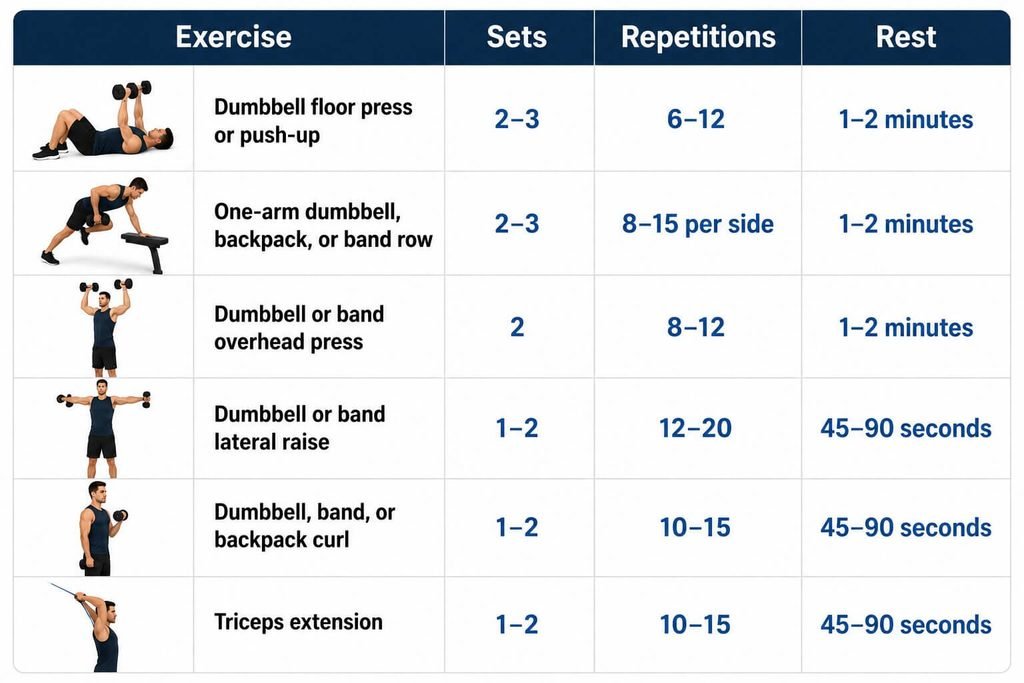
Use a floor press when dumbbells make progression easy, or select a stable push-up height that permits controlled repetitions. During rows, support one hand, hinge at the hips, and pull without rotating your trunk. Press overhead only through a comfortable range; substitute another floor press or incline push-up if overhead movement is uncomfortable.
Keep raises, curls, and extensions controlled. With bands, record the band, grip, stance, and anchor distance so the resistance is repeatable.
Day 2: Lower A Workout
Lower A emphasizes a squat and Romanian deadlift, followed by single-leg, calf, and trunk work. Use a stable support when balance limits the reverse lunge.
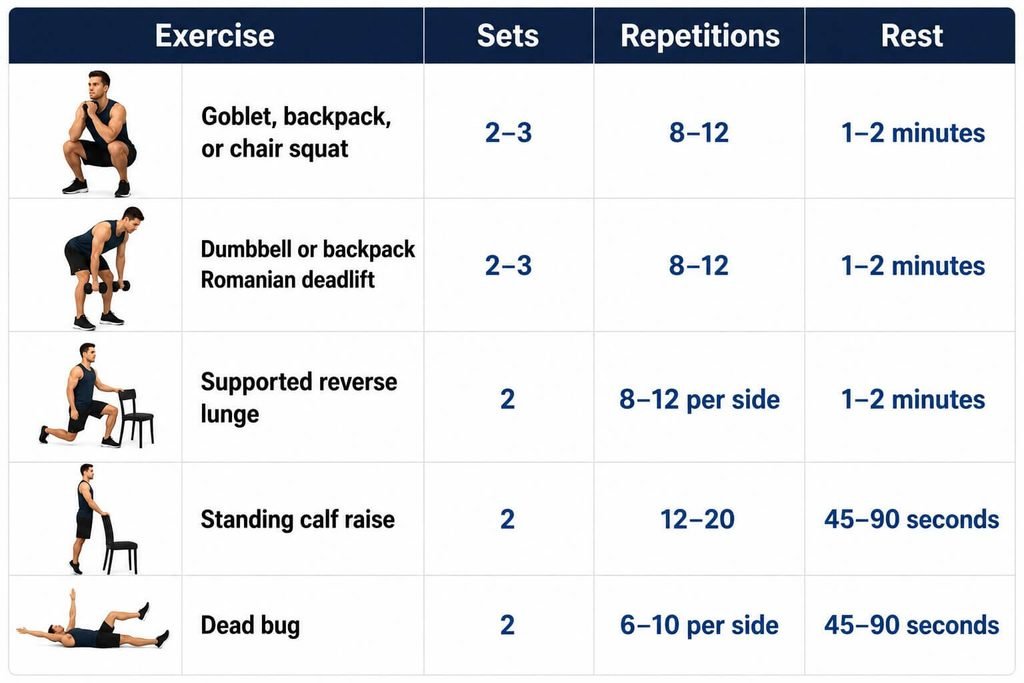
Choose a squat depth you can control while keeping your whole foot supported. Use a chair as a target, not a surface to bounce from. During Romanian deadlifts, keep the load close, soften your knees, and move your hips backward; the weight does not need to touch the floor.
Use a support for reverse lunges or substitute a stationary split squat when balance dominates the movement. Perform calf raises slowly, and shorten the dead bug range if your trunk position changes.
Day 3: Upper B Workout
Upper B repeats pressing and pulling with different variations, then adds rear-shoulder and arm work. Changing the variation provides practice and distributes stress without requiring an entirely new routine.
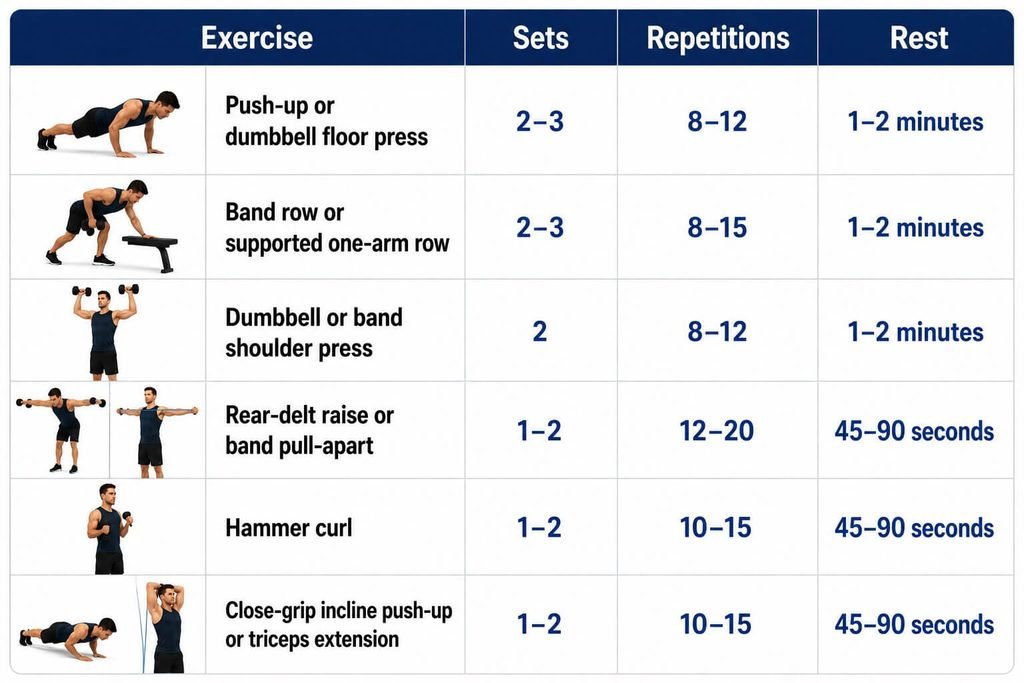
Select a press and row that differ slightly from Upper A—for example, floor presses on Monday and incline push-ups on Thursday. Use light, controlled resistance for rear-delt work. If time is limited, omit the final arm exercises; the presses and rows already train those muscles.
Day 4: Lower B Workout
Lower B emphasizes supported single-leg work and hip extension. It still includes a hinge, calves, and trunk exercise to complete the lower-body week.
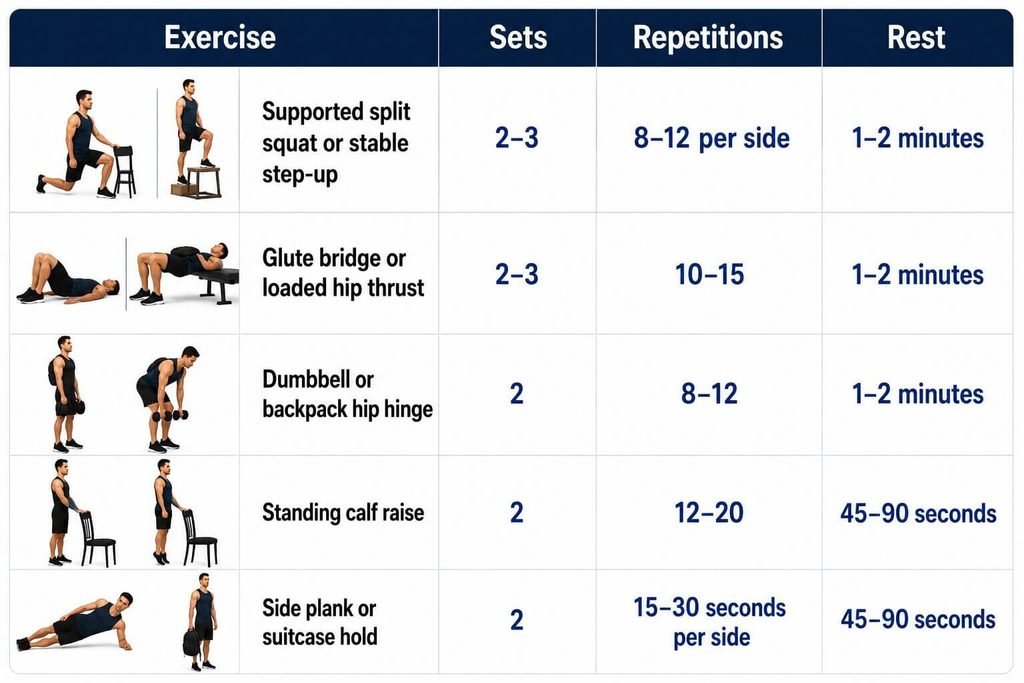
Use a stable support for split squats. Perform step-ups only on a solid, nonslip platform designed to hold your weight—not a chair or improvised object. Begin glute bridges without weight, then add a stable padded load only after you control the movement.
Keep the second weekly hinge controlled rather than chasing extra range. During side planks or suitcase holds, maintain a steady trunk and end the set when your position changes.
Exercise Substitution Table
Substitute exercises by movement pattern, not randomly. The replacement should train a similar action and allow safe, measurable progression.
| Movement | Primary exercise | Easier or equipment-light option | Alternative loaded option |
|---|---|---|---|
| Horizontal push | Dumbbell floor press | Wall or incline push-up | Backpack floor press only if securely held |
| Horizontal pull | One-arm dumbbell row | Light band row | One-arm backpack row |
| Vertical push | Dumbbell overhead press | Light band press | Additional incline push-up if overhead work is uncomfortable |
| Squat | Goblet squat | Chair squat | Front-loaded backpack squat |
| Single-leg squat | Split squat | Supported shallow split squat | Dumbbell reverse lunge |
| Hip hinge | Dumbbell Romanian deadlift | Unweighted hip hinge practice | Backpack Romanian deadlift |
| Hip extension | Loaded glute bridge | Bodyweight glute bridge | Dumbbell hip thrust with secure support |
| Trunk | Side plank | Bent-knee side plank | Suitcase hold |
Avoid household substitutions that create more risk than training value. Doorframe rows, table rows, bedsheet suspension setups, and step-ups on chairs can fail unexpectedly. A resistance band or securely held load is the better solution for most home programs.
How Many Sets, Repetitions, and Minutes of Rest?
Start with two working sets for each main exercise and one or two sets for smaller exercises. Use a repetition range that allows controlled form, and rest long enough to repeat the movement well.
The ranges in the workout tables are targets, not pass-or-fail numbers. If a set calls for 8–12 repetitions, choose a variation or resistance that lets you complete at least eight while stopping before technique breaks down.
Use Repetitions in reserve.
Repetitions in reserve, or RIR, means the number of additional good repetitions you estimate you could have completed. An RIR of 2 means you stopped when roughly two controlled repetitions remained.
For this beginner plan:
- Use about 2–3 RIR for most working sets.
- Stop earlier when learning a new movement.
- Do not continue a set after your safe range or technique changes.
- You do not need to reach muscular failure for the program to work.
The ACSM’s 2026 guidance notes that training to fatigue or failure is not consistently necessary for average healthy adults. Treat RIR as a practical estimate, not a precise measurement. ACSM, 2026
Rest Between Sets
Rest approximately 1–2 minutes for most exercises. Take longer after demanding squats, presses, rows, or single-leg work if breathing or fatigue prevents another controlled set.
Shorter rest is not automatically better. The goal is to complete productive sets, not to turn every strength session into a race.
Four-Week Starting Schedule
The first four weeks should build consistency and movement quality before adding substantial volume. Increase only when you are recovering normally and completing the current work with control.
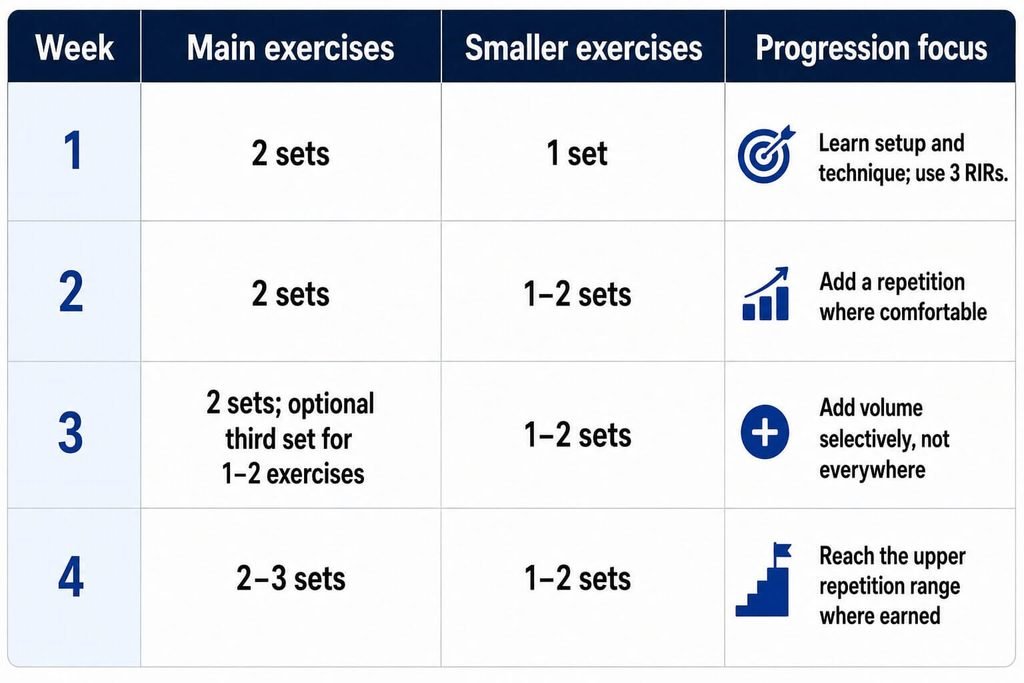
Do not add a third set simply because the calendar reaches Week 3. Keep two sets when soreness is persistent, performance declines, or four sessions already feel difficult to sustain.
How to Progress the Workout
Use double progression: first add repetitions within a range, then increase resistance after you consistently reach the top. This method works with dumbbells, bands, and loaded backpacks.
For an exercise prescribed for 2 sets of 8–12:
- Select a load or variation you can perform for 8 controlled repetitions with 2–3 RIR.
- Keep the same setup and add one repetition to one or both sets over future sessions.
- Reach 12 repetitions on both sets while maintaining the target effort.
- Repeat that performance in the next matching session.
- Increase resistance by the smallest practical amount.
- Return toward 8 repetitions and build again.
When weight cannot increase in small steps, progress by tightening band tension, adding a small soft item to a backpack, using a harder push-up angle, increasing the range you can safely control, or slowing the lowering phase. Change only one variable at a time so you know what improved.
Record the exercise, resistance or variation, sets, repetitions, and approximate RIR. A simple log makes progress visible and prevents accidental changes from week to week. For more detail on choosing repetitions, see this guide to rep ranges for strength and muscle growth.
Can You Add Cardio to a 4-Day Split?
Yes. Add moderate cardio in amounts that do not interfere with recovery or make the four strength sessions unsustainable. Easy walking, cycling, or similar activity can fit on rest days or after a shorter strength session.
The U.S. physical activity guidelines recommend that adults work toward at least 150 minutes of moderate-intensity aerobic activity per week, or 75 minutes of vigorous activity, plus muscle-strengthening activity on at least two days. Inactive adults can begin with smaller amounts and build gradually. CDC adult activity guidelines
Treat those figures as overall public health targets, not a requirement to add a large amount immediately. If you are new to both cardio and strength training, establish the workout routine first and increase total activity gradually.
Recovery and Safety Guidance
Recovery determines whether four weekly sessions remain productive. Maintain regular meals, hydration, and enough sleep for your normal health and daily responsibilities; avoid turning the plan into an endurance challenge.
Use this recovery checklist:
- Keep Wednesday and Sunday free from hard resistance training.
- Repeat a muscle group only after performance and normal movement have recovered.
- Reduce a set or use an easier variation after unusually demanding days.
- Keep at least 2–3 RIR when soreness or coordination is worse than usual.
- Replace a workout with rest when illness or unusual fatigue affects safe movement.
Some muscle effort and temporary mild soreness may occur, but sharp pain, chest pain, faintness, or unusual shortness of breath are not progression signals. Stop the session and seek appropriate medical care for concerning symptoms. If you have an injury, chronic condition, are pregnant, or have been advised to limit exercise, ask a qualified healthcare professional for individualized guidance before using this general program.
Common Mistakes to Avoid
The most common problems are starting with too much work, changing exercises too often, and using unstable household equipment. A simple routine performed consistently is easier to evaluate and progress.
Adding Every Optional Set Immediately
Three sets for every exercise can turn a manageable plan into excessive starting volume. Begin at the bottom of the set range and add only where recovery and schedule allow.
Taking Every Set to Failure
Repeated failure training can increase fatigue and make technique harder to maintain. Stop most sets with controlled repetitions available; reserve difficult efforts for later, after you have learned the movement and can judge effort reliably.
Turning A and B Days Into Unrelated Workouts
Variety is useful only when the plan remains measurable. Keep the same core movements for several weeks and use one or two planned variations, rather than selecting a new online workout every session.
Ignoring Pulling Exercises
Push-ups and squats are accessible, but a balanced upper-body plan also needs pulling. Use a dumbbell, backpack, or suitable resistance band rather than relying only on pressing. This home resistance-band guide explains additional band options.
Progressing Everything at Once
Adding repetitions, resistance, sets, and harder variations simultaneously makes fatigue difficult to manage. Adjust one factor, observe the next one or two sessions, and continue only when movement quality remains stable.
Forcing a Four-Day Schedule
Four days are not superior when the fourth session is repeatedly missed. Use a beginner home workout routine or three-day plan when it fits your week better.
Practical Recommendations
Start the split with conservative volume, use repeatable equipment setups, and track only the information needed to make the next session slightly better. The following checklist keeps the plan simple.
- Choose your four weekly time slots before the first session.
- Select one safe option for every movement in the tables.
- Begin with two sets for main movements and one set for optional arm or shoulder work.
- Write down repetitions and resistance after each exercise.
- Add repetitions before load.
- Keep most sets at approximately 2–3 RIR.
- Review the plan after four weeks, not after every workout.
- Move to three days if recovery or scheduling is consistently poor.
Frequently Asked Questions
Is a 4-Day Home Workout Split Effective?
Yes. A four-day home split can effectively improve strength and general fitness when it trains all major muscle groups, uses sufficient resistance and effort, and progresses over time. ACSM recognizes home-based, bodyweight, and elastic-band resistance training as effective options for many adults.
Is Upper/Lower the Best 4-Day Workout Split?
Upper/lower is one of the most practical four-day structures because it trains each area twice weekly and distributes exercises across shorter sessions. It is not universally best; the best split is one that covers the major muscle groups and fits your recovery and schedule.
Can a Beginner Train Four Days per Week?
Yes, but a beginner should start with low volume and avoid four consecutive training days. Two or three days may be easier while learning technique, and there is no need to advance to four days unless it improves consistency or session length.
Is a 4-Day Split Better Than a 3-Day Full-Body Plan?
Neither is automatically better. Four days offer shorter, more focused sessions, while three full-body days require fewer weekly appointments. Choose based on schedule, recovery, and which format you can follow consistently.
Can I Do This With One Pair of Dumbbells?
Yes, although one fixed pair may be too light for some lower-body exercises and too heavy for smaller upper-body exercises. Use bodyweight variations, bands, a backpack, slower controlled repetitions, or different repetition ranges to bridge the gap.
Can Resistance Bands Replace Dumbbells?
Bands can replace dumbbells for rows, presses, lateral raises, curls, triceps work, squats, and hip hinges when the setup is safe. Because resistance changes as a band stretches, track the exact band, grip, stance, and anchor distance.
Can I train upper and lower body on consecutive days?
Yes. Training the upper body on Monday and the lower body on Tuesday is the intended structure because the primary muscle groups differ. Keep Wednesday as a recovery day before repeating the pair.
How Many Exercises Should Be in Each Workout?
Five or six exercises are enough for this plan. The first two or three movements perform most of the work; smaller shoulder, arm, calf, and trunk exercises complete the session but can be reduced when time or recovery is limited.
How Long Should Each Workout Take?
Most sessions should take approximately 30–45 minutes after you learn the setup. Longer rest periods, single-arm exercises, and equipment changes may extend the session.
When Should I Increase the Weight?
Increase resistance after reaching the top of the prescribed repetition range on every set with controlled technique and about two repetitions available, then repeat that result in the next matching session. Use the smallest practical increase.
Can I Do Cardio on Rest Days?
Yes. Easy or moderate cardio can fit on rest days if it does not impair lower-body recovery. Begin with a manageable amount and build gradually rather than adding several hard sessions at once.
How Long Should I Follow This Routine?
Follow it for at least four to eight consistent weeks before making major changes, unless pain, equipment limitations, or poor recovery require an earlier adjustment. Continue longer while performance improves and the schedule remains sustainable.
Conclusion
A 4-day home workout split works best when it makes training simpler: two upper-body sessions, two lower-body sessions, modest starting volume, and one clear progression method. It does not require a gym or a constantly changing exercise list.
Choose safe variations, begin with two sets, keep controlled repetitions available, and record each session. After four weeks, add work only where performance and recovery support it. If four days become difficult to maintain, move to a three-day schedule rather than abandoning the routine.
Next step: Put the four sessions on your calendar, choose one substitution for each exercise you cannot perform with your current equipment, and record your first week as a baseline.