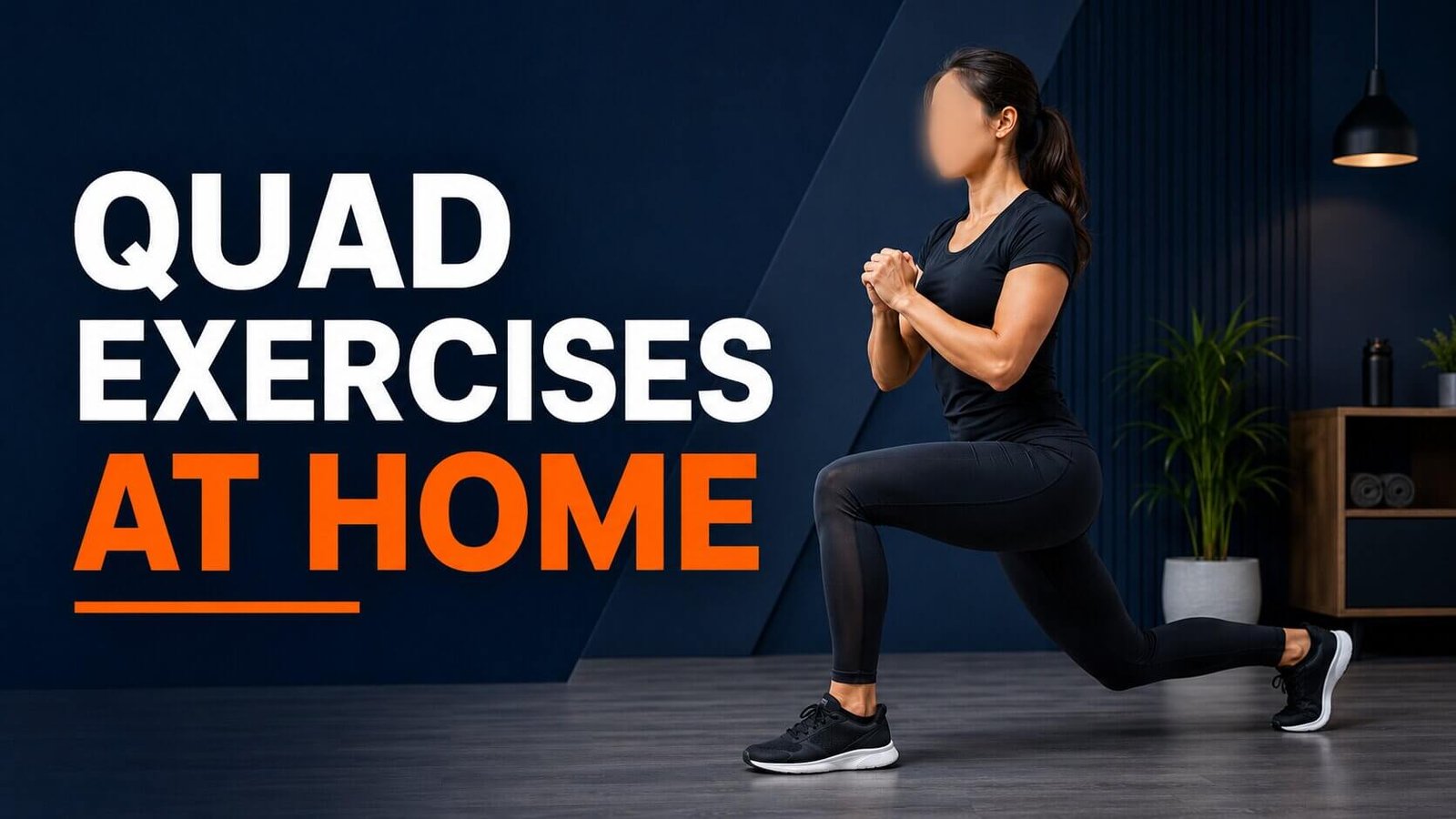
You can strengthen your quads at home with squats, split squats, lunges, step-ups, wall sits, and band knee extensions. Beginners can start with a chair and bodyweight, then progress through more range, slower repetitions, unilateral exercises, or a loaded backpack.
The 10 exercises below include bilateral, single-leg, dynamic, and isometric options. You do not need to perform every movement in one workout; choose three or four that match your ability and equipment.
Safety note: This guide is for generally healthy adults, not rehabilitation for a knee injury or medical condition. Stop if an exercise causes sharp or increasing pain. Seek medical care for severe pain, sudden swelling, deformity, instability, or an inability to bear weight.
What Are the Quadriceps?
The quadriceps are the large muscles at the front of the thigh. Their main shared function is knee extension—straightening the knee—while the rectus femoris also assists with hip flexion.
The traditional four-part description includes:
- Rectus femoris: Runs along the front of the thigh and crosses both the hip and knee.
- Vastus lateralis: Located toward the outside of the thigh.
- Vastus medialis: Located toward the inside of the thigh.
- Vastus intermedius: Lies beneath the rectus femoris.
They help with standing, stairs, squatting, walking, running, and jumping while working with the glutes, hamstrings, calves, hips, and trunk.
The Cleveland Clinic quadriceps overview also identifies knee extension as their primary purpose.
Can You Strengthen Your Quads at Home?
Yes. Bodyweight and simple household resistance can strengthen the quadriceps when an exercise is sufficiently challenging and progressed over time. A gym leg extension or leg press machine is convenient but not essential.
Start with about two controlled reps in reserve. At the top of the target range, progress through the following:
- More comfortable range, slower lowering, or a pause
- Split-stance or single-leg work
- More reps or one set
- A loaded backpack, dumbbells, or resistance band
ACSM’s 2026 position recognizes bodyweight, band, and home programs as effective options and emphasizes consistency and individualization. ACSM guidance
When bodyweight squats become easy, use a harder variation or add resistance.
10 Effective Quad Exercises at Home
Choose exercises based on control, knee comfort, and equipment.
1. Chair Squat
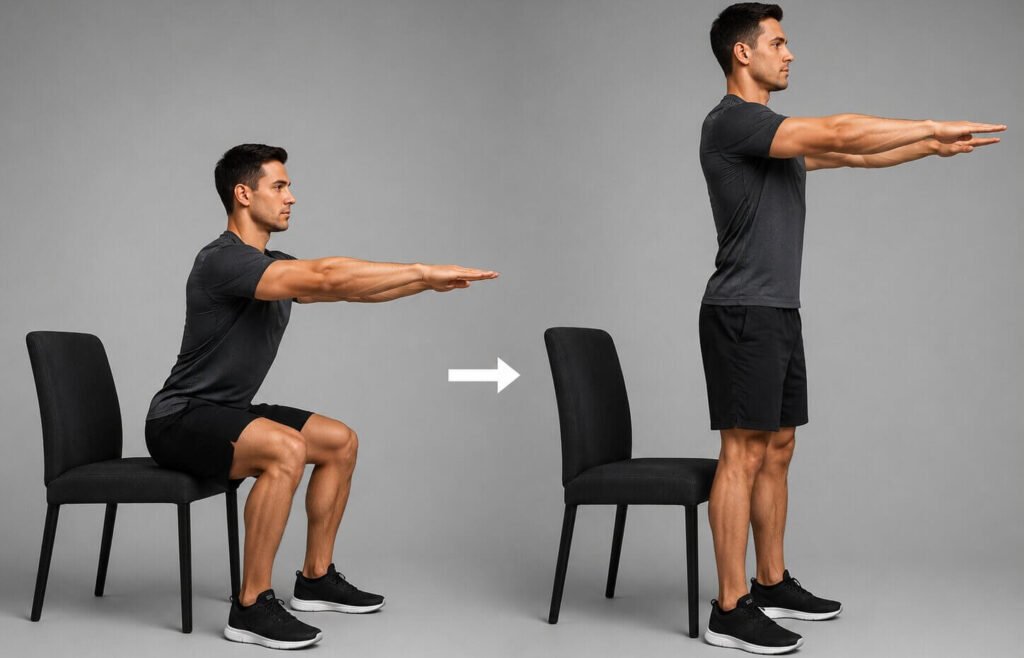
The chair squat teaches sit-to-stand and provides a clear depth target.
How to do it:
- Secure a sturdy, non-wheeled chair against a wall.
- Stand in front, bend your knees and hips, and lower under control.
- Touch or sit briefly without collapsing, then press through your feet to stand.
Start with 2–3 sets of 8–15 reps.
Easier: Use a higher seat or your hands for light support.
Harder: Tap the chair without sitting or hold a light backpack.
Let your knees follow your toes and use a comfortable stance.
2. Bodyweight Squat
The bodyweight squat trains knee and hip extension together but eventually needs progression.
How to do it:
- Stand comfortably and brace gently.
- Bend your knees and hips while keeping the whole foot supported.
- Descend through a controllable range, then press the floor away.
Start with 2–4 sets of 8–20 reps.
Easier: Squat to a chair.
Harder: Use a slower descent, pause, or add a backpack.
Forward knee travel is normal in many squat styles; comfort and control matter more than an absolute toes rule.
3. Wall Sit
The wall sit train is isometric quad endurance but should not be your only exercise.
How to do it:
- Place your back against a wall and step forward.
- Slide to a comfortable knee angle with flat feet.
- Breathe normally and stand before form breaks.
Start with 2–3 holds of 15–40 seconds.
Easier: Use a higher position with less knee bend.
Harder: Hold longer, move slightly lower, or carry a secure load.
Choose a knee angle you can hold without sharp pain or breath-holding.
4. Supported Split Squat
The supported split squat trains one leg while a chair or wall reduces balance demands.
How to do it:
- Take a split stance beside a stable support.
- Bend both knees and lower with most weight through the front foot.
- Keep the front knee aligned with the toes and press up.
Start with: 2–3 sets of 6–12 reps per side
Easier: Shorten the range or use more hand support.
Harder: Use less support, pause at the bottom, or hold a backpack.
A shorter stance and upright torso often feel more quad-focused, but comfort takes priority.
5. Reverse Lunge
The reverse lunge adds a backward step while the front leg performs most of the work.
How to do it:
- Step one foot backward into clear space.
- Bend both knees while keeping the front foot planted.
- Push through the front foot to return.
Start with: 2–3 sets of 6–12 reps per side
Easier: Hold a wall or use a shorter step.
Harder: Add a pause, alternate continuously, or hold weight.
If balance limits you, use a supported split squat.
6. Low Step-Up
The low step-up trains one leg through a stair-climbing pattern.
How to do it:
- Place the whole working foot on a secure low step.
- Push through that foot without launching from the trailing leg.
- Step down slowly.
Start with: 2–3 sets of 8–12 reps per side
Easier: Use a lower step and hand support.
Harder: Increase the step height modestly, slow the descent, or add load.
Never use a lightweight chair, unstable box, or sliding surface.
7. Heel-Elevated Squat
Heel elevation can allow more forward knee travel and an upright torso. Use stable, non-slip support.
How to do it:
- Place both heels on a low squat wedge with the forefeet down.
- Lower as the knees travel in line with the toes.
- Maintain balance and stand with control.
Start with 2–3 sets of 8–15 reps.
Easier: Use a lower heel elevation or hold a stable support.
Harder: Add a pause or hold a backpack.
Skip it if the support shifts, compresses, or causes discomfort.
8. Bulgarian Split Squat
The Bulgarian split squat is a challenging rear-foot-elevated unilateral exercise.
How to do it:
- Place one foot behind you on a stable couch or low bench.
- Lower through the front knee and hip with the front foot planted.
- Press through the front foot to rise.
Start with: 2–3 sets of 6–12 reps per side
Easier: Use hand support or keep the rear foot on the floor.
Harder: Add a pause, more controlled range, or external load.
Use a regular split squat if the rear-foot position or balance dominates.
9. Backpack Front Squat
The backpack front squat adds adjustable resistance in front of the body.
How to do it:
- Load and close a strong backpack, then hold it against your chest.
- Squat through a controlled range with the load close.
- Press through your feet without bouncing.
Start with 3 sets of 8–15 reps.
Easier: Reduce the load or squat to a chair.
Harder: Add a small amount of secure weight or use a longer pause.
Avoid fragile contents and a bag or straps that may tear.
10. Resistance-Band Knee Extension
The banded knee extension isolates knee extension without a machine.
How to do it:
- Secure the band low and sit tall with it around one ankle.
- Straighten the knee without snapping into lockout.
- Pause, then return slowly.
Start with: 2–3 sets of 12–20 reps per side
Easier: Use a lighter band or shorter range.
Harder: Add band tension or slow the return.
Inspect the band and anchor, avoid the recoil path, and skip an insecure setup.
Beginner Minimal-Equipment Quad Workout
This routine combines bilateral, unilateral, stepping, and isometric work. Build from two rounds to three.
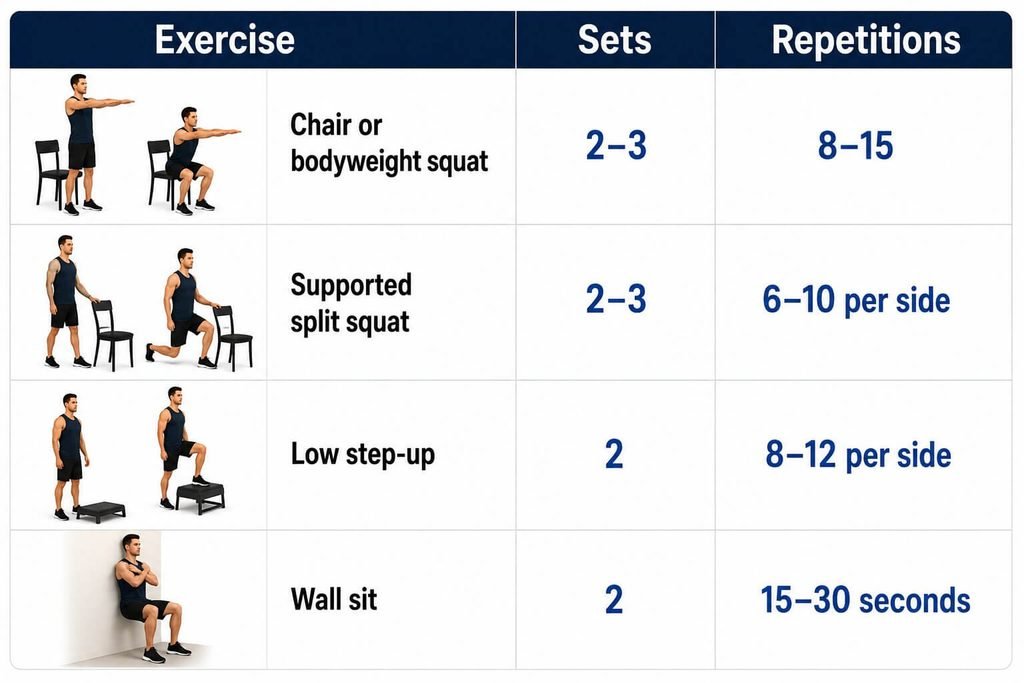
Rest 45–90 seconds between exercises and up to two minutes between rounds. Keep about two reps in reserve.
Train twice weekly on nonconsecutive days. Reduce volume if soreness disrupts daily movement or your next workout.
Progressive Home Quad Workout
This routine suits someone who has mastered basic squats and split squats.
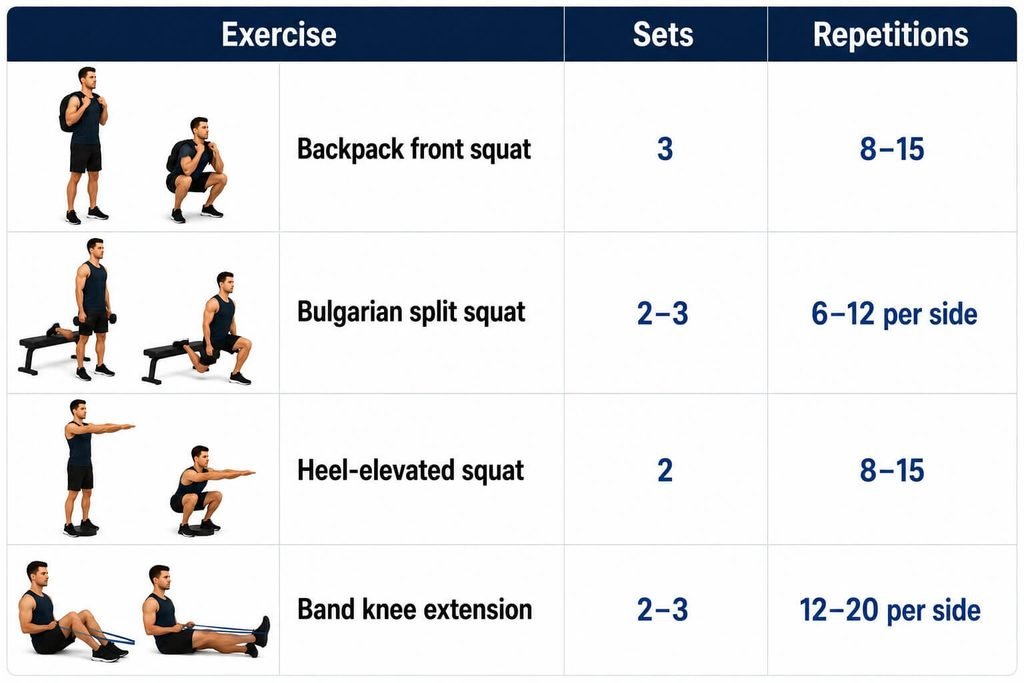
Rest 60–120 seconds. If recovery suffers, alternate the backpack and heel-elevated squats instead of doing both.
Keep at least one recovery day before another demanding lower-body session.
How to Squat With Better Control
A good squat uses a comfortable range, stable feet, controlled knees, and no sharp pain. Stance, depth, and knee travel vary.
Use these checkpoints:
- Keep the heel, base of the big toe, and base of the little toe supported.
- Let the knees track in roughly the same direction as the toes.
- Lower with control instead of dropping quickly into the bottom.
- Use a depth that lets you maintain balance and comfort.
- Press the floor away to stand without the knees collapsing inward.
Can Your Knees Go Past Your Toes?
Your knees can move past your toes during a squat when your anatomy, mobility, and chosen variation allow it comfortably. Deliberately forcing the knees backward changes the movement rather than making every squat universally safer.
A small study found that restricting forward knee travel reduced knee torque but greatly increased hip torque and trunk lean. A later review confirmed that restriction changes load distribution. Fry et al. and 2023 review
More forward travel is not always better. Knee pain may call for less range, a more vertical shin, or professional guidance.
Four-Week Quad Progression Plan
Progress after you complete the current target in two sessions with stable technique. Change only one variable at a time.
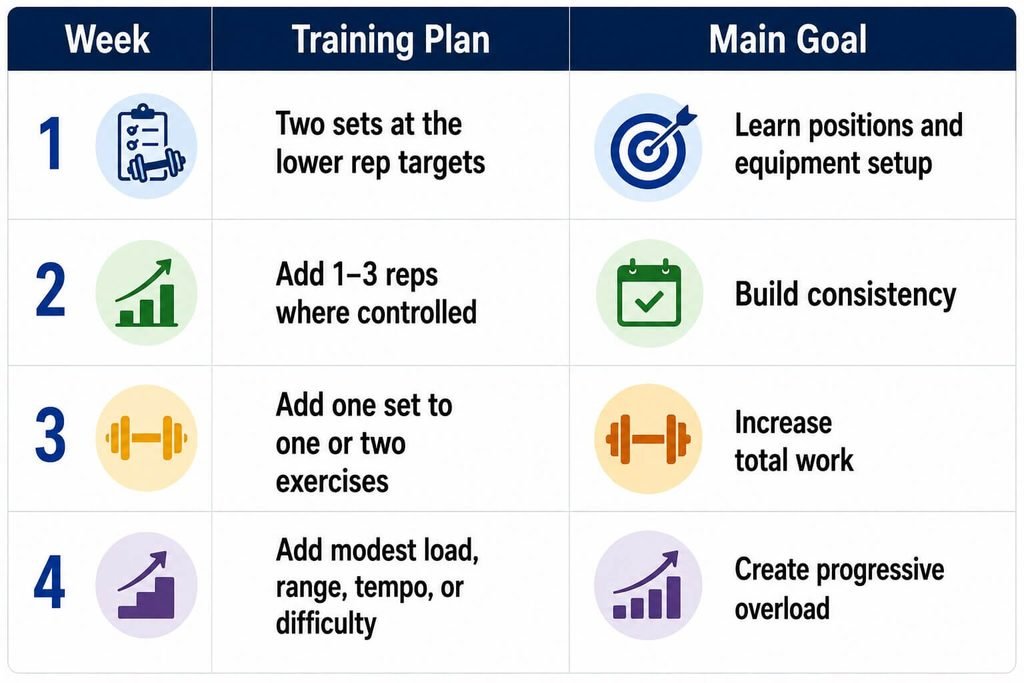
After adding load, return to the lower rep range. Keep sets unchanged when learning a new variation.
Progress may also mean less support, a lower chair, a taller step, or better balance.
How Often Should You Train Your Quads?
Two weekly sessions are a practical start; a third is optional if recovery allows.
The U.S. Physical Activity Guidelines for Americans recommend muscle-strengthening activities for all major muscle groups on at least two days per week. This is a whole-body health recommendation, not a requirement for two separate quad-only days.
Count quad work in a three-day full-body program. Squats on one day and lunges on another may remove the need for a quad-only session.
How to Make Bodyweight Quad Exercises Harder
Make an exercise harder only when you reach the top of its rep range with controlled form and one or two repetitions still available. Use the smallest useful progression.
| Progression Method | Example |
|---|---|
| More range | Progress from a high chair squat to a lower target |
| Slower tempo | Lower a squat for three seconds |
| Pause | Hold the bottom of a split squat for one second |
| Unilateral work | Move from squat to split squat |
| External load | Hold a secure backpack at the chest |
| Additional set | Increase from two to three sets |
| Less assistance | Use less hand support during split squats |
Do not add load, depth, sets, and an advanced variation in the same week. That makes technique and recovery harder to evaluate.
Common Quad-Training Mistakes
Common mistakes include unstable equipment, forced depth, and premature progression.
Allowing the Knees to Collapse Inward
Let the knees follow the toes. Reduce range or use support if they collapse inward.
Forcing One-Foot Position
Use a comfortable stance instead of forcing perfectly straight feet.
Lifting the Heels Unintentionally
If the heels rise unintentionally, reduce depth, adjust stance, or use stable heel elevation.
Chasing Maximum Depth
Use the deepest range you can control without sharp pain or balance loss.
Pushing Off the Trailing Leg
Use a lower step or support instead of launching from the nonworking leg.
Using Unstable Household Furniture
Skip furniture that can roll, tip, or slide.
Adding Jumps Too Early
Jump squats add power and impact but are unnecessary for beginner strength.
What If Squats or Lunges Feel Uncomfortable?
Adjust rather than force the movement. Try less range, more support, or another exercise; persistent pain needs assessment.
| Problem | Adjustment to Try |
|---|---|
| Knee discomfort near the bottom | Use a higher chair or shallower range |
| Balance limits split squats | Hold a wall or stable chair |
| Heels rise during squats | Reduce depth or use a stable heel wedge |
| Step-ups feel uncontrolled | Lower the step and use hand support |
| Lunges feel awkward | Use a stationary split squat |
| Band extensions irritate the knee | Reduce tension and range or omit them |
Muscular effort or mild temporary fatigue is expected. Sharp pain, rapidly increasing discomfort, swelling, locking, giving way, or inability to bear weight is not a signal to push harder.
Mayo Clinic advises seeking medical care for marked swelling, instability, inability to fully bend or straighten the knee, deformity, or severe injury-related pain. Mayo Clinic knee-pain guidance
Quad Strengthening vs. Knee Rehabilitation
General training cannot diagnose or treat arthritis, tendon pain, ligament injury, kneecap pain, or postsurgical weakness.
Rehabilitation depends on diagnosis, healing stage, range, and tolerable load. Clinical exercises are not automatically the best general strength choices.
Seek an individualized plan for known conditions, recent surgery, persistent swelling, instability, or pain that limits daily life.
Practical Recommendations
- Select one squat, one unilateral exercise, and one optional isometric or knee-extension exercise.
- Begin with two sets and leave about two controlled repetitions in reserve.
- Use a chair or wall while learning balance-dependent movements.
- Inspect chairs, steps, backpacks, bands, anchors, and heel supports before training.
- Progress only one variable at a time.
- Leave at least one recovery day between demanding quad sessions.
- Pair quad work with hamstring exercises at home and other lower-body movements.
- Record the variation, sets, reps, load, and any discomfort.
Frequently Asked Questions
What is the best quad exercise to do at home?
There is no single best exercise. Pair a squat with a unilateral movement; band extensions add direct knee-extension work.
Can you build your quads without weights?
Yes. Use comfortable range, tempo, pauses, split squats, and step-ups, then add load when needed.
Are squats enough to build the quadriceps?
Squats can build the quads when challenging and progressing. Add split squats, step-ups, or band extensions for variety.
Are wall sits good for quad strength?
Wall sits build isometric capacity around the trained angle. Pair them with dynamic exercise.
Why do I feel squats more in my glutes?
Squats train the quads and glutes. A comfortable, narrower stance, heel elevation, or upright torso may feel more quad-focused.
Should my knees go past my toes during squats?
They can when comfortable and controlled. Knee travel depends on anatomy, mobility, stance, depth, and variation.
What can I do if lunges hurt my knees?
Reduce range, add support, or switch exercises. Stop for sharp, increasing, or persistent pain.
Are jump squats necessary for stronger quads?
No. Controlled squats, split squats, step-ups, and resistance can strengthen quads without jumping.
How do I know when to add weight?
Add a small load after reaching the top rep target with stable technique, then return to the lower range.
Conclusion
Effective quad exercises at home include squats, split squats, lunges, step-ups, wall sits, and band knee extensions. Start with chair-supported and bodyweight options, then progress through range, tempo, unilateral work, or external resistance.
Train about twice per week, keep the knees and feet controlled, and use a range that feels comfortable. You do not need advanced pistol squats, sissy squats, or jumps to build a useful home quad workout.
For balanced lower-body development, combine these exercises with a complete guide to building leg muscle at home without equipment rather than training the quadriceps in isolation indefinitely.