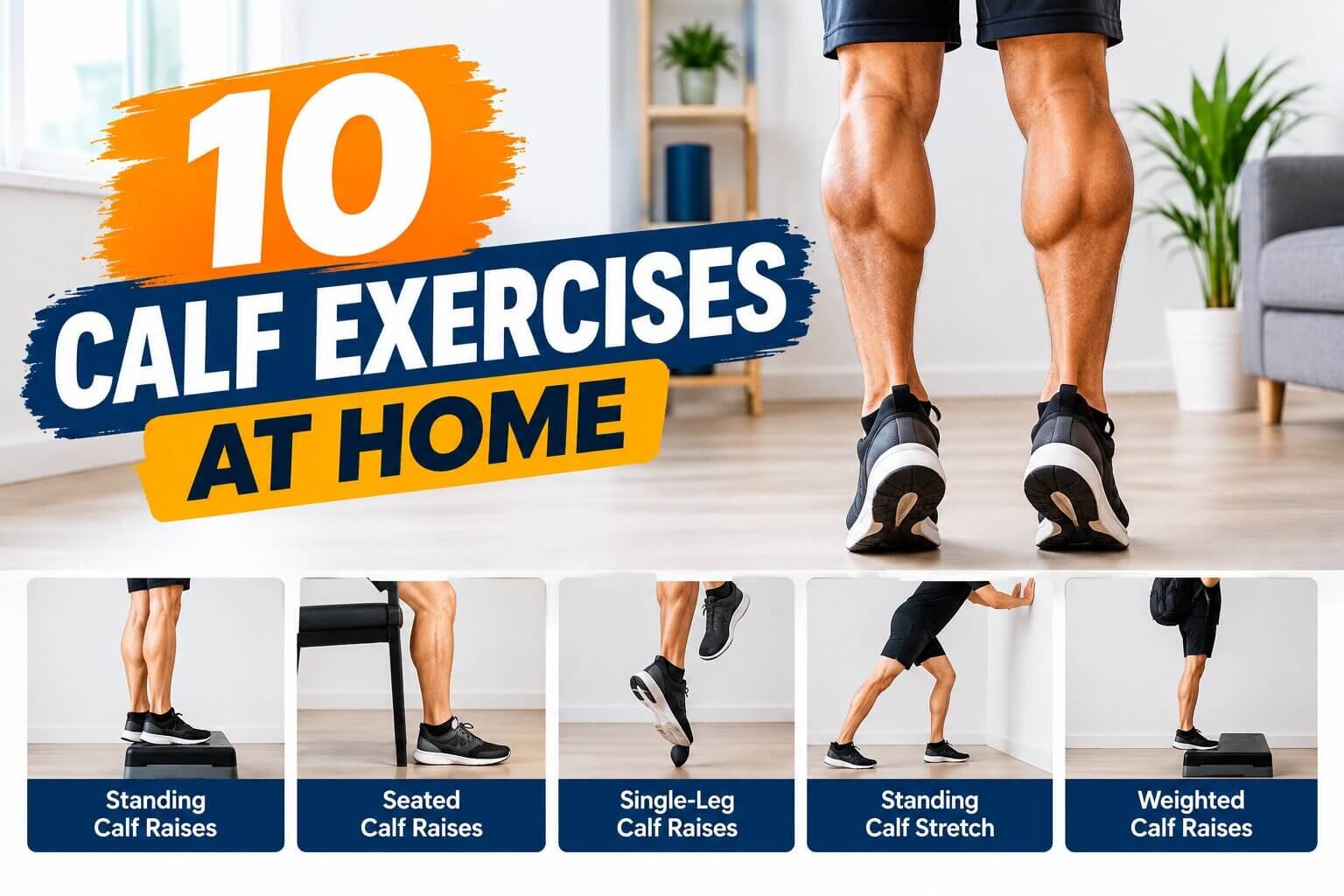
You can train your calves effectively at home with calf raises, a stable step, and simple resistance such as a loaded backpack. Start with controlled two-leg raises, then progress to single-leg or loaded variations as your strength improves.
The most useful routine is not the one with the most exercises. It is one that trains your calves through a comfortable range of motion, becomes gradually harder, and fits into your week consistently. This guide provides 10 practical exercises, two ready-to-use workouts, and a four-week progression plan.
Can You Strengthen Your Calves at Home?
Yes. Bodyweight, resistance bands, and home-based resistance training can improve strength and support muscle growth when the exercises are challenging enough and progressed over time.
The American College of Sports Medicine’s 2026 resistance-training update notes that a traditional gym is not required: bodyweight exercises, elastic bands, and home routines can produce meaningful improvements in strength, hypertrophy, and physical function.
The main limitation is resistance. A regular two-leg calf raise may become easy because your calves already work during standing and walking. When you can perform the exercise comfortably for many repetitions, make it harder by using one leg, adding a loaded backpack, increasing the usable range on a stable step, or slowing the lowering phase.
What Muscles Do Calf Exercises Work?
Calf exercises primarily train the gastrocnemius and soleus, which join the Achilles tendon and help lift the heel. Together, these muscles contribute to standing, walking, running, jumping, and pushing the foot downward.
According to the Cleveland Clinic’s calf anatomy overview, the visible gastrocnemius crosses the knee and ankle, while the deeper soleus crosses only the ankle. Both contribute to plantar flexion—lifting the heel and rising onto the ball of the foot.
Gastrocnemius
The gastrocnemius is trained well with the knee straight or slightly unlocked. Standing, stair, and straight-knee single-leg raises are the main options.
Soleus
The soleus works during straight- and bent-knee plantar flexion. Seated or bent-knee raises change the relative contribution of the calf muscles but do not perfectly isolate the soleus.
Standing vs. Seated Calf Raises
Use standing calf raises as your primary movement and seated or bent-knee raises as complementary work. Current direct research favors standing raises for gastrocnemius growth, while soleus growth may be similar between the two positions.
In a 12-week study, 14 untrained adults trained one leg with standing calf raises and the other with seated calf raises. Standing training produced substantially greater gastrocnemius and total triceps surae growth, while soleus growth was similar between conditions. Because the study was small and involved untrained young adults, it should guide—not dictate—exercise selection. See the study in Frontiers in Physiology.
For a simple home program:
- Choose at least one standing, straight-knee variation.
- Add one seated or bent-knee option if you want more calf volume.
- Progress the standing movement instead of replacing it with easier seated repetitions.
10 Calf Exercises to Do at Home
The best home calf exercises are variations you can perform safely, control through the entire repetition, and progressively make harder. You do not need to perform all 10 in one workout; select two or three that match your current ability and equipment.
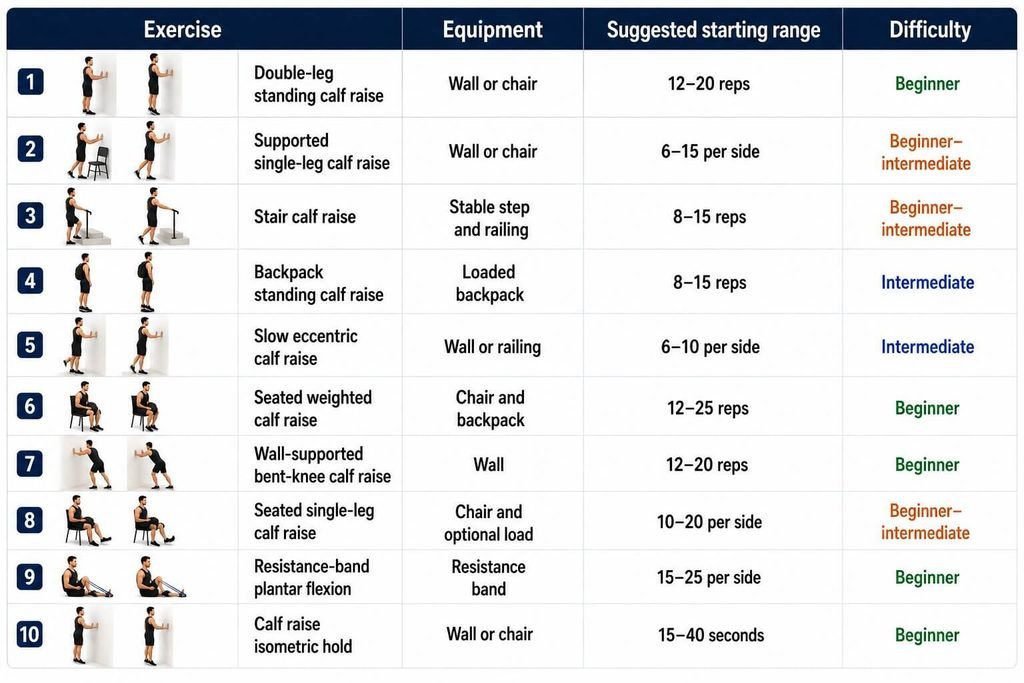
These ranges are practical starting points, not universal rules. Stop each set when your technique begins to change or when you have only about two or three controlled repetitions left.
1. Double-Leg Standing Calf Raise
The double-leg standing calf raise is the best starting exercise for learning the movement. Stand hip-width apart with your fingertips on a wall, keep your knees straight but not locked, and lift both heels. Pause, then lower under control without rolling your ankles outward.
Use more hand support if needed. Progress with a loaded backpack or a three-second lowering phase.
2. Supported Single-Leg Calf Raise
The supported single-leg raise increases resistance by placing most of your weight on one calf. Stand beside a wall, lift the other foot, rise on the working leg, pause, and lower slowly. Use the free foot lightly for assistance if you cannot complete six clean repetitions.
3. Stair Calf Raise
A stair calf raise provides more usable range when your mobility and control allow it. Place the balls of your feet securely on a stair, hold the railing, lower into a comfortable stretch, and lift without bouncing. Never force depth or use unstable furniture as a step.
4. Backpack Standing Calf Raise
A backpack calf raise adds measurable resistance without gym equipment. Load the bag evenly with non-breakable items, secure it, and perform standing raises near a wall. Record the load and add a small amount only after reaching the top of your rep range with consistent form.
5. Slow Eccentric Calf Raise
The slow eccentric calf raise makes bodyweight more demanding by emphasizing the lowering phase. Rise with both feet, shift most of your weight to one side, and lower that heel for three to five seconds. Begin on the floor; this is a strength variation, not an injury-treatment protocol.
6. Seated Weighted Calf Raise
The seated weighted calf raise provides a bent-knee option using a chair and backpack. Sit with your knees near 90 degrees, secure a padded backpack across your thighs just above the knees, and lift and lower both heels. Reduce the load if it feels unstable or uncomfortable.
7. Wall-Supported Bent-Knee Calf Raise
The wall-supported bent-knee raise changes knee position without a machine. Face a wall, bend your knees slightly, and maintain that angle while lifting and lowering your heels. Keep your knees aligned with your toes instead of turning each repetition into a squat.
8. Seated Single-Leg Calf Raise
The seated single-leg raise is an accessible step between two-leg seated work and standing single-leg raises. Sit with one knee bent, rest your hands or a light backpack on that thigh, and lift and lower the heel. Avoid painful pressure on the leg.
9. Resistance-Band Plantar Flexion
Band plantar flexion is a seated accessory exercise that avoids a standing balance demand. Loop a band around the ball of one foot, hold both ends, point the foot away, and return slowly. Inspect the band first and keep it away from your face.
10. Calf Raise Isometric Hold
An isometric hold develops control and local endurance without repeated movement. Rise onto both feet while holding a wall, breathe normally, and hold for 15–40 seconds. Progress to one leg or a light backpack, but do not use holds as your only calf exercise.
Beginner No-Equipment Calf Workout
Beginners can start with two short calf workouts per week, separated by at least one recovery day. The routine below takes about 10–15 minutes and requires only a wall or sturdy chair.
| Exercise | Sets | Repetitions or time | Rest |
|---|---|---|---|
| Double-leg standing calf raise | 2 | 12–20 | 45–75 seconds |
| Wall-supported bent-knee calf raise | 2 | 12–20 | 45–75 seconds |
| Calf raise isometric hold | 1–2 | 15–30 seconds | 45–60 seconds |
Perform every repetition slowly enough to control both directions. During the first week, finish each set with several good repetitions still available. Add effort gradually as the movement becomes familiar.
An example schedule is Monday and Thursday. You can add the routine to a beginner home workout or perform it after a lower-body session.
Progressive Home Calf Workout
Use this workout when regular two-leg raises no longer feel challenging. It combines a loaded straight-knee exercise with unilateral and bent-knee work.
| Exercise | Sets | Repetitions | Rest |
|---|---|---|---|
| Backpack stair calf raise | 3 | 8–15 | 60–90 seconds |
| Supported single-leg calf raise | 2 | 8–15 per side | 60–90 seconds |
| Weighted seated calf raise | 2 | 12–20 | 60–90 seconds |
Complete this routine twice per week at first. If you already perform calf work during two full lower-body workouts, you may not need separate calf days.
Choose a load or variation that leaves about two controlled repetitions in reserve at the end of most sets. Reaching absolute failure is not required for an effective workout; the updated ACSM resistance-training guidance emphasizes that advanced methods such as routine momentary failure are optional for the average healthy adult.
Four-Week Calf Workout Progression Plan
Progress one variable at a time so you can identify what made the exercise harder. The following plan is an example for a beginner who starts with the no-equipment workout.
| Week | Focus | How to progress |
|---|---|---|
| 1 | Learn the movement. | Use two sets, a comfortable range, and controlled repetitions |
| 2 | Add repetitions. | Add 1–3 reps per set without speeding up. |
| 3 | Add a set or harder variation. | Add one set to the first exercise or begin assisted single-leg raises. |
| 4 | Add resistance. | Use a light backpack or a stable step while returning to the lower end of the rep range. |
A simple long-term method is double progression. Use a range such as 8–15 repetitions. When you reach 15 clean reps on every set in two workouts, add a little load or choose a harder variation, return to the lower end, and build upward again.
Range of motion is another progression, but more is not automatically better. A small study of 42 young women favored training in the lengthened portion for gastrocnemius growth, but it does not establish one perfect technique for everyone. Use a stable step only when you can control a comfortable stretch. See the 2023 study indexed by PubMed.
How Often Should You Train Your Calves?
Two focused calf sessions per week are a practical starting point for most beginners. You can consider a third session later if you recover well and need more weekly training, but daily calf workouts are unnecessary.
The Physical Activity Guidelines for Americans recommend muscle-strengthening activity for all major muscle groups on at least two days per week. That is a general health guideline, not a calf-specific prescription, but it supports using two weekly strength sessions as a simple baseline.
Your total training matters. Squats, lunges, walking, running, and jumping involve the calves to varying degrees, although they may not progressively load plantar flexion as directly as calf raises. Account for sports and lower-body workouts when judging recovery.
Reduce volume or add recovery time if performance declines across several sessions, soreness repeatedly affects walking, or your Achilles and ankles feel increasingly irritated.
How to Make Bodyweight Calf Raises Harder
Make calf raises harder by increasing resistance or mechanical difficulty while preserving control. Adding hundreds of rushed repetitions is rarely the most practical progression.
Use this order:
- Improve control and reach a comfortable full range.
- Add repetitions within your planned range.
- Use a slower lowering phase or a brief pause.
- Move from two legs to an assisted single-leg version.
- Add a backpack, dumbbell, or stronger resistance band.
- Use a stable step for more range if it feels comfortable.
Change only one factor at a time. For example, do not add a heavy backpack, a step, and single-leg execution in the same workout.
Common Calf-Training Mistakes
Most calf-training problems come from using momentum, choosing an unstable setup, or failing to make the exercise progressively harder. Correcting these basics matters more than finding an unusual foot angle.
Bouncing Through Repetitions
Bouncing reduces control. Pause at the top and lower smoothly instead of springing from the bottom.
Performing Only Short, Fast Repetitions
Use the largest comfortable range you can control without forcing painful depth.
Letting the Ankles Roll Outward
Maintain pressure across the forefoot. Reduce the load or add support if your ankles roll outward.
Turning Every Set Into a Balance Test
Light wall or railing support helps you focus on the working calf and improves safety.
Doing Endless Easy Repetitions
When you exceed your range easily, use a harder variation or add resistance rather than chasing endless repetitions.
Using Only Bent-Knee Calf Raises
Bent-knee work is complementary. Keep a standing variation unless a professional advises otherwise.
Changing Toe Angle Excessively
Extreme toe angles are unnecessary. Use a natural, stable foot position.
Practical Recommendations
For effective home calf training, keep the setup simple and make your progress measurable. The following checklist covers the main decisions.
- Train calves after your main leg exercises so fatigue does not interfere with squats or lunges.
- Record the exercise, load, sets, and repetitions.
- Use a straight-knee raise as the main movement.
- Add a bent-knee variation if you want additional volume.
- Control the bottom position instead of bouncing.
- Use support during single-leg work.
- Add only a small amount of backpack weight at a time.
- Give the program several weeks before deciding it does not work.
For balanced lower-body training, combine this calf work with exercises from the quad exercises at home and hamstring exercises at home guides.
Calf Exercise Safety
Calf training should create muscular effort, not sharp pain. Use stable equipment, progress gradually, and distinguish ordinary fatigue from symptoms that may require medical assessment.
- Warm up with easy walking or ankle movements and one light set.
- Use a non-slip surface and secure backpack contents.
- Use a fixed stair and railing; never unstable household objects.
- Do not force a deep heel drop through Achilles or ankle pain.
- Stop for a snap, sudden sharp pain, or rapidly increasing discomfort.
Seek prompt medical care for sudden or severe calf pain, swelling, skin discoloration, or difficulty walking. These symptoms should not be treated as normal workout soreness. The Cleveland Clinic’s calf-pain guidance recommends medical evaluation for these warning signs.
Ask a healthcare professional before starting if you have a calf or Achilles injury, recent surgery, major balance limitation, or a condition affecting your feet or circulation.
Frequently Asked Questions
What is the best calf exercise to do at home?
The standing calf raise is the best general starting point. Progress to one leg, a backpack, or a stable step when the two-leg version becomes easy.
Can you build calf muscles without weights?
Yes. Single-leg raises, slow lowering, pauses, and a greater comfortable range can make bodyweight challenging. Added load may eventually make progression easier.
Are standing or seated calf raises better?
Prioritize standing raises for overall development. Current direct research favors them for gastrocnemius growth, while seated or bent-knee raises remain useful complementary work.
How many calf raises should a beginner do?
Start with two sets of 12–20 controlled repetitions. Use more support if needed; progress to one leg or light load when 20 are easy.
How often should beginners train calves?
Twice per week is practical. Leave a recovery day between sessions and account for running, sports, and other lower-body training.
Can I do calf raises every day?
Easy practice is possible, but hard daily sessions are unnecessary. Challenging single-leg, loaded, and deep-range work still requires recovery.
Why do I feel calf raises in my Achilles tendon?
The Achilles connects the calves to the heel, so tension is expected; pain is not. Reduce load and range, and stop if discomfort is sharp or worsening.
Why do my calves cramp during calf raises?
Fatigue or an unfamiliar position can contribute, but cramps have several possible causes. Stop the set. Seek professional guidance for recurrent cramps with pain, swelling, numbness, or skin changes.
Do squats and lunges train the calves?
They involve the calves, but direct raises are more specific when calf strength or growth is the goal.
Should my heels drop below a stair?
They may if the step is stable and the range is comfortable. Stop before pain or loss of control; extra depth is optional.
Do I need jump rope or calf raises?
No. Jumping can develop reactive strength and power, but it adds impact and is unnecessary for basic calf training.
Conclusion
Effective calf exercises at home do not require a machine or a long list of jumping drills. Begin with controlled standing calf raises, use a wall for balance, and train twice per week. As the exercise becomes easier, progress to single-leg raises, a loaded backpack, or a stable stair.
Keep one straight-knee movement at the center of the routine and use seated or bent-knee work as a complement. Track your repetitions and resistance so each workout has a clear purpose.
Choose the beginner or progressive routine above and follow it for four weeks. For a complete lower-body plan, add it to a full-body bodyweight workout for beginners or a structured three-day home workout.