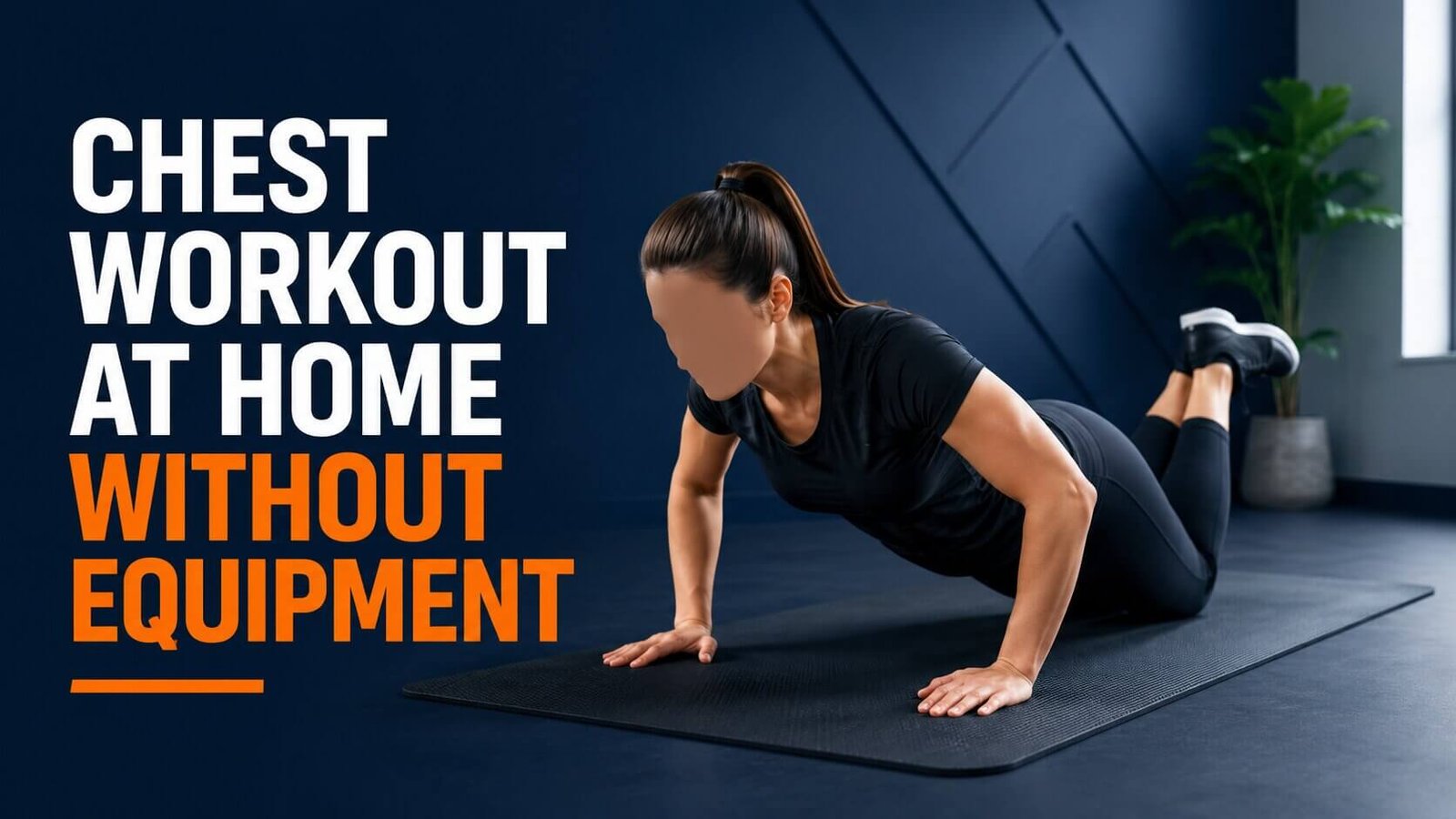
A practical chest workout at home without equipment needs only a few push-up variations. Select a wall, incline, or floor push-up that allows controlled repetitions, train twice per week, and gradually add repetitions before choosing a harder angle.
The plans below use straight sets rather than a fast circuit. Finish most sets with two or three good repetitions available.
Chest Workout at a Glance
Choose the beginner or intermediate routine—not both. Complete all sets of one movement before starting the next, and use the lowest prescribed set total during the first week.
Beginner Chest Workout
| Exercise | Sets | Repetitions | Rest |
|---|---|---|---|
| Wall or incline push-up | 2–3 | 6–15 | 60–120 seconds |
| Pause incline push-up | 2 | 6–12 | 60–120 seconds |
| Slightly wide incline push-up | 1–2 | 8–15 | 60–90 seconds |
| Close-grip wall or incline push-up | 1–2 | 8–15 | 60–90 seconds |
| Wall or incline scapular push-up | 1–2 | 8–12 | 45–90 seconds |
Intermediate Chest Workout
| Exercise | Sets | Repetitions | Rest |
|---|---|---|---|
| Standard floor push-up | 2–3 | 6–15 | 60–120 seconds |
| Pause or slow-lowering push-up | 2 | 6–12 | 60–120 seconds |
| Slightly wide push-up | 1–2 | 8–15 | 60–90 seconds |
| Low decline push-up | 1–2 | 6–12 | 60–120 seconds |
| Close-grip push-up | 1–2 | 8–15 | 60–90 seconds |
| Program detail | Recommendation |
|---|---|
| Frequency | 2 nonconsecutive days per week |
| Session length | Approximately 20–30 minutes |
| Starting volume | About 6–8 working sets |
| Effort | Finish most sets with 2–3 good repetitions available |
| Initial duration | Follow for 4 weeks before major changes |
Can Push-Ups Train the Chest Effectively?
Yes. Push-ups can improve chest strength and support muscle growth when the variation provides enough resistance and becomes progressively harder. They also train the triceps, front shoulders, and trunk rather than isolating the chest.
The American College of Sports Medicine’s 2026 resistance-training guidance recognizes bodyweight and home-based training as effective options. It emphasizes consistent, progressive resistance work over unnecessarily complex programming. ACSM resistance-training guidance
In a small study of trained young men, push-ups performed at a load comparable to a light bench press produced similar chest and triceps muscle thickness and strength changes over eight weeks. The narrow sample and matched loading matter: the finding does not prove that every push-up routine equals every bench-press program. Kikuchi and Nakazato, 2017
Another randomized study found that progressively harder calisthenic push-up training improved upper-body strength over four weeks. Together, these findings support selecting an appropriate push-up difficulty and progressing it rather than repeating an easy version indefinitely. Kotarsky et al., 2018
What Muscles Do Push-Ups Train?
Push-ups primarily train the pectoralis major in the chest, with substantial assistance from the triceps and anterior deltoids. The serratus anterior and trunk muscles help control the shoulder blades and body position.
The pectoralis major has fibers running in different directions, including a clavicular region nearer the collarbone and a larger sternal region. Changing body angle can alter joint positions and relative muscle demands, but these regions continue working together.
There is no special push-up that isolates an “inner chest.” Muscle fibers do not become separate compartments based on hand spacing, and chest exercise cannot selectively remove fat from one location.
Prepare a Safe Home Setup
Use a wall or stable counter for incline push-ups and confirm that the surface cannot move, slide, or tip. Clear enough floor space to maintain a straight-body position without contacting furniture.
Avoid light chairs, stools, stacked objects, and any surface not designed to support exercise. For decline push-ups, use only a low, solid, nonslip platform. If no suitable platform is available, use standard or pause push-ups instead.
Five-Minute Chest Warm-Up
A short warm-up should rehearse pressing without tiring the chest. Complete one controlled round, then perform an easier practice set before the first working exercise.
- March in place while moving your arms for 60 seconds.
- Perform 8 slow shoulder rolls in each direction.
- Perform 8 standing shoulder-blade protractions and retractions.
- Perform 6 wall push-ups.
- Perform 6 wall shoulder taps per side.
- Perform 6 additional push-ups using a higher surface than your working sets.
How to Perform the Chest Exercises
Each variation should use a comfortable range and repeatable setup. Stop the set when your hips sag, shoulders shrug, or range becomes noticeably shorter.
Wall or Incline Push-Up
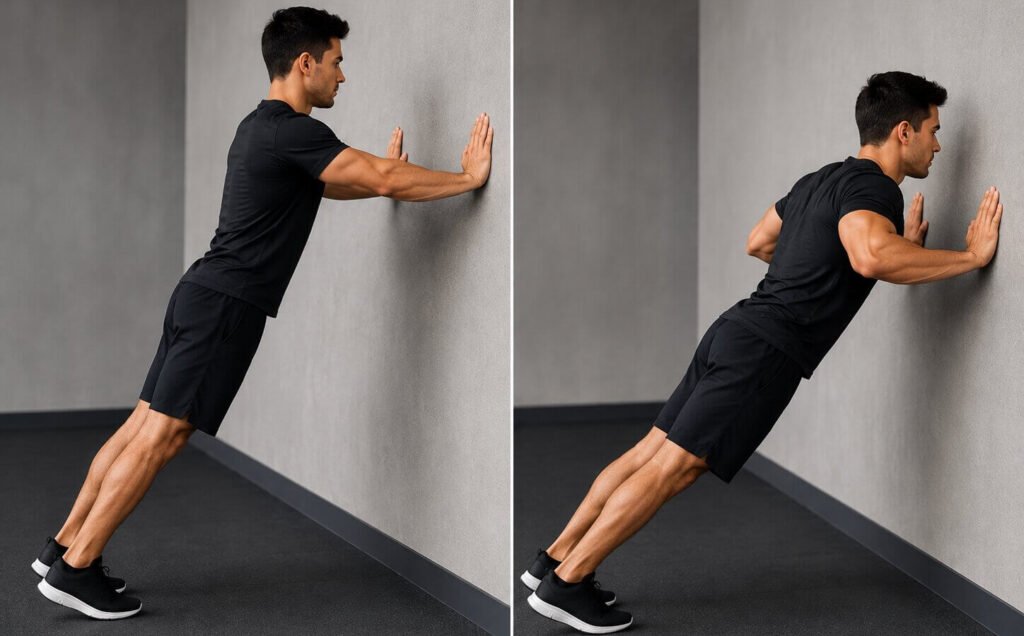
The wall or incline push-up adjusts difficulty through hand height. Place your hands on a stable surface, maintain a straight body position, lower your chest toward the support, and press away without bouncing or letting your hips drop.
Progression: Wall → high counter → lower counter or secure surface → floor.
Standard Floor Push-Up
The floor push-up is appropriate after incline push-ups become easy. Place your hands shoulder-width apart or slightly wider, maintain a plank, and lower through a controlled range with a comfortable elbow angle.
If fewer than six clean repetitions are available, return to an incline and accumulate productive work there.
Pause or Slow-Lowering Push-Up
A brief pause or controlled lowering phase increases difficulty without equipment. Lower for two or three seconds, pause briefly near your controlled bottom position, and press up normally.
Use fewer repetitions than during regular push-ups. Long, exhausting tempos are not necessary.
Slightly Wide Push-Up
A slightly wider hand position provides another pressing variation, but extremely wide hands are unnecessary. Move each hand only a small distance outward and use an incline if floor repetitions become uneven.
Low Decline Push-Up
A decline push-up places the feet above the hands, increasing the challenge and often shifting more demand toward the upper chest and front shoulders. It is an intermediate option.
Use a low, stable, nonslip platform. Maintain a straight body position and stop if the exercise becomes primarily a shoulder challenge or your range declines sharply.
Close-Grip Push-Up
A close-grip push-up emphasizes the triceps while the chest and shoulders assist. Place your hands approximately shoulder-width apart rather than forcing a diamond, and use an incline if the floor version changes your technique.
Scapular Push-Up
The scapular push-up trains controlled shoulder-blade movement while the elbows remain straight. It is included for shoulder control, not as a major chest-building exercise.
From a wall, incline, or plank position, allow your chest to move slightly toward the support as the shoulder blades approach each other. Then press the surface away so the shoulder blades move apart. Keep the motion small and controlled.
How to Choose the Correct Push-Up Level
Select a variation that lets you complete at least six controlled repetitions while leaving approximately two or three more available. The correct version may be a wall or counter push-up even if you can perform one or two uneven floor repetitions.
| Current performance | Recommended starting level |
|---|---|
| Wall push-ups are challenging | Continue wall push-ups and adjust foot distance |
| Wall push-ups exceed 15 controlled reps | Use a high counter |
| High-counter push-ups exceed 15 reps | Use a lower, stable surface |
| Low-incline push-ups exceed 15 reps | Test floor push-ups |
| Floor push-ups exceed 15 reps | Add a pause, slow lowering, or low decline |
Do not skip several levels at once. A small height change can meaningfully increase the load on your arms and chest.
Do Push-Up Angles Target Different Parts of the Chest?
Push-up angles can shift relative emphasis, but they cannot completely isolate separate chest regions. The chest, shoulders, and triceps remain involved in every version.
- Incline push-up: Easier overall because the hands are elevated; often used to learn the movement.
- Floor push-up: A practical standard variation for general chest pressing.
- Decline push-up: Harder because the feet are elevated; may increase relative upper-chest and front-shoulder demand.
- Slightly wide push-up: Changes shoulder and elbow positions but does not create a separate “outer chest.”
- Close-grip push-up: Usually increases triceps demand rather than isolating an “inner chest.”
Choose angles mainly for appropriate difficulty, comfort, and progression. Chasing every supposed chest angle can produce repetitive volume without adding meaningful training value.
Sets, Repetitions, Rest, and Effort
Start with approximately six to eight total working sets per session. Use 6–15 repetitions for most variations and finish at about 2–3 repetitions in reserve, or RIR.
RIR estimates how many additional good repetitions you could complete. An RIR of 2 means you stopped with roughly two controlled repetitions available. It is a practical estimate rather than an exact measurement.
Rest 60–120 seconds between sets. Take longer after demanding the floor or decline push-ups if the next set would otherwise lose repetitions or range. Short rest can make the workout feel harder without improving the quality of each set.
Two-Day Weekly Schedule
Train the chest on two nonconsecutive days, such as Monday and Thursday. Use other days for lower-body, pulling, full-body training, cardio, or recovery.
| Day | Activity |
|---|---|
| Monday | Chest workout |
| Tuesday | Lower body, pulling, or rest |
| Wednesday | Rest or manageable activity |
| Thursday | Chest workout |
| Friday–Sunday | Other training and recovery as appropriate |
This chest routine is not a complete training program. The CDC recommends muscle-strengthening activities covering all major muscle groups on at least two days per week, so include back, legs, hips, shoulders, arms, and trunk work elsewhere. CDC adult activity guidelines
Four-Week Progression Plan
Use the first month to establish consistent technique and measurable progression. Increase one variable at a time.
| Week | Training plan | Main goal |
|---|---|---|
| 1 | 1–2 sets per exercise, 2 sessions | Select variations and use about 3 RIRs. |
| 2 | 2 sets for most exercises, 2 sessions | Add repetitions within each range |
| 3 | Add one set to the main push-up if recovered | Increase volume selectively |
| 4 | Maintain sets and progress one variation | Lower the incline or add a pause |
Do not add volume simply because the calendar advances. Maintain the current plan if soreness persists, joint discomfort develops, or performance declines.
How to Progress Without Equipment
Use double progression: increase repetitions within a range, then choose a slightly harder variation after consistently reaching the top.
For 2 sets of 6–15 push-ups:
- Select a height that permits six or more controlled repetitions.
- Add one repetition to one or both sets over future sessions.
- Reach 15 repetitions on both sets with about 2 RIR.
- Confirm that performance in the next workout.
- Lower the surface slightly and return toward six repetitions.
Record the surface, variation, sets, repetitions, and approximate RIR. When even harder bodyweight variations become impractical or uncomfortable, bands, dumbbells, or a securely loaded backpack can offer more precise resistance.
Wrist and Shoulder Modifications
Use a higher incline, smaller range, or different exercise when a position feels uncomfortable. Do not force a variation to match the written plan.
- Wrist discomfort: Use a wall or counter to reduce the wrist angle and load. Purpose-built push-up handles may allow a more neutral grip.
- Front-shoulder discomfort: Raise the incline, reduce depth, and use a comfortable elbow angle.
- Decline push-ups are uncomfortable: Replace them with paused or slow-lowering push-ups.
- Close-grip push-ups are uncomfortable: Use your normal hand position or omit the accessory set.
These adjustments are training options, not treatment for persistent pain. Stop the aggravating movement and seek individualized guidance when symptoms continue or affect daily activity.
Common Mistakes to Avoid
The most common mistakes are doing too many nearly identical variations, selecting a level that is too difficult, and using soreness as proof of effectiveness.
Starting With Excessive Volume
Performing three sets of five push-up variations creates 15 pressing sets before a beginner has established tolerance. Begin with the lower set totals and add volume only when recovery supports it.
Choosing the Floor Too Soon
Uneven floor push-ups are not more productive than controlled incline repetitions. Use a height that permits consistent range and trunk position.
Using Extreme Hand Positions
Very wide hands or a forced diamond grip may irritate some wrists and shoulders. Small hand-position changes are enough to create a variation.
Taking Every Set to Failure
Failure is not required for every productive set. Stop most beginner sets with two or three good repetitions available to manage fatigue and maintain technique.
Chasing “Inner” and “Outer” Chest Exercises
Push-up variations do not isolate an inner or outer chest compartment. Base exercise selection on difficulty, comfort, and progression rather than anatomical marketing claims.
Using Unstable Furniture
Chairs, stools, and stacked objects may slide or tip. Use a wall, stable counter, or purpose-built platform and test the setup before loading it.
Recovery and Safety Guidance
Keep at least one day between chest sessions and reduce sets if repetitions or technique decline from workout to workout. Regular meals, hydration, and sufficient sleep support recovery without requiring a specialized supplement routine.
Temporary muscular effort and mild soreness can occur. Sharp pain, chest pain unrelated to normal muscle effort, faintness, or unusual shortness of breath are not progression signals; stop exercising and seek appropriate medical care for concerning symptoms.
This general workout is not rehabilitation. If you have an injury, chronic condition, pregnancy, significant balance concern, or medical exercise restriction, ask a qualified healthcare or exercise professional for individualized guidance.
Practical Recommendations
Choose one main push-up level, keep the routine stable for four weeks, and record every working set. Consistency makes progress easier to evaluate.
- Schedule two nonconsecutive sessions.
- Start with six to eight working sets.
- Use straight sets and adequate rest.
- Add repetitions before adding variations.
- Keep two or three repetitions available on most sets.
- Include back and lower-body training elsewhere in the week.
- Review progress after four consistent weeks.
For a broader session that includes shoulders, triceps, and upper-back work, use this upper-body bodyweight workout at home. The full-body bodyweight workout for beginners includes legs, hips, and trunk training.
Frequently Asked Questions
Can Push-Ups Build Chest Muscle?
Yes. Push-ups can support chest muscle growth when the variation creates enough resistance and becomes progressively harder. Easy, unchanged repetitions eventually provide less stimulus.
What Is the Best Push-Up for Beginners?
The best starting version is a wall or incline push-up that permits at least six controlled repetitions, with two or three to be available. Floor push-ups are not required initially.
How Many Push-Ups Should I Perform?
Use sets rather than one daily total. Begin with 6–15 controlled repetitions per set and approximately six to eight total working sets in the session.
Do Decline Push-Ups Train the Upper Chest?
Decline push-ups may shift more relative demand toward the upper chest and front shoulders, but they do not isolate the upper chest. They are mainly a harder-pressing variation.
Why Do I Feel Push-Ups Mainly in My Arms?
The triceps normally contribute strongly to push-ups. An overly difficult variation, short range, or close hand position may increase the arm challenge; try a higher incline and comfortable hand spacing.
Should Every Set Reach Failure?
No. Most beginner sets can stop with two or three good repetitions available. Reaching failure repeatedly can increase fatigue and make technique harder to maintain.
When Should I Use a Harder Variation?
Progress after reaching the top of the repetition range on every set with controlled technique and about two repetitions available. Confirm the result in the next session before advancing.
Conclusion
A chest workout at home without equipment can be simple and measurable. Select an appropriate wall, incline, or floor push-up; complete a manageable number of sets twice per week; and add repetitions before increasing difficulty.
Avoid excessive variation, extreme hand positions, and unsupported claims about isolating the inner, outer, upper, or lower chest. Progress one factor at a time and include pulling and lower-body exercises elsewhere in your weekly program.
Next step: Test a wall or incline height, select the first level that allows 6–15 controlled repetitions, and record your first two working sets.