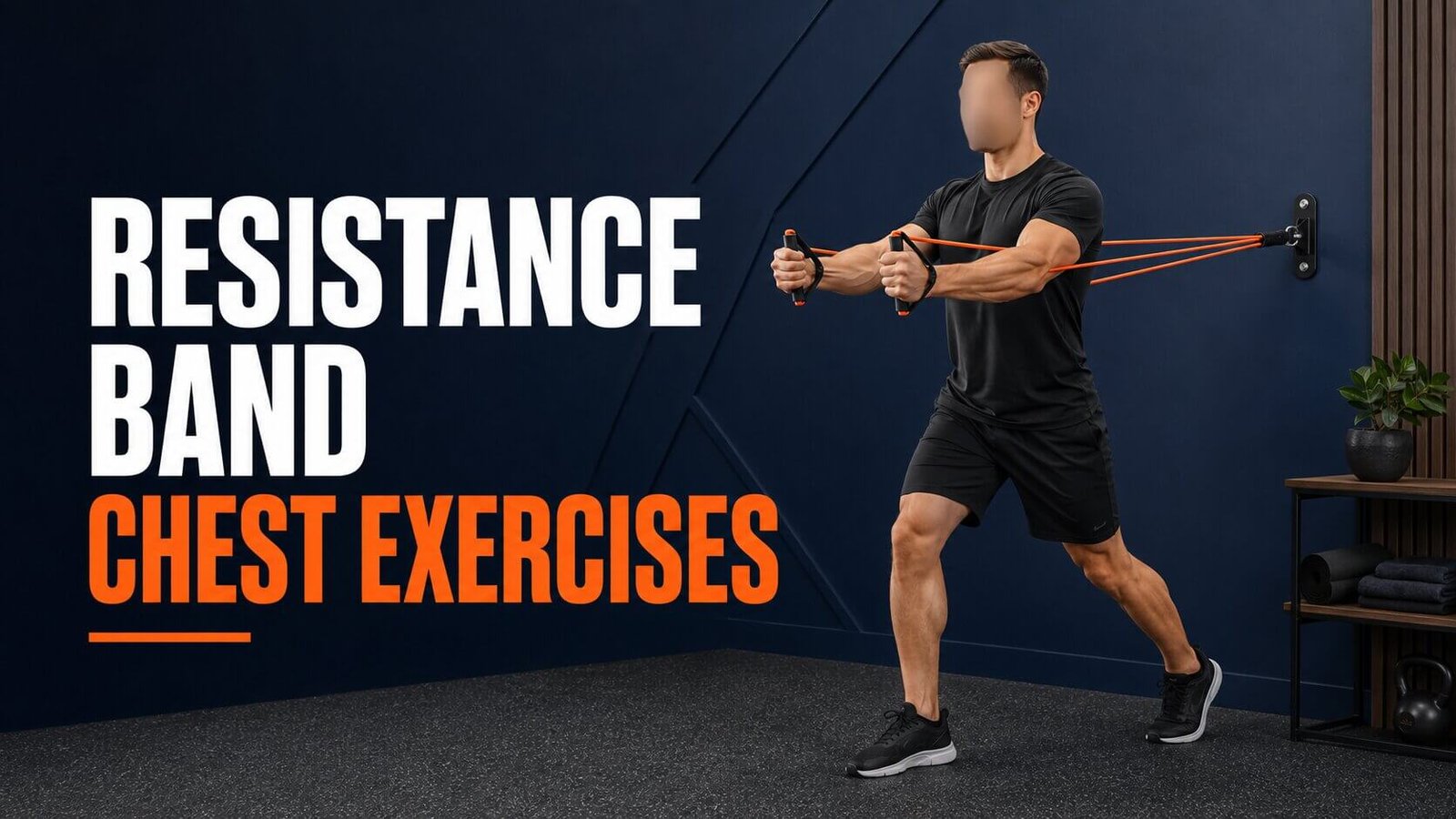
Resistance bands can train your chest through presses, push-ups, flys, and crossovers. A balanced session needs one challenging press, a second pressing variation, and a lighter fly or crossover. You can do this with a secure anchor or with the band wrapped across your upper back.
This guide provides nine resistance band chest exercises, two complete workouts, band-selection guidance, and practical progression. It also explains how to place more emphasis on the chest without pretending that your shoulders and triceps can be removed from pressing movements.
Safety note: Inspect the band and every attachment before training. Keep your face outside the likely recoil path, control the return, and stop if an exercise causes sharp, radiating, or worsening pain, numbness, dizziness, or joint instability. Seek individualized guidance if you have an injury, recent surgery, or a medical condition that affects exercise.
Resistance Band Chest Exercises at a Glance
Choose exercises by setup and movement pattern rather than trying to fit all nine into one session. Two presses and one fly-style movement are enough for a complete beginner workout.
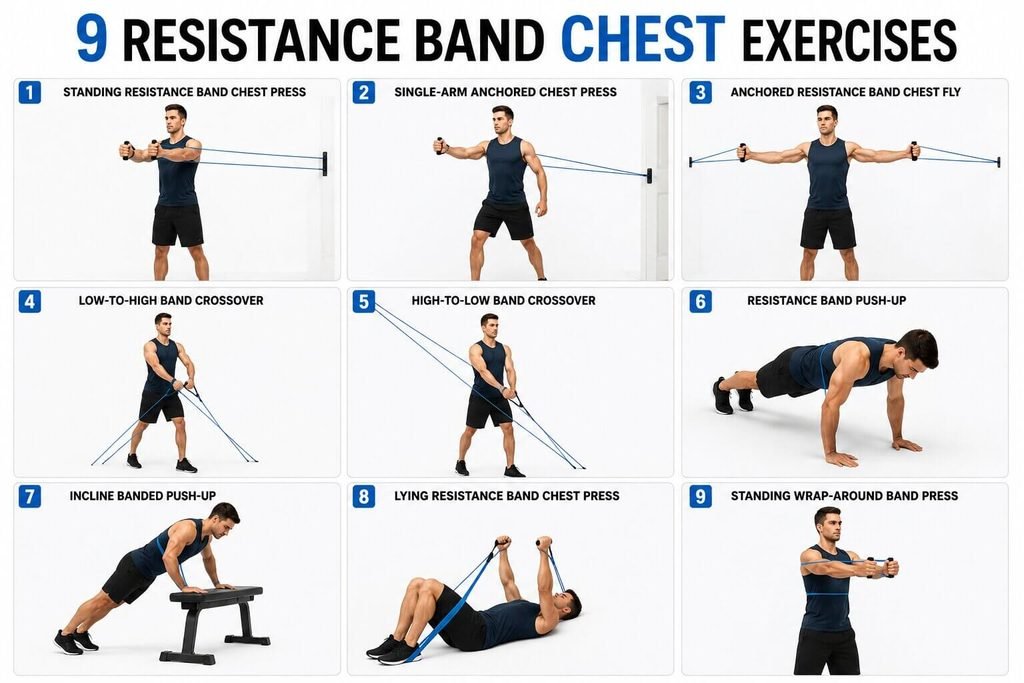
| Exercise | Main emphasis | Anchor? | Beginner range |
|---|---|---|---|
| Standing band chest press | General chest, triceps | Chest height | 8–15 |
| Single-arm anchored press | Chest, trunk stability | Chest height | 8–15 per side |
| Anchored chest fly | Chest adduction | Chest height | 10–20 |
| Low-to-high crossover | Upper-chest emphasis | Low | 10–20 per side |
| High-to-low crossover | Lower-chest emphasis | High | 10–20 per side |
| Banded push-up | Chest, triceps, shoulders | No | 6–15 |
| Incline banded push-up | Beginner press | No | 6–15 |
| Lying band chest press | General chest, triceps | No | 8–15 |
| Standing wrap-around press | General chest, triceps | No fixed anchor | 10–20 |

- 💖Resistance Bands for Women: Our exercise bands are based on market conditions to upgrade women’s resistance bands, to u…
- 🌟High quality and thoughtful exercise bands resistance for women: these workout bands are made of eco-friendly natural l…
- 👍Portable & Customised Training Manual: The resistance bands set is portable and comes with a carrying bag that fits eas…
Can Resistance Bands Build Chest Strength and Muscle?
Yes. Resistance bands can build chest strength and support muscle growth when sets create enough muscular effort and the challenge progresses over time. A systematic review and meta-analysis found broadly similar strength gains from elastic and conventional resistance training across the included studies. [1]
The chest does not know whether tension came from a band, dumbbell, cable, or machine. It responds to muscular tension, effort, range of motion, training volume, and recovery. The equipment changes how that tension feels and how easily it can be measured.
Band resistance generally rises as the material stretches. A press may feel easiest near the chest and hardest as the arms extend. Research measuring elastic bands confirms that tension changes with elongation and that measured values can differ across bands and from manufacturer estimates. [2]
That resistance curve can be useful, but it is not automatically superior to weights. If the band becomes so difficult at the finish that your elbows cannot extend or your range shortens, reduce the tension.
What Muscles Do Band Chest Exercises Train?
The pectoralis major performs most of the chest work, while the front deltoids and triceps assist presses and push-ups. The serratus anterior helps the shoulder blades move around the rib cage during pressing.
Upper, middle, and lower chest
Changing the arm path can shift emphasis among regions of the pectoralis major, but no exercise completely isolates one portion.
- Horizontal presses and flys: broad chest emphasis.
- Low-to-high crossover: more clavicular or upper-chest emphasis.
- High-to-low crossover: more sternocostal or lower-chest emphasis.
Bench-angle studies show that pressing angle can alter regional muscle activation, although surface EMG does not prove that one angle will create greater long-term growth. [3][4] Treat these angles as options for emphasis, not mandatory “upper” and “lower” chest days.
Can you isolate the inner chest?
No separate inner-chest muscle exists. A crossover can move the upper arm across the torso and create a strong shortened-position contraction, but it does not switch on an independent inner pec.
Developing the chest as a whole can change its appearance. Genetics, total muscle growth, and body-fat level also influence how the area looks.
Shoulders and triceps involvement is normal
Your front shoulders and triceps should work during band presses and push-ups. Technique can shift more emphasis toward the chest, but it cannot eliminate the muscles that move the shoulder and elbow.
If the shoulders fatigue first, check the band strength, anchor height, elbow path, and how far the band pulls your arms backward.
Equipment and Band Strength
A long loop band or tube band with handles works for most exercises. Anchored variations require a compatible, purpose-made door or wall anchor.
Useful equipment
- long loop or tube resistance band;
- compatible handles and clips, if applicable;
- purpose-made anchor for anchored exercises;
- stable elevated surface for incline push-ups; and
- clear floor space without sharp edges.
Mini loop bands are usually too short for a complete chest workout. Flat therapy-style bands may work, but gripping and durability can limit heavy presses.
Choose resistance with the Rep–Range–Form test.
Use a practice set and confirm that you can:
- reach the bottom of the target rep range;
- complete the intended range of motion;
- keep the wrists, shoulders, and trunk stable;
- control the return for about 2 seconds; and
- finish with roughly 2–3 clean repetitions in reserve.
If you cannot reach the minimum reps or the final repetitions become partials, reduce tension. Use a lighter band, move closer to the anchor, or lengthen the working section.
If you exceed the top of the range with several good reps left, add tension by using a stronger band, stepping slightly farther away, or shortening your grip. Change one variable at a time.
Record the band brand and color, anchor height, distance from the anchor, grip position, repetitions, and estimated reps in reserve. Band color is not a universal load measurement.
Quick Chest Warm-Up
A short warm-up should prepare your shoulders and pressing pattern without tiring your chest. Spend 4–6 minutes moving, then perform an easy set of your first exercise.
Try one round:
- March or walk briskly for 60 seconds.
- Perform 6–8 slow arm circles in each direction.
- Complete 8 wall push-ups.
- Perform 8 light band pull-aparts.
- Complete 8 easy reps of your first chest press or push-up variation.
Use a comfortable range. Skip any warm-up movement that worsens symptoms.
9 Resistance Band Chest Exercises
The first five exercises require a secure anchor. The final four need no fixed attachment. You only need three or four exercises in a workout.
1. Standing Resistance Band Chest Press
The standing press is the main anchored compound exercise for the chest. Position the anchor near mid-chest height and use a split stance for stability.
How to do it:
- Secure the band behind you at chest height and test it with gentle tension.
- Face away from the anchor, hold the handles near your chest, and step forward.
- Stagger your feet, brace your trunk, and keep the wrists over the elbows.
- Press forward and slightly inward until the elbows are straight but not forcefully locked.
- Return slowly until the hands reach the sides of your chest.
Easier: Move closer or use a lighter band.
Harder: Step forward slightly, add repetitions, or pause at full extension.
Avoid flaring the elbows straight sideways, arching the lower back, shrugging, and allowing the band to pull the hands behind the torso.
2. Single-Arm Anchored Chest Press
The single-arm press trains the chest while the trunk resists rotation. It also allows each side to work independently.
How to do it:
- Anchor the band at chest height and hold it in one hand.
- Face away in a split stance with the opposite foot forward if that feels stable.
- Hold the hand near the lower or middle chest and keep the torso square.
- Press forward without rotating the shoulders or hips.
- Return under control, complete the set, and switch sides.
Easier: Use a lighter band or half-kneel for a more stable base.
Harder: Add a short pause or slightly increase anchor distance.
Avoid: Twisting to finish, bending the wrist, and using different ranges on each side. Start with the weaker side and match its reps.
3. Anchored Resistance Band Chest Fly
The chest fly emphasizes horizontal adduction—bringing the upper arms toward the midline—with less elbow movement than a press. Use lighter resistance because the arms create a longer lever.
How to do it:
- Anchor the band behind you at chest height.
- Face away and hold one end in each hand with the arms open and elbows softly bent.
- Maintain that elbow angle while sweeping the upper arms forward.
- Bring the hands together in front of the chest without forcing them across.
- Return only until you feel a comfortable chest stretch.
Easier: Use a lighter band or shorten the opening range.
Harder: Pause with the hands together or add reps.
Avoid the following: turning it into a press, overstretching behind the body, shrugging, and letting the band snap the arms open.
4. Low-to-High Band Crossover
The low-to-high crossover uses an upward diagonal arm path to place more emphasis on the clavicular or upper-chest fibers. It remains a chest exercise, not an isolated upper-pec switch.
How to do it:
- Secure one band low and slightly behind you.
- Hold it in the same-side hand and step forward until lightly tensioned.
- Start with the hand near the hip and elbow slightly bent.
- Sweep the upper arm forward and upward toward the opposite upper chest.
- Return slowly, complete the set, and switch sides.
Easier: Use less tension and finish below shoulder height.
Harder: Add reps or a one-second pause.
Avoid: Shrugging, twisting the torso, curling the hand upward, and finishing so high that the movement becomes mostly a shoulder raise.
5. High-to-Low Band Crossover
The high-to-low crossover uses a downward diagonal path for more lower-chest emphasis. Keep the movement controlled and avoid using body weight to drag a heavy band downward.
How to do it:
- Secure one band above shoulder height.
- Face away and hold it in one hand with a soft elbow bend.
- Brace and draw the upper arm forward and down toward the opposite hip or lower chest.
- Stop before the shoulder rolls forward.
- Return slowly and repeat on the other side.
Easier: Move closer or use a lighter band.
Harder: Pause at the finish or add reps.
Avoid: Side-bending, rotating, straightening and bending the elbow repeatedly, and pulling far past the body.
6. Resistance Band Push-Up
The banded push-up combines body weight with rising band tension. The band should lie across the upper-to-middle back—not the neck—and remain trapped securely beneath the palms.
How to do it:
- Drape a long band across your upper back below the neck.
- Hold an end in each hand and place your palms over the band on the floor.
- Set a stable plank from head to heels.
- Lower the chest between the hands while keeping the elbows roughly 30–60 degrees from the torso.
- Press the floor away until the arms straighten.
Easier: Use an unbanded push-up or the incline version below.
Harder: Use a stronger band only after you can maintain full range.
Avoid the following: placing the band on the neck, letting it roll toward the head, sagging through the lower back, shortening the bottom range, and lifting a palm while the band is stretched.
7. Incline Banded Push-Up
The inclined banded push-up reduces the body-weight demand while retaining band resistance near the top. It is the most practical banded push-up progression for many beginners.
How to do it:
- Place the band across the upper back and trap it under both palms.
- Put your hands on a stable counter, rail, or heavy bench that cannot slide.
- Walk the feet back and create a straight line from head to heels.
- Lower the chest toward the support.
- Press away while keeping the band secure.
Easier: Use a higher surface or remove the band.
Harder: Use a lower stable surface before increasing band strength.
Avoid: Using a lightweight chair, placing the band near the neck, and allowing the hips to sag.
8. Lying Resistance Band Chest Press
The lying band press requires no anchor and gives the floor a stable base. The band runs across the upper back while you press both hands over the chest.
How to do it:
- Sit with the band across your upper back and an end in each hand.
- Lie down with knees bent and feet planted.
- Position the elbows 30–60 degrees from the torso and stack the wrists above them.
- Press the hands upward and slightly inward.
- Lower until the upper arms touch the floor gently.
Easier: Use a lighter or longer band.
Harder: Shorten the grip, add reps, or pause at the top.
Avoid: Routing the band near the neck, bending the wrists backward, bouncing the arms off the floor, and releasing a stretched end.
9. Standing Wrap-Around Band Press
The wrap-around press needs no fixed anchor because the band loops across the upper back. It works best with moderate tension and a band that stays below the neck.
How to do it:
- Wrap the middle of a long band across the upper-to-middle back.
- Hold an end in each hand near the chest.
- Stand in a split stance with the ribs controlled.
- Press forward until the elbows straighten comfortably.
- Return slowly without letting the band slide upward.
Easier: Use a longer grip or lighter band.
Harder: Shorten the working length slightly or add repetitions.
Avoid: Placing the band across the neck, arching, jerking, and allowing the ends to slip from the hands.
Anchored vs. No-Anchor Chest Exercises
Anchored exercises offer more angles, while no-anchor variations are faster to set up and easier to use while traveling. Choose the method you can perform safely and consistently.
| Factor | Anchored | No anchor |
|---|---|---|
| Best options | Press, fly, low/high crossover | Push-up, lying press, wrap-around press |
| Angle choices | High, low, horizontal | Mostly horizontal |
| Main risk | Anchor or attachment failure | Band slipping from hands or back |
| Progress tracking | Record anchor height and distance | Record grip length and band placement |
Do not improvise with a doorknob, lightweight chair, or sharp railing. If no trustworthy anchor exists, use the no-anchor workout.
Two Resistance Band Chest Workouts
Choose one workout and perform it up to twice per week on nonconsecutive days. Start at the lower set count and add work only when technique and recovery remain good.
Workout A: No Anchor Needed
| Exercise | Sets | Repetitions | Rest |
|---|---|---|---|
| Banded push-up or incline banded push-up | 2–3 | 6–15 | 60–120 sec |
| Lying band chest press | 2–3 | 8–15 | 60–120 sec |
| Standing wrap-around press | 2 | 10–20 | 60–90 sec |
Begin with two sets of each exercise. If the push-up and wrap-around press feel too similar, keep the push-up and lying press, then perform only one wrap-around set or omit it.
Workout B: Secure Anchor Available
| Exercise | Sets | Repetitions | Rest |
|---|---|---|---|
| Standing anchored chest press | 2–3 | 8–15 | 60–120 sec |
| Single-arm anchored press | 2 per side | 8–15 | 60–90 sec |
| Anchored chest fly | 1–2 | 10–20 | 45–90 sec |
| Low-to-high or high-to-low crossover | 1–2 per side | 10–20 | 45–90 sec |
Start with two press sets, two single-arm sets per side, one fly set, and one crossover set per side. Do not count a unilateral set twice for each side: two sets per side means each side received two sets.
How to Feel Band Exercises in Your Chest
Reduce the resistance first, then improve the pressing path. The chest can work effectively without a dramatic burn, so use technique and progression—not sensation alone—to judge the exercise.
Try these cues:
- Keep the elbows roughly 30–60 degrees from the torso during presses.
- Align the anchor with the direction you want to press.
- Keep the wrists reasonably stacked over the elbows.
- Press forward and slightly inward rather than straight outward.
- Avoid shrugging.
- Stop the return before the shoulders are pulled into an excessive stretch.
- Control the band back for about 2 seconds.
If the triceps fatigue first, that may simply reflect their current strength. A fly variation uses less elbow extension, but it should not replace every press.
Sets, Reps, Frequency, and Progression
Beginners can start with 6–8 direct chest sets per session, mostly 8–20 reps, and up to two sessions per week. Count chest pressing performed in full-body or shoulder workouts before adding more volume.
Practical starting points
- Presses and push-ups: 2–3 sets of 6–15 reps.
- Flys and crossovers: 1–2 sets of 10–20 reps.
- Rest: 60–120 seconds for presses; 45–90 seconds for lighter accessories.
- Effort: Finish most sets with about 2–3 clean reps in reserve.
Training to complete failure is not required. A systematic review and meta-analysis found no clear need to reach momentary failure for strength or muscle growth. [5]
Use double progression
Keep the setup consistent and add repetitions within a range. For a 2 × 8–15 press, progress from 11 and 10 reps toward 15 and 15. Once both sets reach the top with clean form and about 2 RIR, add a small amount of tension and return to the lower end.
Progress by:
- using a stronger band;
- moving slightly farther from the anchor;
- shortening the grip;
- adding repetitions;
- adding one set;
- slowing the return; or
- pausing at full extension.
Change one variable at a time and record the setup.
Common Mistakes
Most errors come from excessive resistance, unsafe setup, or trying to force a dramatic stretch. Correcting those issues usually improves chest involvement immediately.
- Choosing by color alone: Band colors are not standardized. Use the Rep–Range–Form Test.
- Starting with flys: Perform your main press or push-up before lighter isolation work.
- Using too much tension: Reduce tension if the range shortens or the trunk leans forward.
- Over-stretching the shoulders: Do not let the band pull the elbows far behind the torso.
- Turning flys into presses: Keep a soft, nearly fixed elbow angle.
- Flaring elbows straight sideways: Use a comfortable angle closer to 30–60 degrees.
- Letting the band snap back: Control the return and remain clear of recoil.
- Using unsafe anchors: Do not use doorknobs, loose furniture, or sharp objects.
- Placing the band on the neck: Position wrap-around bands across the upper-to-middle back.
- Expecting spot fat loss: Chest exercises build muscle but cannot selectively remove chest fat.
Resistance Band Chest Workout Safety
Band recoil and attachment failure can cause serious injury. Published reports describe eye trauma from elastic exercise bands, making inspection and recoil awareness essential. [6]
Before every workout
- Inspect the complete band for cracks, cuts, thinning, brittleness, or damaged seams.
- Check handles, clips, and anchor loops.
- Use a compatible purpose-made anchor and follow its instructions.
- Remove rings or sharp objects that could cut the band.
- Test each setup with light tension.
- Keep pets, children, and other people out of the training path.
- Replace damaged equipment instead of using tape, glue, or knots as a repair.
During each set
- Keep your face outside the likely recoil path.
- Never release a stretched band.
- Keep wrap-around bands below the neck.
- Trap the band securely under the palms during push-ups.
- Do not stretch beyond the manufacturer’s stated limit.
- Stop immediately if the anchor moves, a clip opens, or the band begins to roll or slip.
Muscular effort is expected. Sharp pain, radiating symptoms, sudden weakness, numbness, or joint instability are reasons to stop. General exercise guidance cannot diagnose or treat chest, shoulder, or arm pain.
Practical Recommendations
Choose one workout and repeat it for four weeks. Begin with six working sets, leave 2–3 reps in reserve, and log the band, anchor or grip setup, reps, and effort.
Keep the exercise order simple: primary press, secondary press, then fly or crossover. Add reps before resistance, and change only one loading variable at a time. Use the Resistance Band Levels Explained guide for detailed band-selection help.
Frequently Asked Questions
What are the best resistance band chest exercises?
The best combination is a standing press or banded push-up, a second press, and a chest fly or crossover. This covers compound pressing and horizontal adduction without unnecessary duplication.
Can I train my chest without an anchor?
Yes. Use banded push-ups, incline banded push-ups, lying band chest presses, and standing wrap-around presses. Keep the band across the upper-to-middle back rather than the neck.
Are resistance band flies effective?
Band flies can train the chest through horizontal adduction. Use them after presses, choose lighter resistance, maintain a soft elbow bend, and avoid an excessive backward stretch.
How can I target my upper chest with bands?
Use a low-to-high crossover or a slightly upward pressing path. These movements can shift emphasis toward the clavicular fibers, but they still train the wider chest and assisting muscles.
Why do I feel bad chest exercises in my shoulders?
The front shoulders normally assist. Excessive shoulder fatigue may indicate too much resistance, a high or poorly aligned anchor, flared elbows, shrugging, or too much backward range.
How often should I train my chest?
Up to two nonconsecutive sessions per week is a practical beginner starting point. Include chest sets from full-body, push, and shoulder workouts when estimating total volume.
Should I train to failure with resistance bands?
No. Finish most sets with approximately 2–3 good reps remaining. Getting close enough to challenge the target muscles matters, but failure is not required on every set.
Can resistance band exercises reduce chest fat?
No exercise can selectively remove fat from the chest. Band exercises can strengthen and build the chest muscles, while overall fat loss depends on sustained energy balance and broader lifestyle factors.
Are bands as effective as dumbbells for chest training?
Both can train the chest, but they feel different. Band tension rises with stretch, while dumbbells provide gravity-based load and are easier to quantify. The better option is the one you can progress safely and consistently.
Read Dumbbells vs. Resistance Bands for a complete equipment comparison.
Conclusion
Resistance bands can provide a complete chest workout at home. Build each session around a press or banded push-up, add a second press, then finish with a lighter fly or crossover.
Start with six controlled working sets twice weekly. Choose resistance by reps and form, record the exact setup, and add repetitions before tension. Most importantly, inspect the equipment, secure every anchor, keep bands away from the neck, and control every return.
For a full-body plan using the same equipment, continue with the Resistance Band Workout for Beginners.
References
- Lopes JSS, Machado AF, Micheletti JK, de Almeida AC, Cavina AP, Pastre CM. Effects of training with elastic resistance versus conventional resistance on muscular strength: A systematic review and meta-analysis. SAGE Open Medicine. 2019;7:2050312119831116. PubMed | DOI
- Uchida MC, Nishida MM, Sampaio RAC, Moritani T, Arai H. Thera-Band elastic band tension: Reference values for physical activity. Journal of Physical Therapy Science. 2016;28(4):1266–1271. PubMed | DOI
- Trebs AA, Brandenburg JP, Pitney WA. An electromyography analysis of three muscles surrounding the shoulder joint during the performance of a chest press exercise at several angles. Journal of Strength and Conditioning Research. 2010;24(7):1925–1930. PubMed
- Lauver JD, Cayot TE, Scheuermann BW. Influence of bench angle on upper extremity muscular activation during bench press exercise. European Journal of Sport Science. 2016;16(3):309–316. PubMed
- Grgic J, Schoenfeld BJ, Orazem J, Sabol F. Effects of resistance training performed to repetition failure or non-failure on muscular strength and hypertrophy: A systematic review and meta-analysis. Journal of Sport and Health Science. 2022;11(2):202–211. PubMed | DOI
- Ng CC, Carrera W, Peng MY, et al. Ocular injuries associated with elastic exercise bands. Retinal Cases & Brief Reports. 2022;16(6):786–792. PubMed | DOI