A beginner bodyweight workout should progress through measurable improvements, not random exercise changes. Start with a version of each movement that fits your current ability, build controlled repetitions within a range, and then make the leverage or range of motion slightly more demanding.
This guide uses six movement ladders: squat, push, hinge and glute, pull, vertical push, and core. Each ladder provides easier and harder variations, while the training plan explains when to move up, when to stay, and when to step back. The result is a repeatable system rather than a collection of increasingly flashy exercises.
The program is designed for generally healthy adults who are new to resistance training or returning after a break. It is not a medical assessment or rehabilitation plan. Pain, recent surgery, pregnancy-related restrictions, dizziness, chest symptoms, or a condition that affects exercise may require guidance from an appropriate health professional.
How Should Beginners Progress Bodyweight Workouts?
Beginners should use double progression: first add repetitions within a defined range, then move to a slightly harder exercise variation. This keeps progress visible while limiting unnecessary jumps in difficulty.
Resistance training works when the muscles repeatedly face a meaningful challenge and that challenge increases over time. This idea is progressive overload. With bodyweight training, the overload does not have to come from a heavier dumbbell. You can change joint angles, reduce assistance, increase useful range of motion, shift more weight to one limb, or slow a difficult part of the repetition.
Current resistance-training guidance emphasizes consistency and individualization over complicated programming. Home-based training, elastic bands, and bodyweight movements can improve strength and physical function when they are performed regularly and progressed appropriately. U.S. physical activity guidance also recommends muscle-strengthening activity for all major muscle groups on at least two days each week.
The Double-Progression Method
Use the same variation long enough to improve it. The following six-step method is a practical coaching framework, not a universal scientific law or a guarantee that every person will progress on the same schedule.
1. Select the variation: Choose an exercise that allows at least 5 clean repetitions but becomes challenging before roughly 12.
2. Start with two sets: Most beginners can learn the movement and recover well with two work sets. Add a third set later if progress stalls and recovery is good.
3. Build repetitions: Add one repetition to one or more sets when the previous session felt controlled. You do not need to increase every set at once.
4. Confirm the top of the range: Reach the upper target with the planned range of motion, steady tempo, and about 2-3 repetitions in reserve.
5. Repeat before advancing: Meet the standard in two sessions. This reduces the chance that one unusually good day triggers a premature jump.
6. Move up and reset: Choose the next sensible variation and restart near the lower end of its repetition range.
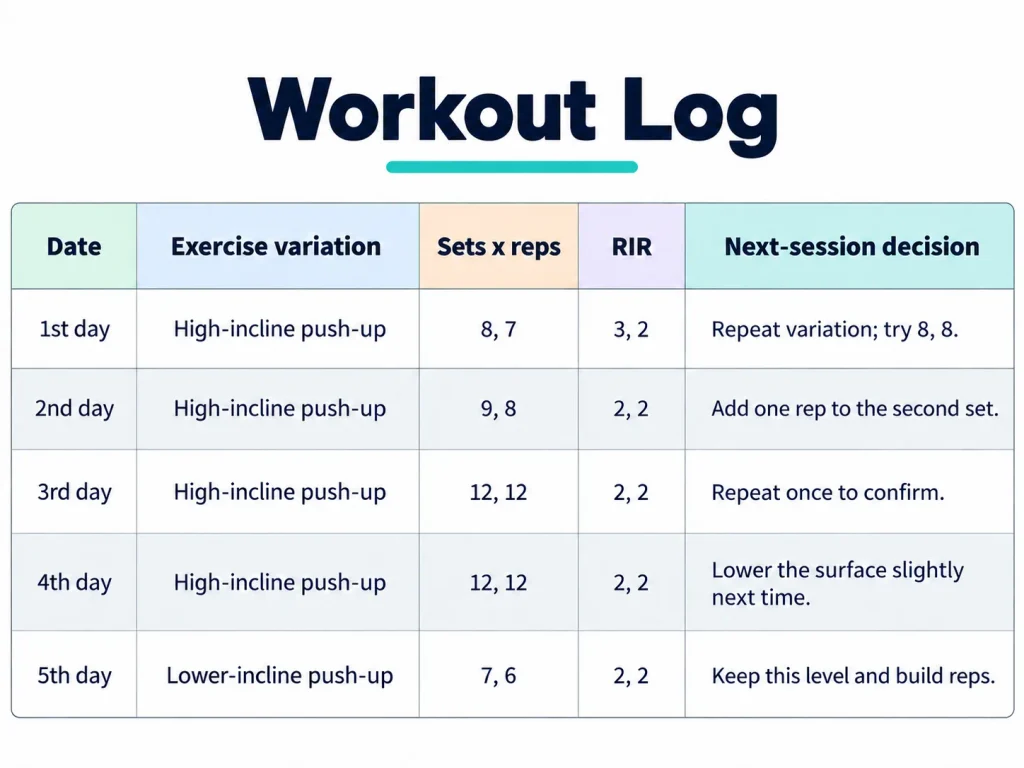
| Example: A beginner performs high-incline push-ups for 8 and 7 repetitions. Over several sessions, the sets become 12 and 12 with clean technique. After repeating that result, the trainee lowers the hands to a slightly shorter surface and begins again at 6-8 repetitions. |
|---|
How Can You Make Bodyweight Exercises Harder Without Weights?
Make an exercise harder by changing one variable at a time. The safest next step is usually a modest leverage or range-of-motion change, not an advanced skill that looks unrelated to the movement you practiced.
- Reduce assistance: use less hand support in a squat or a lower surface for incline push-ups.
- Increase range of motion: squat slightly deeper or lower the chest farther during an incline push-up, provided control remains stable.
- Change leverage: move the feet farther from the anchor during a suspension row or use a longer plank position.
- Use unilateral loading: progress from a bridge to an assisted single-leg bridge or from a squat to a supported split squat.
- Add a pause or slower lowering phase: this can increase difficulty, but it should not replace normal full-range repetitions in every session.
- Add minimal resistance: a backpack, band, or light dumbbell is reasonable when the bodyweight ladder becomes awkward or impractical.
How Do You Choose the Correct Starting Level?
Start at the easiest variation that still feels like strength work. The correct level lets you complete the minimum repetitions with control and no sharp pain, yet does not allow endless easy repetitions.
Test one movement at a time after a short warm-up. Perform up to 12 deliberate repetitions, stopping earlier if technique changes or you estimate only two or three clean repetitions remain. Use a lower level if you cannot reach five controlled repetitions. Use a harder level if 12 repetitions feel easy and your range stays consistent.
Beginner Starting-Level Checklist
- You can enter and leave the position without losing balance or rushing.
- You can complete at least five repetitions or hold the position for at least 10 controlled seconds.
- The last repetitions slow slightly, but your range of motion and joint position remain consistent.
- You feel the intended muscles working without sharp, radiating, or worsening pain.
- You could probably complete two or three more good repetitions if required.
When Should You Advance or Regress?
Advance when performance is repeatable and controlled; regress when the minimum standard requires compensation. A variation is a tool, not a status symbol, so moving down for a day is often the most productive choice.
| Decision | Use this test | Next action |
|---|---|---|
| Advance | Top of the rep range on all planned sets; 2-3 reps in reserve; stable range and tempo; repeated in two workouts. | Move to the next small variation and restart near the low end. |
| Stay | Minimum reps are met, but the top of the range or technique standard is not yet repeatable. | Keep the same variation and add reps gradually. |
| Regress | Fewer than five clean reps, shortened range, joint discomfort, breath-holding you cannot control, or repeated technique breakdown. | Use more assistance, a shorter range, or an easier variation. |
| Pause and assess | Sharp or radiating pain, dizziness, chest pain, unusual shortness of breath, or symptoms that worsen. | Stop the session and seek appropriate medical guidance when needed. |
Sleep, stress, illness, heat, and previous activity can temporarily reduce performance. One poor session does not erase progress. Repeat the easier version, reduce a set, or stop early rather than forcing the planned level.
Six Bodyweight Exercise Progression Ladders
The ladders below move from supported, stable variations toward exercises that use more range, less assistance, or more single-limb loading. Skip a step only when you already meet the starting and advancement standards.
1. Squat Progression
Progress the squat by reducing assistance, increasing comfortable depth, and then introducing split-stance work. Single-leg variations usually create a larger jump than a small depth or pause change.
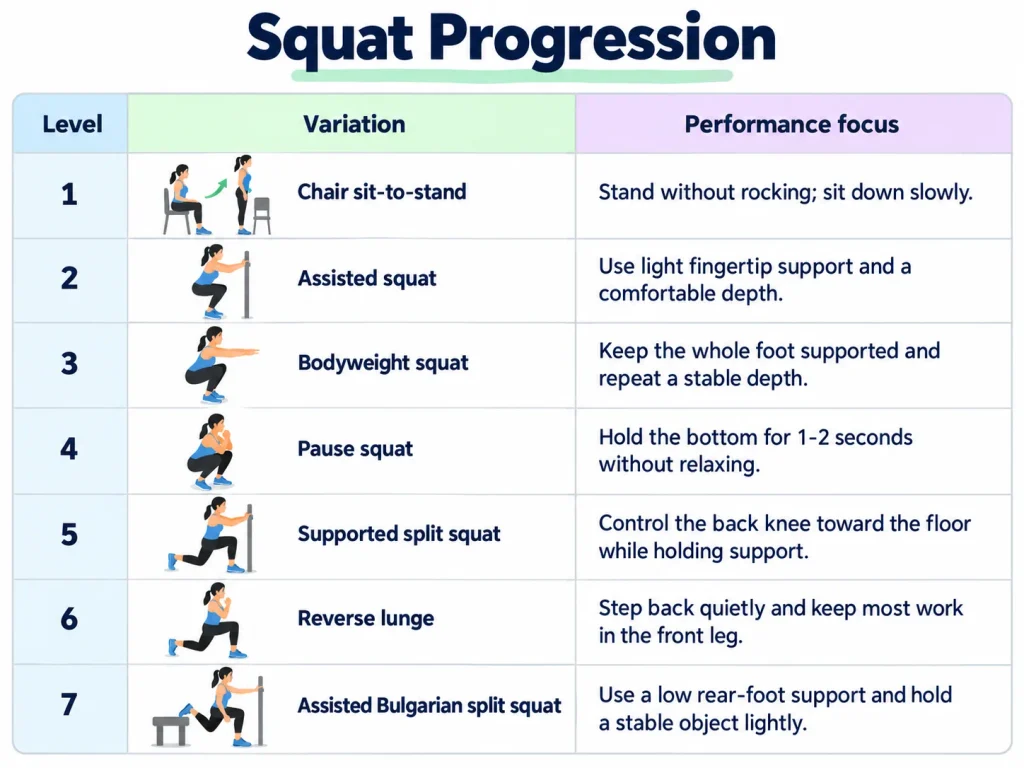
If knee or hip discomfort appears, shorten the range, return to a chair, and check that the foot remains stable. A knee moving forward is not automatically an error; the relevant test is whether the motion is controlled and comfortable for you.
2. Push-Up Progression
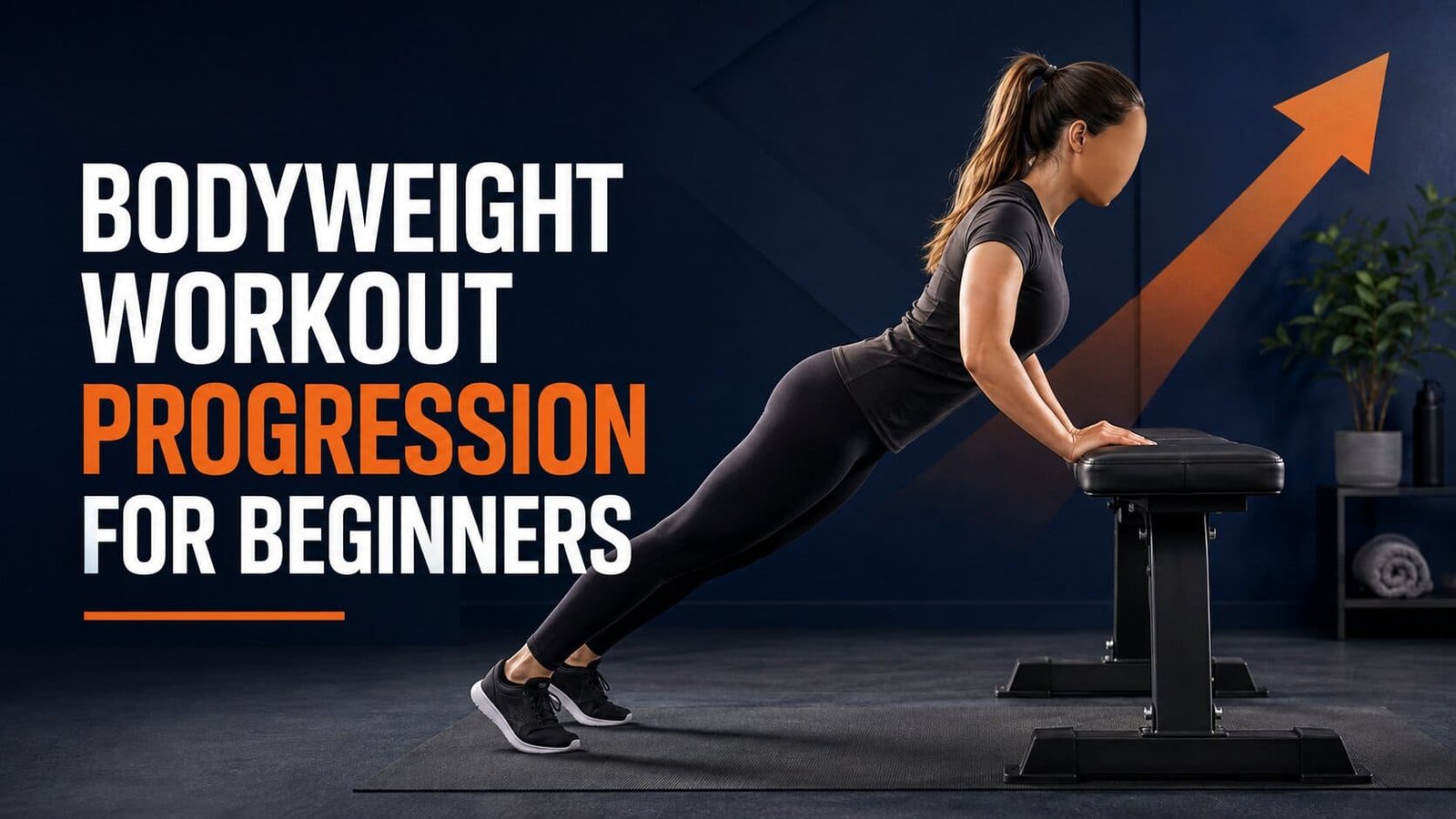
Progress push-ups by gradually lowering the hand support until you can control a floor repetition. Incline height is easier to adjust in small steps than jumping directly from wall push-ups to the floor.
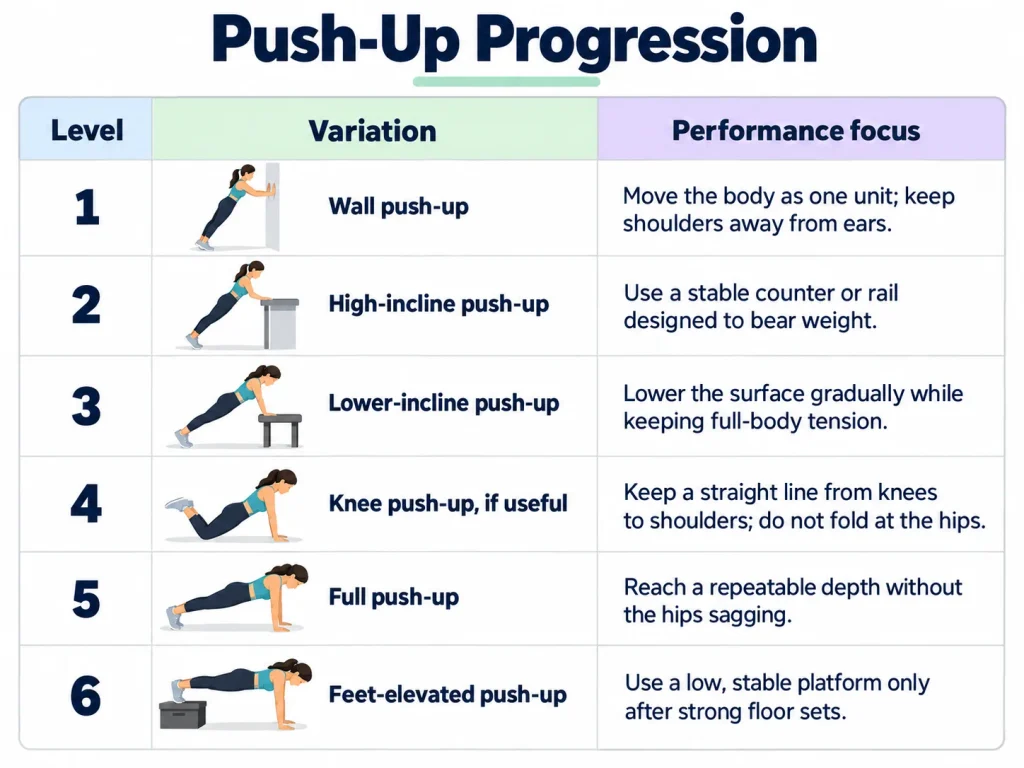
Knee push-ups help some trainees but are not mandatory. A progressively lower incline often provides a smoother path because it preserves the full-body position used in a floor push-up. A hybrid calisthenics demonstration was consulted for practical wall-to-floor variation ideas, but the progression rules in this guide rely on general resistance-training principles rather than video authority. [5]
3. Hip Hinge and Glute Progression
Build the hinge by learning hip extension on the floor, then practicing a standing hip shift before adding single-leg loading. The hamstrings and glutes should do the work; the lower back should not be forced through extra range.
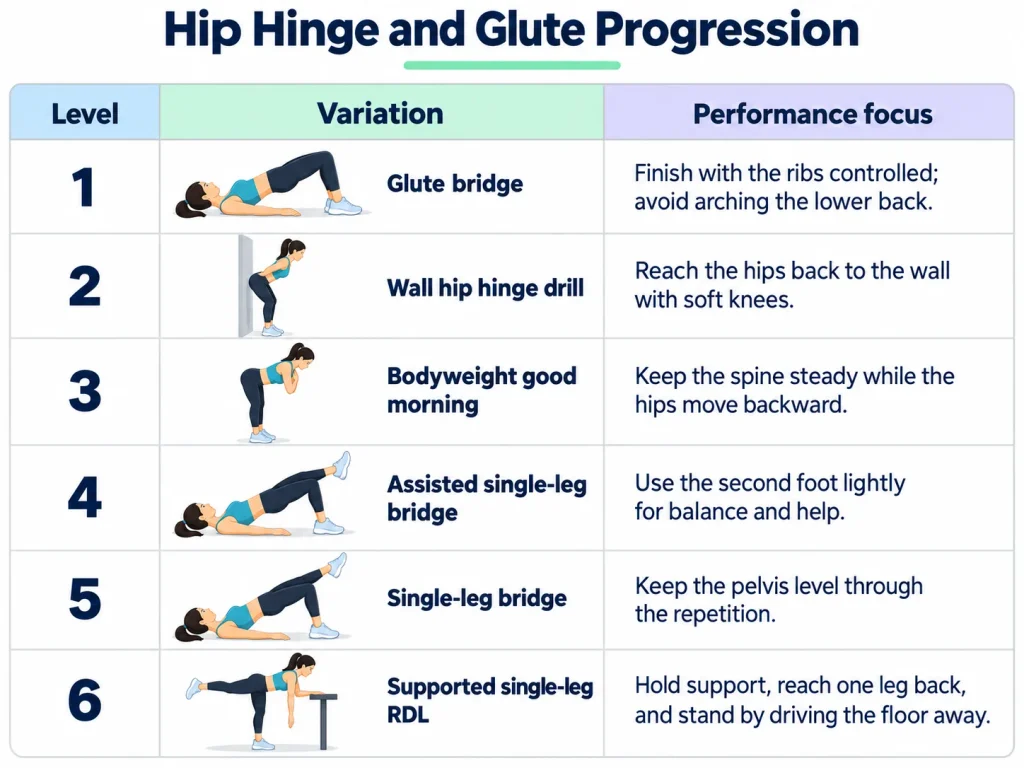
Bodyweight hinges can become too easy before balance is ready for advanced single-leg work. In that case, add a secure backpack or dumbbell to a two-leg Romanian deadlift rather than turning the movement into a balance test.
4. Pulling Progression
Meaningful pulling progression usually requires an anchor and some equipment. A resistance band, suspension trainer, or properly installed pull-up bar provides a safer and more scalable path than improvised furniture.
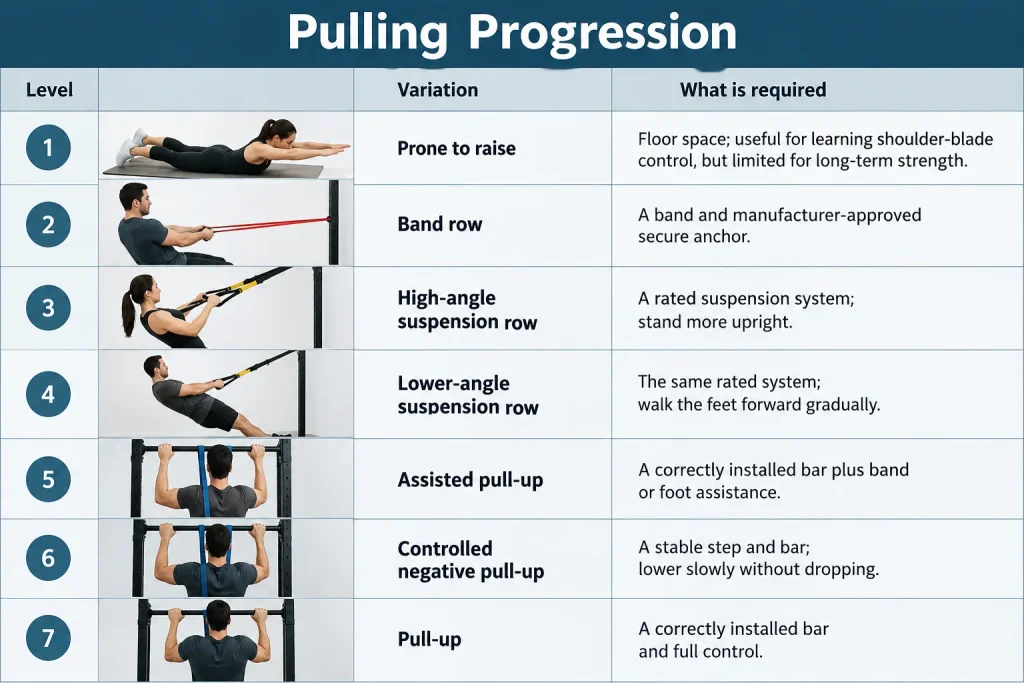
| Safety limitation: Do not perform rows by hanging from an ordinary door, a table edge, a railing, or furniture that is not designed and rated to support your moving body weight. If you lack a safe pulling setup, use floor-based shoulder work temporarily and plan to obtain a band and secure anchor. |
|---|
5. Vertical Push Progression
Vertical pushing begins with learning to support the shoulders in a pike position, then gradually shifts more body weight toward the hands. Handstand push-ups are an advanced skill, not a required beginner goal.
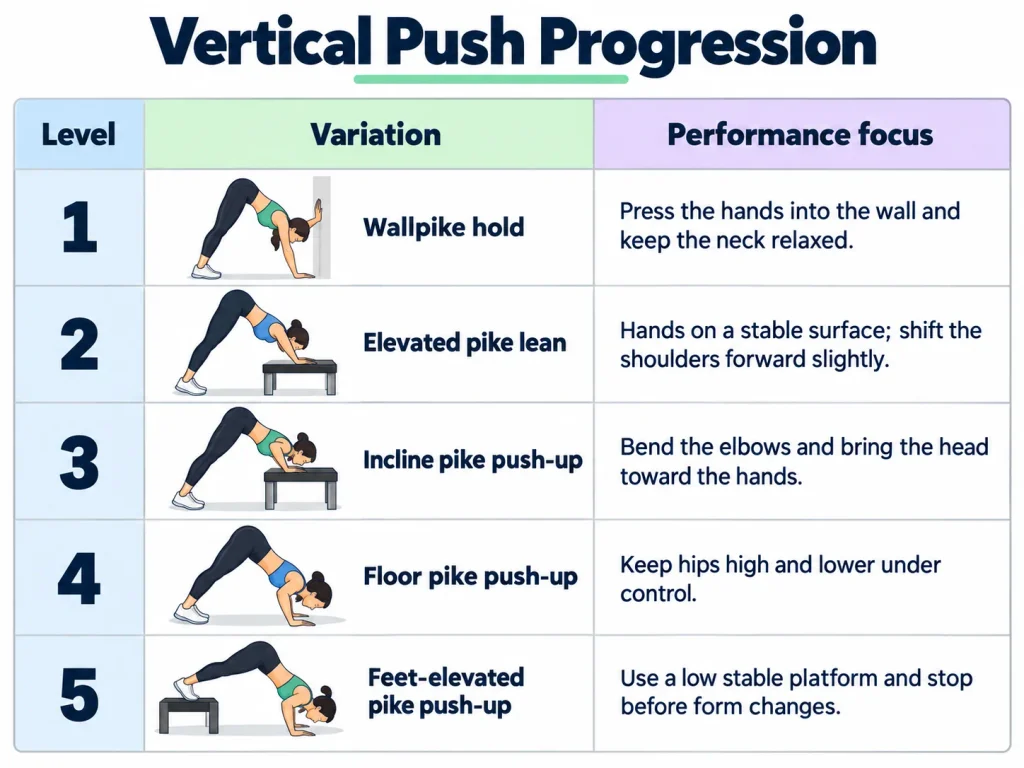
Wrist or shoulder discomfort is a reason to reduce the angle, shorten the range, or substitute a light overhead press if equipment is available. Do not force a vertical push because it appears later in the ladder.
6. Core Progression
Progress core work by increasing lever length and reducing support while keeping the trunk position steady. Longer holds are not useful if breathing stops or the lower back repeatedly changes position.
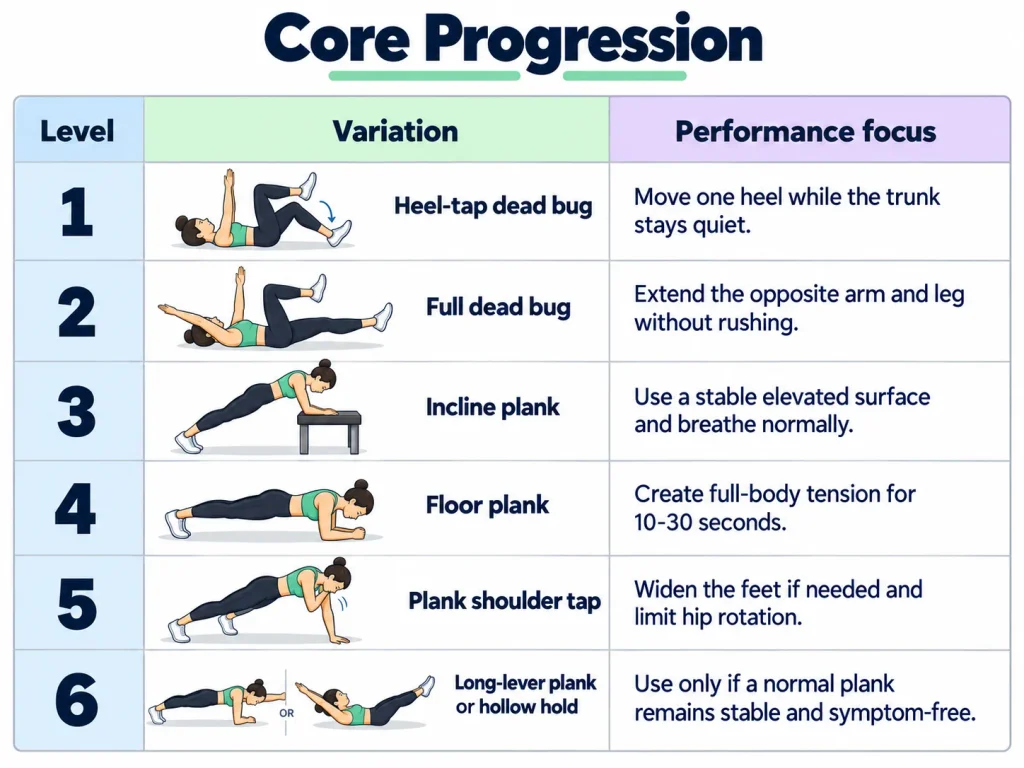
For dead bugs, count repetitions per side. For planks, use 10-30-second holds instead of chasing very long durations. When 30 seconds is controlled for all sets, make the position slightly harder rather than extending the hold indefinitely.
Beginner Full-Body Bodyweight Workout Template
Train the six patterns two or three times per week on nonconsecutive days. Start with two sets of each exercise. A third set is optional after several weeks if recovery is good and a movement has stopped improving.
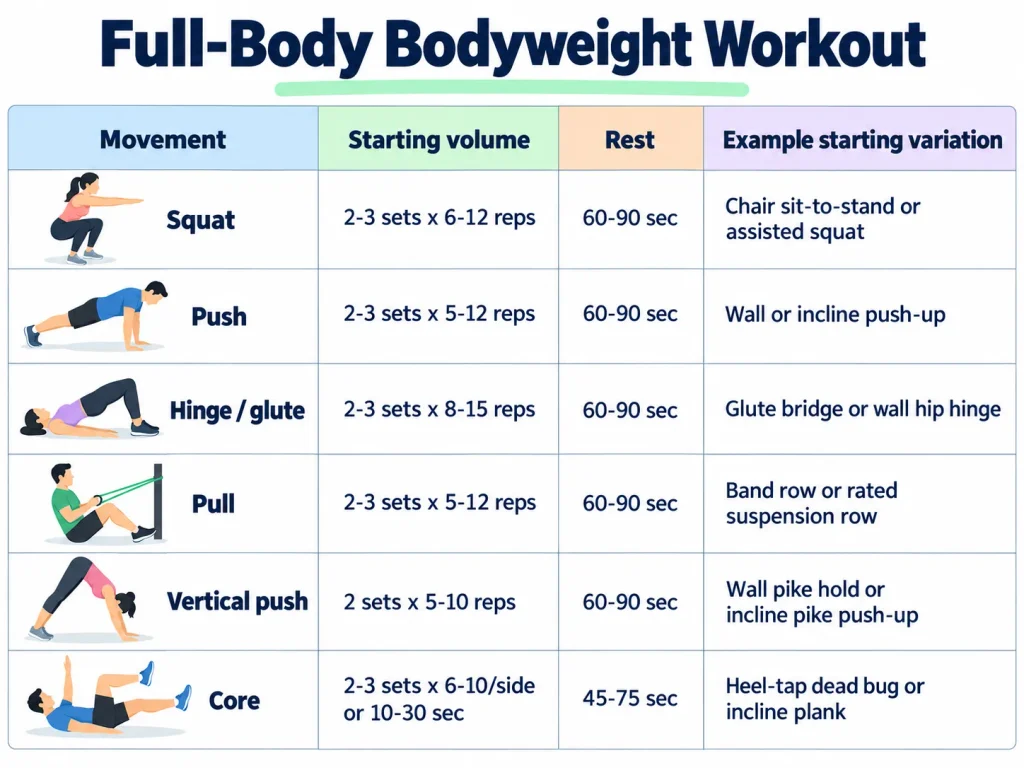
Perform the large movements first, when possible: squat, push, hinge, and pull. Finish with vertical pushing and core work. Rest long enough to repeat controlled technique. The workout is strength-focused, so there is no need to turn it into nonstop cardio.
How Hard Should Each Set Feel?
Most sets should finish with about two or three repetitions in reserve (RIR), meaning you estimate that two or three more clean repetitions were possible. This does not need to be perfectly measured; it is a simple way to avoid both effortless sets and repeated all-out failure.
Beginners can gain strength without taking every set to failure. Stopping slightly short makes technique practice more repeatable and may improve recovery. If you consistently finish a set knowing you could perform many more repetitions, the variation is probably too easy.
Eight-Week Bodyweight Progression Plan
The first eight weeks should emphasize repeatable practice, not a race through the ladders. Progress only the movements that meet the standard; it is normal for the push, squat, pull, and core ladders to move at different speeds.
| Weeks | Primary goal | Progression rule |
|---|---|---|
| 1-2 | Learn the starting variations | Use two sets, conservative range, and 2-3 reps in reserve. Record every session. |
| 3-4 | Add controlled repetitions | Keep the variations stable and add one rep where technique allows. |
| 5-6 | Build useful volume | Continue adding reps. Add a third set to one or two stalled movements only if recovery is good. |
| 7-8 | Advance qualifying movements | Move up only after the top standard is repeated twice; restart at the low end. |
| After week 8 | Repeat and individualize | Run another cycle, maintain difficult movements longer, or add minimal external resistance. |
A review of full-body and split resistance-training routines found similar strength and muscle outcomes when weekly training volume was matched. [3] For beginners, full-body sessions are often simpler because each movement gets regular practice without requiring many training days.
Example Workout Log
A simple log turns progression into a decision instead of a guess. Record the exact variation, repetitions, and estimated repetitions in reserve. Add a short technique note only when it will change the next session.
What If You Cannot Progress?
A plateau usually calls for a smaller change, better recovery, or more practice at the current level. It does not automatically mean you need a completely new routine.
- Check the measurement: use the same surface height, range of motion, and tempo so the log compares like with like.
- Reduce the jump: use a slightly lower incline or less assistance instead of skipping several ladder steps.
- Add a set selectively: if two sets have stopped improving for several sessions and recovery is good, add one set to that movement.
- Extend the repetition range: for bridges or squats, working up to 15 controlled repetitions may be more practical than forcing an awkward advanced variation.
- Use minimal external load: a band, backpack, or dumbbell may create a smoother progression than advanced balance or skill work.
- Review recovery: inconsistent training, inadequate sleep, illness, low food intake, or excessive additional activity can affect performance.
- Take an easier week: reduce sets by about one-third to one-half when fatigue has accumulated, then resume normal training.
Common Beginner Progression Mistakes
The most common mistakes come from progressing the exercise name faster than the underlying strength and control. A harder variation is useful only when it still trains the intended movement safely.
Changing Exercises Every Workout
Frequent novelty makes improvement difficult to measure. Keep the main variations stable for several sessions and change them only when the log or technique gives you a reason.
Advancing After One Good Set
One strong set may reflect extra rest, a different setup, or simple day-to-day variation. Confirm the top of the range across all planned sets and repeat the result before moving up.
Taking Every Set to Failure
Repeated failure is not required for a beginner to progress and can make technique less consistent. Stop with one to three good repetitions available on most work sets, especially on complex or unsupported exercises.
Using Tempo as a Substitute for Load Forever
A controlled lowering phase and short pause can improve awareness, but extremely slow repetitions eventually become inconvenient. When a movement is clearly too easy, use a better leverage change or modest external resistance.
Ignoring Pulling Work
Push-ups do not replace rows or pull-ups. If a safe pulling setup is unavailable, identify that limitation instead of pretending prone arm raises provide unlimited back-strength progression.