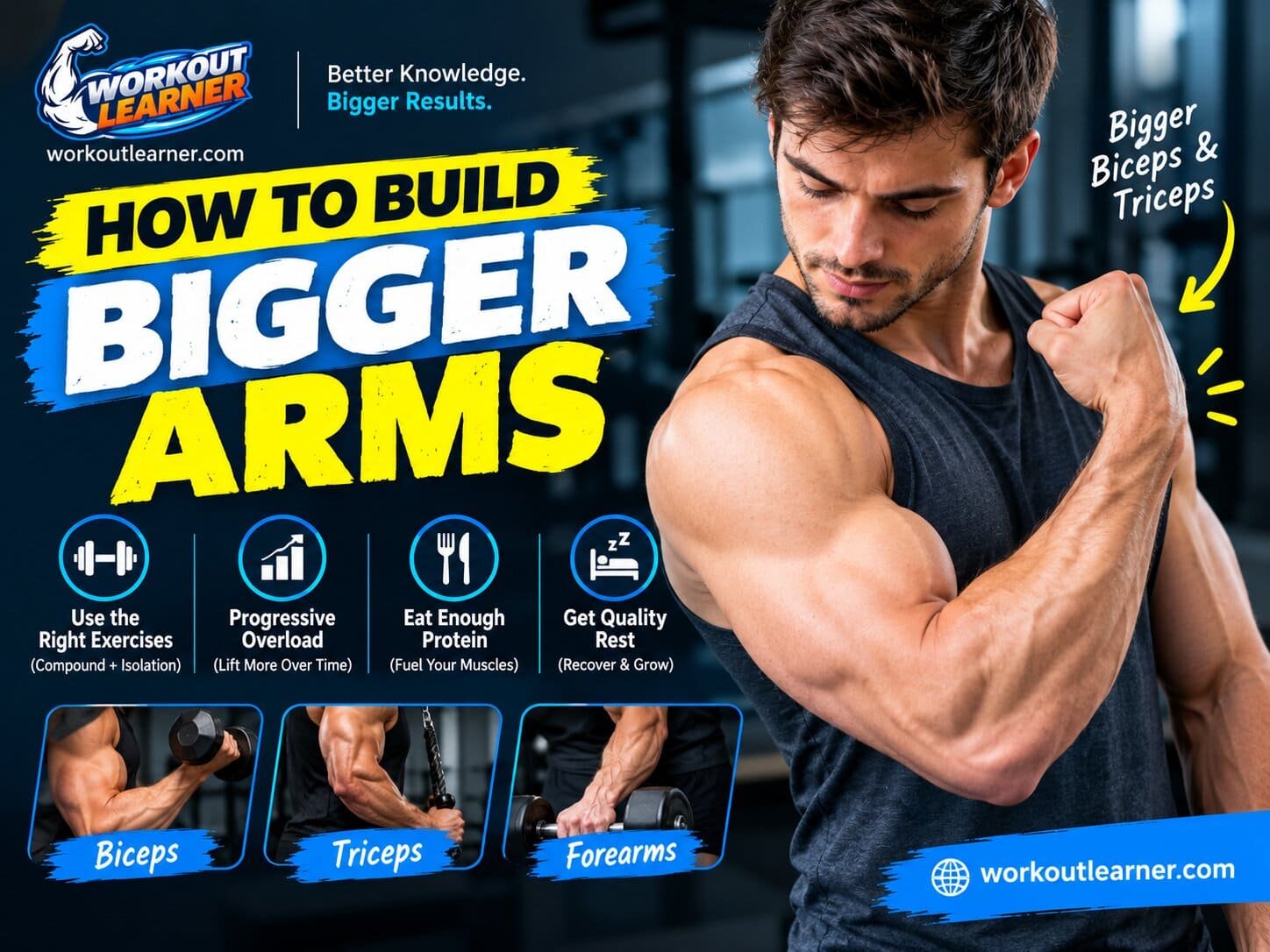
Building bigger arms requires more than doing random curls. Train the biceps, triceps, brachialis, and forearms with challenging, controlled sets; gradually improve your performance; and allow enough time for recovery. For most beginners, two arm-focused sessions per week and roughly 6–10 direct weekly sets for both the biceps and triceps provide a sensible starting point when compound exercises are also included.
No routine can guarantee a specific increase in arm size or a deadline. Genetics, training history, nutrition, sleep, exercise technique, and consistency all affect the result. The practical goal is steady improvement in strength and training quality over months—not a dramatic change in a few days.
What Actually Makes the Arms Grow?
Arm muscle growth occurs when resistance training repeatedly challenges the muscles and the body has enough time and resources to adapt. The main program variables are productive weekly volume, sufficient effort, consistent technique, progressive overload, and recovery.
Muscle hypertrophy means an increase in muscle size. During an arm hypertrophy workout, the biceps produce elbow flexion, the triceps produce elbow extension, and the brachialis, brachioradialis, and forearm muscles assist with different grips and movements. Challenging these actions through a controlled range of motion creates mechanical tension—the force the muscle produces while working against resistance.
The updated American College of Sports Medicine position stand concludes that resistance training improves muscle size and that higher weekly volume generally favors hypertrophy, although individualization and adherence matter. A recent dose–response analysis also found that more weekly sets tend to produce more growth, but with diminishing returns. In other words, adding some work can help; endlessly adding sets is unlikely to be efficient. (ACSM position stand, 2026; Pelland et al., 2026)
This explains why a simple arm-building workout performed consistently usually beats a complicated routine that changes every week.
Arm Muscles You Need to Train
To build muscular arms evenly, train more than the visible front of the upper arm. The biceps and related elbow flexors add shape and thickness to the front and side, while the triceps make up a substantial part of the back of the upper arm.
Biceps brachii
The biceps brachii has a long head and a short head. Both contribute to elbow flexion and forearm supination—the action of turning the palm upward. Standard dumbbell curls, barbell curls, cable curls, and resistance-band biceps curls all train this muscle.
You do not need a separate exercise for every small region of the biceps. Using two complementary curl patterns—such as a supinated curl and a neutral-grip hammer curl—is a practical way to train the elbow flexors without making the program unnecessarily long.
Brachialis and brachioradialis
The brachialis lies beneath the biceps and is a strong elbow flexor. The brachioradialis crosses the elbow and contributes more during neutral- and pronated-grip movements. Hammer curls and reverse curls are useful brachialis exercises that can improve upper-arm and forearm strength.
Triceps brachii
The triceps brachii has long, lateral, and medial heads. All three straighten the elbow, while the long head also crosses the shoulder joint. A well-rounded triceps hypertrophy workout normally includes an overhead extension plus a pressdown, close-grip press, or close-grip push-up.
In one controlled study, cable elbow extensions performed overhead produced more triceps growth than the same movement performed with the arm beside the torso, especially in the long head. That result supports including an overhead triceps extension, but it does not make every other triceps exercise ineffective. (Maeo et al., 2023)
Forearms
The forearm flexors and extensors help stabilize the wrist and grip. Rows, chin-ups, curls, carries, and other gripping exercises already train them. If forearm strength is a priority, add a small amount of direct work such as reverse curls, wrist curls, reverse wrist curls, or farmer carries.
Best Exercises for Bigger Arms
The best exercises for bigger arms are movements you can perform comfortably, progress over time, and repeat with consistent technique. No single curl or extension is mandatory.
Best biceps exercises
Dumbbell or barbell curl
A basic curl provides a stable foundation for biceps hypertrophy. Keep the upper arms mostly still, curl without throwing the torso backward, and lower the resistance under control.
A barbell or EZ-curl bar lets both arms work together and is easy to load. Dumbbells allow each arm to move independently and may feel more comfortable at the wrist. Choose the option that fits your equipment and joints.
Incline dumbbell curl
The incline dumbbell curl places the upper arm behind the torso, creating a long muscle position at the start. Use a bench angle that feels comfortable at the shoulder, keep the load moderate, and avoid pushing into a painful stretch.
Research on elbow-flexion training suggests that work performed in the more lengthened part of the curl can support regional biceps growth. However, this does not prove that partial repetitions are universally better than a controlled full range of motion. (Pedrosa et al., 2023)
Preacher curl
The preacher bench supports the upper arm and reduces the opportunity to swing. A preacher curl can be performed with a dumbbell, EZ-curl bar, cable, or machine. Do not force the elbow into an uncomfortable bottom position or let the resistance drop quickly.
Hammer curl
A hammer curl uses a neutral grip, with the palms facing each other. It trains the biceps while placing more emphasis on the brachialis and brachioradialis than a fully supinated curl. Standing, cross-body, rope, dumbbell, and band versions can all work.
Chin-up or supinated row
Chin-ups and rows train the back and elbow flexors together. They are efficient for full upper-body development, but direct curls can provide extra biceps volume when arm muscle growth is a major training goal.
Best triceps exercises
Overhead triceps extension
An overhead extension trains elbow extension while the shoulder is flexed. It can be performed with a dumbbell, cable, or resistance band. Keep the elbows in a comfortable path rather than forcing them to point perfectly forward.
Triceps pressdown
Cable and resistance-band pressdowns provide a stable way to train the triceps. Save the upper arms controlled, straighten the elbows smoothly, and avoid turning the exercise into a whole-body movement.
Close-grip bench press
The close-grip bench press trains the triceps along with the chest and shoulders. A grip slightly narrower than the lifter’s normal bench-press grip is usually more practical than placing the hands extremely close together. Use safeties or a competent spotter when training with a barbell.
Close-grip or diamond push-up
Close-grip push-ups are a useful bodyweight arm exercise. Beginners can place their hands on a sturdy bench or countertop; stronger lifters can use the floor, elevate the feet, or add band resistance. A very narrow diamond position is optional and may not feel comfortable for every wrist or shoulder.
Lying triceps extension
The lying triceps extension, often called a skull crusher, can effectively load elbow extension. Use controlled resistance, keep the movement comfortable, and consider dumbbells or an EZ-curl bar if a straight bar bothers the wrists or elbows.
Compound exercises versus isolation exercises
Compound presses and pulls can build the arms, especially for beginners, but an arm-focused plan benefits from direct curls and extensions. Compound lifts train several muscle groups at once; isolation exercises make it easier to add targeted arm volume without exhausting the chest or back first.
Research comparing single-joint and multi-joint training is mixed and depends on the exercise, muscle region, participant, and program. One practical interpretation is to use compounds for general strength, then add a small number of direct exercises for areas you want to prioritize. (Brandão et al., 2020)
Sets, Reps, Frequency, and Effort
For most beginners, a productive starting plan is 6–10 direct weekly sets for the biceps and 6–10 for the triceps, usually divided across two sessions. Count rows and chin-ups as additional elbow-flexor work and presses as additional triceps work rather than ignoring their contribution.
These ranges are starting points, not biological rules. Recent evidence suggests that indirect sets contribute to muscle growth but probably should not always be counted like direct sets. A practical bookkeeping method is to count a hard row or pull-down as roughly half a biceps set and a hard press as roughly half a triceps set. This is an evidence-informed estimate, not an exact measurement. (Pelland et al., 2026)
| Training variable | Practical beginner target | Why it works |
|---|---|---|
| Direct biceps work | 6–10 sets per week | Provides focused elbow-flexor volume without starting excessively high |
| Direct triceps work | 6–10 sets per week | Adds targeted elbow-extension work alongside pressing |
| Frequency | About 2 sessions per week | Distributes weekly sets and preserves set quality |
| General curl/extension reps | 8–20 | Makes moderate and lighter resistance practical |
| Compound press/pull reps | 6–12 | Balances strength practice and muscle-building work |
| Effort | About 1–3 reps in reserve | Keeps sets challenging without requiring constant failure |
| Rest | 1–2 minutes for most isolation work; 2–3 minutes for compounds | Helps maintain repetitions, load, and technique |
What rep range is best for arm growth?
Muscle can grow across a broad range of loads when sets are sufficiently challenging. Moderate reps are often the most convenient: heavy enough to progress clearly, but light enough to keep technique controlled.
Use these ranges as practical guides:
- Compound presses and pulls: about 6–12 reps
- Most curls and triceps extensions: about 8–15 reps
- Lighter cables, bands, and forearm work: about 12–20 or occasionally higher
Heavier loads generally improve one-repetition maximum strength more than lighter loads, but hypertrophy can be similar across a wider loading range. Very light sets often require more repetitions and closer proximity to failure, which can be uncomfortable and time-consuming. (Lopez et al., 2021)
How close to failure should you train?
Finish most arm sets with roughly 1–3 repetitions in reserve. This means you believe you could complete only one to three more controlled reps before your technique breaks down.
Training to complete muscular failure is not required for growth. A systematic review found no clear overall hypertrophy advantage from taking every set to failure, while frequent failure training can add fatigue. If you occasionally use failure, save it for the final set of a stable curl, pressdown, machine, or band exercise—not a heavy unsupported press. (Grgic et al., 2022)
How often should you train biceps and triceps?
Training arms twice a week is practical, but frequency is mainly a tool for distributing volume. When total weekly work is matched, higher frequency does not consistently produce more hypertrophy. (Schoenfeld et al., 2019)
Leave at least one recovery day between demanding arm sessions when possible. If your elbows remain sore or your performance drops repeatedly, reduce volume or effort before adding more work.
How long should you rest between sets?
Rest long enough to repeat the exercise with good performance. About 1–2 minutes suits many curls and extensions, while 2–3 minutes is reasonable for chin-ups, rows, and close-grip presses.
A 2024 systematic review found a small potential hypertrophy advantage to resting longer than 60 seconds, likely because longer rest helps preserve training volume. You do not need to watch the clock rigidly; begin the next set when your breathing and target muscles are ready for another high-quality effort. (Singer et al., 2024)
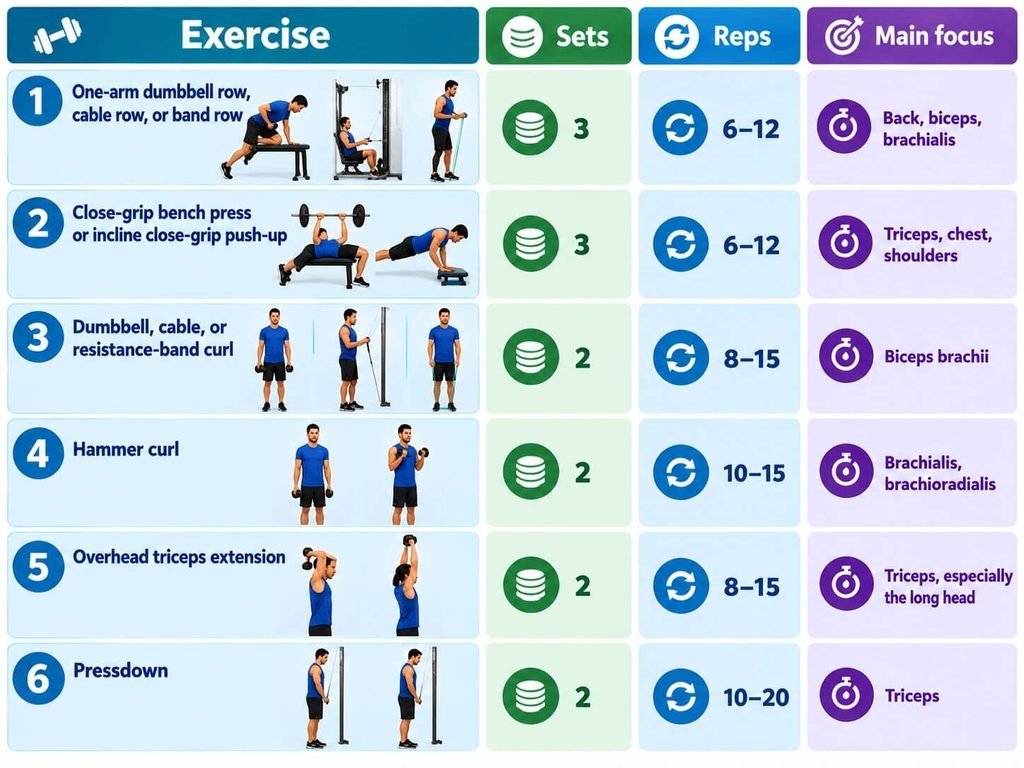
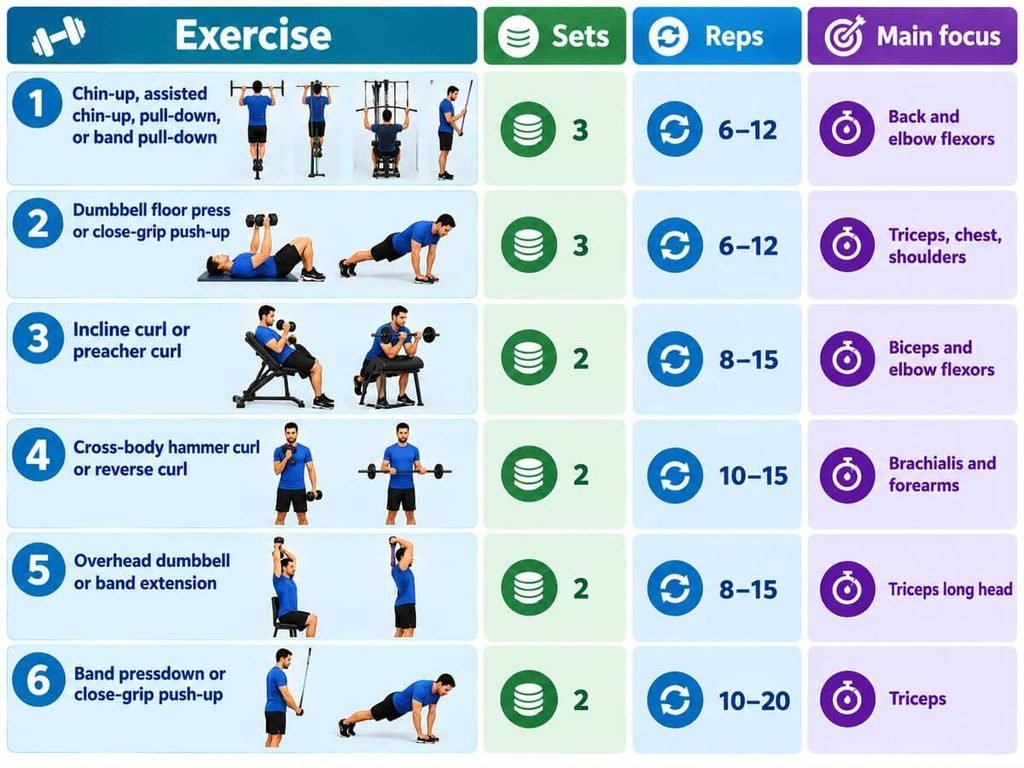
Beginner Arm-Building Workout
Perform Workout A and Workout B on nonconsecutive days. The routine combines compound lifts with direct biceps and triceps exercises and begins with a moderate volume that most beginners can adjust.
If you already follow a full upper-body program, do not automatically add every exercise below. Replace your current arm work or use only the direct exercises so your total weekly volume remains manageable.
Workout A
Workout B
How to perform the program
- Warm up with five minutes of easy movement, then complete one or two lighter practice sets for the first press and pull.
- Choose resistance that lets you stay within the listed range with about 2–3 repetitions in reserve during the first week.
- Keep the shoulder stable and move the elbow through the largest comfortable, controlled range.
- Stop a set when momentum increases sharply, range shortens unintentionally, or joint discomfort appears.
- Record the resistance, repetitions, and any technique notes after each working set.
- Run the plan for at least 8–12 weeks before judging it, making only small adjustments when necessary.
Beginners can start with one direct set per isolation exercise during the first one or two weeks. Add the second set after technique and recovery are reliable.
How to Build Bigger Arms at Home
You can build bigger arms at home with dumbbells, resistance bands, or bodyweight exercises. Muscles respond to tension and effort, not the brand or location of the equipment.
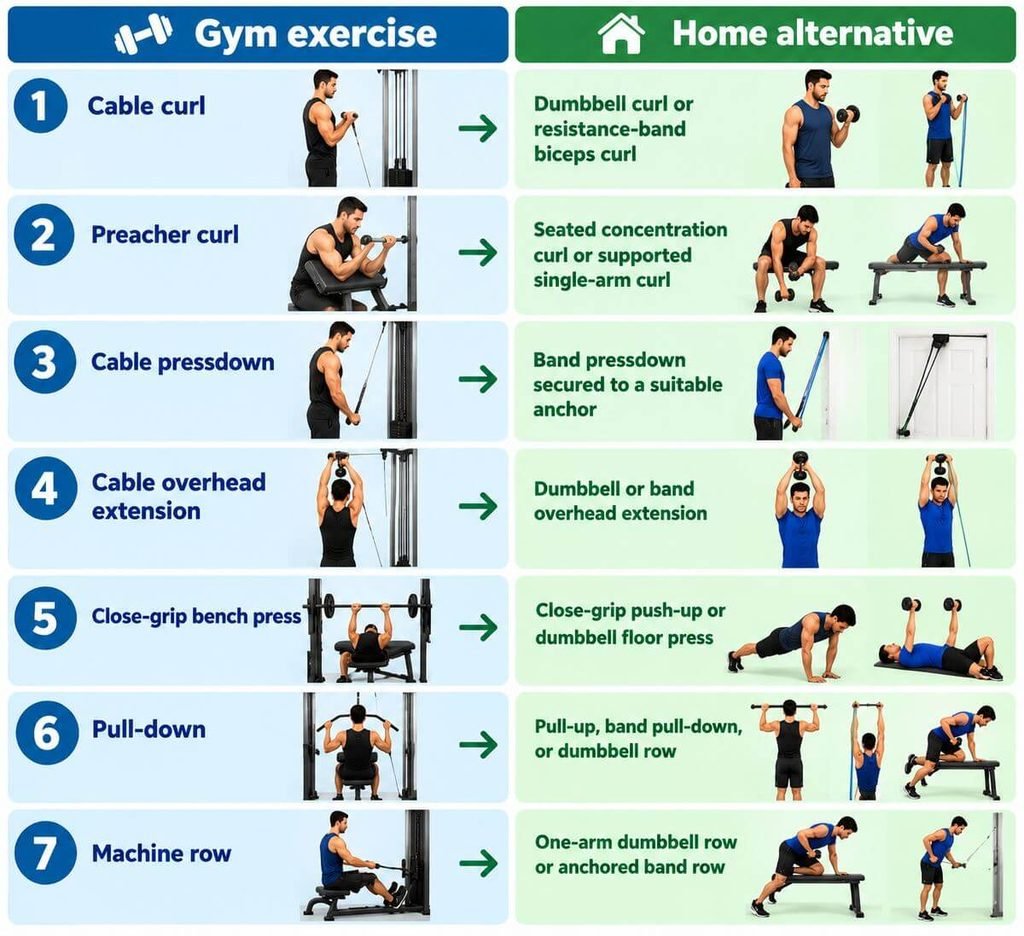
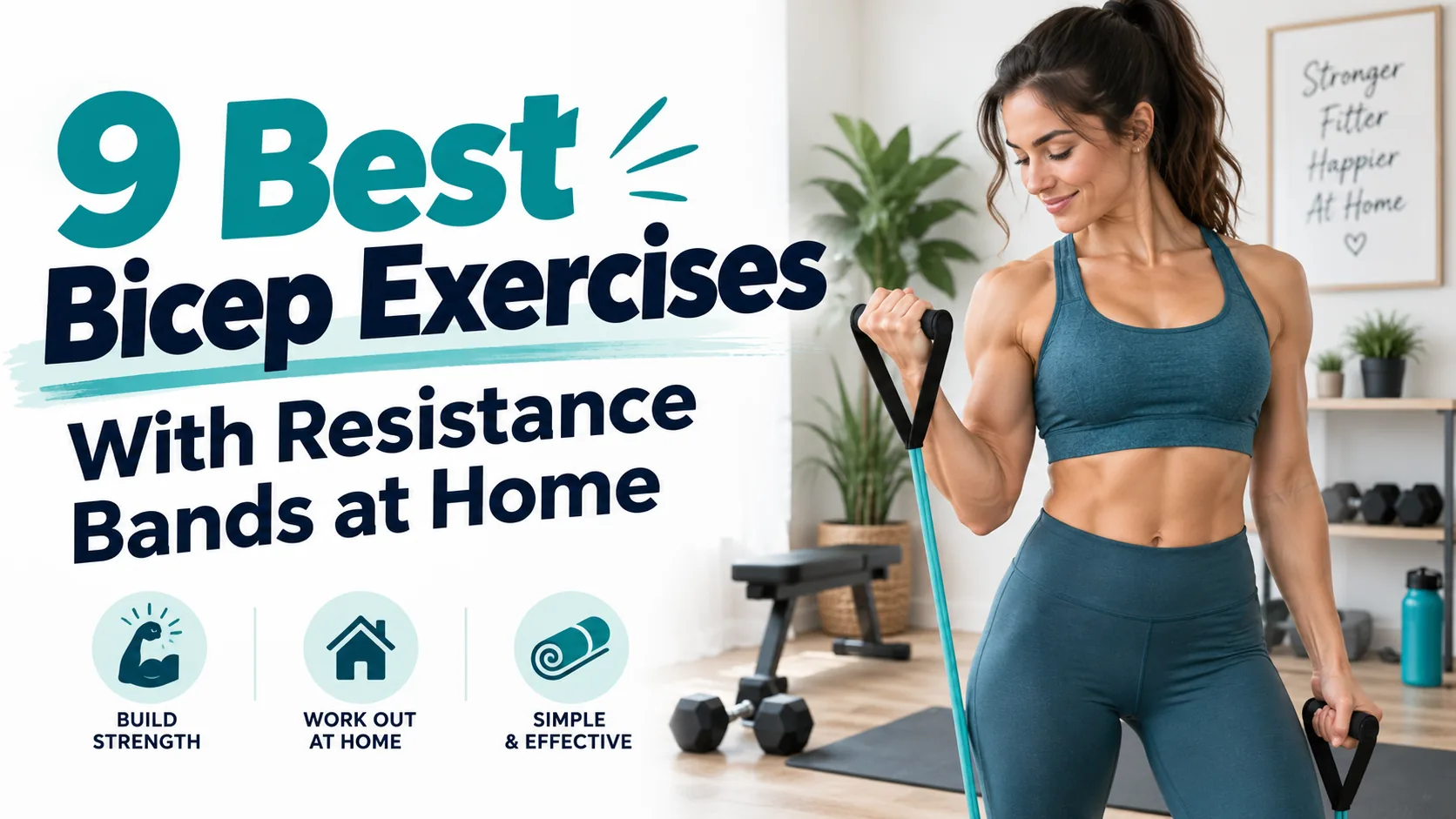
Elastic resistance can improve strength similarly to conventional resistance in many settings, although the evidence covers varied populations and programs. Bands can therefore support arm muscle growth if the exercise remains challenging and progresses over time. (Lopes et al., 2019)
Before using a resistance band, inspect it for cracks, thinning, or damage. Secure it to an anchor designed for exercise, keep your face away from the line of recoil, and test the setup with light tension first. Do not attach a band to unstable furniture, sharp edges, or a door that can open toward you.
Progressing when your weights are limited
If you cannot add weight, increase the challenge by:
- Adding repetitions within the target range
- Using a thicker band or standing farther from the anchor
- Moving through a larger comfortable range of motion
- Reducing body assistance during chin-ups or push-ups
- Using a harder variation
- Slowing an uncontrolled lowering phase until it becomes smooth
- Adding one set only after progress has stalled and recovery remains good
Extremely slow repetitions are not required. The goal is controlled movement, not making every set last as long as possible.
Progressive Overload for Arms
Progressive overload means gradually increasing the training challenge as your body adapts. The simplest method is double progression: improve repetitions first, then increase resistance.
Suppose your target is 8–12 reps for three sets of curls:
| Week | Resistance | Repetitions |
|---|---|---|
| 1 | 20 lb | 10, 9, 2008 |
| 2 | 20 lb | 11, 10, 2009 |
| 3 | 20 lb | 12, 11, 10 |
| 4 | 20 lb | 12, 12, 12 |
| 5 | 25 lb | 9, 8, 2008 |
Once all sets reach the top of the range with the same controlled technique and intended effort, add the smallest available amount of resistance. Repetitions will usually fall toward the bottom of the range, and the process starts again.
Do not increase load if you must shorten the range, swing the torso, or turn a curl into a shoulder raise. An apparent weight increase that removes tension from the target muscle is not useful progression.
How to track arm-training progress
Track performance before relying on appearance or a tape measurement. Useful indicators include:
- More repetitions with the same resistance and technique
- More resistance for the same repetitions
- A harder variation performed with equal control
- Better range of motion at the same load
- Stable or improving performance across weekly sessions
Arm circumference can be recorded, but measurement conditions must stay consistent. Use the same arm position, tape location, time of day, and relation to training. Temporary swelling after exercise is not permanent muscle growth, so compare measurements taken under similar rested conditions and space them several weeks apart.
Nutrition and Recovery
Arm growth depends on the whole training and recovery plan, not a special food eaten after curls. Eat regular meals, include protein-rich foods, consume enough overall food to support training and normal health, and stay hydrated.
Good protein sources include eggs, poultry, fish, dairy foods, tofu, tempeh, beans, and lentils. Protein powder is optional; it is simply a convenient food product and cannot replace progressive training.
In healthy adults who resistance train, a large meta-analysis found that increasing protein intake can modestly improve gains when it raises an otherwise insufficient intake, with average benefits leveling off around 1.6 grams per kilogram of body weight per day. This is a population estimate, not a mandatory prescription for every person. People with kidney disease or other medical conditions should seek individualized advice from a clinician or registered dietitian. (Morton et al., 2018)
You do not need an aggressive “bulk” to gain arm muscle. Beginners and people returning to training may gain muscle without deliberately eating a large surplus. Favor consistent, balanced meals rather than force-feeding or using rapid-body-change diets.
Sleep supports overall health, training performance, and recovery. The CDC recommends at least seven hours for adults ages 18–60 and 8–10 hours for teenagers ages 13–17. (CDC sleep guidance)
If you are under 18, use age-appropriate supervision and focus on technique, strength, sport, and health—not rapid changes in appearance. Adult protein targets and bodybuilding diets should not be treated as personalized instructions for teenagers.
Common Mistakes That Limit Arm Growth
Training only the biceps
Curls matter, but neglecting the triceps leaves a major upper-arm muscle group undertrained. Include at least one overhead extension and one press or press-down pattern.
Adding sets before improving existing sets
More volume can help, but it also creates more fatigue. First make the current sets consistent, challenging, and trackable. Add one or two weekly sets only when performance has stalled for several weeks and recovery is still good.
Using momentum to move more weight
A small amount of natural movement is not automatically harmful, but repeated torso swinging often shifts work away from the elbow flexors. Lower the resistance and make the technique repeatable.
Turning every set into failure training
Failure is a tool, not a requirement. Keeping 1–3 repetitions in reserve on most sets makes it easier to preserve technique and recover for the next session.
Changing exercises too often
Constant variation makes progressive overload hard to measure. Keep the main curls, presses, and extensions for at least several weeks unless they cause discomfort or equipment becomes unavailable.
Ignoring compound-exercise overlap
Rows, pull-downs, and chin-ups train the elbow flexors. Bench presses, push-ups, and overhead presses train the triceps. Adding a full arm specialization plan on top of high-volume upper-body training can exceed your recoverable workload.
Chasing soreness or a pump
A temporary pump shows that blood and fluid have moved into the trained area; soreness reflects an unfamiliar or stressful training dose. Neither proves that a workout will produce long-term growth. Progress in repetitions, resistance, and consistent training is more useful.
Training through joint pain
Muscle effort and mild post-workout soreness can be normal. Sharp pain, joint swelling, numbness, or an unexplained loss of strength is different. Stop the aggravating movement and consult a qualified healthcare professional if symptoms persist or are severe.
Practical Arm-Growth Checklist
- Train biceps and triceps about twice per week.
- Include one compound pull and one compound press.
- Use at least two complementary curl patterns.
- Include an overhead triceps extension plus another elbow-extension movement.
- Start with moderate weekly volume and count compound overlap.
- Keep most working sets 1–3 reps from technical failure.
- Rest long enough to repeat good-quality work.
- Record resistance and repetitions.
- Progress one variable at a time.
- Eat balanced meals with adequate protein and get enough sleep.
- Reduce training when joints or performance show poor recovery.
Frequently Asked Questions
How long does it take to build bigger arms?
Visible arm growth normally takes months of consistent training, not days. Early strength increases can occur sooner because technique and coordination improve before large changes in muscle size become noticeable. The rate varies with training history, genetics, recovery, and nutrition.
How many sets should I do for bigger arms?
Begin with roughly 6–10 direct weekly sets for the biceps and 6–10 for the triceps, then adjust for compound pulling and pressing. Add volume only when your current work is consistent, performance has stalled, and your elbows and recovery remain good.
Should you train biceps and triceps together?
Yes. Training biceps and triceps in the same session is effective and time-efficient. You can also separate them into pull and push sessions. The weekly volume, effort, progression, and recovery matter more than whether the muscles share a workout.
Are compound exercises enough for bigger arms?
Compound exercises may be enough for some beginners to gain arm muscle, but direct curls and extensions make the stimulus more targeted. Add modest isolation work if arm growth is a priority.
Can you build bigger arms using only dumbbells?
Yes. Dumbbell curls, hammer curls, rows, floor presses, close-grip presses, and overhead triceps extensions can train all the major upper-arm actions. Progress resistance or repetitions and keep the sets challenging.
Can resistance bands build bigger arms?
Yes. Bands can train elbow flexion and extension effectively when the tension is sufficient and progresses over time. Use secure anchors, inspect the band before training, and control the recoil.
Do hammer curls make the arms thicker?
Hammer curls train the biceps, brachialis, and brachioradialis, which can contribute to upper-arm and forearm development. They work best as a complement to a supinated curl rather than the only biceps exercise.
Are pressdowns or overhead extensions better?
Both are useful. Overhead extensions train the triceps in a lengthened position and may be particularly valuable for the long head; pressdowns are stable and easy to progress. Including both covers complementary positions.
Why are my arms not getting bigger?
Common reasons include inconsistent training, no measurable progression, too few challenging sets, excessive volume, poor technique, inadequate recovery, or unrealistic expectations about time. Review your training log before adding more exercises.
Does soreness mean the arms are growing?
No. Soreness can occur after unfamiliar training, but it is not a reliable measure of muscle growth. Use performance trends and consistent measurements instead.
Is protein powder necessary?
No. You can obtain enough protein from ordinary foods. Protein powder is optional and mainly useful for convenience when it helps meet nutritional needs.
Conclusion
The most reliable way to build bigger arms is to train the entire upper arm with a repeatable plan. Combine presses and pulls with direct curls, hammer curls, overhead triceps extensions, and pressdowns. Start with a manageable number of hard sets, finish most of them close to—but not at—failure, and progress gradually.
Run the beginner program for 8–12 weeks while recording every working set. If repetitions or resistance improve and your joints feel good, continue. If progress stalls, examine technique, recovery, and compound-exercise overlap before adding more volume.
Next step: Choose your two weekly training days, record your starting loads, and complete the first week with controlled technique. For more beginner guidance, read the related training and nutrition articles below.