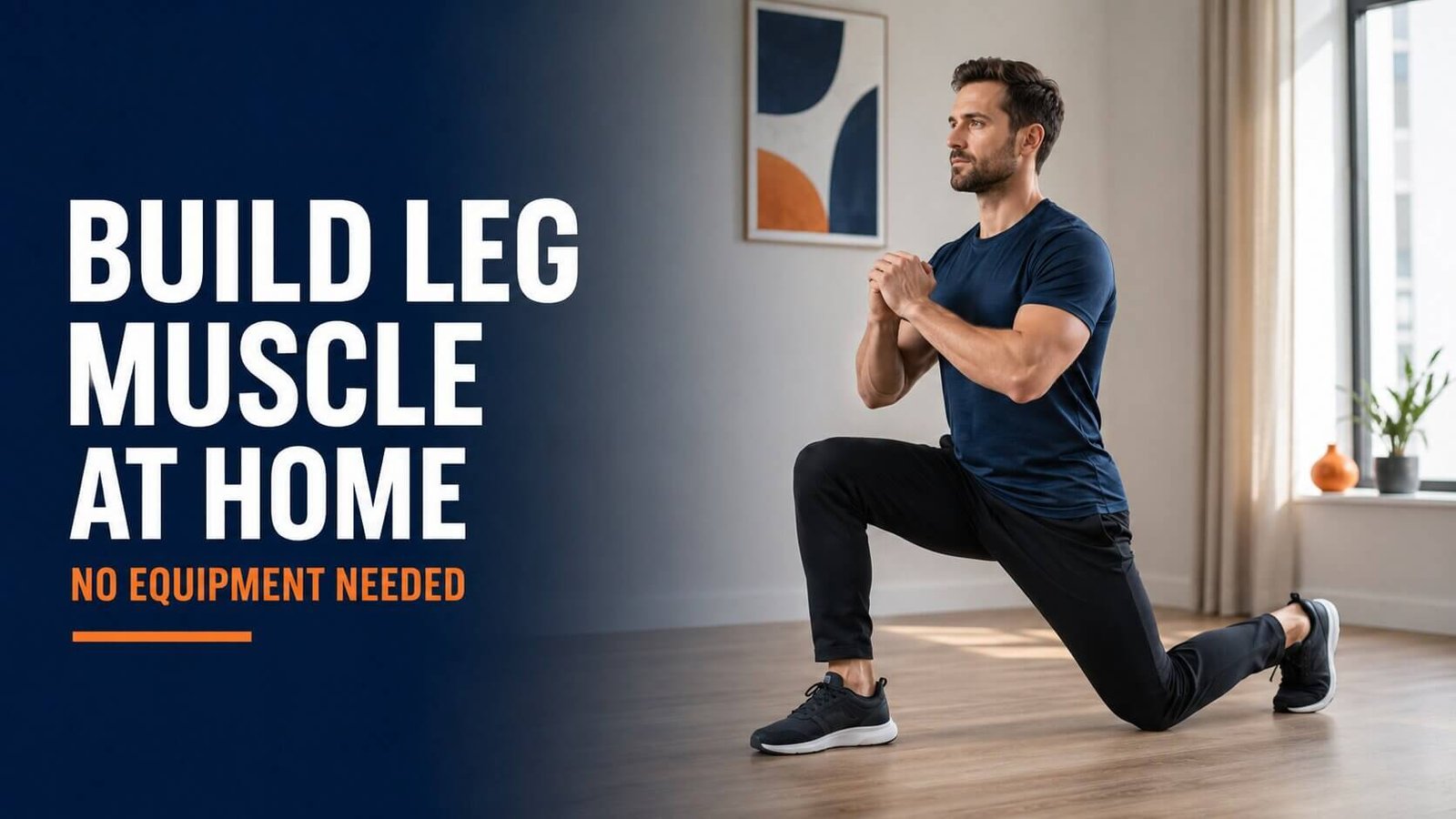
You can build leg muscle at home without equipment if your exercises become progressively more challenging. The most effective approach combines squats or lunges for the quadriceps, bridges and walkouts for the glutes and hamstrings, and calf raises for the lower legs.
The difficulty matters more than chasing a huge repetition count. Choose variations that make the last few repetitions demanding, keep your technique controlled, and record enough detail to make the next workout slightly better.
Can You Build Leg Muscle Without Weights?
Yes. Your muscles respond to resistance and effort, not to whether the resistance comes from a barbell, machine, band, or your own body. Bodyweight training can stimulate muscle hypertrophy when the exercises are difficult enough and become progressively harder.
The American College of Sports Medicine’s 2026 resistance-training guidance recognizes bodyweight and home-based exercise as effective options for improving strength, hypertrophy, and physical function. It also emphasizes that regular participation and adequate weekly training are more important for most healthy adults than complicated programming or a particular type of equipment (ACSM, 2026).
A small 2023 trial provides more direct evidence. Thirteen previously sedentary young women completed progressive bodyweight squats or barbell back squats twice weekly. After six formal training weeks, both groups improved measures of lower-body strength and muscle thickness, with no significant differences between groups. The bodyweight program progressed from two-leg to harder single-leg movements. Because the sample was small, short, and limited to young women, it supports feasibility rather than proving that bodyweight and barbell training are equivalent for every person or over the long term (Wei et al., 2023).
Where bodyweight training has limits
Bodyweight training works especially well for beginners and intermediate home exercisers, but progression can eventually become awkward. A strong trainee may need very high repetitions or advanced single-leg movements to make a set challenging. At that point, dumbbells, bands, or gym machines may offer a simpler way to keep increasing resistance.
Research comparing training loads generally finds that muscle growth can occur with lighter or heavier resistance when sets are sufficiently demanding. Heavier loads, however, tend to produce larger gains in maximal strength (Lopez et al., 2021).
What Makes a No-Equipment Leg Workout Effective?
An effective bodyweight leg workout combines progressive overload, challenging working sets, complete muscle coverage, and enough recovery. Repeating the same easy circuit every day may improve endurance, but it becomes a weak muscle-building plan once the movements stop challenging you.
Progressive overload
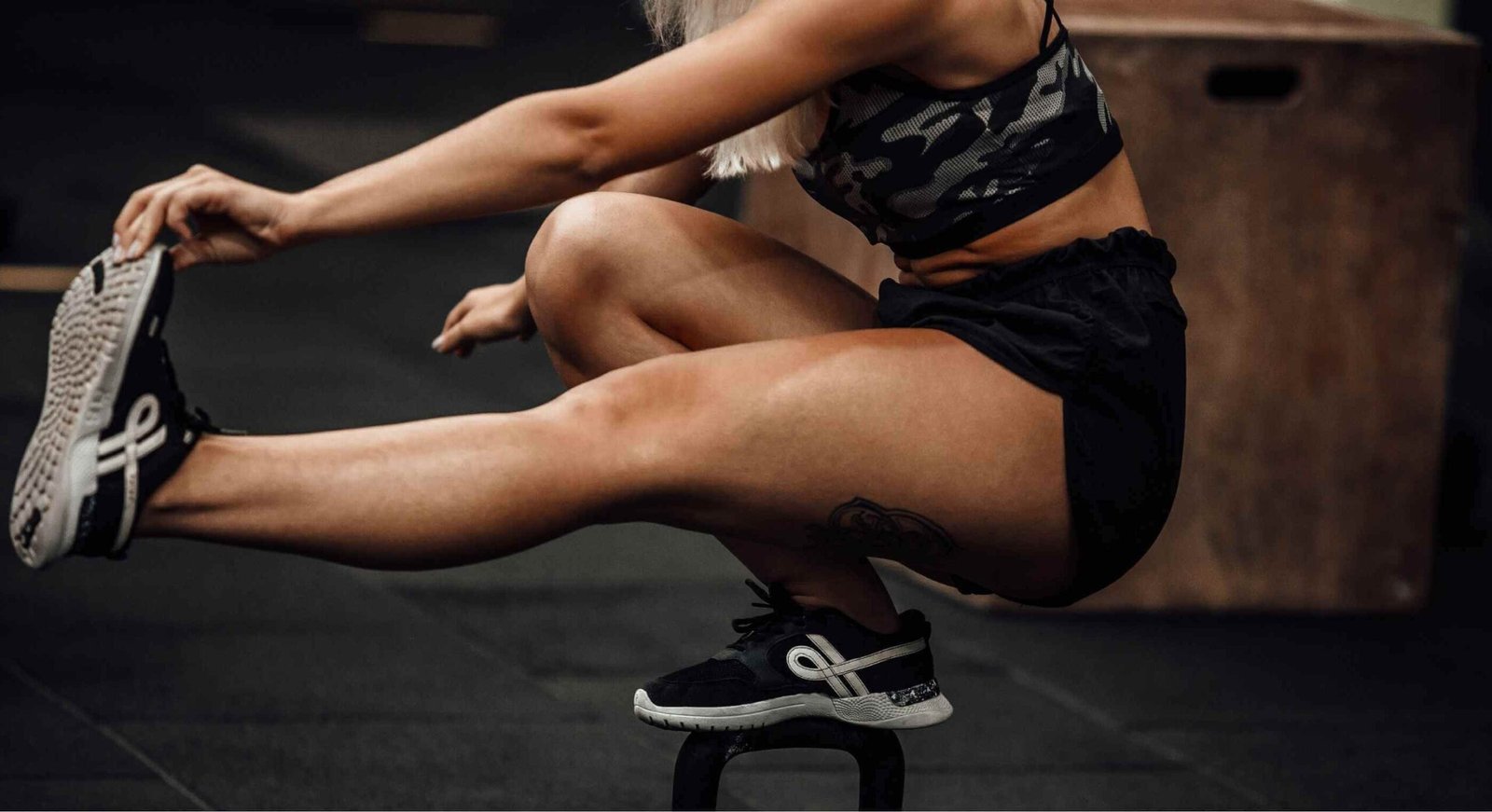
Progressive overload means increasing the training challenge as your body adapts. Without weights, you can add controlled repetitions, use a greater comfortable range of motion, shift more work to one leg, reduce balance assistance, add a pause, or select a harder variation.
The change does not need to be dramatic. One extra good repetition on each set is measurable progress.
Challenging effort
For muscle growth, the final repetitions of a set should feel noticeably harder while your movement remains controlled. A practical target is to stop with about 1–3 repetitions in reserve (RIR)—meaning you believe you could perform only one to three more good repetitions.
This is a useful coaching range, not a biological rule. Evidence suggests that training closer to failure generally matters more with light resistance, but reaching complete muscular failure on every set has not shown a consistent hypertrophy advantage and creates more fatigue (Refalo et al., 2023; ACSM, 2026).
Consistent technique and range of motion
Use the largest pain-free range you can control. A deeper squat is not automatically better if your heels lift, your balance disappears, or joint discomfort begins. Gradually earn more range rather than forcing it.
Slowing the lowering phase to about two or three seconds or adding a brief pause can make an exercise more controlled and demanding. Tempo is a progression tool, not a special shortcut to growth; the set still needs enough resistance and effort.
Train All the Major Leg Muscles
A complete home leg workout needs more than squats. It should include a knee-dominant movement, a hip-dominant movement, direct hamstring work, and calf work.
| Area | Main muscles | Useful no-equipment patterns |
|---|---|---|
| Front of the thigh | Quadriceps: rectus femoris, vastus lateralis, vastus medialis, vastus intermedius | Squats, split squats, reverse lunges, assisted single-leg squats |
| Back of the thigh | Hamstrings: biceps femoris, semitendinosus, semimembranosus | Hamstring walkouts, long-lever bridges, single-leg hip hinges |
| Hips | Gluteus maximus, gluteus medius, adductors | Deep comfortable squats, split squats, lunges, glute bridges |
| Lower leg | Gastrocnemius and soleus | Straight-knee and bent-knee calf raises |
Squats train the quadriceps and glutes well, but they should not be treated as complete hamstring training. In one squat-depth study, deeper squats increased several thigh and hip muscles, while hamstring growth was not significant (Kubo et al., 2019). Adding a knee-flexion exercise such as a hamstring walkout fills that gap more effectively.
Best Bodyweight Exercises for Leg Muscle Growth
The best no-equipment exercises are movements you can perform safely, take through a controlled range, and progress before they become endurance-only work. The following options cover the major lower-body movement patterns.
1. Bodyweight Squat
The bodyweight squat is a beginner-friendly way to train the quadriceps, glutes, and adductors. It also helps you practice coordinated movement at the hip, knee, and ankle joints.
How to do it
- Stand with your feet in a comfortable position around shoulder width.
- Brace your trunk gently and sit down between your hips.
- Keep your whole foot in contact with the floor and let your knees track in the same general direction as your toes.
- Descend as far as you can without pain or losing control.
- Push the floor away and stand tall.
Progression: bodyweight squat → two-second pause squat → slow-lowering squat → split squat.
If you can perform 30 or more controlled squats with several repetitions left, a unilateral movement is usually more practical than adding endless repetitions.
2. Split Squat
The split squat is one of the most useful bodyweight exercises for muscle growth because the front leg handles most of the work. It challenges the quadriceps, glutes, and adductors without requiring advanced balance or impact.
How to do it
- Take a comfortable staggered stance and keep both feet on the floor.
- Lower your body mostly straight down by bending both knees.
- Keep the front foot planted and the front knee tracking with the toes.
- Stop at a controlled, comfortable depth.
- Drive through the front leg to rise.
Use a wall lightly for balance if needed. Balance assistance can improve the muscle-building stimulus by letting the target leg—not wobbling—limit the set.
3. Reverse Lunge
Reverse lunges train one leg at a time while challenging the quadriceps, glutes, and hip stabilizers. Many beginners find stepping backward easier to control than stepping forward.
How to do it
- Stand tall and step one foot backward.
- Lower until both knees bend comfortably.
- Keep most of your pressure through the front foot.
- Push through the front leg to return to standing.
- Complete one side at a time or alternate legs.
Shorten the step or reduce depth if you lose control. A light fingertip touch on a wall is fine.
4. Assisted Single-Leg Squat
Assisted single-leg squats substantially increase the resistance placed on one leg. They are a progression for trainees who no longer find regular squats or basic split squats challenging.
Hold a wall or doorframe lightly, sit the hips down and back, and lower only as far as you can control. Increase depth gradually. Reduce assistance only after your strength improves; there is no hypertrophy prize for turning the set into a balance test.
5. Glute Bridge
The glute bridge trains hip extension, mainly through the gluteus maximus with help from the hamstrings. Two-leg bridges suit beginners, while long-lever and single-leg versions provide useful progressions.
How to do it
- Lie on your back with your knees bent and feet flat.
- Gently brace your trunk.
- Push through your feet and lift your hips until your body forms a comfortable line from shoulders to knees.
- Pause while squeezing the glutes without overextending your lower back.
- Lower under control.
Progression: two-leg bridge → paused bridge → feet farther from the hips → single-leg bridge.
6. Hamstring Walkout
Hamstring walkouts provide direct, equipment-free work for the muscles behind the thighs. They combine hip extension with knee flexion and can become challenging with relatively few controlled repetitions.
Start at the top of a bridge. Take small steps away from your hips, keeping them lifted as well as you can, then walk your feet back. Begin with a short distance. Stop if your feet slip, your hamstrings cramp sharply, or you feel joint pain.
7. Single-Leg Hip Hinge
The single-leg hip hinge trains the hamstrings, glutes, and hip stabilizers. Use a wall for balance so that the hip muscles—not coordination—determine when the set ends.
Stand on one leg with a soft knee. Push your hips backward while your free leg reaches behind you. Keep your trunk long, stop when you feel tension in the back of the working thigh, and squeeze the glute to stand. Avoid twisting the hips toward the ceiling.
Because there is little external resistance, this movement may become too easy for strong trainees. Hamstring walkouts usually remain the more challenging no-equipment option.
8. Single-Leg Calf Raise
Single-leg calf raises make bodyweight calf training more efficient by loading one side at a time. Straight-knee raises emphasize the gastrocnemius; slightly bent-knee raises shift more work toward the soleus.
Rise as high as you can without rolling the ankle outward, pause briefly, and lower slowly. Hold a wall lightly for balance. Train on a flat, nonslip floor; using an unstable ledge is unnecessary.
Exercise Selection at a Glance
| Exercise | Main target | Practical rep range | Easier option | Harder option |
| Bodyweight squat | Quads, glutes, adductors | 10–30 | Reduced comfortable depth | Pause or split squat |
| Split squat | Quads, glutes, adductors | 8–20 per side | Wall-assisted shallow split squat | Deeper range or less assistance |
| Reverse lunge | Quads, glutes | 8–20 per side | Supported reverse step | Slower lowering or longer range |
| Assisted single-leg squat | Quads, glutes | 6–15 per side | More assistance | Less assistance or greater depth |
| Glute bridge | Glutes | 10–30 | Short-range bridge | Long-lever or single-leg bridge |
| Hamstring walkout | Hamstrings, glutes | 6–15 | Fewer, shorter steps | Longer walkout with control |
| Single-leg hip hinge | Hamstrings, glutes | 8–20 per side | Two-leg hip hinge | Less assistance or slower lowering |
| Single-leg calf raise | Calves | 10–30 per side | Two-leg calf raise | Paused or bent-knee version |
These ranges are practical targets, not hard physiological boundaries. Move to a harder variation when the top of the range becomes easy and additional repetitions would mainly add time or discomfort.
Beginner Leg Workout at Home Without Weights
Start with two sessions per week on nonconsecutive days. Alternating Workout A and Workout B gives the legs repeated practice while spreading the stress across different patterns.
Warm-Up: 3–5 Minutes
A warm-up should prepare the movements you are about to perform, not exhaust you.
- March briskly in place for 60–90 seconds.
- Perform 8–10 easy squats.
- Perform 5–8 shallow reverse lunges per side.
- Perform 8 glute bridges.
- Perform one easier practice set of the first workout exercise.
Workout A
| Exercise | Sets | Repetitions | Effort |
| Bodyweight squat or pause squat | 2–3 | 10–20 | About 2–3 RIR |
| Split squat | 2–3 | 8–15 per side | About 1–3 RIR |
| Glute bridge | 2–3 | 12–20 | About 1–3 RIR |
| Hamstring walkout | 2 | 6–12 | Stop before form breaks |
| Single-leg calf raise | 2 | 10–20 per side | About 1–3 RIR |
Workout B
| Exercise | Sets | Repetitions | Effort |
| Reverse lunge | 2–3 | 8–15 per side | About 2–3 RIR |
| Assisted single-leg squat or split squat | 2 | 6–12 per side | About 1–3 RIR |
| Single-leg glute bridge | 2–3 | 8–15 per side | About 1–3 RIR |
| Single-leg hip hinge | 2 | 8–15 per side | Controlled technique |
| Bent-knee calf raise | 2 | 12–25 | About 1–3 RIR |
If this is your first strength program, begin with two working sets per exercise. Add a third set only after you recover well, maintain technique, and no longer progress with the lower dose.
Sets, Reps, Rest, and Frequency for Leg Growth
Most beginners can make progress with 2–3 lower-body sessions per week, several challenging sets for each major muscle group, and enough rest to repeat high-quality efforts. More work can help up to a point, but volume has diminishing returns.
How many sets should you do?
A reasonable starting range is:
- Quadriceps: about 6–10 challenging sets per week
- Glutes: about 6–10 challenging sets per week
- Hamstrings: about 4–8 challenging sets per week
- Calves: about 4–8 challenging sets per week
These are programming ranges, not minimum requirements. Split squats, for example, count toward both quadriceps and glute training, so do not treat every muscle as if it needs completely separate exercises.
ACSM highlights roughly 10 weekly sets per muscle group as a broad hypertrophy target for healthy adults. A 2026 meta-regression likewise found that muscle growth generally increases with weekly set volume, but with diminishing returns (ACSM, 2026; Pelland et al., 2026). Beginners should earn higher volume gradually rather than starting with the maximum they can tolerate.
How many repetitions should you perform?
Use a repetition range that makes the exercise challenging without turning technique into a struggle. For most bodyweight leg exercises, roughly 6–30 repetitions works well in practice. Single-leg exercises often become difficult within 6–20 repetitions, while squats, bridges, and calf raises may require more.
Do not choose a number first and assume the set was effective. If 20 squats feel easy and you could perform another 15, the movement is too easy for an efficient hypertrophy set. Progress the exercise.
How long should you rest?
Rest about 60–120 seconds between most sets. Take closer to two minutes after demanding split squats, lunges, or single-leg squats. Longer rest is appropriate if breathing or balance, rather than the target muscles, would limit the next set.
How often should you train legs?
Two nonconsecutive sessions per week are enough to start. A third session can be added if each session is shorter and recovery remains good.
The U.S. Physical Activity Guidelines recommend muscle-strengthening activity at least two days per week for adults. Youth ages 6–17 should include age-appropriate muscle-strengthening activity as part of their daily activity on at least three days per week; that does not mean repeating a hard hypertrophy leg workout every day (U.S. Department of Health and Human Services).
How to Progressively Overload Leg Exercises Without Weights
Progress one variable at a time and keep a simple workout log. The clearest sequence is to improve repetitions first, then increase the movement’s difficulty when you reach the top of the target range.
Nine ways to progress
- Add one or two controlled repetitions.
- Add a working set when recovery is good.
- Increase your pain-free range of motion.
- Add a one- or two-second pause in the hardest position.
- Slow the lowering phase while keeping the upward phase purposeful.
- Shift from a two-leg to a single-leg variation.
- Reduce balance assistance gradually.
- Improve control and remove momentum.
- Choose a harder exercise progression.
Do not combine every method at once. If you add a third set, a deeper range, and slower repetitions in the same workout, you will not know which change caused excessive soreness or a performance drop.
Example: Split-squat progression
Suppose your target is two sets of 8–15 repetitions per leg at about two RIR.
| Week | Set 1 | Set 2 | Next step |
| 1 | 10 | 9 | Keep the same variation |
| 2 | 12 | 10 | Add controlled reps |
| 3 | 14 | 12 | Keep progressing |
| 4 | 15 | 15 | Confirm technique and effort |
| 5 | 12 | 11 | Use a deeper range, longer pause, or less assistance |
The lower repetition count in week five does not mean you became weaker. It reflects a harder version of the exercise.
A simple progression decision rule
After each exercise, ask:
- Below the rep range? Keep the variation and build control.
- Inside the range with 1–3 RIR? Add a repetition next time.
- At the top with more than 3 RIR? Choose a harder progression.
- Technique breaks or pain appears? Reduce the range, use assistance, or stop.
Record the exercise version, assistance used, sets, repetitions, and estimated RIR. “Split squat, light wall support, 12 and 11 per side, 2 RIR” is far more useful than writing only “leg day completed.”
Do You Need Jump Squats or Plyometrics?
No. Jump squats, jump lunges, and bounds can improve explosive power, but they are not required to grow leg muscle. Controlled resistance exercises are easier for beginners to progress and usually create less impact and coordination demand.
A difficult workout is not automatically a productive hypertrophy workout. Six minutes of nonstop jumping may create burning and soreness, yet it gives you little control over which muscle failed, how many high-quality sets you completed, or how to progress next week.
Use plyometrics only if power or sport performance is also a goal and you can land quietly with stable knees and ankles. They should supplement—not replace—your strength work. Beginners, people returning after a long break, and anyone with joint pain can leave them out.
Nutrition and Recovery for Muscle Growth
Training provides the stimulus; regular meals and recovery support adaptation. You do not need a supplement or an extreme eating plan to benefit from bodyweight resistance training.
Build meals around a mix of:
- Protein-rich foods such as eggs, milk, yogurt, poultry, fish, tofu, tempeh, beans, or lentils
- Carbohydrate sources such as oats, rice, potatoes, whole-grain bread, fruit, or beans
- Vegetables and fruit for fiber and micronutrients
- Fluids throughout the day, with extra attention during hot or sweaty training
Avoid aggressive dieting while trying to support muscle growth. For children and teenagers, food intake should support normal growth, school, daily activity, and training; restrictive diets and bodybuilding-style cutting plans are inappropriate without qualified medical guidance.
Sleep also matters for health and recovery. The CDC recommends 8–10 hours for teens ages 13–17 and at least 7 hours for most adults ages 18–60 (CDC).
Common No-Equipment Leg-Training Mistakes
Performing only squats
Squats are useful, but a squat-only routine gives the hamstrings and calves limited direct work. Add a bridge or hip hinge, hamstring walkout, and calf raise.
Doing hundreds of easy repetitions
Very high repetitions build endurance and create fatigue, but they are inefficient if the set never becomes mechanically challenging. Move to a harder variation instead.
Treating soreness as proof of growth
Soreness is affected by novelty, exercise selection, and recovery. You can grow without becoming very sore, and severe soreness does not prove that a session was better. Track repetitions, exercise difficulty, technique, and consistency instead.
Changing the routine every workout
Variety can be enjoyable, but constant changes make progression hard to measure. Keep the main exercises for at least several weeks unless they cause discomfort or do not fit your abilities.
Turning single-leg work into a balance contest
Lightly hold a wall if balance ends the set before your leg muscles become tired. Gradually reduce assistance as control improves.
Forcing depth or ignoring pain
Use a comfortable range and progress it slowly. Muscle fatigue and a burning sensation can occur during hard sets; sharp, sudden, or worsening joint pain is a reason to stop.
Training hard every day
More frequent work is not automatically better. Leave recovery between demanding lower-body sessions so you can return with stable technique and useful effort.
Using unstable household furniture
Do not perform advanced variations from rolling chairs, glass tables, weak stools, or slippery surfaces. The routine in this article requires only floor space and an optional wall for balance.
Practical Recommendations
Use this checklist to make your home leg workout productive:
- Train the lower body twice weekly to start.
- Include at least one squat or lunge, one hip-extension exercise, one direct hamstring exercise, and one calf exercise.
- Begin with two working sets per movement.
- Choose a variation that becomes challenging within roughly 6–30 repetitions.
- Finish most sets with about 1–3 good repetitions in reserve.
- Rest long enough to make the next set limited by the target muscles rather than breathlessness.
- Add repetitions until you reach the top of the range, then progress the exercise.
- Keep the same main movements long enough to measure improvement.
- Eat regular balanced meals and prioritize sleep.
- Stop for sharp pain, dizziness, chest pain, or unusual shortness of breath.
Safety Guidance
Most healthy beginners can start with simple bodyweight exercises, but the routine should match the individual. Use a clear, nonslip space, keep breathing normally, and avoid holding your breath through long repetitions.
Speak with a qualified healthcare professional or physical therapist before starting if you have a recent injury, significant joint pain, a condition that affects balance or exercise tolerance, or medical instructions that limit activity. Seek medical care for concerning symptoms such as chest pain, faintness, or severe shortness of breath.
Young people should use age-appropriate progressions and focus on technique rather than maximal effort or appearance goals. A parent, physical education teacher, or qualified coach can help check the training space and movement quality.
Frequently Asked Questions
Can bodyweight squats build leg muscle?
Yes, especially for beginners, if the sets become challenging near the end. Once regular squats are easy for 20–30 or more repetitions, pause squats, split squats, or assisted single-leg squats usually provide a more efficient muscle-building stimulus.
How many squats should I do to build muscle?
There is no universal number. Choose a variation that becomes difficult within roughly 6–30 controlled repetitions and stop with about 1–3 good repetitions remaining. Two or three hard sets are more useful than a fixed daily target of easy squats.
Are split squats better than regular squats?
Neither is always better. Regular squats are simpler for beginners, while split squats place more resistance on each leg and therefore offer more room for equipment-free progression. Many effective routines use both.
Can lunges build leg muscle?
Yes. Reverse and forward lunges can train the quadriceps, glutes, and adductors when performed through a controlled range and close enough to muscular fatigue. Reverse lunges are often easier for beginners to control.
How can I build my hamstrings without equipment?
Use hamstring walkouts, long-lever glute bridges, single-leg bridges, and controlled hip hinges. Walkouts are especially useful because they make the hamstrings work while the knees change angle; squats alone provide incomplete hamstring training.
Can bodyweight calf raises build muscle?
Yes, provided they remain challenging. Progress from two-leg to single-leg calf raises, pause at the top, lower under control, and include both straight-knee and slightly bent-knee versions.
How often should I train my legs at home?
Start with two challenging lower-body sessions per week, separated by at least a day. A third session can work if you distribute the weekly sets and recover well. Hard leg training every day is unnecessary.
How long should a home leg workout take?
A focused beginner session with a short warm-up and five exercises often takes about 25–40 minutes. The exact duration matters less than completing challenging, controlled sets with enough rest.
Do slow repetitions build more muscle?
Slower lowering and pauses can make a bodyweight exercise harder and improve control, but slow tempo is not automatically superior. Use it as one progression method and keep the set challenging; avoid moving so slowly that technique or useful repetition output collapses.
How long does it take to build leg muscle?
There is no guaranteed timeline. Strength and movement control may improve before visible muscle changes become obvious. Training history, exercise difficulty, weekly volume, nutrition, sleep, age, and genetics all influence the rate of progress. Compare workout performance over several weeks rather than judging the plan after a few days.
Why are my legs not growing from bodyweight squats?
The squats may be too easy, your weekly training may be inconsistent, or the routine may lack enough challenging sets and exercise variety. Track your repetitions and RIR, add single-leg work, train the hamstrings and calves directly, and improve recovery. Advanced trainees may eventually need external resistance for practical long-term progression.
Does muscle soreness mean the workout worked?
No. Soreness can occur after unfamiliar exercise, but it is not a reliable measure of hypertrophy. Better indicators include improved repetitions, harder exercise variations, better control, and consistent performance over time.
Conclusion
Learning how to build leg muscle at home without equipment comes down to making bodyweight resistance progressive. Train every major lower-body region, choose exercises that become difficult within a practical repetition range, and improve one measurable variable at a time.
Start with the two-day routine for several weeks. Record the exercise version, repetitions, and estimated RIR after each session. When you reach the top of a range with clean technique and plenty of effort left, progress the movement instead of repeating the same easy workout.
CTA: Choose Workout A or Workout B, complete two controlled sets of each exercise, and write down your results. Use that record to make one small improvement in your next session.