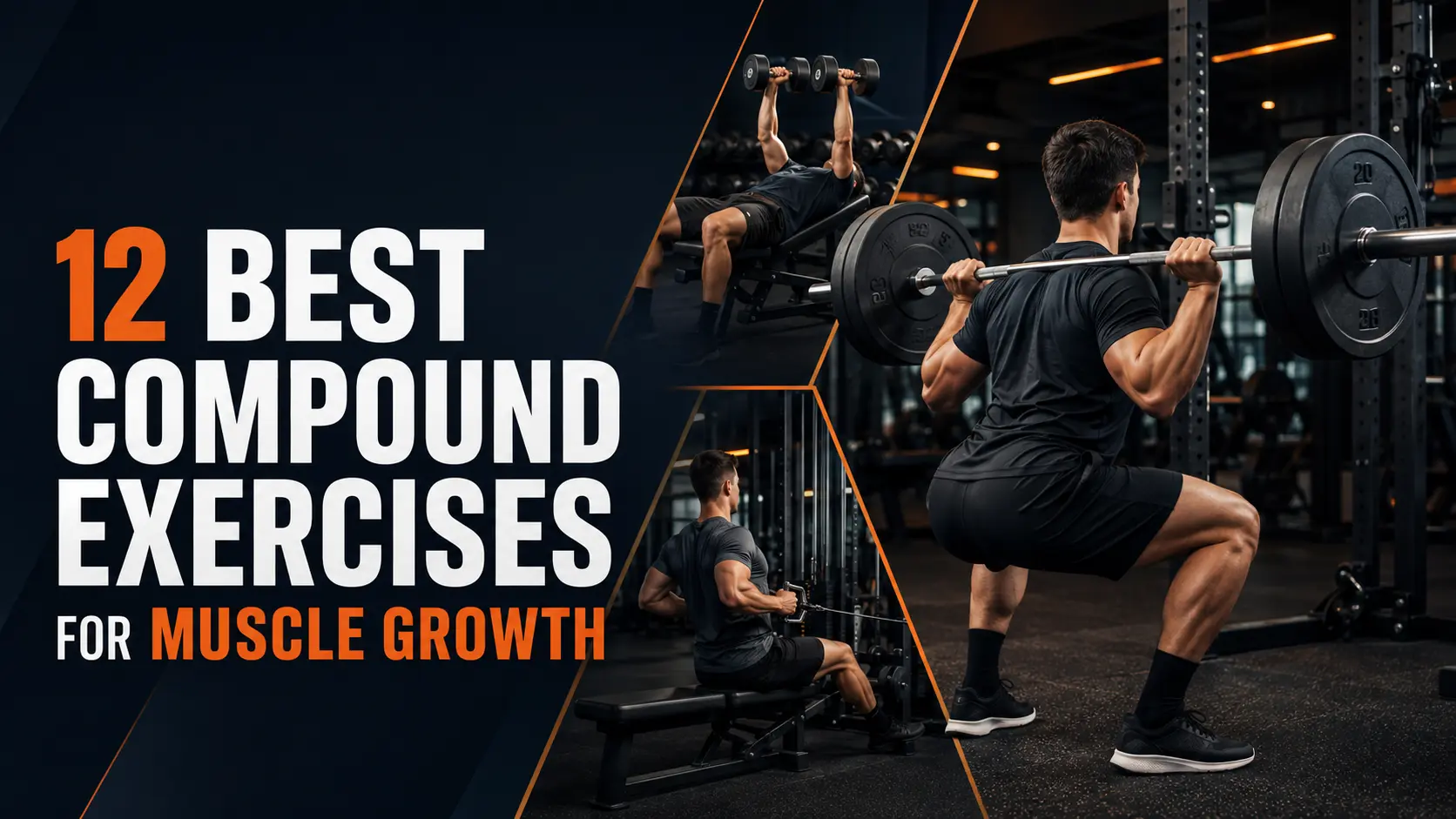
Compound exercises such as squats, presses, rows, pullups, and Romanian deadlifts can form the foundation of a muscle-building program. They train several muscles across multiple joints, making it possible to cover the whole body with fewer exercises. However, no single lift is essential, and the best variation is one you can perform comfortably, progress over time, and recover from.
This guide explains the best compound exercises for muscle growth, how to select them, and how to turn them into a practical beginner routine at the gym or at home.
What Are Compound Exercises?
Compound exercises are movements that involve two or more joints and train several muscles at the same time. A bench press, for example, combines movement at the shoulders and elbows while training the chest, triceps, and front deltoids.
An isolation exercise primarily uses one joint and places a narrower emphasis on one muscle or muscle group. Biceps curls, triceps extensions, lateral raises, and leg extensions are common examples.
The distinction is useful, but it is not a ranking system. Multi joint exercises offer broad muscle coverage, while single-joint exercises make it easier to add targeted volume. Most complete hypertrophy programs use both.
What Makes a Compound Exercise “Best” for Muscle Growth?
The best compound movements for muscle gain are not simply the lifts that allow the heaviest weight. A useful hypertrophy exercise should train the intended muscles through a repeatable range of motion without causing excessive joint discomfort, balance demands, or fatigue.
Use these five criteria:
- Muscle coverage: Does the exercise train the major muscles you want to develop?
- Progression: Can you gradually add repetitions, resistance, sets, or a harder variation?
- Stability and control: Can you keep the intended muscles working without technique breaking down?
- Comfort: Can you use a productive range of motion without sharp pain?
- Recovery cost: Does the exercise provide enough local muscle stimulus without exhausting you so much that later training suffers?
This framework explains why a leg press can be as useful as a squat for some trainees, or why chest-supported row may be preferable to a bent-over row when lower-back fatigue is limiting the workout. Research comparing machine and free-weight training has not found a clear hypertrophy advantage for either category, so equipment can be selected according to goals, access, and preference (Haugen et al., 2023).
The 12 Best Compound Exercises for Muscle Growth
The following exercises cover the main squat, hinge, push, pull, and single-leg patterns. You do not need all 12 in one workout. Select one suitable option from each important pattern and spread the exercises across the week.
| Exercise | Movement pattern | Main muscles trained | Beginner-friendly alternative |
| Squat | Knee-dominant lower body | Quadriceps, glutes, adductors | Goblet squat or box squat |
| Leg press | Knee-dominant lower body | Quadriceps, glutes, adductors | Light machine leg press |
| Romanian deadlift | Hip hinge | Hamstrings, glutes, spinal erectors | Dumbbell Romanian deadlift |
| Conventional or trapbar deadlift | Hip hinge with knee drive | Glutes, hamstrings, quadriceps, back | Elevated kettlebell or trapbar deadlift |
| Bench press | Horizontal push | Chest, triceps, front deltoids | Dumbbell press or machine chest press |
| Pushup | Horizontal push | Chest, triceps, front deltoids | Hand-elevated pushup |
| Pullup or chinup | Vertical pull | Lats, biceps, upper back, forearms | Assisted pullup |
| Lat pulldown | Vertical pull | Lats, biceps, upper back | Resistance band pulldown |
| Row | Horizontal pull | Lats, trapezius, rhomboids, rear deltoids, biceps | Chest-supported or cable row |
| Overhead press | Vertical push | Deltoids, triceps, upper chest | Seated dumbbell or machine press |
| Split squat | Unilateral knee-dominant | Quadriceps, glutes, adductors | Supported stationary split squat |
| Reverse lunge or step-up | Unilateral lower body | Quadriceps, glutes, hamstrings | Bodyweight reverse lunge |
1. Squat
Squats are effective compound leg exercises because they load knee and hip extension together. Depending on the variation and technique, they primarily train the quadriceps, glutes, and adductors while the trunk stabilizes the load.
Useful variations include the back squat, front squat, goblet squat, hack squat, Smith machine squat, and bodyweight squat. A beginner does not need to start with a barbell. Goblet and machine variations often reduce the skill and balance demands.
Basic technique cues
- Place the feet in a comfortable stance with the whole foot supported.
- Brace the trunk, then bend at the knees and hips.
- Keep the knees tracking in a comfortable line with the toes.
- Descend only as far as you can control without pain or losing position.
- Push the floor away to stand.
Use the deepest comfortable range you can control rather than forcing a universal depth. Reviews generally favor full or longer ranges of motion over shortened partial repetitions for lower-body strength and hypertrophy, although anatomy, mobility, and symptoms should guide the usable range (Pallarés et al., 2021).
2. Leg Press
The leg press is a high-value compound quadriceps exercise that also trains the glutes and adductors. Its supported position reduces the balance and trunk stability demands found in free-weight squats, which can make hard leg training easier to learn.
Adjust the seat and foot position so the hips remain supported, and the knees move comfortably. Lower the platform under control, avoid bouncing at the bottom, and do not force a depth that causes the pelvis to roll away from the pad.
A recent direct comparison found that the leg press produced similar overall quadriceps growth to knee extensions while also growing the gluteus maximus and adductor magnus. Knee extensions produced more rectus femoris growth, which shows why compound and isolation exercises can complement each other rather than compete (Kinoshita et al., 2026).
3. Romanian Deadlift
The Romanian deadlift is one of the most practical compound hamstring exercises because it loads the hip hinge while the knees remain slightly bent. It mainly trains the hamstrings, glutes, and spinal erectors, with the forearms supporting the weight.
Basic technique cues
- Start tall with the resistance close to the thighs.
- Soften the knees and keep their angle relatively steady.
- Push the hips backward while maintaining a stable trunk.
- Lower until you reach a strong, comfortable hamstring stretch or can no longer keep the weight close.
- Drive the hips forward to stand without leaning backward.
Barbells, dumbbells, kettlebells, and resistance bands can all work. Use straps only if grip consistently ends the set before the target muscles and you already understand how to handle the load safely.
4. Conventional or TrapBar Deadlift
Deadlifts train many muscles at once and can build strength through the hips, legs, back, and grip. They are useful, but they are not compulsory for hypertrophy.
The conventional deadlift starts with the load in front of the body. A trapbar deadlift places the lifter inside the implement and often permits a more upright torso. Elevated kettlebell or trapbar deadlifts can make the starting position more accessible.
Deadlifts can also produce substantial whole-body fatigue. If repeated heavy sets reduce the quality of the rest of your training, use fewer sets, moderate loads, or a more targeted hinge such as the Romanian deadlift. The goal is to stimulate muscle, not to prove that one exercise belongs in every program.
5. Bench Press
The bench press is a foundational compound chest exercise that trains the pectoralis major, triceps, and front deltoids. Barbell, dumbbell, machine, incline, and floor press variations are all legitimate options.
Set the shoulder blades in a stable position, keep the wrists stacked over the forearms, and lower the resistance under control. Choose a grip and elbow path that feel comfortable rather than forcing an exact angle.
Use safety arms or a competent spotter when a failed barbell repetition could trap the bar. Beginners who train alone may prefer dumbbells, a chest press machine, or push-ups.
6. PushUp
Push-ups are effective bodyweight compound exercises for the chest, triceps, and front deltoids. They can support muscle growth when the variation is difficult enough to make the target repetition range challenging.
Progressions include:
- Wall or counter pushup
- Hand-elevated pushup
- Standard floor pushup
- Deficit or feet-elevated pushup; resistance band pushup
- Carefully loaded pushup
Keep the body controlled from head to hips, allow the shoulder blades to move naturally, and use a comfortable depth. If standard pushups are too difficult, elevating the hands usually provides a more scalable progression than performing uncontrolled floor repetitions.
7. PullUp or ChinUp
Pullups and chinups train the lats, upper back, biceps, and forearms through a vertical pulling pattern. The chin-up uses a palm-toward-you grip and usually involves substantial elbow flexor work.
Start with an assisted pullup machine, controlled band assistance, or eccentric repetitions if needed. Select a neutral, overhand, or underhand grip according to shoulder and elbow comfort. Add weight only after you can complete consistent bodyweight repetitions without swinging.
8. Lat Pulldown
The lat pulldown is a scalable vertical pull that trains many of the same muscles as a pullup. Because the resistance changes in small increments, it may be easier for beginners to apply progressive overload.
Sit tall, secure the thighs under the pad, and pull the elbows down toward the sides. Bring the handle toward the upper chest without turning the movement into a large backward lean. Let the arms return overhead under control.
Neither pulldowns nor pullups are automatically superior. Pullups provide a convenient bodyweight challenge, while pulldowns offer finer load adjustment.
9. Bent-Over, Chest-Supported, Cable, or Dumbbell Row
Rows provide the horizontal pulling work needed to develop the lats, trapezius, rhomboids, rear deltoids, and biceps. The best variation is the one that lets you move the shoulders and elbows through a consistent range without another body part becoming the main limitation.
A barbell bent-over row also challenges the hip hinge and spinal stabilizers. That can be useful, but it may interfere with back training if the lower back tires first. Chest-supported seated cable rows and one-arm dumbbell rows reduce that limitation.
Pull the elbow toward the hip or torso, pause briefly if helpful, and lower under control. Avoid turning every repetition into a rapid torso swing.
10. Overhead Press
The overhead press is the main vertical pushing movement for the deltoids and triceps. Standing variations also require trunk and lower-body stability, while seated dumbbell and machine presses provide more external support.
Brace the trunk, keep the ribs controlled, and press through a path that feels natural for the shoulders. Dumbbells and machines allow the hands to follow a less fixed path than a barbell, which some people find more comfortable.
Pressing gives the front deltoids considerable work, but it does not guarantee complete shoulder development. Lateral raises and rear deltoid exercises may still be useful additions.
11. Split Squat
The split squat trains the quadriceps, glutes, and adductors one leg at a time. It can create a strong lower-body stimulus with less external weight than a bilateral squat.
Start in a stable split stance and lower both knees while keeping the front foot planted. Hold a rack or other stable support if balance prevents the legs from working hard. Progress from bodyweight to dumbbells before choosing more complex variations.
Bulgarian split squats are effective but not mandatory. A stationary or front-foot-elevated split squat may be easier to control.
12. Reverse Lunge or Step-Up
Reverse lunges and step-ups are useful unilateral muscle-building exercises for the quadriceps and glutes, with assistance from the hamstrings and trunk. They also allow each side to work independently.
Many beginners find a reverse lunge easier to control than a forward or walking lunge. For stepups, select a box height that lets you keep the working foot planted and rise without pushing excessively from the trailing leg.
Unilateral exercises can reveal side-to-side differences, but they should not be used to diagnose an injury. Persistent weakness, pain, or a sudden change in function deserves assessment by a qualified health professional.
Do Compound Exercises Build More Muscle Than Isolation Exercises?
Compound exercises are not universally better for hypertrophy; they are more time-efficient for training several muscles together. Isolation movements can be better for adding focused work to muscles that a compound lift does not fully train.
Research comparing single-joint and multijoint programs has produced mixed, context-dependent findings. Some studies found similar overall muscle growth, while targeted single-joint work may produce more growth in a specific muscle or region (Gentil et al., 2015; Brigatto et al., 2020).
A practical balance is:
- Use compound exercises to cover the major movement patterns.
- Add isolation work for muscles that need more direct volume.
- Keep targeted exercises when they are comfortable, recoverable, and relevant to your goals.
For example, presses train the triceps but may not replace all direct triceps work. Rows and pullups train the biceps, yet curls may still help if arm development is a priority. Squats and leg presses train much of the quadriceps, but knee extensions can emphasize the rectus femoris differently.
Do Compound Exercises Cause Special Muscle-Building Hormone Spikes?
Compound lifts can produce temporary changes in hormones after training, but those short-lived systemic spikes should not be treated as the reason the exercises build muscle. Research has found no meaningful relationship between acute post-workout changes in commonly discussed anabolic hormones and later strength or hypertrophy gains (Morton et al., 2016).
Compound movements work because they can expose several muscles to progressive resistance, not because squats or deadlifts release a unique whole-body growth signal.
How to Build a Compound Workout for Muscle Growth
A productive compound workout uses a few complementary movement patterns, enough challenging weekly sets, and gradual progression. Exercise selection matters, but consistent training and recovery matter more than finding a perfect list.
Cover the main movement patterns.
A balanced week should generally include:
- Squat or knee-dominant movement
- Hip hinge
- Horizontal push
- Horizontal pull
- Vertical push
- Vertical pull
- Optional unilateral lower-body movement
You can use a machine, free weight, bodyweight, or resistance band exercise for each pattern. The American College of Sports Medicine’s 2026 position stand reports that bands, bodyweight movements, and home-based routines can improve strength and hypertrophy; a traditional gym is not required (ACSM, 2026).
Choose a practical repetition range.
Muscle growth can occur with low, moderate, and high loads when sets are sufficiently challenging. Heavier loads tend to be better for maximizing one-repetition maximum strength, while hypertrophy outcomes can be similar across a broader loading range (Lopez et al., 2021).
These ranges are practical starting points, not rigid “hypertrophy zones”:
| Exercise type | Practical starting range |
| Technically demanding barbell compound lift | 5–10 repetitions |
| Dumbbell or machine compound movement | 8–15 repetitions |
| Bodyweight or band exercise | 8–20+ repetitions |
Very high-repetition sets can work, but they may feel uncomfortable and make it harder to judge technique. Beginners often learn movements more easily with moderate loads and controlled sets.
Use enough weekly sets.s
Begin with approximately two working sets per exercise and add volume only when technique and recovery are stable. The 2026 ACSM position stand identifies about 10 weekly sets per muscle group as a broad target for optimizing hypertrophy, but this is not a minimum that every beginner must reach immediately (ACSM, 2026).
Remember that compound sets overlap. A bench press set primarily trains the chest but also contributes work to the triceps and front deltoids. Counting every indirect set as a full set can overestimate the volume those assisting muscles receive, while ignoring it completely can underestimate fatigue.
Stop close to failure without sacrificing form.
Most compound sets do not need to reach complete muscular failure. A meta-analysis found no significant overall hypertrophy advantage for failure training compared with nonfailure training (Grgic et al., 2022).
A useful approach is to finish most working sets with about one to three controlled repetitions in reserve. The final repetitions should feel demanding, but you should still be able to maintain the intended range and technique. Stay farther from failure while learning a movement.
Rest long enough to repeat quality work.
Rest about two to three minutes after demanding compound sets. Smaller or lighter movements may need only 60–120 seconds. A 2024 systematic review found a small hypertrophy benefit from rest periods longer than 60 seconds, possibly because longer recovery helps maintain training performance (Singer et al., 2024).
Use readiness as a guide: begin the next set when breathing is controlled, the target muscles can produce another good effort, and technique is unlikely to deteriorate.
Perform priority exercises early.
Compound lifts are often performed before isolation work because they require more coordination and energy. However, the exercise placed first tends to receive the best strength performance, while research has not found one universal exercise order that produces more hypertrophy (Nunes et al., 2021).
Place the movement you most want to improve near the start, after an appropriate warm-up. Do not prefatigue a muscle if doing so makes a later freeweight exercise unsafe.
Apply progressive overload
Progressive overload means making training more challenging over time as your body adapts. It does not require adding weight every workout.
You can progress by:
- Adding one or more repetitions with the same load
- Increasing resistance in a small increment
- Adding a working set when more volume is appropriate
- Using a longer, controlled range of motion
- Improving stability or technique with the same load
- Moving to a harder bodyweight variation
- Reducing unnecessary assistance
Simple double progression example: Use 8–12 repetitions. When you can complete 12 controlled repetitions on every set with the planned repetitions in reserve, increase the load slightly. Your repetitions may fall back toward eight, and you build up again.
Beginner Full-Body Compound Workout for Muscle Gain
This three-day plan alternates two full-body sessions and trains each major movement pattern more than once per week. Start with two working sets per exercise for the first few weeks. A third set can be added selectively if technique, sleep, motivation, and performance remain good.
Workout A & B
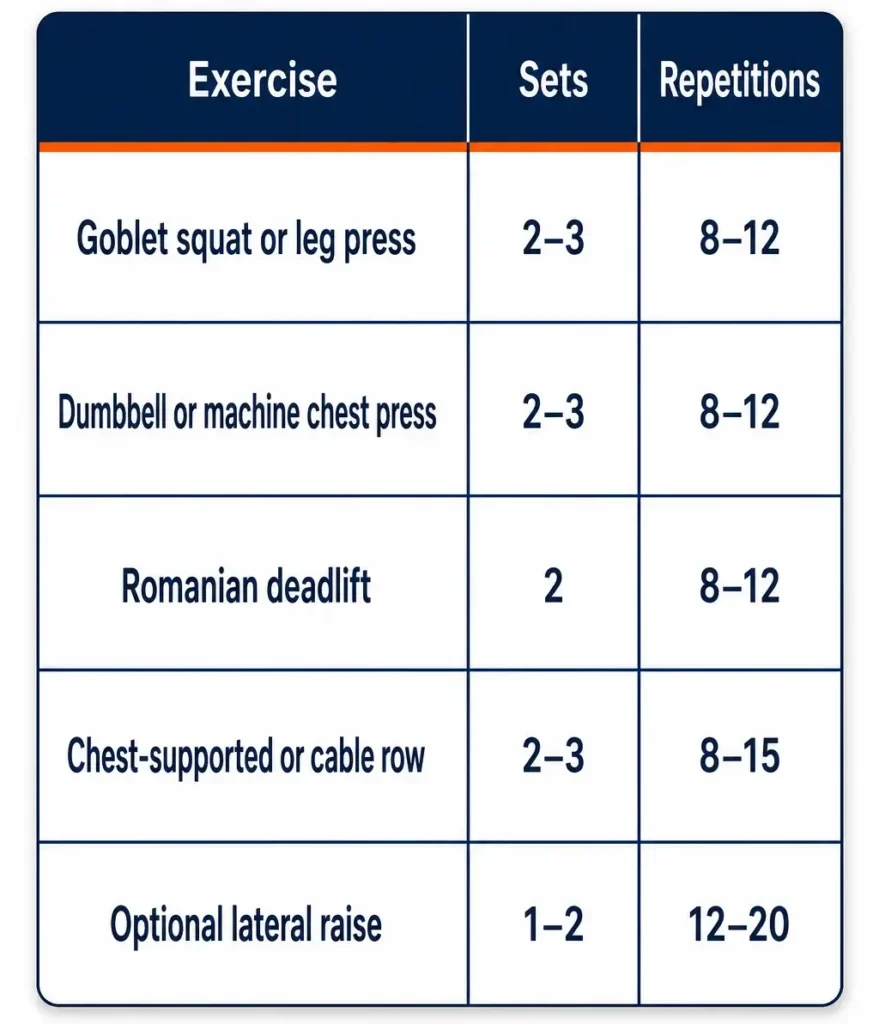
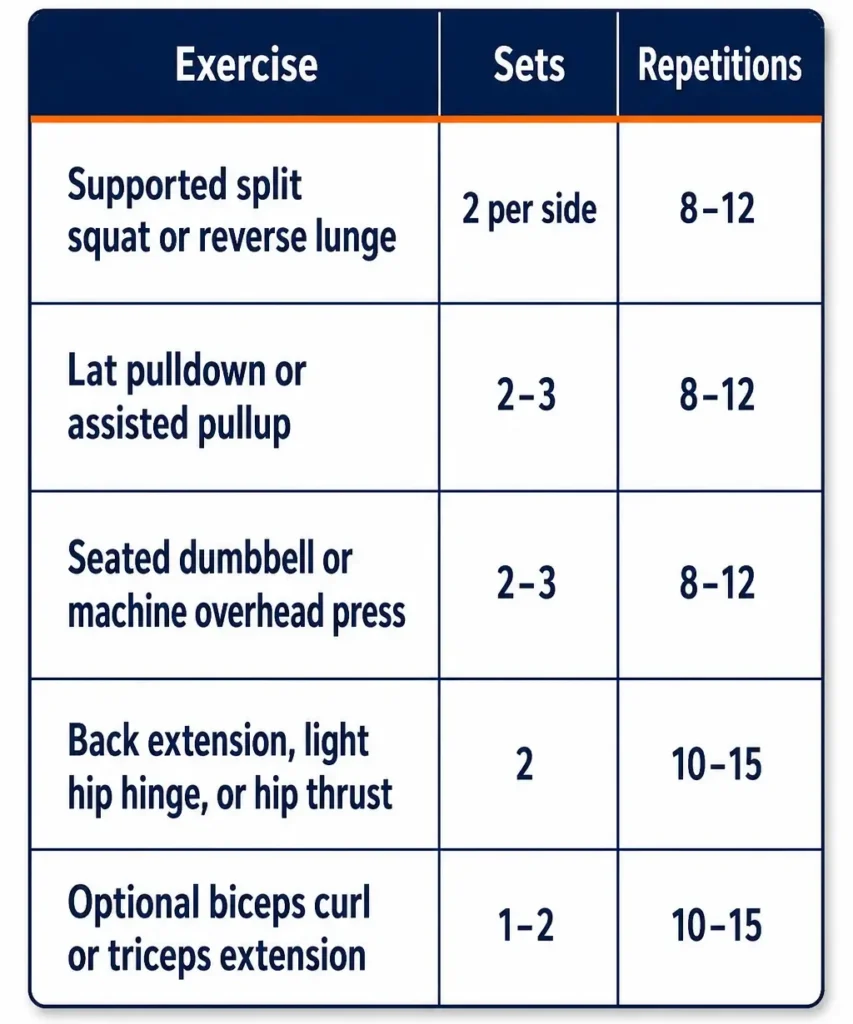
One schedule is:
- Monday: Workout A
- Wednesday: Workout B
- Friday: Workout A
- The following week: B, A, B
Leave at least one day between these full-body sessions. Two weekly sessions are also enough to begin: simply perform A and B once each. ACSM recommends training all major muscle groups at least twice weekly, while emphasizing that consistency and individualization are more important than a needlessly complex plan (ACSM, 2026).
How to warm up
Use a brief general warm-up followed by exercise-specific preparation:
- Perform several minutes of comfortable movement to raise body temperature.
- Practice the first exercise with bodyweight or very light resistance.
- Complete one or more gradual warmup sets before a heavier working set.
- Do not turn warmup sets into fatiguing workouts.
A warmup prepares you to train; it does not guarantee injury prevention. Good load selection, equipment setup, recovery, and attention to symptoms remain important.
Compound Exercises for Muscle Growth at Home
A home compound workout can build muscle if each exercise becomes progressively challenging. Pushups, split squats, band rows, band pulldowns, and loaded hip hinges can cover the major patterns without a full gym.
Beginner home compound workout
| Movement | Home exercise | Progression option |
| Kneedominant | Squat or split squat | Add a backpack, dumbbell, or deeper controlled range |
| Hip hinge | Backpack, band, or dumbbell Romanian deadlift | Add resistance or single-leg support |
| Horizontal push | Hand-elevated or floor pushup | Lower the hand position, add a band, or elevate the feet |
| Resistance band | Use a stronger band or pause at the contracted position | |
| Vertical push | Band overhead press or pike pushup | Increase band resistance or use a harder pike angle |
| Vertical pull | Band pulldown or pullup | Stronger band, less assistance, or added repetitions |
Perform two or three sets of each exercise for a controlled repetition range that becomes challenging near the end. Anchor resistance bands only to a stable object designed to tolerate the force, inspect bands for damage, and keep the pulling path away from the face.
Common Compound Exercise Mistakes
Most problems come from poor exercise selection or progression, not from failing to use a famous lift. Avoid these common errors.
Treating the “big lifts” as mandatory
Squats, deadlifts, and bench presses are effective, but none is required. A hack squat, Romanian deadlift, machine press, or other stable variation may fit your body, equipment, and goals better.
Adding weight before earning control
Load is only one progression tool. If a heavier weight shortens the range, changes the intended movement, or creates pain, it is not useful progression.
Taking every set to failure
Frequent failure on demanding compound exercises can increase fatigue and technique breakdown without guaranteeing more growth. Keep most sets close to failure and reserve true failure for exercises where a missed repetition can be managed safely.
Using too many compound lifts in one session
More exercises do not automatically create more useful volume. Four to six well-selected movements are usually enough for a full-body beginner workout.
Ignoring smaller muscles
Compound lifts provide broad coverage, but pressing alone may not fully develop the side and rear deltoids, and lower-body compounds may not directly train the calves through a meaningful range. Add a small amount of isolation work when it serves a clear purpose.
Changing exercises too often
Keep core movements long enough to improve skill and track progress. Change a variation when it causes persistent discomfort, cannot be progressed with available equipment, or no longer fits the program, not simply to “confuse” the muscles.
Copying someone else’s stance or range
Limb lengths, joint structure, mobility, and training history differ. Use general technique principles while allowing individual differences in stance, grip, and comfortable range.
Training through sharp or worsening pain
Normal muscular effort is different from sharp, sudden, or increasing pain. Stop the movement and reassess the setup, load, and variation. Seek guidance from a qualified healthcare professional when pain persists, follows an injury, or affects daily function.
Practical Exercise Selection Checklist
Keep an exercise when you can answer “yes” to most of these questions:
- Can I feel and control the intended movement?
- Can I use a consistent, comfortable range of motion?
- Can I progress it in small steps?
- Does it fit the equipment I can access regularly?
- Can I recover before the next session?
- Does it complement the other movement patterns in my program?
- Can I perform it safely, including managing a failed repetition?
Replace or modify an exercise when pain persists, the setup is unsafe, another body part always limits the target muscles, or fatigue consistently disrupts the rest of the program.
Frequently Asked Questions
What are the best compound exercises for muscle growth?
The most useful list includes a squat or leg press, Romanian deadlift, bench press or pushup, row, overhead press, pullup or lat pulldown, and a split squat or lunge. Select variations according to comfort, progression, equipment, and recovery.
Which compound exercises build the most muscle?
No exercise has been shown to build the most muscle for everyone. Exercises that train large muscle groups such as squats, leg presses, hinges, presses, rows, and pulldowns provide broad coverage. However, results depend on effort, weekly volume, progression, nutrition, recovery, and individual response.
How many compound exercises should I do per workout?
Most beginnerfull-bodyy workouts need about four to six exercises. This is enough to cover the major lower-body push, upper-body push, and pull patterns without filling the session with redundant movements.
Are compound exercises enough to build muscle?
Compound exercises can build substantial muscle and may be enough for a time-limited beginner program. Isolation exercises become useful when you want more direct work for the arms, side or rear deltoids, calves, hamstrings, or specific quadriceps regions.
Are compound lifts better than isolation exercises?
Neither category is always better. Compound lifts are efficient for broad coverage; isolation exercises provide targeted volume with less coordination and often less whole-body fatigue. A combination is usually the most flexible approach.
What rep range should I use for compound exercises?
Use roughly 5–10 repetitions for demanding barbell lifts, 8–15 for many dumbbell and machine movements, and higher repetitions when using lighter bands or bodyweight. These are practical ranges, not strict biological limits.
How often should I perform compound lifts?
Train each major muscle group about twice per week as a practical starting point. You do not need to perform the same lift twice; a push-up and dumbbell press can both supply horizontal pressing work.
Should compound exercises be performed first?
Usually, place the most demanding or highest-priority movement early in the session. Exercise order appears more important for the strength performance of the prioritized lift than for producing a universal hypertrophy advantage.
Are deadlifts necessary for building muscle?
No. Deadlifts are effective for total-body strength and posterior-chain training. However, Romanian deadlifts, hip thrusts, rows, leg curls, and other exercises can provide more targeted muscle work with less systemic fatigue.
Can bodyweight compound exercises build muscle?
Yes. Pushups, pullups, split squats, and other bodyweight movements can build muscle when the variation is challenging and progressively overloaded. Add repetitions, expand the range, reduce assistance, or select a harder variation as you improve.
Are machines or free weights better for muscle growth?
Neither has a consistent overall hypertrophy advantage. Free weights may develop skill specific to free-weight lifts, while machines provide stability and simple load adjustments. Use whichever lets you train the target muscles safely and progressively.
Should teenagers perform compound exercises?
Teenagers can participate in appropriately designed resistance training when technique, age-appropriate progression, and qualified adult supervision are provided. The focus should be skill, control, and gradual development, not maximal lifting or competition with others. The National Strength and Conditioning Association describes properly designed and supervised youth resistance training as relatively safe (NSCA position statement).
When should I use a spotter?
Use a competent spotter or correctly positioned safety arms when a failed repetition could trap the weight, especially during barbell bench presses and squats. Do not rely on an untrained person to catch a load they cannot safely manage.
Conclusion
The best compound exercises for muscle growth cover the body’s major movement patterns and allow steady, pain-free progression. Squats, leg presses, Romanian deadlifts, presses, rows, pulldowns, pullups, and unilateral leg exercises are all strong options, but their variations should match the individual.
Start with a short list, perform controlled working sets close to but usually not at failure, and record your repetitions and resistance. Add targeted isolation work only where it improves muscle coverage or supports a specific goal.
Next step: Choose one exercise from each major movement pattern and follow the beginner template for several weeks. Track form, repetitions, resistance, and recovery before adding more work.