Resistance bands can build stronger glutes if you use exercises that challenge hip extension and hip abduction, train consistently, and make the work harder over time. A useful routine should include more than lateral walks and kickbacks: combine a squat or lunge, a hip hinge, a bridge or hip thrust, and one or two abduction exercises.
You do not need to complete every exercise in this guide during one session. Choose four to six movements that match your equipment and ability, then track your repetitions and band resistance. The two workouts below provide a ready-to-use starting point.
Can Resistance Bands Build Your Glutes?
Yes. Resistance bands can help build glute strength and muscle when the exercises are challenging, the weekly workload is appropriate, and resistance increases as you improve. Their main limitation is that strong trainees may eventually need heavier bands, free weights, or machines to keep progressing efficiently.
A systematic review found that elastic resistance and conventional resistance training produced similar strength improvements across the included studies, although protocols and participant groups varied. That does not mean every band exercise equals a heavy barbell exercise. It shows that elastic resistance can be a valid training method when it provides an adequate challenge. Read the systematic review and meta-analysis.
The American College of Sports Medicine’s 2026 resistance-training guidance also recognizes bands, bodyweight, and home-based training as effective options. The larger lesson is practical: consistency and progressive effort matter more than using a complicated program or a particular type of equipment. See the ACSM resistance-training guidance.
For muscle growth, a band should make the final repetitions of a set noticeably slower while your technique remains controlled. If you can perform 30 or 40 easy repetitions and stop only because you are bored, the exercise is probably too light to be an efficient main strength movement.
What the Glute Muscles Do
The glutes include three overlapping muscles with related but different functions.
| Muscle | Important functions | Useful exercise patterns |
|---|---|---|
| Gluteus maximus | Extends the hip and assists external rotation | Bridges, hip thrusts, RDLs, squats, lunges, and good mornings |
| Gluteus medius | Abducts the hip and helps control the pelvis during single-leg tasks | Lateral walks, standing abduction, clamshells, and lunges |
| Gluteus minimus | Assists hip abduction and pelvic control | Abduction exercises and single-leg movements |
No exercise completely isolates one glute muscle. Compound exercises also train the quadriceps, hamstrings, adductors, and trunk. That shared work is useful, not a flaw.
Mini Bands vs. Long Resistance Bands
Use a mini loop for outward-knee or side-to-side resistance and a long loop or handled tube when you want to load a squat, hinge, or lunge. Owning both makes exercise selection easier, but either type can support a useful beginner workout.
| Band type | Best uses | Main limitation |
|---|---|---|
| Mini loop or fabric “booty band” | Lateral walks, clamshells, seated abduction, fire hydrants and knee-banded bridges | Usually cannot provide substantial direct resistance to standing hip extension |
| Long loop band | Squats, RDLs, good mornings, lunges and some hip-thrust setups | Can slip or recoil if setup is poor |
| Tube with handles | Squats, RDLs, kickbacks and general full-body training | Handles and fixed length may limit some lower-body setups |
A mini band around your thighs during a squat pulls the knees inward. Resisting that pull adds hip-abduction demand, but it does not directly increase the vertical load you must lift. To make the upward phase harder, stand on a long band and hold or loop the other end securely at shoulder level.
Band colors are not standardized. A green band from one company may not match a green band from another. Band tension also rises as the material stretches, and the relationship between stretch and force differs by product. Use the manufacturer’s resistance information as a starting point, then judge the band by your form and effort. Research on elastic-band elongation and tension.

- High End Exercise Bands. Our 12″³ By 2″³ Heavy Duty Loop Resistance Bands Come In 5 Varying Resistance Levels. This Make…
- Great With Any Workout. This Resistance Band Set Can Be Integrated Seamlessly With Various Popular Workout Program. Or U…
- Multiple Uses. While These Resistance Bands Are Often Used For Sports And Fitness, Physical Therapists Love These Physic…

- 100% Natural Latex
- 【Natural Latex & Durable Elasticity】Our pull up bands are made of 100% natural Malaysia latex, making these resistance b…
- 【Multifunctional Exercise Bands】These exercise bands add effective resistance and weight to your workouts, ideal for pul…
The 12 Best Resistance Band Glute Exercises
The best selection covers several movement patterns rather than repeating the same small-range abduction exercise. Start with the compound exercises, then use one or two accessories to complete the session.
1. Long-Band Squat
The long-band squat trains the glutes and quadriceps through a familiar sit-and-stand pattern. Unlike placing a mini band around the knees, standing on a long band creates direct resistance as you rise.
How to do it:
- Stand near the center of a long loop band with your feet about shoulder-width apart.
- Hold the other side at your shoulders. Keep it in your hands rather than wrapping it tightly around your neck.
- Brace your trunk and sit down between your hips while keeping your full foot on the floor.
- Descend as far as you can without pain, heel lift, or loss of trunk control.
- Push through the floor and stand tall without forcefully leaning backward.
Start with 2–3 sets of 8–15 repetitions.
Common mistake: Choosing a band that pulls the torso forward or prevents a controlled bottom position. Use a lighter band or reduce the depth while you improve mobility and control.
Make it easier: Perform a band-free box squat on a stable chair.
Make it harder: Use a stronger band, add repetitions, or progress to a split squat.
2. Resistance Band Romanian Deadlift
The resistance band Romanian deadlift, or RDL, is a primary hip-hinge exercise for the glutes and hamstrings. It teaches you to move the hips backward while keeping the spine controlled.
How to do it:
- Stand in the middle of a long loop or tube band with your feet approximately hip-width apart.
- Hold the band ends with your arms long. Start tall with a slight bend in your knees.
- Push your hips backward as if closing a car door behind you.
- Lower until you feel tension through the glutes and hamstrings or before your back position changes.
- Drive your feet into the floor and bring your hips forward to stand.
Start with 2–4 sets of 8–15 repetitions.
Common mistake: Turning the movement into a squat by bending the knees excessively. Keep the shins relatively vertical and let the hips travel backward.
Make it easier: Practice the hip hinge without a band while keeping a hand on the front of your hip crease.
Make it harder: Use a stronger band, increase starting tension, or try a staggered-stance RDL.
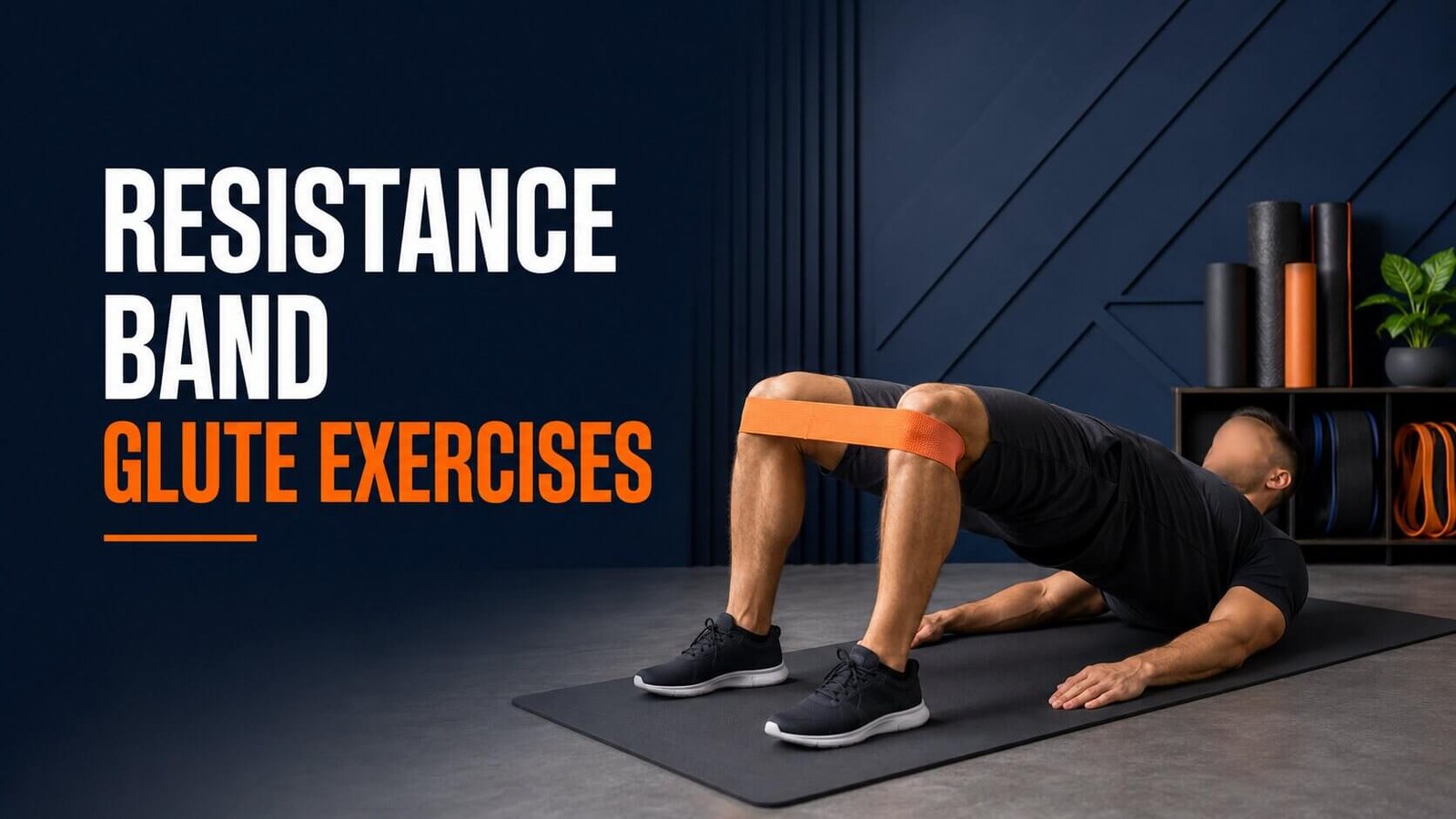
3. Banded Glute Bridge
The banded glute bridge trains hip extension on the floor and is suitable for most beginners. A mini band above the knees mainly adds outward-knee resistance; bodyweight still supplies most of the hip-extension challenge.
How to do it:
- Place a mini band a few inches above your knees and lie on your back.
- Bend your knees and set your feet about hip-width apart.
- Gently brace your abdomen and keep your ribs from flaring upward.
- Press through your feet, maintain light outward tension on the band, and lift your hips.
- Stop when the hips are extended without arching the lower back, then lower under control.
Start with 2–3 sets of 10–20 repetitions.
Common mistake: Chasing extra height by overextending the lower back. Finish each repetition by squeezing the glutes while keeping the rib cage and pelvis controlled.
Make it easier: remove the mini band or shorten the range.
Make it harder: Pause for two seconds at the top, use a single-leg variation, or add an appropriate external load.
4. Banded Hip Thrust
The hip thrust uses the same hip-extension pattern as a bridge but places the upper back on a stable bench or couch, allowing a larger range of motion. It can work well, but a floor bridge is the safer choice if you do not have secure support.
How to do it:
- Sit on the floor with your upper back against a stable bench and place a mini band above your knees.
- Plant your feet about hip-width apart and keep your chin gently tucked.
- Maintain outward pressure against the band as you drive your hips upward.
- Stop with the torso approximately parallel to the floor and the hips fully extended.
- Lower slowly while keeping your feet and support stationary.
Start with 2–4 sets of 8–20 repetitions.
Common mistake: Using an unstable chair that can slide or tip. Test the support before starting and use the floor bridge when uncertain.
Make it easier: Use a glute bridge.
Make it harder: Add a pause, progress to one leg, or use a purpose-built and securely anchored resistance setup.
A nine-week study in previously untrained adults found similar gluteal growth from barbell squats and hip thrusts when set volume was matched. It also found that greater muscle activity measured during one session did not consistently predict the later growth response. The study used barbells rather than bands, but it supports using more than one sound hip-extension or squat pattern instead of searching for a single “perfect” exercise. Read the peer-reviewed study.
5. Supported Band Reverse Lunge
The supported reverse lunge trains each leg separately and challenges the glutes, quadriceps, and pelvic stabilizers. Holding a wall or sturdy support reduces the balance demand so the working leg can receive more attention.
How to do it:
- Stand on the center of a long band with the working foot and hold the band at shoulder level on the same side.
- Lightly hold a stable support with your free hand.
- Step the opposite leg backward and lower both knees through a comfortable range.
- Keep most of your pressure through the front foot.
- Push the floor away with the front leg and return to standing.
Start with 2–3 sets of 8–15 repetitions per side.
Common mistake: Taking such a narrow step that balance, rather than leg strength, limits the set. Keep some side-to-side space between your feet.
Make it easier: Perform a supported split squat without a band.
Make it harder: Increase resistance or use a slower lowering phase.
6. Resistance Band Good Morning
The band good morning is another hip-hinge option for the glutes and hamstrings. Because the resistance acts farther from the hips, a modest band can feel challenging.
How to do it:
- Stand on a long looped band with both feet.
- Hold the opposite side securely against the fronts of your shoulders with both hands.
- Soften your knees, brace your trunk, and push your hips backward.
- Stop before your back position changes or the band begins to slip.
- Squeeze the glutes and stand tall.
Start with 2–3 sets of 10–15 repetitions.
Common mistake: Looping the band loosely around the back of the neck. Keep it controlled in your hands at the shoulders so you can release tension safely if needed.
Make it easier: Use a bodyweight hinge or an RDL with the band held in your hands.
Make it harder: Use a stronger band or pause in the stretched position while maintaining control.
7. Lateral Band Walk
The lateral band walk trains hip abduction and challenges the glutes to control the pelvis and thighs as you step sideways. It works well as a short accessory exercise or warm-up, but it should not replace all your squats, hinges, and bridges.