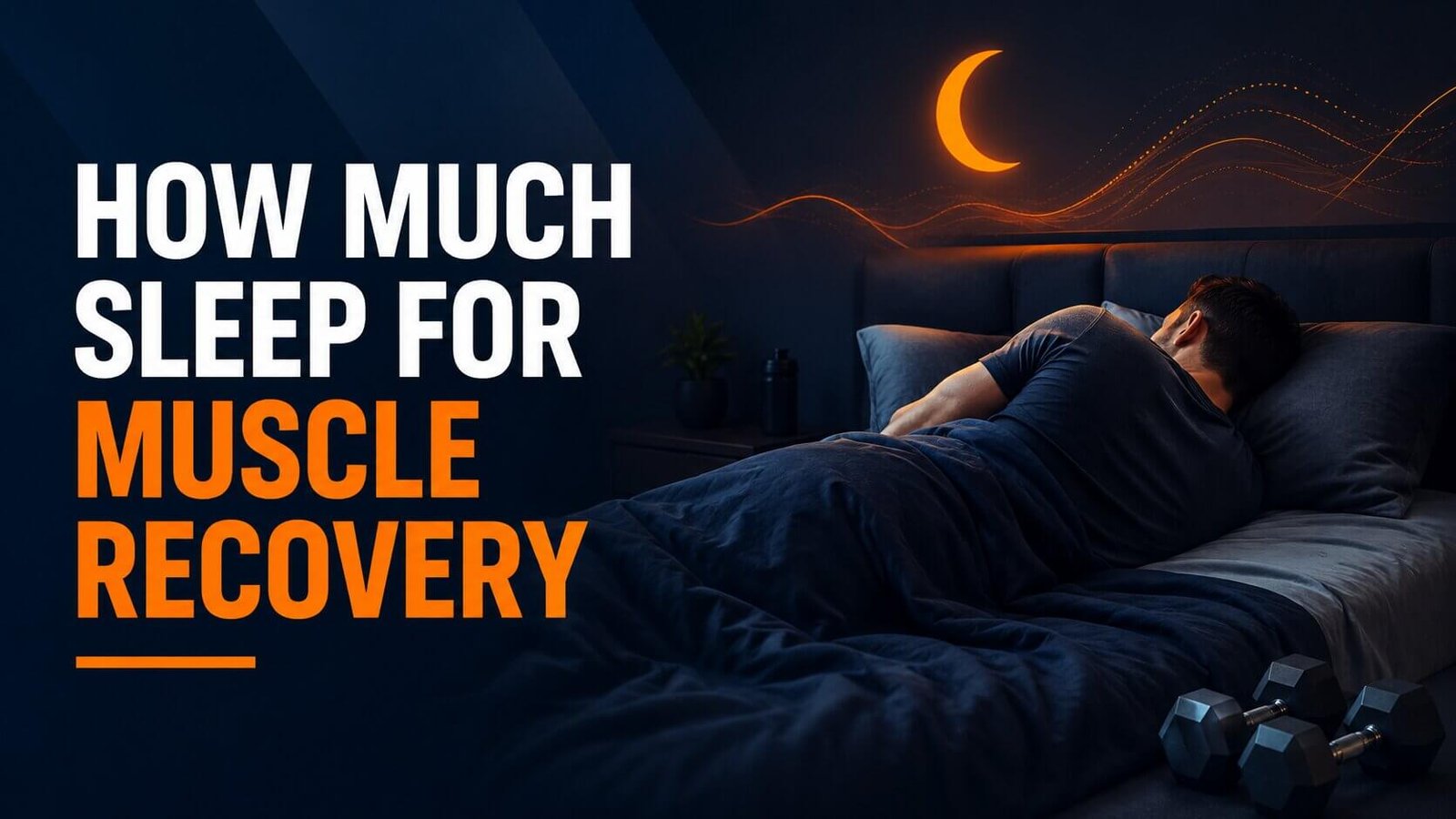
Most adults should aim for 7–9 hours of sleep per night to support overall health, training performance, and sleep for muscle recovery. Seven hours is a general minimum recommended for healthy adults, while about 8 hours is a practical starting target for someone who strength trains regularly. During high-volume training or periods of accumulated fatigue, some people may function better closer to nine hours.
There is no scientifically proven sleep duration that guarantees maximum muscle growth. Your needs depend on age, training load, sleep quality, health, stress, and individual biology. Consistently obtaining sufficient, restorative sleep matters more than hitting one perfect number after every workout.
How Much Sleep for Muscle Recovery?
For most adults who lift weights, 7–9 hours per night is the best evidence-based range, with roughly eight hours serving as a practical target. The American Academy of Sleep Medicine and the Sleep Research Society recommend that adults regularly sleep at least seven hours to support optimal health.
This is a population-level health recommendation, not a muscle-building formula. Research has not established that exactly eight hours produces more hypertrophy than seven hours in every lifter. However, consistently sleeping less than your personal requirement can impair training quality, increase perceived effort, and disrupt biological processes involved in recovery.
Seven Hours Is a Minimum, Not a Universal Optimum
Some adults feel and perform well with a little over seven hours. Others need eight or nine hours to wake refreshed and train effectively. Genetics, age, illness, training stress, work schedules, and prior sleep loss all affect the amount you need.
Use the recommendation as a starting point, then assess:
- Whether you wake reasonably refreshed
- Whether you remain alert through the day
- Whether workout performance is stable
- Whether you rely heavily on caffeine to function
- Whether you sleep much longer whenever given the opportunity
If you regularly need an alarm after eight hours and remain very sleepy, the issue may be insufficient sleep, fragmented sleep, poor timing, or a sleep disorder—not a lack of motivation.
Allow More Time in Bed Than Your Sleep Target
Time in bed is not always equal to time asleep. If you want eight hours of actual sleep but normally need 20 minutes to fall asleep and briefly wake during the night, you may need roughly eight and a half hours between bedtime and wake time.
Consumer sleep trackers can estimate patterns, but they do not measure sleep stages as accurately as a clinical sleep study. Use wearable data for trends rather than treating one night’s “deep sleep” score as a medical result.
Sleep Recommendations by Age and Training Demand
Sleep requirements change with age, and training may increase the practical need for recovery. The ranges below are starting points rather than personalized prescriptions.
| Person or situation | Practical sleep target | Important context |
|---|---|---|
| Healthy adults | 7–9 hours | Adults should regularly obtain at least 7 hours |
| Adults who strength train | About 8 hours | Move toward 8–9 if fatigue accumulates |
| High-volume or two-a-day training | Often 8–9 hours | Individual needs vary; additional time may help if sleep has been limited |
| Teenagers ages 13–18 | 8–10 hours | Growth, school schedules, and training all affect recovery |
| Adults age 65 and older | Usually 7–8 hours | Sleep may become more fragmented; quality still matters |
| Shift workers | Aim for the age-appropriate total | Daytime sleep often requires stronger control of light and noise |
The CDC lists 8–10 hours per 24 hours for teenagers ages 13–18. Young athletes should not use an adult seven-hour minimum as their goal.
Do Athletes Need More Sleep?
Some athletes may benefit from more sleep, particularly when their habitual sleep is short. Studies of sleep extension report possible improvements in perceived fatigue, reaction time, mood, or certain sport-specific outcomes. However, the evidence is not strong enough to prescribe nine or ten hours to every recreational lifter.
The useful lesson is not “athletes must sleep ten hours.” It is that people training hard should create enough sleep opportunities and consider adding time when performance, alertness, or recovery declines.
How Sleep Supports Muscle Recovery
Sleep supports recovery through several connected processes, including muscle protein turnover, nervous-system function, immune regulation, energy metabolism, and motor learning. Muscles do not grow only while you sleep, but inadequate sleep can make the training-and-recovery cycle less effective.
Muscle Protein Remodeling
Resistance exercise stimulates muscle protein synthesis and remodeling for many hours after a workout. Dietary protein supplies amino acids for this process, while sleep provides a long period in which the body coordinates repair and adaptation.
A small controlled study found that one night of total sleep deprivation reduced muscle protein synthesis by approximately 18% in healthy young adults. This finding shows that extreme sleep loss can affect muscle metabolism, but it does not prove that seven hours produces 18% less growth than eight hours. Total sleep deprivation is far more severe than an ordinary short night, and the study measured an acute response rather than long-term muscle gain.
Training Performance
Muscle growth depends partly on performing enough high-quality resistance training over time. Short sleep can increase perceived effort, reduce alertness, and impair some measures of strength or movement speed.
The effects are not identical across every exercise. A review found that isolated strength tests were sometimes preserved after limited sleep, while consecutive nights of restriction were more likely to affect compound movements. A controlled study in resistance-trained women also found that nine nights with only five hours in bed slowed lower-body bar velocity and increased perceived effort and training distress, even though total volume changed little.
This distinction matters: you may still complete the planned sets after poor sleep, but the session can feel harder, and movement quality may decline.
Coordination and Motor Learning
Strength training requires skill. Squats, presses, hinges, and Olympic-style lifts depend on timing, attention, and coordination—not only muscle force. Adequate sleep supports learning and recalling movement patterns, while sleep loss can reduce concentration and decision-making.
Hormonal and Immune Regulation
Sleep influences hormones, inflammatory signaling, glucose regulation, appetite, and immune function. These systems affect recovery and training readiness, but muscle growth should not be reduced to a single hormone.
Growth hormone release during sleep is often used in fitness marketing. Although sleep and slow-wave sleep are associated with growth hormone pulses, this does not mean that missing one “magic hour” stops muscle growth. The overall sleep pattern, training stimulus, nutrition, and long-term consistency matter more than chasing a supposed hormonal bedtime window.
Energy and Appetite Regulation
Sleep loss can make dietary consistency harder by affecting appetite, mood, and food decisions. This may indirectly influence muscle recovery if it leads to inadequate protein, insufficient total calories, or an erratic eating pattern.
What Happens When You Do Not Sleep Enough?
Occasional short sleep will not erase your muscle gains, but repeated sleep restriction can reduce training quality and make recovery more difficult. The effects tend to become more noticeable when lost sleep accumulates across several nights.
Possible effects include:
- Greater perceived effort during normal workouts
- Reduced bar speed or power
- Lower motivation and concentration
- Poorer coordination or exercise technique
- Increased daytime fatigue
- Slower decision-making and reaction time
- Difficulty maintaining nutrition and hydration habits
- Reduced tolerance for high training volume
The outcome depends on how much sleep is lost, when it is lost, the task being tested, and the individual. Research does not support telling every person that one six-hour night will cause muscle loss.
One Bad Night vs. Chronic Short Sleep
One poor night is mainly a short-term performance and safety issue. Repeated short nights are more concerning because sleep debt accumulates and the body receives fewer opportunities for normal recovery.
After an occasional bad night, return to your usual schedule rather than panicking or staying in bed far beyond your normal wake time. If short sleep is routine, the solution requires changing the schedule, sleep environment, or underlying problem—not relying on weekend catch-up alone.
Is Six Hours of Sleep Enough to Build Muscle?

You can build muscle while averaging six hours of sleep, but six hours is below the general recommendation for most adults and is unlikely to be ideal. It may limit training quality or recovery, particularly when combined with demanding workouts, work stress, or a calorie deficit.
Avoid an all-or-nothing mindset. Someone sleeping six hours can still make progress through sensible training and nutrition. Increasing average sleep from six hours to six and a half or seven hours may be more realistic and beneficial than failing repeatedly at an immediate nine-hour target.
If You Currently Sleep Only Five or Six Hours
Start with a manageable plan:
- Add 15–30 minutes of sleep opportunity for one week.
- Keep the wake time reasonably consistent.
- Move bedtime earlier only when you are likely to become sleepy.
- Reduce training volume temporarily if performance and recovery are deteriorating.
- Limit caffeine late enough that it does not delay sleep.
- Track daytime alertness and training performance, not only time in bed.
If you have enough opportunity to sleep but repeatedly cannot fall asleep or remain asleep, spending even longer in bed may not solve the problem. Persistent insomnia deserves proper assessment.
Sleep Duration vs. Sleep Quality
Sleep duration and quality both matter. Eight hours in bed with frequent awakenings may be less restorative than a slightly shorter period of consolidated sleep, but good quality does not make four or five hours sufficient for most people.
Signs of Reasonably Good Sleep Quality
Good sleep commonly includes:
- Falling asleep without a prolonged struggle most nights
- Remaining asleep with only brief awakenings
- Waking reasonably refreshed
- Staying alert during normal daytime activities
- Not requiring excessive caffeine to avoid unintended sleep
Sleep Consistency Matters
A regular sleep-wake schedule helps align sleep with the body’s circadian rhythm. Large differences between workdays and weekends can make Monday morning feel like a time-zone change.
Perfect consistency is not required. Aim for a schedule you can maintain most days, then make practical adjustments for work, family, travel, and social life.
Bedtime Is Individual
There is no universal muscle-building bedtime such as 10:00 p.m. The best bedtime is one that provides enough sleep before your required wake time and fits your circadian tendencies. A later schedule can still provide adequate sleep if it is consistent and compatible with daily obligations.
How to Know Whether You Need More Sleep
You may need more sleep—or better-quality sleep—when daytime function and training performance remain impaired despite otherwise reasonable programming. Use patterns across a week rather than judging one morning.
Common signs include:
- Difficulty waking even after repeated alarms
- Falling asleep unintentionally during quiet daytime activities
- Needing much more sleep on days off
- Persistent irritability or poor concentration
- Workouts feeling unusually difficult for several sessions
- Declining bar speed, strength, or coordination
- Heavy dependence on caffeine to feel functional
- Poor recovery despite manageable training volume and adequate nutrition
A sleep diary can help. For one or two weeks, record bedtime, estimated sleep time, awakenings, wake time, naps, caffeine, alcohol, exercise timing, and daytime sleepiness. This provides more useful context than a single readiness score.
How to Improve Sleep for Muscle Recovery
Improving sleep usually begins with protecting enough time and building a consistent routine. Supplements and expensive technology are secondary.
1. Set a Realistic Sleep Opportunity
Work backward from your required wake time. If you want about eight hours of actual sleep, reserve roughly eight and a half hours for winding down, falling asleep, and normal brief awakenings.
2. Keep a Consistent Wake Time
A stable wake time helps anchor the body clock. Keep it reasonably similar on days off when practical, especially if you struggle to fall asleep Sunday night.
3. Use Light Strategically
Get outdoor or bright light earlier in the day, particularly after waking. In the evening, reduce unnecessary bright light if it makes you feel more alert. You do not need to fear every screen, but dimming devices and avoiding stimulating content can help protect a wind-down routine.