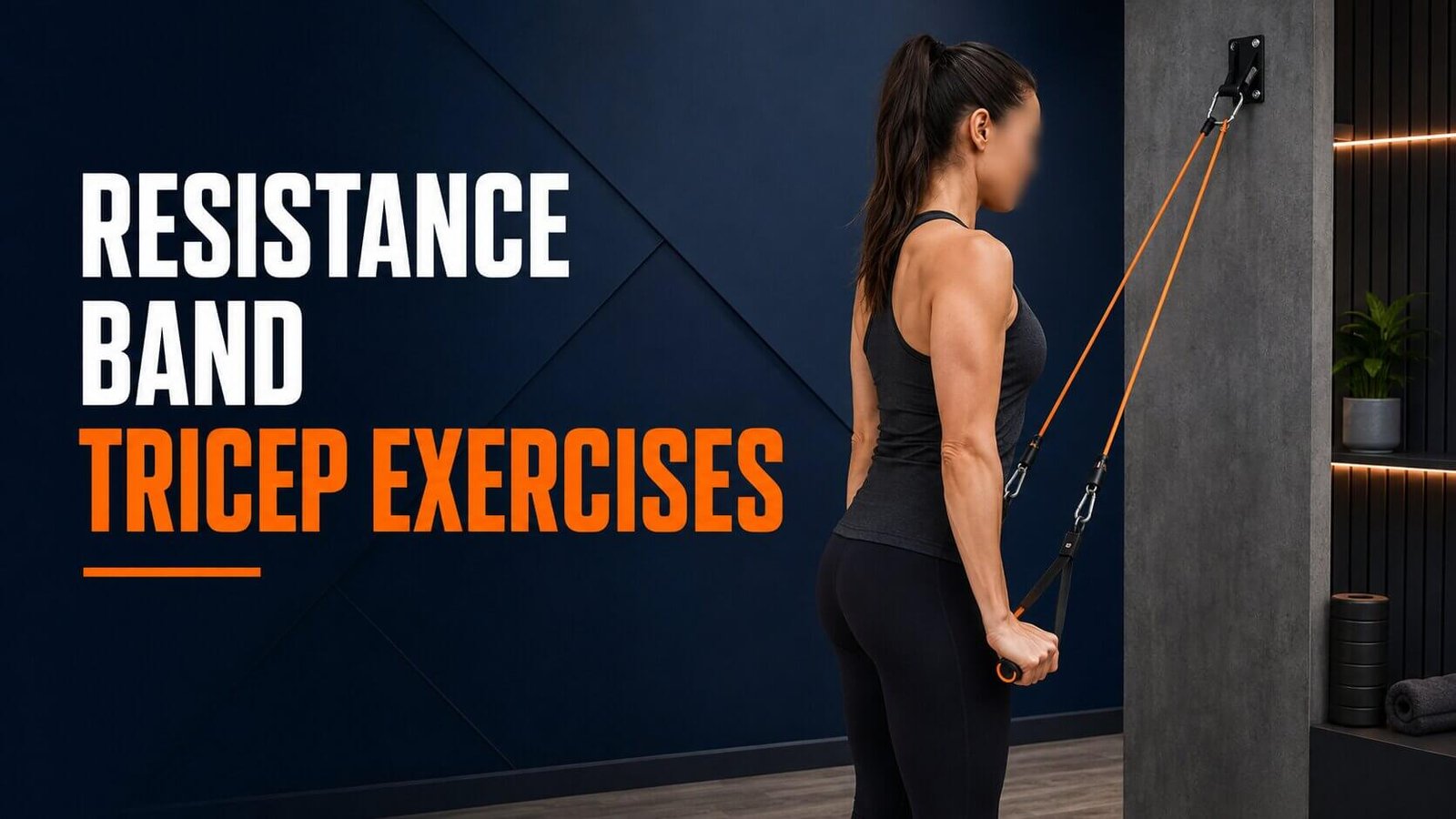
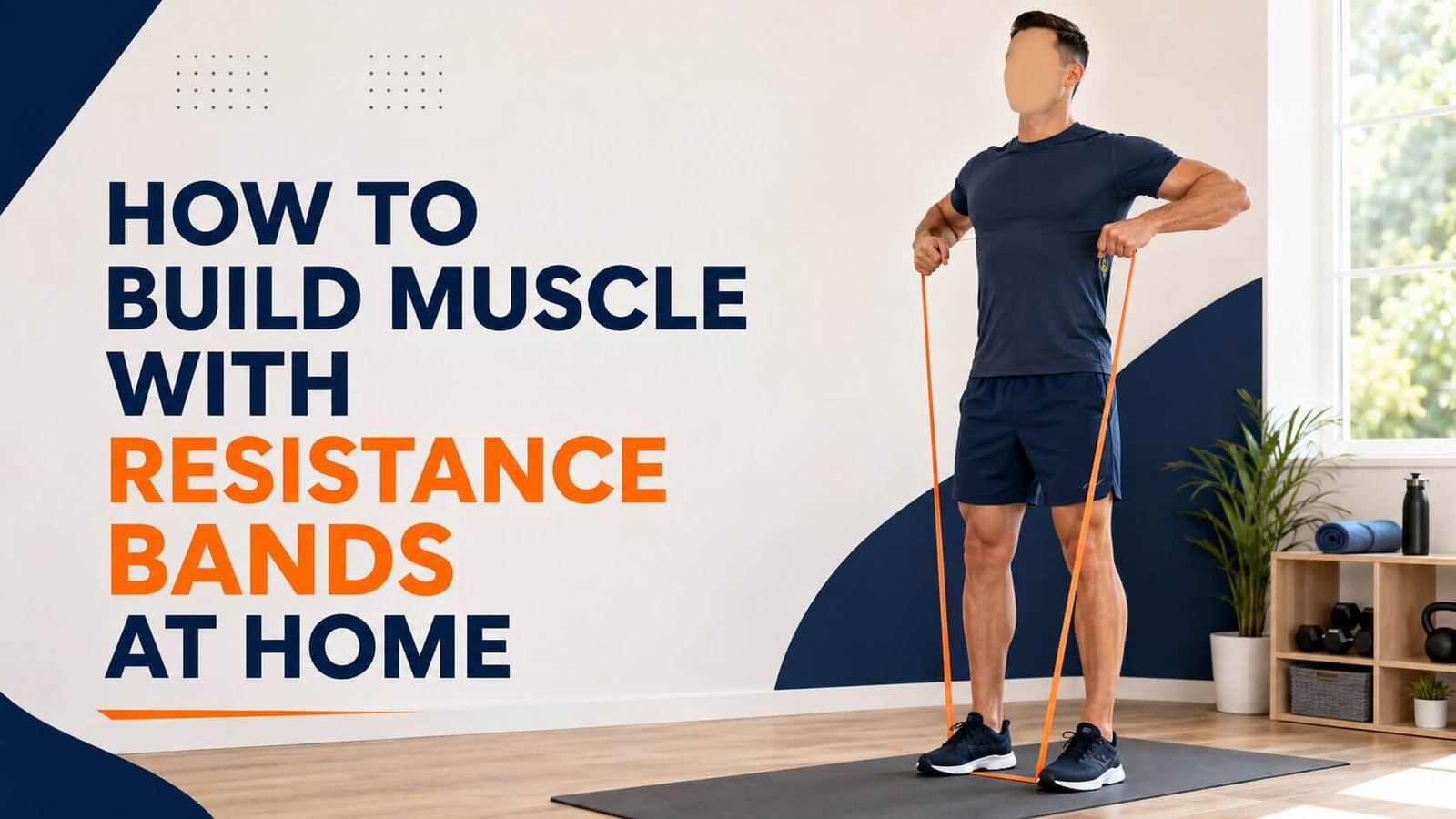
You can build muscle with resistance bands at home if your exercises become progressively more challenging. The type of equipment matters less than applying enough resistance, training each major muscle group consistently, using controlled technique, and recovering between sessions.
Bands are inexpensive, portable, and suitable for beginners. However, simply repeating the same light routine will eventually stop producing progress. You need a structured way to increase band tension, repetitions, sets, range of motion, or exercise difficulty.
Can You Build Muscle With Resistance Bands at Home?
Yes. Resistance bands can build muscle when they provide enough tension and your working sets are sufficiently challenging. Bands do not make muscle growth automatic, but neither do dumbbells, barbells, or machines.
A 2019 systematic review and meta-analysis found that elastic resistance training produced strength improvements comparable to conventional resistance equipment across the included studies. The analysis primarily examined strength rather than muscle size, so it should not be interpreted as proof that every band routine produces identical hypertrophy. Still, it shows that elastic resistance can provide a meaningful training stimulus. Lopes et al., 2019
The American College of Sports Medicine’s 2026 resistance-training guidance also recognizes elastic bands, bodyweight exercises, and home-based training as effective options. Its main message is that regular training, sufficient effort, and progressive programming matter more for most healthy adults than using one particular type of equipment. American College of Sports Medicine
Bands may not be ideal for every goal. Free weights and machines make exact loading easier to measure and often provide simpler progression for very strong lifters. For general strength, health, and muscle development at home, however, bands can be a practical primary training tool.
How Resistance Bands Stimulate Muscle Growth
Resistance bands help build muscle by creating mechanical tension—the force your muscles produce while working against resistance. Repeated exposure to challenging tension, followed by adequate recovery, encourages the muscles to adapt.
Unlike a dumbbell, which has a fixed mass, a band usually becomes more resistant as it stretches. This is called variable resistance. The exercise may feel relatively easy near the beginning and considerably harder near the end.
That resistance curve has practical consequences:
- The starting position must contain enough tension to challenge the muscle.
- You should control both the lifting and returning portions of each repetition.
- Some exercises may need a different anchor position to keep tension where you want it.
- A stronger band is not always better if it prevents a comfortable, controlled range of motion.
Research comparing training loads indicates that muscle growth can occur across a broad range of resistance levels when sets are challenging. Heavier loads remain more specific to developing maximum one-repetition strength. Lopez et al., 2021
What Resistance Bands Do You Need?
A long loop band or a set of tube bands with handles can cover most full-body exercises. A purpose-built door anchor expands your options for rows, presses, pulldowns, and arm exercises.
| Band type | Best uses | Main limitation |
|---|---|---|
| Tube bands with handles | Chest presses, rows, curls, shoulder presses | Handles, clips, and stitching require regular inspection |
| Long loop bands | Squats, hinges, presses, pulldowns, assisted exercises | Hand comfort may become an issue with heavy tension |
| Mini loop bands | Hip abduction, glute work, warmups | Usually too short for a complete full-body program |
| Fabric bands | Glute and lower-body exercises | Limited exercise variety |
| Flat therapy bands | Rehabilitation-style movements and light resistance | Often too light or awkward for advanced progression |


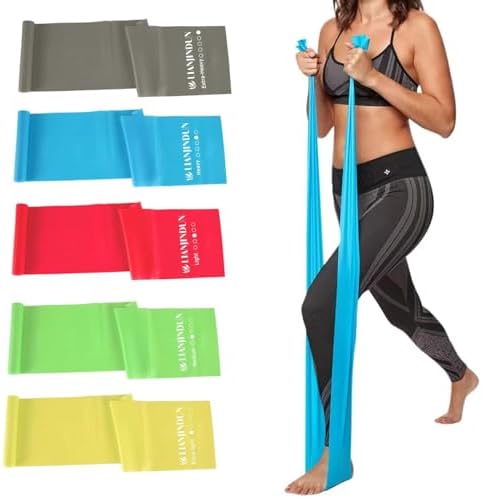
Band colors are not standardized. A “heavy” band from one manufacturer may not match a heavy band from another, so follow the manufacturer’s resistance chart rather than relying on color alone.
For a versatile home band workout, consider:
- Several resistance levels
- One long loop band
- Tube bands with handles
- A purpose-built door anchor
- An exercise mat
- An ankle strap, if supplied by the manufacturer
Do not combine bands, handles, carabiners, or anchors unless their instructions confirm that they are compatible.
The Training Principles That Matter Most
Make Every Working Set Challenging
A working set should become noticeably difficult near the end while your movement remains controlled. If you could easily complete another ten repetitions, the resistance is probably too light to provide an efficient muscle-building stimulus.
A practical target is to finish most sets with one to three repetitions in reserve, commonly abbreviated as RIR:
- 3 RIR: You estimate that you could perform three more controlled repetitions.
- 1 RIR: You could probably complete one more repetition.
- Technical failure: You cannot perform another repetition without changing your technique.
You do not need to reach complete muscular failure on every set. A systematic review and meta-analysis found no clear requirement to train to failure for strength or hypertrophy when training volume was considered. Grgic et al., 2022
Estimating RIR takes practice. Beginners can stop a set when repetitions slow substantially or technique begins to change, rather than testing absolute failure.
Use a Practical Repetition Range
Approximately 8–20 repetitions per set works well for many resistance band exercises. This is a practical range, not a biological boundary.
Different exercises may fit different ranges:
- Compound exercises: approximately 8–15 repetitions
- Isolation exercises: approximately 10–20 repetitions
- Small-band glute and shoulder exercises: approximately 12–25 repetitions
A set of 20 repetitions can be more productive than a set of 10 if the 20-repetition set is challenging and controlled. Conversely, performing 50 easy repetitions usually signals that you need more tension or a harder variation.
Perform Enough Weekly Sets
Beginners can start with roughly six to ten challenging sets per major muscle group each week, including relevant work from compound exercises. You do not need to start at the top of that range.
The 2026 ACSM guidance identifies approximately ten weekly sets per muscle group as a useful hypertrophy target, while emphasizing that training should be individualized and built gradually. American College of Sports Medicine
More sets are not automatically better. Add volume only when you are recovering well and your performance has stopped improving.
Train Each Major Muscle Group Regularly
Two or three full-body sessions per week are practical for most beginners. This schedule distributes the work without requiring daily hard training.
US physical activity guidelines recommend muscle-strengthening activity involving all major muscle groups on at least two days per week. Physical Activity Guidelines for Americans
Training frequency mainly helps organize weekly volume. When total volume is matched, higher frequency does not appear to produce substantially greater hypertrophy by itself. Schoenfeld et al., 2019
Rest Long Enough Between Sets
Rest until you can perform the next set with stable technique and useful effort. Most people can start with:
- 90–180 seconds after demanding squats, presses, rows, and hinges
- 60–120 seconds after curls, lateral raises, triceps work, and core exercises
Short rest periods are not required for muscle growth. If limited rest causes your repetitions or range of motion to drop sharply, wait a little longer.
How to Apply Progressive Overload With Resistance Bands
Progressive overload means gradually increasing the training challenge as your body adapts. With bands, progression involves more than switching colors.
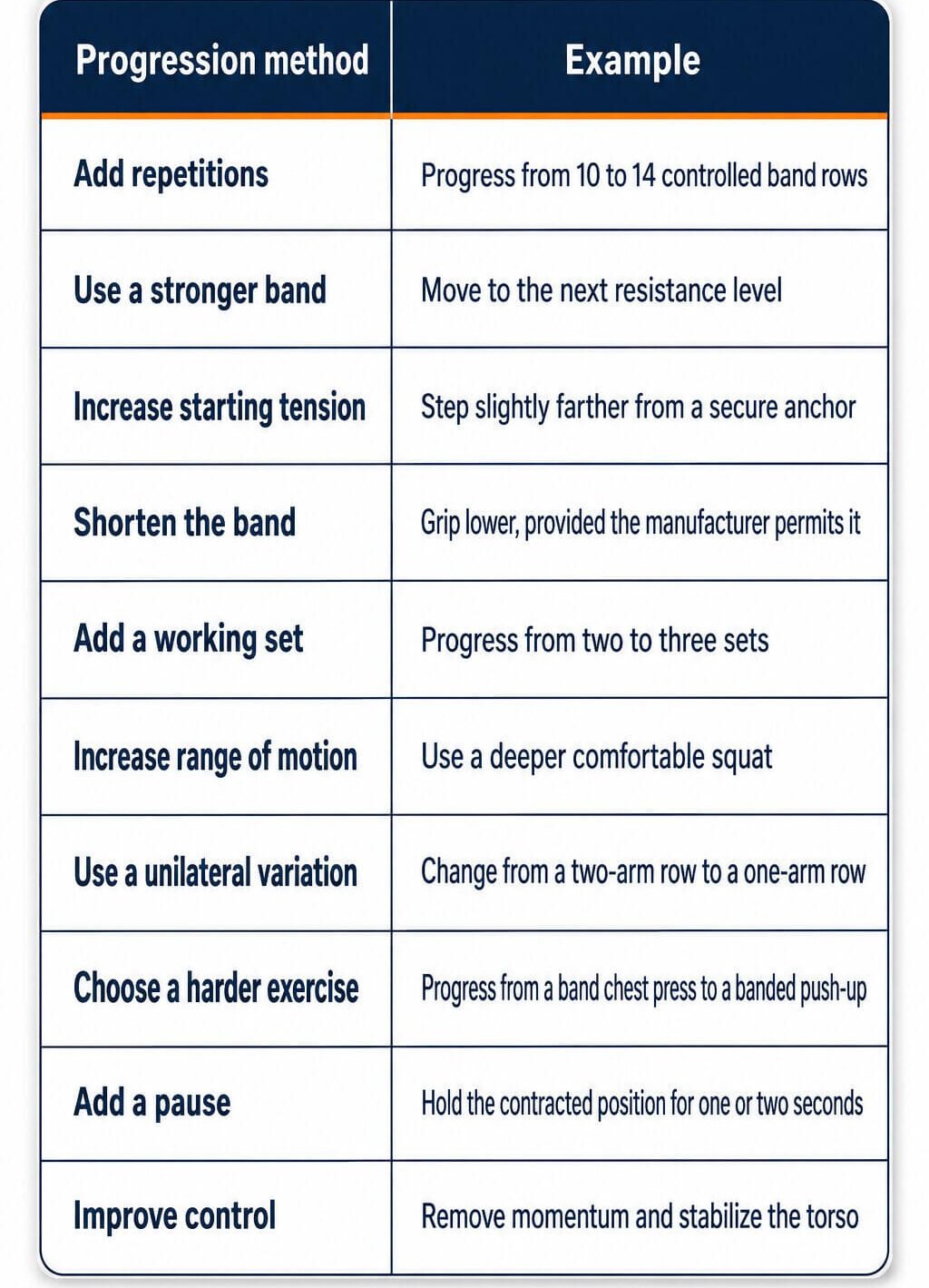
Use one or two changes at a time. Adding tension, sets, repetitions, and difficult techniques simultaneously makes progress hard to measure and may create unnecessary fatigue.
A Simple Double-Progression Method
Double progression is one of the easiest ways to organize resistance band training:
- Choose a repetition range, such as 8–15.
- Select a band that allows at least eight controlled repetitions.
- Keep the same band and setup while gradually adding repetitions.
- When you can perform 15 repetitions on every set with approximately two repetitions remaining, increase the tension.
- Return to the lower end of the range and repeat.
For example:
- Session 1: 12, 11, 10 repetitions
- Session 2: 13, 12, 11 repetitions
- Session 3: 14, 13, 12 repetitions
- Session 4: 15, 15, 14 repetitions
- Session 5: 15, 15, 15 repetitions
- Next session: use more tension and aim for at least eight controlled repetitions
The sessions may not progress this neatly in real life. Sleep, stress, illness, and exercise order can affect performance. Look for improvement across several weeks rather than expecting a personal record every workout.
Best Resistance Band Exercises for Muscle Growth
The best resistance band exercises collectively cover pushing, pulling, squatting, hinging, single-leg work, and core stabilization.
| Movement | Exercise | Main muscles |
|---|---|---|
| Squat | Resistance band squat | Quadriceps, gluteus maximus, core |
| Single-leg | Band split squat | Quadriceps, glutes, hamstrings |
| Hip hinge | Band Romanian deadlift | Hamstrings, glutes, spinal erectors |
| Hip extension | Band glute bridge | Glutes, hamstrings |
| Horizontal push | Standing band chest press | Pectoralis major, triceps, front deltoids |
| Horizontal pull | Seated or anchored band row | Latissimus dorsi, rhomboids, trapezius, biceps |
| Vertical push | Band overhead press | Deltoids, triceps |
| Vertical pull | Kneeling band lat pulldown | Latissimus dorsi, upper back, biceps |
| Elbow flexion | Band biceps curl | Biceps and other elbow flexors |
| Elbow extension | Band triceps pressdown | Triceps |
| Shoulder isolation | Band lateral raise | Side deltoids |
| Core stabilization | Pallof press | Abdominals and other trunk stabilizers |
Resistance Band Squat
Band squats train the quadriceps and glutes. Stand on the middle of a long band, hold the ends near your shoulders, and squat through a comfortable range.
Keep your feet planted and knees moving generally in the same direction as your toes. If the band becomes difficult to hold, use a long loop placement recommended by its manufacturer or select a split-squat variation.
Band Romanian Deadlift
The Romanian deadlift trains the hamstrings, glutes, and spinal erectors. Stand securely on the band, soften your knees, and move your hips backward while keeping your spine controlled.
Stop when you feel tension in the hamstrings or when further movement would cause your lower back to round. Stand by driving the hips forward, not by leaning backward.
Standing Band Chest Press
A band chest press trains the chest, triceps, and front shoulders. Anchor the band securely behind you at approximately chest height and press forward without letting your shoulders rise.
If you do not have a suitable anchor, perform a banded push-up or wrap a long band behind your upper back for an anchor-free pressing option.
Resistance Band Row
Rows train the back and biceps. Attach the band to a secure point in front of you, begin with your arms extended, and pull your elbows toward your torso.
Avoid turning the exercise into a backward lean. If an anchor is unavailable, sit on the floor and place the band around the midfoot, provided the band cannot slip.
Band Overhead Press
The overhead press trains the shoulders and triceps. Stand on the band and press the handles or loop overhead while keeping your ribs and pelvis controlled.