

To break a strength plateau, first confirm that performance has stalled across several comparable workouts. Then change the smallest variable that addresses the likely cause: your progression method, load, weekly volume, lift frequency, rest periods, exercise selection, or recovery.
Do not replace your entire program after one poor session. A plateau in one lift usually needs a lift-specific solution. A decline across several lifts is more likely to involve accumulated fatigue, inadequate recovery, illness, or under-fueling.
The 2026 American College of Sports Medicine (ACSM) position stand supports progressive resistance training and identifies several variables that can enhance strength, including heavier loads, a complete range of motion, multiple sets, performing priority work early in the session, and regular training exposure. It also emphasizes that programming should be individualized rather than built around rigid rules. (ACSM position stand)
Confirm That You Have a Real Strength Plateau
A real strength plateau is a repeated lack of improvement under comparable conditions. One bad workout may reflect normal variation in sleep, stress, food intake, equipment, motivation, or accumulated fatigue.
Compare several recent exposures to the same exercise. Keep these variables as consistent as practical:
- Exercise variation and equipment
- Grip, stance, setup, and range of motion
- Warm-up sequence
- Exercise order
- Rest between sets
- Number of working sets
- Repetitions in reserve (RIR) or rating of perceived exertion (RPE)
You may still be progressing even when the weight has not increased. More reps with the same load, cleaner technique, a fuller range of motion, or the same performance at a lower RPE all indicate improvement.
If you are unsure why progress stopped, read Why am I not getting stronger? before applying a plateau strategy.
Use a consistent performance marker
Choose one primary marker for each lift. This might be a top set of five at 2 RIR, three sets within a fixed rep range, or an estimated one-repetition maximum calculated from the same rep range.
Avoid comparing unrelated performances. A beltless pause squat for six reps is not a failed version of a belted competition squat for three. Both can be useful, but they measure different tasks.
Find the Right Plateau-Breaking Strategy
The best adjustment depends on the pattern in your training log. Use the table below to select a first step, then keep other major variables stable long enough to evaluate it.
| Pattern | Likely bottleneck | First strategy to test |
|---|---|---|
| The program has no rule for adding reps or load | Missing progression system | Use double progression |
| You reach the rep target but cannot handle the next weight | Load increase is too large | Microload or add weight to one set |
| High-rep sets improve but heavy attempts feel unfamiliar | Insufficient heavy practice | Add controlled lower-rep work |
| One lift stalls while the others progress | Lift-specific skill, setup, or weak position | Review technique and use one targeted variation |
| First set is strong but later sets collapse | Short rest or excessive session volume | Rest longer; review set count |
| Warm-ups and working sets decline across several lifts | Accumulated fatigue or poor recovery | Reduce training stress temporarily |
| Technique changes as load increases | The performances are not comparable | Standardize range of motion and execution |
| Training is consistent, recovery is good, but long-term progress has stopped | Stimulus may be too low or more muscle may be needed | Add a small amount of recoverable volume |
| Strength falls during an aggressive diet | Energy availability and recovery may be limiting | Moderate the deficit and protect training quality |
Do not assume every plateau requires more volume. The same symptom—no progress—can result from either too little stimulus or too much fatigue.
10 Ways to Break a Strength Plateau
1. Install a clear progression system
A progression system tells you exactly what must happen before load, reps, or sets increase. Without one, workouts easily become repeated demonstrations of the strength you already have.
For many beginners and intermediate lifters, double progression works well:
- Select a rep range, such as 5–8 reps.
- Keep the load stable while increasing reps over time.
- When all planned sets reach the top of the range with consistent form and effort, add the smallest practical load.
- Allow reps to fall toward the bottom of the range and build again.
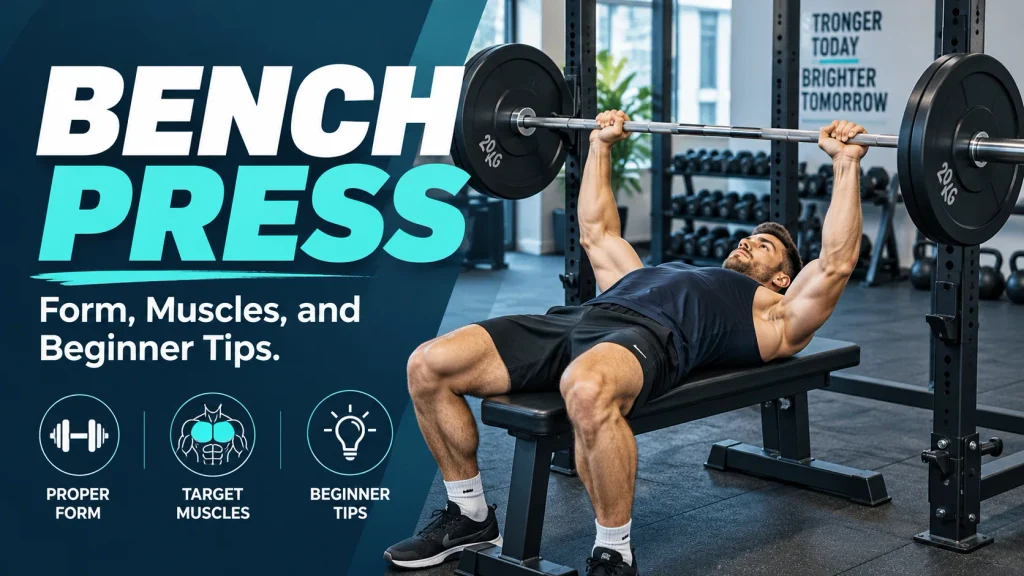
Example: bench press for 3 sets of 5–8 reps
| Session | Performance | Next step |
|---|---|---|
| 1 | 135 lb × 7, 6, 5 | Keep 135 lb |
| 2 | 135 lb × 7, 7, 6 | Keep 135 lb |
| 3 | 135 lb × 8, 8, 8 | Add the smallest available load |
| 4 | 140 lb × 6, 6, 5 | Build reps at 140 lb |
Rep quality must stay comparable. Adding a rep by shortening the range of motion does not represent the same progression.
See Progressive Overload for Beginners for more progression methods.
2. Make smaller load incre ases
When the next available weight is too large, reduce the size of the jump instead of forcing repeated failures. This matters most on upper-body lifts and lighter isolation exercises.
Moving from 20- to 25-pound dumbbells increases the load by 25% per hand. That is not a small progression, even if the rack makes it look like the obvious next step.
Practical options include:
- Use microplates on barbells.
- Add repetitions before adding load.
- Increase the load on the first set only, then expand it across later sets.
- Use an adjustable dumbbell, cable, or machine with smaller increments.
- Keep the weight stable while improving range of motion, control, or pauses.
For example, if you complete three sets of eight but cannot repeat them with the next dumbbell, use the heavier dumbbell for the first set and the previous load for the remaining sets. Gradually add heavy sets as performance improves.
3. Practice the priority lift more often
Strength is specific to the movement, range of motion, load, and skill being tested. More frequent exposure can improve technique and distribute weekly work across fresher sessions, but frequency should not rise so far that recovery worsens.
The ACSM review found enhanced strength outcomes with at least two weekly resistance-training sessions, while a meta-analysis on training frequency suggests that much of the benefit of higher frequency may come from performing more weekly volume. (ACSM position stand; Grgic et al., 2018)
If a priority lift is performed once per week, try dividing its current sets across two days before adding more total work.
Example: Replace six hard bench-press sets on Monday with three sets on Monday and three sets on Thursday. One session can emphasize heavier practice, while the second uses moderate loads and more repetitions.
This approach may improve rep quality without increasing weekly volume. Learn more in How often should you strength train?.
4. Add heavier practice without constantly testing your maximum
To improve maximal strength, include some work with relatively heavy loads while keeping technique stable. Heavy practice builds familiarity with the positions, bracing, and force demands that lighter sets do not fully reproduce.
Meta-analyses generally find greater one-repetition-maximum strength gains with higher-load training than with lower-load training. The 2026 ACSM review reports enhanced voluntary-strength outcomes with loads at or above approximately 80% of one-repetition maximum. (Lopez et al., 2021; ACSM position stand)
This does not mean every working set must exceed 80% or reach failure. A practical session might use:
- A few technically controlled sets of 3–6 reps on the priority lift
- Longer rests between heavy sets
- Moderate-rep assistance work afterward
- Approximately 1–3 RIR on most working sets
Beginners should first learn stable technique with manageable loads. Maximal singles are tests, not a required weekly training method. See Best rep range for muscle growth and strength.
5. Adjust weekly volume in the correct direction
Volume can help break a plateau when the current dose is too low, but cutting volume is often better when fatigue is suppressing performance. Decide which direction to move based on your log and recovery.
Research supports a graded relationship between weekly set volume and strength gain, although returns diminish and individual tolerance varies. The current ACSM review reports that multiple sets can enhance strength outcomes. (Ralston et al., 2017; ACSM position stand)
Consider adding volume when:
- Performance is stable but unchanged.
- You recover well between sessions.
- Working sets are challenging but not maximal.
- The lift receives very few weekly sets.
Add only one or two weekly sets for the stalled movement or its main muscles. Monitor performance for several exposures.
Consider reducing volume when:
- Several exercises decline together.
- Later sets consistently lose many reps.
- Warm-ups feel unusually difficult.
- Joint discomfort or persistent fatigue is increasing.
- You recently added sets, training days, conditioning, or failure work.
Remove the least specific or least productive work first. More volume is useful only when you can recover and adapt from it.
6. Stop turning every working set into a test
Leaving a small number of repetitions in reserve lets you accumulate quality work without the fatigue and technique breakdown that frequent failure can create. Training to failure is a tool, not a requirement for strength.
A systematic review and meta-analysis found no overall strength advantage for failure training compared with nonfailure training. (Grgic et al., 2022)
For compound exercises, keep most working sets around 1–3 RIR. Stable accessory movements may be trained closer to failure when appropriate, but repeatedly grinding squats, presses, and deadlifts can reduce the quality of later sets and sessions.
If you have been failing reps each week, reduce the load enough to complete the planned range with clean technique. Then rebuild using measurable progression.
Read Training to failure vs. not to failure and Reps in reserve explained for practical effort guidelines.
7. Rest long enough to repeat strong sets
Longer rest periods can improve set-to-set performance by allowing more recovery before the next effort. If repetitions collapse after the first set, rest may be the easiest variable to fix.
A systematic review found that both short and long inter-set rests can produce strength gains, but trained lifters generally appear to need more than two minutes to maximize strength development. (Grgic et al., 2018)
Use these practical starting points:
| Exercise type | Starting rest period |
|---|---|
| Heavy squat, bench press, deadlift, or overhead press | 3–5 minutes |
| Moderate-load compound exercise | 2–3 minutes |
| Isolation or small accessory exercise | 1–2 minutes |
The correct rest period is long enough to reproduce the target load, reps, range, and technique. It may be longer after demanding lower-body sets or shorter for small exercises that create little systemic fatigue.