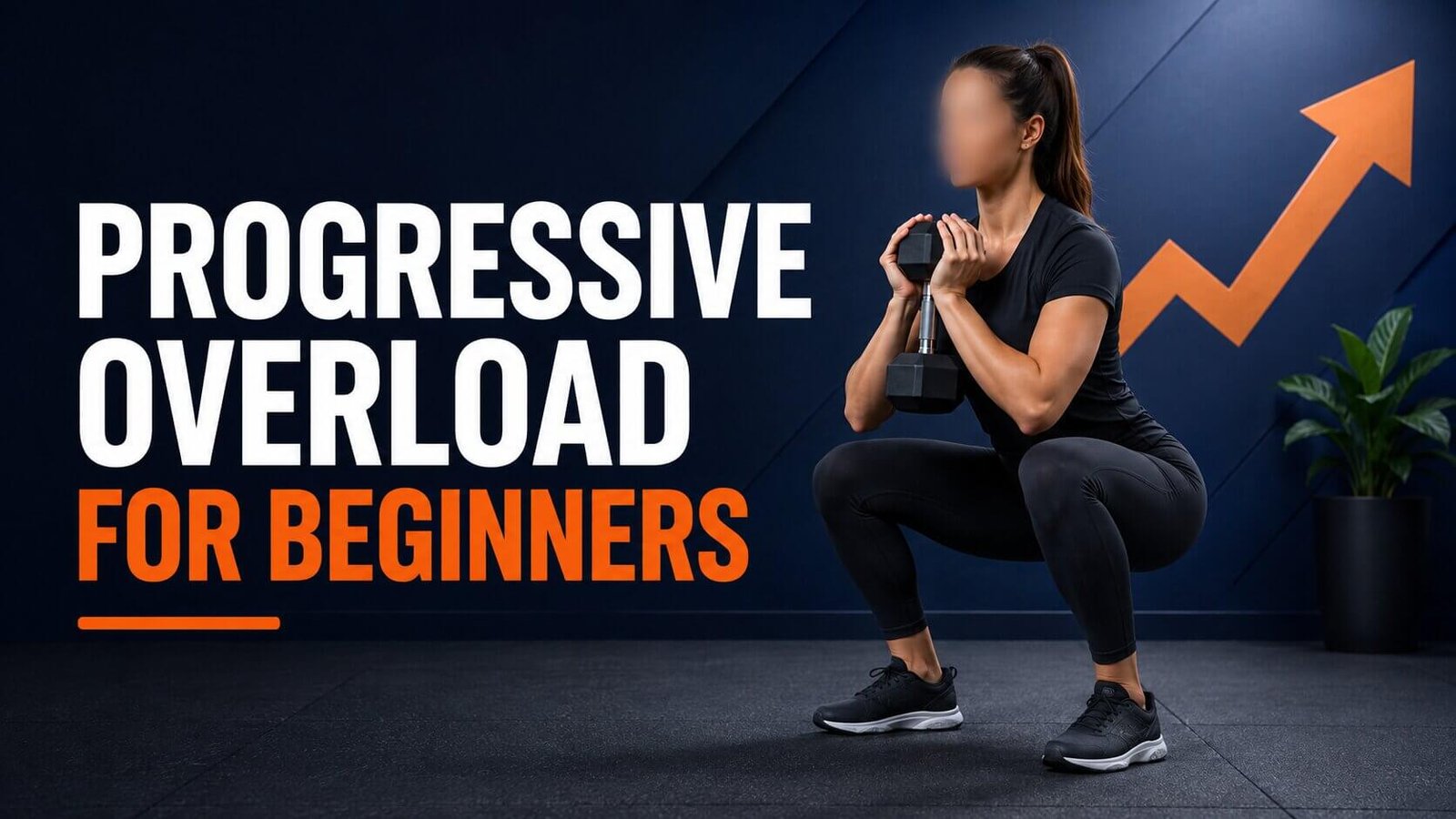
Progressive overload means gradually increasing the challenge of your workouts as your body adapts. You might add repetitions, use slightly more resistance, perform another productive set, improve your range of motion, reduce assistance, or advance to a harder exercise variation.
It does not mean adding weight every workout or pushing every set to failure. Some days, repeating your previous performance with better control is enough. Progress also becomes slower and less predictable as you gain experience.
For most beginners, the simplest approach is double progression: choose a repetition range, gradually build toward the top of that range, and then increase resistance slightly. This article explains exactly how to use that method, when to progress, and what to do when the next weight feels too heavy.
What Is Progressive Overload?
Progressive overload is the gradual increase of training demands over time. Its purpose is to keep an exercise challenging enough to support further improvements in strength, muscle size, endurance, or movement skill.
Your body adapts to repeated demands. A beginner who initially struggles with eight push-ups may eventually perform the same eight repetitions comfortably. If the exercise never becomes more challenging, it may no longer provide the same stimulus for continued improvement.
Progressive overload can involve changing:
- Resistance
- Repetitions
- Working sets
- Range of motion
- Exercise leverage
- Assistance
- Exercise variation
- Training density
The appropriate method depends on your goal. Adding resistance is especially useful for strength, while repetitions, resistance, and productive weekly volume can all contribute to muscle growth.
The 2026 American College of Sports Medicine position stand recommends progressive resistance training but emphasizes consistency and individualization over complicated programming. It also recognizes free weights, machines, bands, bodyweight exercises, and home-based routines as effective options. ACSM resistance-training guidance
Why Do Beginners Need Progressive Overload?
Beginners need progressive overload because the same workout eventually becomes easier as strength, coordination, and work capacity improve. Gradually increasing the challenge helps training remain productive.
This does not mean your program stops working if you fail to add weight for a week. Early improvements can appear through better balance, technique, coordination, and confidence. Overload becomes necessary when the current exercise no longer creates enough challenge for your goal.
Progressive overload can support:
- Increased muscular strength
- Muscle hypertrophy
- Improved muscular endurance
- Better exercise performance
- Continued progress after the beginner adaptation period
A 2024 study compared increasing resistance with increasing repetitions in 39 previously untrained adults. Both progression methods improved strength and muscle size over 10 weeks, with no meaningful difference between them. Resistance-training progression study
A 2026 study in untrained young women found that progressively increasing overload produced greater muscle growth than maintaining an unchanged challenge. However, the non-progressive group still gained muscle. The results came from a short-term study in one population, so they should not be treated as a universal formula for every trainee. Progressive overload and hypertrophy study
Progress vs. Overload: What Is the Difference?
Progress describes an improvement, while overload describes an increase in training demand. They often occur together, but they are not identical.
| Example | Progress? | Increased overload? |
|---|---|---|
| Add two repetitions with the same weight | Yes | Yes |
| Add five pounds with the same repetitions | Yes | Yes |
| Use better technique with the same load | Yes | Not necessarily |
| Perform the same workout with less effort | Yes | No |
| Increase controlled range of motion | Yes | Usually |
| Finish the workout faster by rushing repetitions | Not necessarily | Not productively |
| Add weight but shorten the range of motion | Unclear | The target muscle may not receive more useful overload |
| Add a set | Usually | Yes, through greater volume |
Better technique is valuable progress. However, it does not always mean the muscle experienced greater resistance. Once technique becomes consistent, the training challenge eventually needs to increase for continued strength or muscle gain.
Overload Is Not the Same as Intensity
The word “intensity” has several meanings. In exercise science, it often describes resistance relative to your maximum strength. In everyday fitness language, it may describe how difficult or exhausting a workout feels.
A faster circuit may feel more intense because you are breathing harder, but that does not necessarily mean the target muscles experienced more useful resistance. The overload method should match the adaptation you want.
Establish a Baseline Before Progressing
A baseline records what you can currently do with controlled technique. Without one, it is difficult to know whether the workout has genuinely improved.
For each exercise, record:
- Exercise or variation
- Resistance used
- Number of working sets
- Repetitions in each set
- Range of motion or assistance level
- Approximate repetitions in reserve
- Any relevant pain, fatigue, or technique notes
For example:
Goblet squat: 20-pound dumbbell, 3 sets of 10, 9, and 8 repetitions, approximately 2 repetitions in reserve on the first set.
Do not choose your baseline by testing the heaviest possible weight. Beginners can select resistance through trial and adjustment.
A suitable starting load should allow you to complete the minimum target repetitions with controlled technique while leaving a few technically sound repetitions available.
The Double-Progression Method
Double progression means increasing repetitions first and resistance second. It gives beginners a clear rule for when to make an exercise harder.
Here is the basic process:
- Choose a repetition range.
- Select resistance that allows the lower end of that range.
- Keep the resistance unchanged while adding repetitions.
- Reach the top of the range across all planned sets.
- Increase the resistance slightly.
- Return to the lower end of the range and repeat.
Double-Progression Example
Suppose your dumbbell chest-press target is three sets of 8–12 repetitions:
| Workout | Resistance | Set 1 | Set 2 | Set 3 | Decision |
|---|---|---|---|---|---|
| 1 | 15 lb | 10 | 9 | 8 | Keep the same weight |
| 2 | 15 lb | 11 | 10 | 9 | Keep building repetitions |
| 3 | 15 lb | 12 | 11 | 10 | Keep the same weight |
| 4 | 15 lb | 12 | 12 | 12 | Increase resistance |
| 5 | 17.5 lb | 9 | 8 | 8 | Build repetitions again |
This progression does not need to happen over exactly five workouts. It may take two sessions or several weeks to move from the bottom to the top of the range.
A Practical Progression Test
Consider adding resistance when:
- Every planned set reaches the top of the repetition range.
- Technique remains consistent.
- You use the same controlled range of motion.
- The final repetitions are challenging but not uncontrolled.
- You could likely perform approximately two more good repetitions.
- You have repeated the performance across two sessions.
The two-session rule and two-repetition estimate are practical recommendations, not strict scientific requirements. They reduce the chance of increasing resistance because of one unusually strong workout.
Eight Ways to Apply Progressive Overload
Progressive overload can be created in several ways. Beginners should usually change one measurable variable at a time.
1. Add Repetitions
Adding repetitions with the same resistance is often the easiest beginner progression. It works well when the next available weight represents a large jump.
For example:
- Week 1: 3 sets of 8 dumbbell rows
- Week 2: 3 sets of 9
- Week 3: 3 sets of 10
- Week 4: 3 sets of 11
- Week 5: 3 sets of 12
Repetition progress does not need to be identical across every set. You might add one repetition to the first set before improving the later sets.
Avoid adding repetitions indefinitely. Once the set becomes very long or moves beyond the range selected for your goal, increase resistance or choose a more challenging variation.
2. Add Resistance
Adding a small amount of resistance is a direct way to increase mechanical demand. Use it after you can complete your target repetitions with consistent technique.
Possible increases include:
- Moving to the next dumbbell
- Adding a small weight plate
- Using a heavier resistance band
- Adding load to a backpack
- Increasing a machine’s resistance setting
The correct increase depends on the exercise. A five-pound increase may be manageable for a squat but excessive for a lateral raise.
There is no universal rule requiring a 5% or 10% increase. Use the smallest practical change your equipment allows.
3. Add a Working Set
Adding a set increases training volume. It can be useful when the current number of sets feels manageable and your recovery remains adequate.
For example:
- Weeks 1–2: Two sets of split squats
- Weeks 3–4: Three sets of split squats
Adding sets also increases fatigue and workout duration. Do not automatically add a set to every exercise at the same time.
Research generally finds that more weekly volume can support greater hypertrophy, but the benefit shows diminishing returns. More work is not infinitely better. Resistance-training volume and frequency meta-regression
Beginners should establish consistent training before pursuing high weekly set totals.
4. Increase Range of Motion
Increasing controlled range of motion can make an exercise more demanding without changing the external resistance. The added range should remain comfortable and repeatable.