
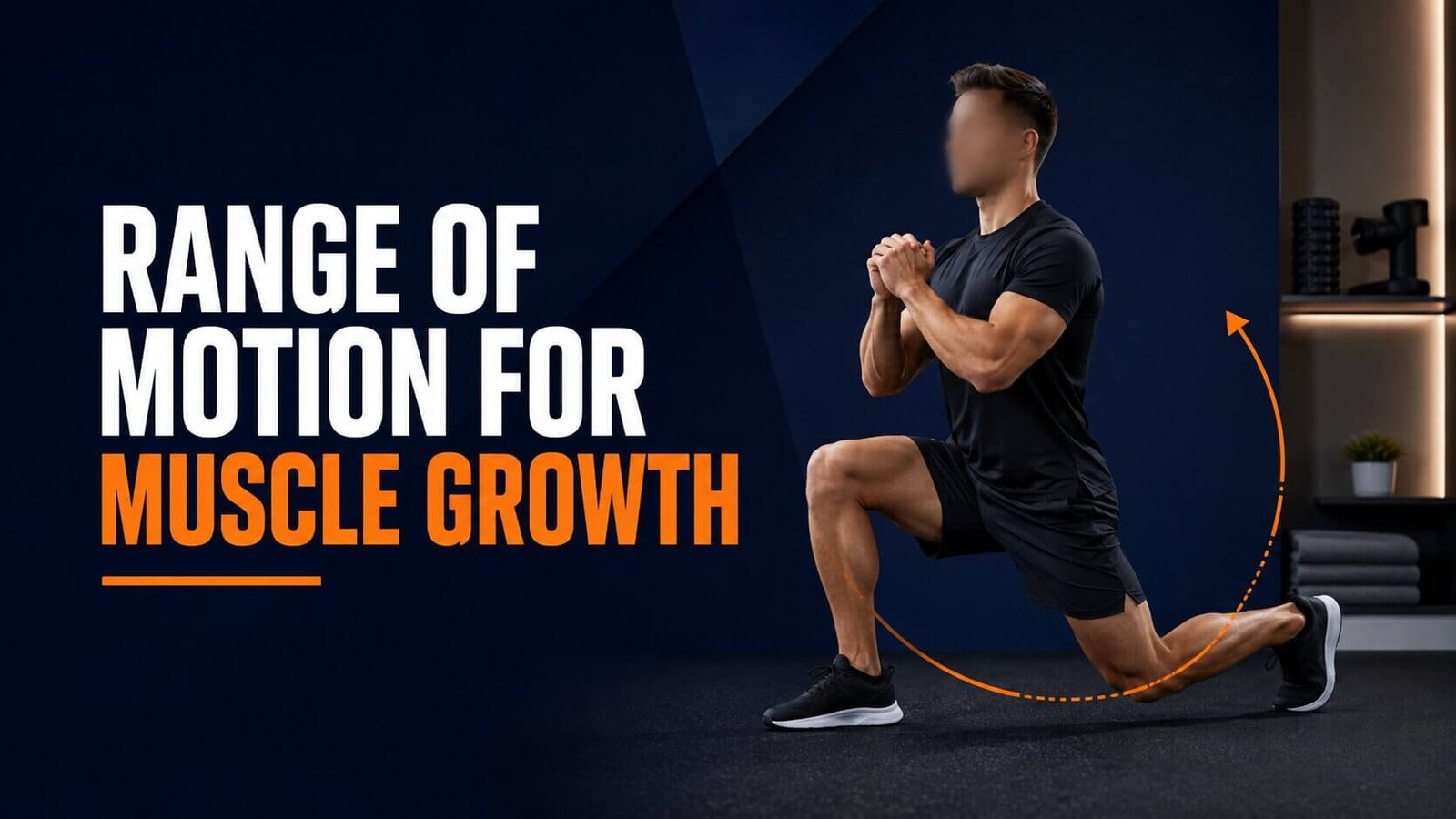
Range of motion (ROM) matters for muscle growth, but the best answer is more nuanced than “always go as deep as possible.” For most lifters, the most reliable default is a controlled full range of motion that fits the exercise, your anatomy, and your current mobility. This trains the muscle through both lengthened and shortened positions, makes progress easier to measure, and develops strength across a broader movement range.
Partial reps can also build muscle. In particular, lengthened partials—repetitions performed where the target muscle is relatively stretched—often outperform short-length partials and may produce growth similar to, or occasionally greater than, full-ROM reps. However, the evidence varies by muscle and exercise. Lengthened partials are a useful option, not a universal replacement for full reps.
What Is Range of Motion?
Range of motion is the distance a joint or group of joints travels during an exercise. A squat from standing to a controlled deep position uses more knee and hip ROM than a shallow squat. Lowering a dumbbell curl until the elbow is nearly straight uses more elbow ROM than moving only through the top half.
Three terms are useful:
- Full range of motion: The largest practical range you can control with the intended technique.
- Partial range of motion: Any deliberately shortened portion of that movement.
- Muscle length: How stretched or shortened the target muscle is at a particular point in the repetition.
Joint angle and muscle length are related, but they are not identical. Many muscles cross two joints, and equipment changes where resistance is hardest. That is why the “bottom half” is not automatically the lengthened half for every exercise.
Full ROM Is Individual and Exercise-Specific
Full ROM does not mean forcing maximum depth at all costs. Your practical ROM depends on your limb proportions, joint structure, mobility, exercise selection, equipment, and technique.
For example, a full-ROM Romanian deadlift ends when you have reached the greatest controlled hip hinge you can perform while maintaining the intended spinal and pelvic position. It does not require the bar to touch the floor. Similarly, a bench press should use a depth that you can control without painful shoulder positioning; the safest and most productive endpoint is not identical for everyone.
Is Full Range of Motion Better for Muscle Growth?
Full ROM is the best general starting point, but it is not dramatically superior in every comparison.
A 2023 systematic review and meta-analysis found a trivial overall effect favoring full ROM over partial ROM for muscle growth and other adaptations. The estimated differences were generally trivial to small. Importantly, the partial-ROM studies were not all performed in the same part of the movement. When the researchers examined partials performed at longer muscle lengths, those reps appeared potentially competitive with—and possibly better than—full ROM for hypertrophy, although the available evidence was limited.
The practical interpretation is straightforward:
- Full ROM usually performs at least as well as unspecified or short-ROM training.
- Training the target muscle at longer lengths appears more important than simply making the movement as large as possible.
- The best strategy can differ between muscles and exercises.
- A good program does not need to choose only one ROM method forever.
The updated evidence also supports a distinction between long-length and short-length training. A 2026 meta-analysis of eight studies found a small hypertrophy advantage when partial repetitions were performed at longer rather than shorter muscle lengths. That comparison does not prove that lengthened partials always beat full ROM; it shows that, when choosing between two partial ranges, the lengthened portion is generally the better-supported option.
Full ROM vs. Partial Reps
| ROM method | What it looks like | Likely hypertrophy value | Best use | Main limitation |
|---|---|---|---|---|
| Controlled full ROM | Largest stable and comfortable movement range | Excellent default; generally similar or superior to arbitrary partials | Most sets and most exercises | A poorly chosen exercise may be uncomfortable at an endpoint. |
| Lengthened partials | Reps kept where the target muscle is relatively stretched | Promising; often similar to full ROM and sometimes better in specific exercises | Hypertrophy-focused variation, extending some isolation sets | The correct lengthened zone depends on anatomy and exercise mechanics. |
| Shortened partials | Reps kept where the target muscle is relatively contracted | Can build muscle, but less consistently than longer-length training | Adding work when the shortened position is specifically desired | Easy to load heavily while reducing the effective challenge elsewhere |
| Past-failure partials | Full reps to failure, then lengthened partials until another stopping point | May increase stimulus per set; evidence is limited and exercise-specific | Occasional advanced work on stable isolation exercises | More discomfort and fatigue; not necessary for growth |
No ROM method rescues poor programming. Weekly training volume, effort, exercise selection, recovery, nutrition, and long-term progression still matter.
What Are Lengthened Partials?
Lengthened partials are partial repetitions performed in the section where the target muscle works at a relatively long length. They are sometimes called long-length partials.
Examples include:
- Calf raises performed around the bottom, dorsiflexed position
- Preacher curls performed mainly from a straighter elbow into the early-to-middle part of the curl
- Leg extensions performed in the more knee-flexed portion, where the quadriceps are relatively lengthened
- Some triceps extensions performed around the stretched position, depending on shoulder and elbow setup
The purpose is not to bounce out of a deep stretch. Each rep should remain controlled, and the load should suit the shorter ROM. If you cannot identify where the target muscle is lengthened—or cannot keep tension and joint position stable—use full reps instead.
Are Lengthened Partials the Same as Stretch-Mediated Hypertrophy?
Not necessarily. Researchers observe that resistance training at longer muscle lengths can produce favorable growth, but the exact mechanisms are still being studied. Calling all of it “stretch-mediated hypertrophy” can imply that simply feeling a strong stretch guarantees more growth. It does not.
Treat long-muscle-length training as an evidence-informed programming strategy, not as a reason to chase the deepest or most uncomfortable stretch possible.
What the Research Shows
The overall evidence is promising, but it is not uniform across the body.
Full ROM and Lengthened Partials Can Produce Similar Upper-Body Growth
In a 2025 within-person study, resistance-trained participants trained one side with full-ROM repetitions and the other with lengthened partials for eight weeks. Both approaches produced similar changes in elbow-flexor, elbow-extensor, and latissimus muscle thickness, along with similar improvements in lat-pulldown performance. The study supports emphasizing the stretched region through either full ROM or lengthened partials rather than insisting that one method is always superior.
Another small 2025 study compared full-ROM preacher curls with initial lengthened partials in trained lifters. Most outcomes were similar, with only small and site-specific differences. Because the sample was small, this is better viewed as evidence that lengthened partials can be effective—not as proof that they universally outperform full reps.
Calves May Respond Especially Well to the Lengthened Position
A 2023 study in young women compared calf raises using full ROM, lengthened partials, and shortened partials. The lengthened-partial condition produced greater gastrocnemius growth than the other conditions. This is one of the strongest direct examples supporting long-length partial training.
However, calf results should not automatically be applied to the chest, back, quadriceps, or arms. Muscle architecture, exercise resistance curves, and the amount of tension available at long lengths all differ.
Long-Length Knee Extension Training Has Also Shown Favorable Results
Research on knee extensions has found better muscular adaptations when partial-ROM training was performed at longer rather than shorter quadriceps lengths. This supports the broader pattern that where a partial occurs matters more than the label “partial rep.”
The Evidence-Based Bottom Line
Current research supports this hierarchy for hypertrophy programming:
- Controlled full ROM: the most dependable default.
- Lengthened partials: a strong alternative or supplement when the exercise loads the target muscle effectively in that region.
- Shortened partials: potentially useful, but less supported as the main ROM strategy.
That hierarchy is a practical guide, not a law. Individual comfort, joint tolerance, training goals, and exercise design can change the best choice.
Should You Do Partial Reps After Failure?
Past-failure partials involve completing full-ROM repetitions until you can no longer perform another clean full rep, then continuing with partial reps—usually in the lengthened portion.
The method gained attention after a 2025 calf-raise study found greater medial gastrocnemius growth when participants added lengthened partials after full-ROM failure. But the extended sets also included more work and caused more discomfort, making it unclear whether the benefit came from the partial-rep technique itself or simply from doing more hard repetitions.
A 2026 volume-load-equated calf study helps clarify the issue. One leg performed more traditional full-ROM sets to failure; the other performed half as many sets but continued with lengthened partials after full-ROM failure. Both conditions increased average gastrocnemius thickness by about 8%. The past-failure approach produced similar growth with fewer sets, suggesting better per-set efficiency, not necessarily greater growth when total work was comparable.
Practical Recommendation
You do not need past-failure partials to build muscle. If you want to try them:
- Use them on stable, low-risk exercises such as calf raises, curls, leg extensions, or selected machine movements.
- Start with the final set of one exercise, not every set of the workout.
- Stop when ROM becomes extremely short, technique breaks down, or joint discomfort appears.
- Account for the extra repetitions when managing weekly volume and recovery.
- Avoid applying this method to free-weight squats, deadlifts, or bench presses where failure can create a meaningful safety risk.
Beginners usually gain more by learning consistent full reps, estimating effort accurately, and progressing gradually.
How to Choose Your Range of Motion
Use the following decision process for each exercise.
1. Identify the Intended Movement
Know which joints should move and which should remain stable. In a Romanian deadlift, the hips move while the spine stays controlled. In a curl, most movement should occur at the elbow rather than through shoulder swinging.
2. Find Your Largest Controlled Range
Move through the greatest range that lets you:
- Maintain the intended technique
- Control the lowering phase
- Avoid sharp or worsening joint pain
- Keep the target muscles loaded
- Repeat the same endpoints from rep to rep
This is your current practical full ROM. It may improve with practice or mobility work, but it does not need to match another lifter’s ROM.
3. Check Whether the Exercise Loads the Lengthened Position
An exercise may place the muscle in a long position without providing much resistance there. Cables, machines, free weights, and body position create different resistance curves. Choose exercises that feel stable and maintain useful tension across the range you want to train.
4. Standardize the Range
Use clear endpoints—a consistent squat depth, the same touch point on a press, or the same elbow position on a curl. Standardization makes your training log meaningful.
5. Add Partials Only for a Clear Reason
Use partial reps when you want to emphasize long-length training, work around a temporary and professionally assessed limitation, strengthen a specific range, or extend a safe isolation set. Do not shorten ROM merely to lift more weight.
Exercise-by-Exercise ROM Guidelines
These are starting points, not medical prescriptions.
Squats and Leg Presses
Descend as far as you can while keeping the feet stable, controlling the load, and maintaining a position appropriate to the variation. Greater depth can increase the training stimulus for several lower-body muscles, but depth should not be forced through pain or loss of control. Adjust stance, heel elevation, machine setup, or exercise selection if needed.
Romanian Deadlifts
Push the hips back until you reach your controlled hip-flexion limit and feel substantial hamstring tension. Stop before you need to round the lower back or turn the movement into a squat. The floor is not the target.
Bench and Dumbbell Presses
Lower under control to the deepest comfortable position that preserves stable shoulders and wrists. Dumbbells or machines may allow a more suitable path for some lifters. Do not force an extreme bottom position simply to claim full ROM.
Rows and Pulldowns
Allow a controlled reach or stretch without turning every rep into uncontrolled spinal movement. Finish the pull without excessive torso swinging. The exact path should match the chosen exercise and target muscles.
Biceps Curls
Use a nearly straight elbow at the bottom if it is comfortable, then curl without driving the shoulder forward. Preacher curls can emphasize the lengthened-to-middle portion, but the bottom should remain controlled—never bounced.
Triceps Extensions
Choose an elbow and shoulder position that allows a comfortable stretch and stable technique. Overhead variations often train the long head of the triceps at longer lengths, but shoulder mobility and cable alignment matter.
Calf Raises
Lower the heel under control into a comfortable dorsiflexed position, pause briefly if needed to prevent bouncing, and rise as high as you can without shifting through the foot. The current evidence makes the bottom, lengthened region, especially relevant for calf hypertrophy.
Lateral Raises
Use a range that keeps the shoulder comfortable and the movement controlled. The part of the rep that is hardest depends heavily on whether you use dumbbells, cables, or a machine, so “bottom partials” do not have the same meaning across variations.
Range of Motion and Progressive Overload
Progressive overload only works as a measurement strategy when the exercise standard stays reasonably consistent.
Suppose you squat 80 kg for 10 controlled reps to a consistent depth. The next week, you use 85 kg for 10 shallower reps. The load increased, but you may not have increased the demand through the original range. You changed two variables at once.
To track progress accurately:
- Record the exercise variation, load, reps, and relevant setup.
- Use repeatable start and finish positions.
- Count only reps that meet your chosen ROM standard.
- If you intentionally use partials, log them separately from full-ROM sets.
- Progress load or repetitions only after you can control the current target ROM.
A temporary increase in ROM can itself be progression. Performing the same load for the same reps through a larger controlled range is often a meaningful improvement.
When Partial Reps Are Useful
Partial reps can serve several legitimate purposes:
- Hypertrophy emphasis: Use lengthened partials to add focused work in the long-muscle-length region.
- Strength specificity: Train a sticking point or the exact range required by a sport or task.
- Exercise modification: Use a tolerable range while working with a qualified clinician or coach when pain, injury, or mobility limits movement.
- Equipment constraints: Adapt when a machine or setup does not permit a useful full range.
- Set extension: Add controlled partials after full-ROM failure on a safe, stable exercise.
- Technique progression: Gradually expand ROM while learning a movement or rebuilding capacity.
Partials are a tool. They become a problem when they occur unintentionally because the load is too heavy or fatigue has erased your technique.
Common Range-of-Motion Mistakes
Assuming Deeper Is Always Better
More ROM is valuable only when it remains controlled, suitable for the exercise, and tolerable for your joints. Forced depth is not a hypertrophy shortcut.
Using Momentum in the Stretched Position
Bouncing can shift stress away from the target muscle and make joint loading less predictable. Control the turnaround, especially on calf raises, curls, presses, and squats.
Calling Every Bottom-Half Rep a Lengthened Partial
The target muscle’s length depends on the joints involved, body position, and exercise setup. Confirm the mechanics instead of relying on “top” and “bottom” labels.
Reducing ROM Every Time the Weight Increases
This creates the appearance of progressive overload without comparable reps. Keep your standard visible and honest.
Copying Calf Research Across the Entire Body
Lengthened calf training is promising, but one muscle and exercise cannot establish a universal rule for every movement.
Taking Every Set Past Failure
Past-failure partials add fatigue and discomfort. More effort per set does not guarantee more weekly growth if recovery and subsequent training quality suffer.
Training Through Warning-Sign Pain
Muscular effort and mild training discomfort are not the same as sharp pain, joint instability, numbness, or radiating symptoms. Stop the exercise if those warning signs occur and seek qualified medical guidance when appropriate.
A Simple ROM Plan for Beginners
For the first several months of structured resistance training:
- Choose stable exercises that fit your joints and equipment.
- Use a comfortable, controlled full ROM for nearly all working sets.
- Lower the weight in roughly two to three controlled seconds when needed to learn the endpoints; there is no need to exaggerate an ultra-slow tempo.
- Finish most sets with approximately 1–3 good repetitions in reserve.
- Add reps or weight while keeping ROM consistent.
- Consider lengthened partials only after you can identify the target muscle, control the movement, and recover from your current program.
This approach builds technique and provides a clear baseline. Advanced methods can be added later if they solve a specific problem.
Frequently Asked Questions
Is full range of motion always best for muscle growth?
No. Full ROM is the most reliable default, but lengthened partials can produce similar or sometimes greater growth in certain exercises. The advantage of either method is usually context-dependent rather than universal.
Do half reps build muscle?
Yes, half reps can build muscle if they are challenging and progressed over time. Half reps performed where the target muscle is lengthened generally have stronger evidence than half reps performed only in the shortened position.
Are lengthened partials better than full reps?
Not consistently. They appear better than short-length partials and can match full-ROM training. Some studies favor lengthened partials for particular muscles, especially the calves, while other studies show similar results.
Should beginners use partial reps?
Beginners should learn the controlled full-ROM technique first. Intentional partials can be added later, but they are not required for rapid beginner progress.
Is a deeper squat better for muscle growth?
A deeper controlled squat can train several lower-body muscles through a longer range, but the best depth is the deepest position you can perform with stable technique and acceptable joint tolerance. Forcing depth is unnecessary.
Does full ROM prevent injuries?
No ROM can guarantee injury prevention. Gradual progression, suitable exercise selection, load management, technique, and individual tolerance all matter. Use a range you can control, and modify painful exercises.
Can I use more weight with partial reps?
Often, yes—but the heavier number alone does not prove a greater hypertrophy stimulus. Compare progress within the same exercise, ROM, and technique standard.
Should I pause in the stretched position?
A brief pause can help remove momentum and standardize reps, but long pauses are not mandatory for growth. Maintain control without relaxing into an unstable joint position.
Are partial reps after failure necessary?
No. They may increase per-set efficiency on some stable exercises, but similar muscle growth can be achieved with conventional hard sets and appropriate weekly volume.
How do I know if my ROM is too large?
Your ROM may be excessive for that exercise if you cannot control the load, lose the intended joint position, rely on momentum, or experience sharp or worsening joint pain. Reduce the range, adjust the setup, or choose another variation.
Conclusion
For muscle growth, start with the largest range of motion you can perform comfortably and consistently with good control. Full ROM remains the most dependable general recommendation because it trains more of the movement and makes strength and technique easier to evaluate.
Lengthened partials are a valuable second tool. They can match full-ROM hypertrophy and may outperform it in specific muscles or exercises, but the evidence does not justify replacing every full rep with partials. Shortened partials and past-failure methods have narrower roles.
Build your program around controlled repetitions, consistent ROM, sufficient effort, and progressive overload. Then use partials deliberately—because they serve a purpose, not because they let you move a heavier weight.
Next step: Choose one main exercise for each muscle group, define a repeatable full-ROM standard, and track it for four to six weeks before changing the ROM strategy.