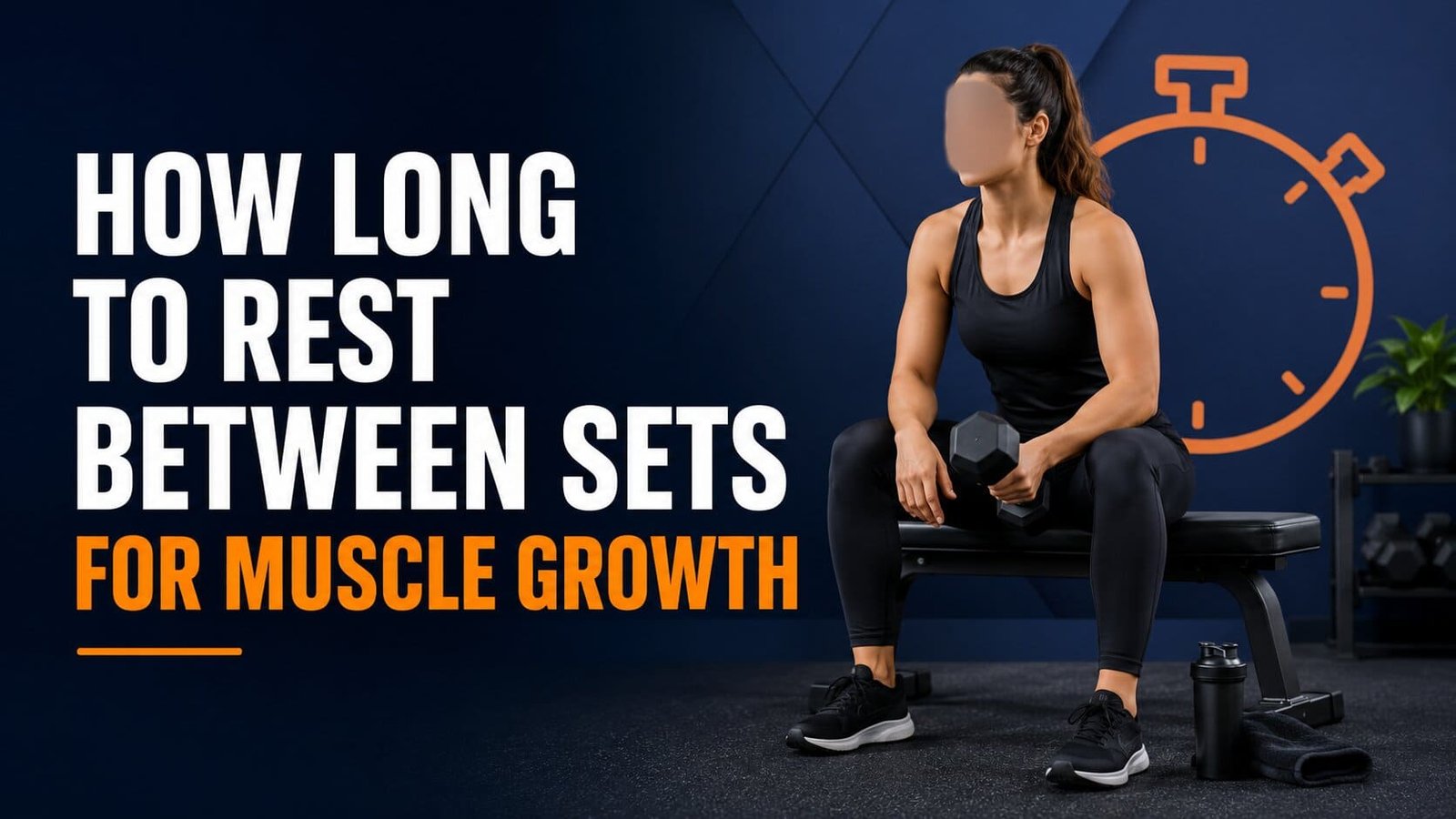
For muscle growth, rest about 1–3 minutes between most working sets. Isolation exercises often work well for 1–2 minutes, while demanding compound exercises may require 2–3 minutes or longer. The right rest period is long enough for you to perform the next set with controlled technique and without a large, fatigue-driven drop in repetitions.
Short breaks can make a workout feel harder and create a stronger pump, but that does not automatically make them better for hypertrophy. If you start the next set while still severely fatigued, you may perform fewer productive repetitions or need to reduce the weight. Resting a little longer can help preserve set quality.
This guide explains what current research says, how to adjust rest for different exercises, and how to know when you are ready for your next set.
Recommended Rest Times for Muscle Growth
Most lifters can start with 1–2 minutes for isolation exercises and 2–3 minutes for compound exercises. These are practical starting points rather than biological deadlines. Add more time when you cannot repeat the planned set with stable technique and a similar level of performance.
| Exercise or set type | Suggested starting rest | Examples |
|---|---|---|
| Small-muscle isolation exercise | 1–2 minutes | Biceps curl, triceps extension, calf raise |
| Moderate isolation or machine exercise | 1–2 minutes | Lateral raise, leg curl, leg extension |
| Upper-body compound exercise | 2–3 minutes | Bench press, overhead press, row, pull-up |
| Demanding lower-body compound exercise | 2–4 minutes | Squat, Romanian deadlift, leg press, split squat |
| Very heavy or unusually fatiguing set | 3–5 minutes if needed | Heavy squat, deadlift, weighted pullup |
| Superset using unrelated muscles | Minimal transition between exercises; 1–3 minutes before repeating the pairing | Lateral raise with calf raise |
These ranges reflect practical coaching guidance informed by research on rest intervals and performance. Current studies do not establish one exact rest time for every exercise, muscle, repetition range, and training level.
Beginners can make the process simple: begin with approximately two minutes between working sets. Shorten the break after easy isolation exercises or extend it after demanding movements. Keeping a consistent starting point also makes workout tracking easier.
What Research Says About Rest and Hypertrophy
Current evidence suggests that a wide range of rest intervals can build muscle, but routinely resting more than 60 seconds may provide a small advantage over using 60 seconds or less. Researchers have not established a precise point beyond 60–90 seconds that maximizes hypertrophy for everyone.
A 2024 systematic review and Bayesian meta-analysis examined nine training studies that compared different inter-set rest periods. The results slightly favored rest intervals longer than 60 seconds for arm and thigh muscle growth. However, the estimated differences were generally small, and the researchers reported substantial uncertainty when comparing longer categories such as 1–2, 2–3, and 3 or more minutes.
That review also identified important limitations:
- Most studies involved younger, untrained participants.
- Few data were available for experienced lifters.
- The interventions lasted only 5–10 weeks.
- Exercise selection and muscle-measurement methods differed among studies.
- No included study directly measured hypertrophy in torso muscles such as the chest or back.
An earlier systematic review reached a similar cautious conclusion: both short and long rest intervals can support hypertrophy, although longer rests may be more useful for trained lifters who need to maintain performance across multiple sets.
One well-known study involving resistance-trained young men compared one-minute and three-minute rest periods. After eight weeks, the three-minute group achieved greater increases in strength and some measures of muscle thickness. This trial supports using adequate rest, but one small study cannot prove that three minutes is optimal for every person or exercise.
Is the traditional 30–60-second recommendation outdated?
The claim that 30–60 seconds is automatically the best hypertrophy rest period is not well supported by current long-term evidence. Short rests were historically promoted partly because they increase metabolic stress and temporary post-workout hormone levels, but those acute changes do not reliably predict how much muscle someone will build.
The newer evidence does not mean that a 60-second break is useless. It means that you should not force short rests when they substantially reduce your repetitions, load, technique, or ability to train the target muscle effectively.
Does resting longer always build more muscle?
Resting longer does not produce unlimited additional growth. The 2024 meta-analysis found uncertainty about whether rest periods longer than roughly 90 seconds consistently create more hypertrophy.
Once you can perform the next set as planned, additional rest may provide little benefit for muscle growth. For example, five minutes might be appropriate after a heavy squat set but unnecessary after a moderate set of cable curls. Longer breaks can also make workouts less time-efficient.
Why Rest Time Affects Muscle-Building Sets
Rest affects hypertrophy mainly by influencing what you can do in the next set. Adequate recovery helps you maintain repetitions, load, technique, range of motion, and focus on the target muscle.
A short rest can reduce repetitions.
If you repeat an exercise before recovering sufficiently, fatigue may cause your repetition count to fall sharply. The 2024 review noted that rest periods of 60 seconds or less often reduce the repetitions completed across multiple sets compared with longer breaks.
Suppose you perform dumbbell presses with the following results:
- Two-minute rest: 12, 11, and 10 repetitions
- Forty-five-second rest: 12, 8, and 6 repetitions
The second approach feels more intense, but it produces fewer repetitions after the first set. More discomfort is not necessarily a better muscle-building stimulus.
Rest supports technique and range of motion
Fatigue can change how you perform an exercise. You may shorten the range of motion, use momentum, lose stability, or shift work away from the intended muscle. Resting longer is sensible when another minute helps you perform safer, more consistent repetitions.
This matters especially for exercises that require coordination and whole-body bracing, such as squats, Romanian deadlifts, overhead presses, and unsupported rows.
Local recovery and cardiovascular recovery are different.
Your breathing may recover before the target muscle is ready—or the muscle may feel ready while you are still breathless. Consider both.
High-repetition squats, lunges, and deadlift variations create substantial cardiovascular fatigue. Starting the next set while gasping for air can make conditioning, rather than muscular capacity, the limiting factor. Smaller exercises such as curls usually require less whole-body recovery.
A stronger pump is not proof of better growth.
Short rest periods often increase the pump and burning sensation because metabolites accumulate in the working muscle. These sensations can accompany productive training, but they are not reliable measurements of hypertrophy.
Use the pump as optional feedback, not as the main reason to shorten rest. Progressive training, sufficient effort, appropriate weekly volume, nutrition, and recovery matter more than maximizing a temporary sensation.
Rest Times for Compound and Isolation Exercises
Compound exercises generally need longer rest because they involve more muscle mass, heavier loads, greater coordination, and more cardiovascular demand. Isolation exercises usually recover faster because they place less total demand on the body.
Compound exercises: usually 2–3 minutes
Begin with two to three minutes between sets of presses, rows, pullups, squats, and hip hinges. Extend the break to three to five minutes when a very heavy or high-effort set leaves you unable to repeat the planned performance.
Examples that commonly need longer rest include:
- Barbell back squats
- Romanian deadlifts
- Leg presses
- Weighted pullups
- Heavy bench presses
- Standing overhead presses
- Bulgarian split squats
The goal is not to feel completely fresh. It is to recover enough that breathlessness or general fatigue does not ruin the next set.
Isolation exercises: usually 1–2 minutes
One to two minutes is a useful starting range for exercises that primarily train one joint or smaller muscle group. Some people can recover in less time, especially when the set is not close to failure.
Examples include:
- Biceps curls
- Triceps extensions
- Lateral raises
- Leg curls
- Leg extensions
- Calf raises
- Cable flies
Rest longer if performance still falls sharply. A hard set of 15–20 leg extensions may require more recovery than a moderate set of eight curls, even though both are isolation exercises.
Machines versus free weights
Exercise demands matter more than the equipment category. A machine can reduce balance and stabilization requirements, but a heavy leg press can still be extremely fatiguing. A light dumbbell lateral raise may require much less recovery than a barbell squat.
Choose rest based on the actual demands of the movement, not simply whether it uses a machine, cable, resistance band, dumbbell, or barbell.
How Rep Range and Effort Change Rest Needs
Sets using heavy loads, high repetitions, or close proximity to failure often need more recovery. Rest time should respond to how demanding the completed set was, not only the exercise name.
Heavy, low-repetition sets
Heavy sets often need two to five minutes because they demand high force, concentration, and technical consistency. Even if hypertrophy is the main goal, there is no reason to force a one-minute break before another heavy compound set.
Longer rest is especially appropriate when a short break would require you to reduce the load or compromise form.
Moderate-repetition sets
Sets of roughly 6–15 repetitions commonly fit well within the 1–3-minute recommendation. Use the shorter end for less demanding isolation work and the longer end for compound exercises or sets performed close to failure.
This does not mean 6–15 is the only effective hypertrophy range. It is simply a common training range that balances load, repetitions, and time efficiency.
High-repetition sets
High-repetition sets may need more rest than expected because they create substantial local discomfort and breathlessness. A set of 20 split squats can require more recovery than a set of eight machine chest presses.
Do not assume that lighter weight always means shorter rest. Judge the total fatigue created by the set.
Sets close to failure
The closer a set gets to momentary muscular failure, the more fatigue it generally creates. A set stopped with three repetitions in reserve may need less recovery than a set taken until no more controlled repetitions are possible.
The 2024 rest-interval review did not find clear evidence that training to failure fundamentally changes the relationship between rest duration and hypertrophy. Practically, however, close-to-failure sets can still reduce short-term performance and justify a longer break.
How to Know When You Are Ready for the Next Set
Start the next set when you can repeat it with controlled technique and reasonable performance. A timer provides structure, but readiness should determine whether you need additional recovery.