A 20-minute strength workout at home can be productive when it uses basic movement patterns, enough resistance, and a repeatable progression method. The goal is not to squeeze dozens of exercises into a short window. It is to perform a small number of useful movements with control.
This plan uses seven one-minute stations. You complete a target number of repetitions, rest for whatever time remains in the minute, and then move to the next station. Two rounds provide 14 minutes of focused strength work. A three-minute warm-up and three-minute cooldown make the entire session exactly 20 minutes.
The primary version uses one or two dumbbells, a stable chair, and optional floor space. Every station also includes a bodyweight alternative. The substitutions make the workout more accessible, although a completely equipment-free plan has clear limits for progressively training the back.
This routine is general fitness guidance for healthy adults. It is not a medical assessment or rehabilitation program. If an injury, pregnancy-related restriction, recent surgery, heart or lung condition, or another health concern affects exercise, ask an appropriate health professional how to modify the plan.
Can a 20-Minute Workout Build Strength?
Yes. A 20-minute workout can build strength when the exercises challenge the target muscles, technique remains controlled, and the program becomes gradually harder. Session length alone does not determine whether resistance training works.
The American College of Sports Medicine’s 2026 resistance-training update emphasizes that regular participation matters more than complicated programming for most healthy adults. It also reports that bodyweight exercises, resistance bands, and home-based training can improve strength and physical function.
A short session does have limitations. You cannot perform high volumes of work for every muscle group in 20 minutes, and a beginner home plan is not designed to maximize powerlifting performance. The routine is best viewed as an efficient full-body foundation that can be repeated and progressed.
How the 20-Minute Workout Is Organized
The workout uses three minutes of preparation, 14 minutes of strength training, and three minutes to cool down. The strength block is repetition-based rather than a continuous high-speed circuit, which helps keep the focus on technique and resistance.
| Time | Block | What to do | Purpose |
|---|---|---|---|
| 0:00-3:00 | Warm-up | Three dynamic drills, 60 seconds each | Practice the main patterns and gradually raise effort. |
| 3:00-10:00 | Round 1 | Seven one-minute stations | Learn the movements and establish a controlled pace. |
| 10:00-17:00 | Round 2 | Repeat the same seven stations. | Accumulate a second quality set for each movement. |
| 17:00-20:00 | Cooldown | Easy movement, breathing, and comfortable mobility | Let effort settle and finish without rushing. |
How to Use Each One-Minute Station
Start the minute, perform the planned repetitions, and rest for the time that remains. Most exercises will use 6-12 repetitions. Slower or unilateral movements may use fewer repetitions per side.
- If you finish 10 repetitions in 35 seconds, rest for about 25 seconds.
- If 6 repetitions take almost the full minute, the load or variation may be too difficult for this format.
- If 12 repetitions feel very easy and finish quickly, use a harder variation or a slightly heavier load next time.
- Do not add fast, sloppy repetitions simply to fill the minute.
Equipment and Setup
You need enough clear floor space to lie down and extend the arms, plus a stable chair or countertop for support. One or two dumbbells provide the most balanced version, but several movements can use a secure backpack.
- One or two dumbbells, or a securely closed backpack with evenly distributed contents
- A sturdy chair, bench, or countertop that will not slide or tip
- An exercise mat or comfortable floor surface
- A timer that can signal one-minute intervals
- Water nearby, especially in a warm room
Inspect improvised equipment before starting. Do not use a backpack with damaged straps or unsecured objects, and do not support your body on lightweight furniture.
Three-Minute Dynamic Warm-Up
Spend one minute on each drill. Begin easily and increase your range only as the movement becomes comfortable. The warm-up should prepare you, not tire you out.
| Minute | Warm-up drill | How to perform it |
|---|---|---|
| 1 | March with arm swings | March quietly in place while the arms swing naturally. Gradually lift the knees a little higher. |
| 2 | Alternating squat and hip hinge | Perform one comfortable squat, then one bodyweight hip hinge. Repeat slowly. |
| 3 | Wall push-up to overhead reach | Perform a wall push-up, stand tall, and reach the arms overhead without forcing the range. |
20-Minute Full-Body Strength Workout at Home
Complete the seven exercises in order, using one minute per exercise. After exercise seven, return to exercise one and repeat the circuit. Aim for smooth repetitions and use the rest of the minute to change position safely.
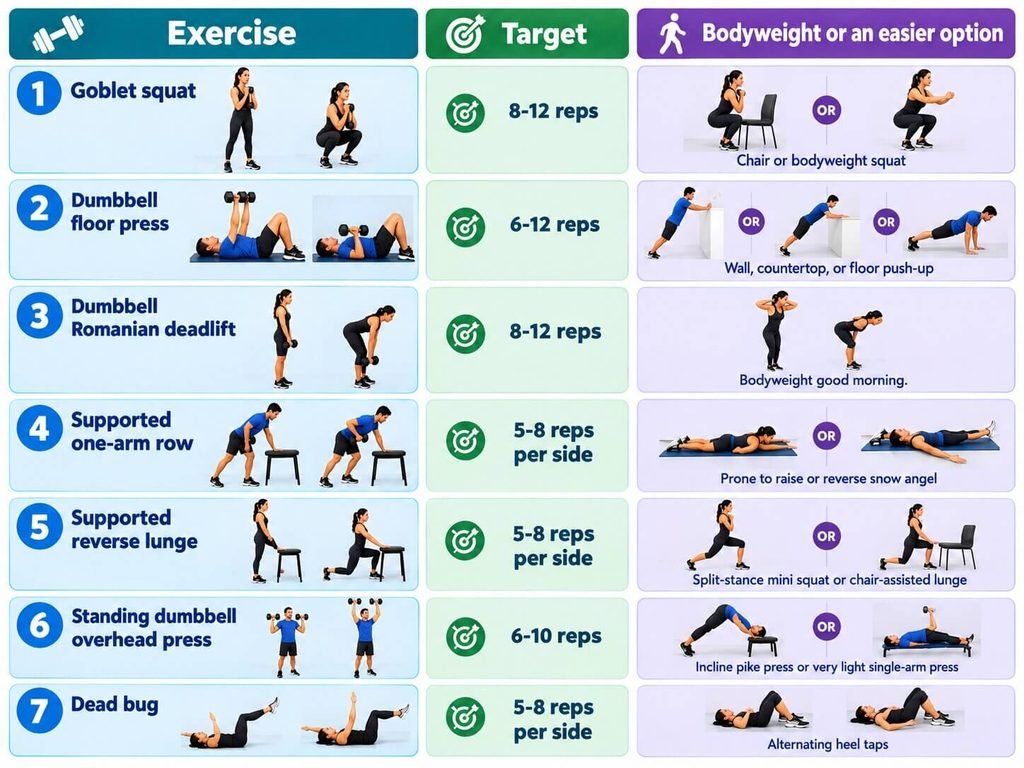
| Strength focus: The repetition targets are planning ranges, not tests. Stop the set when you cannot maintain the same controlled technique, even if that happens before the top of the range. |
|---|
Exercise Instructions and Beginner Modifications
Use the following cues as checkpoints rather than rigid rules. Body proportions and comfortable ranges differ, so prioritize stable, pain-free movement over copying one exact appearance.
1. Goblet Squat
Hold one dumbbell close to the chest. Stand with the feet around hip- to shoulder-width apart, brace gently, and sit down between the hips. Keep the whole foot connected to the floor as you stand.
Beginner option: Use a sturdy chair as a depth target. Begin without weight, then hold a light dumbbell or backpack when 12 repetitions feel controlled.
2. Dumbbell Floor Press
Lie on your back with the knees bent. Hold the weights above the chest, keep the wrists stacked over the elbows, and lower until the upper arms lightly contact the floor. Press without bouncing.
Beginner option: Use one dumbbell held with both hands or press one side at a time. For bodyweight work, use a wall or countertop push-up before progressing toward the floor.
3. Romanian Deadlift
Hold the weights close to the thighs. Soften the knees, move the hips backward, and keep the spine long. Stop when the hamstrings feel loaded or when you can no longer maintain the same trunk position.
Beginner option: Practice the hinge by standing several inches in front of a wall and reaching the hips back to touch it. A bodyweight good morning uses the same basic pattern.
4. Supported One-Arm Row
Place one hand on a sturdy chair or bench, hinge at the hips, and keep the trunk steady. Pull the working elbow toward the back pocket without shrugging or rotating.
Beginner option: Use a lighter weight and pause briefly at the top. Without equipment, perform a prone W raise, but recognize that it does not provide the same progressive load as a row.
5. Supported Reverse Lunge
Stand beside a wall or chair. Step one foot back, bend both knees within a comfortable range, and push through the front foot to return. Keep the front foot planted.
Beginner option: Use a split stance and move only a few inches up and down. Holding support is a useful balance adjustment, not a failure.
6. Standing Overhead Press
Start with the hands near shoulder height. Brace the abdomen and press the weights overhead without leaning the torso backward. Lower with control.
Beginner option: Use one light dumbbell and alternate arms. If the overhead range is uncomfortable, use a pain-free incline pressing variation or skip the movement and seek guidance when appropriate.
7. Dead Bug
Lie on your back with the hips and knees bent. Exhale gently, keep the ribs controlled, and slowly lower the opposite arm and leg without allowing the low back to arch noticeably.
Beginner option: Tap one heel to the floor at a time. Extend the leg farther only when the trunk stays controlled.
The Limitation of a No-Equipment Back Exercise
A fully equipment-free routine cannot easily reproduce the progressive resistance of a dumbbell, band, or cable row. Prone W raises and reverse snow angels train upper-back and shoulder-blade control, but the load is limited by the weight of the arms.
Use those movements as practical starting options, not exact row replacements. If possible, add a resistance band or dumbbell over time. Avoid improvised rows from doors, tables, or railings unless the setup is specifically designed and verified to support the forces involved.
How to Choose the Right Weight
Choose a load that makes the final repetitions challenging while your technique remains consistent. For this workout, most sets should finish with roughly two or three good repetitions still possible.
Different exercises require different loads. The squat and Romanian deadlift will often use more weight than the overhead press. If you own only one pair of dumbbells, adjust the repetition count or use one dumbbell for the more difficult upper-body movements.
| What happens during the set? | Likely adjustment |
|---|---|
| You cannot reach the lower end of the range with controlled form. | Reduce the weight, shorten the range, or use the easier variation. |
| You reach the target range, and the last reps are challenging but clean. | Keep the same load until it becomes clearly easier. |
| You easily exceed the top of the range and finish with plenty of time. | Add a small amount of load, slow the lowering phase, or choose a harder variation. |
| A joint hurts or symptoms worsen with each repetition. | Stop the exercise and use a pain-free alternative; seek appropriate assessment if needed. |
How Often Should You Do the Workout?
Most beginners can perform this workout two or three times per week on nonconsecutive days. Start with two sessions if you are new, returning after a break, or doing other demanding exercise.
The U.S. Physical Activity Guidelines recommend muscle-strengthening activity involving all major muscle groups on at least two days per week. ACSM’s 2026 update also emphasizes regular training of the major muscle groups and supports simple home-based resistance options.
Full-body training is not inherently inferior to a split routine. A 2024 systematic review and meta-analysis reported similar strength and muscle-growth outcomes from full-body and split routines when weekly training volume was matched.
| Day | Example activity |
|---|---|
| Monday | 20-minute strength workout |
| Tuesday | Easy walking, mobility, or rest |
| Wednesday | 20-minute strength workout |
| Thursday | Recovery activity or rest |
| Friday | Optional third workout after recovery is established |
| Weekend | Flexible cardio, recreation, mobility, or rest |
Four-Week Progression Plan
Keep the exercise order and 20-minute schedule stable for four weeks. Change only one main variable at a time so you can identify what improved and what caused excess fatigue.
Week 1: Learn: Use easy variations and conservative loads. Record the repetitions completed in each round.
Week 2: Repeat: Use the same variations and try to add one controlled repetition to selected exercises, without exceeding the target ranges.
Week 3: Progress: Add a small amount of load or choose one harder variation for movements that have become easy.
Week 4: Consolidate: Repeat the Week 3 setup and improve control, range, or consistency rather than changing every exercise.
What If You Cannot Finish Both Rounds?
Complete one round, then repeat only the first three or four exercises at an easy effort. Use the remaining time for slow marching and comfortable mobility. Add one station per session until you can complete the full plan without rushing.
Common Mistakes
- Trying to move for the entire minute: The remaining time is planned rest. Filling it with rushed repetitions changes the workout from strength practice toward fatigue chasing.
- Using one weight for every exercise: Lower-body movements and upper-body presses rarely need the same load. Adjust where possible.
- Choosing complicated combination exercises: A short session does not require a squat-to-curl-to-press sequence. Simple movements are easier to learn and progress.
- Changing the routine every workout: Repeating the same seven stations for several weeks makes improvement easier to measure.
- Ignoring pulling limitations: Bodyweight back drills are useful, but long-term progression usually benefits from a band, dumbbell, or other safe external resistance.
- Treating soreness as proof of success: Track repetitions, load, range, and technique instead. Severe or persistent soreness can interfere with the next session.
- Skipping setup checks: Unstable chairs, loose backpack straps, slippery floors, and clutter create avoidable risks.
Safety Checklist
Exercise should feel challenging, but it should not require you to ignore warning signs. Check the environment and your symptoms before continuing.
- Clear enough space to move without striking furniture or slipping.
- Confirm that the chair, counter, dumbbells, and backpack are stable and undamaged.
- Breathe continuously; avoid prolonged breath-holding unless a qualified professional has instructed you otherwise.
- Stop a movement that causes sharp pain or steadily worsening joint pain.
- Stop and seek appropriate medical care for chest pain, faintness, severe dizziness, or unusual shortness of breath.
- Follow any restrictions provided by your physician, physical therapist, or other qualified clinician.
Frequently Asked Questions
Is 20 minutes enough for strength training?
It can be enough for a focused full-body session, especially for a beginner. Results depend on training difficulty, progression, weekly consistency, recovery, and the rest of your program.
Can I do this workout every day?
Daily full-body strength training is usually unnecessary for beginners. Start with two nonconsecutive sessions per week and add a third only when recovery and technique remain good.
Can I build muscle with a 20-minute home workout?
Muscle growth is possible when the exercises provide enough resistance and the challenge increases over time. A short plan may eventually need heavier weights, harder variations, or additional weekly volume.
Will this workout help with weight loss?
It can contribute to physical activity and help build or maintain muscle, but body-weight change depends on overall energy balance and broader habits. A generic workout cannot promise a specific calorie burn or weight-loss result.
What dumbbell weight should a beginner use?
There is no universal starting weight. Select a load that allows the target repetitions with consistent form and leaves about two or three clean repetitions in reserve.
Can I use only one dumbbell?
Yes. Hold it at the chest for squats, use it for Romanian deadlifts, row and press one side at a time, and complete equal work on both sides.
Can I make the workout all standing?
Yes, but the substitutions are not identical. Replace the floor press with an incline push-up and the dead bug with a controlled suitcase march or standing cross-body knee drive.
What if lunges hurt my knees?
Reduce the range, hold support, try a split-stance mini squat, or use another pain-free leg exercise. Persistent or worsening pain deserves appropriate professional assessment.
Should I train to failure?
You do not need to reach failure in every station. Stop when technique begins to change and keep a small repetition reserve, particularly while learning the exercises.
Is no-repeat training better for a short workout?
No-repeat sessions can feel varied, but repeating the same movements makes technique and progressive overload easier to track. This plan uses two rounds for that reason.
Conclusion
A useful 20-minute strength workout at home does not need dozens of exercises. Three minutes of preparation, two rounds of seven basic movements, and three minutes of cooldown create a balanced session that is short enough to repeat consistently.
Begin with manageable variations, record your repetitions and loads, and progress one factor at a time. If the session becomes too easy, increase resistance or exercise difficulty instead of simply moving faster.
| Next step: Set a one-minute repeating timer, choose your exercise variations, and schedule two nonconsecutive sessions for the first week. Review your log after two weeks before increasing the challenge. |
|---|