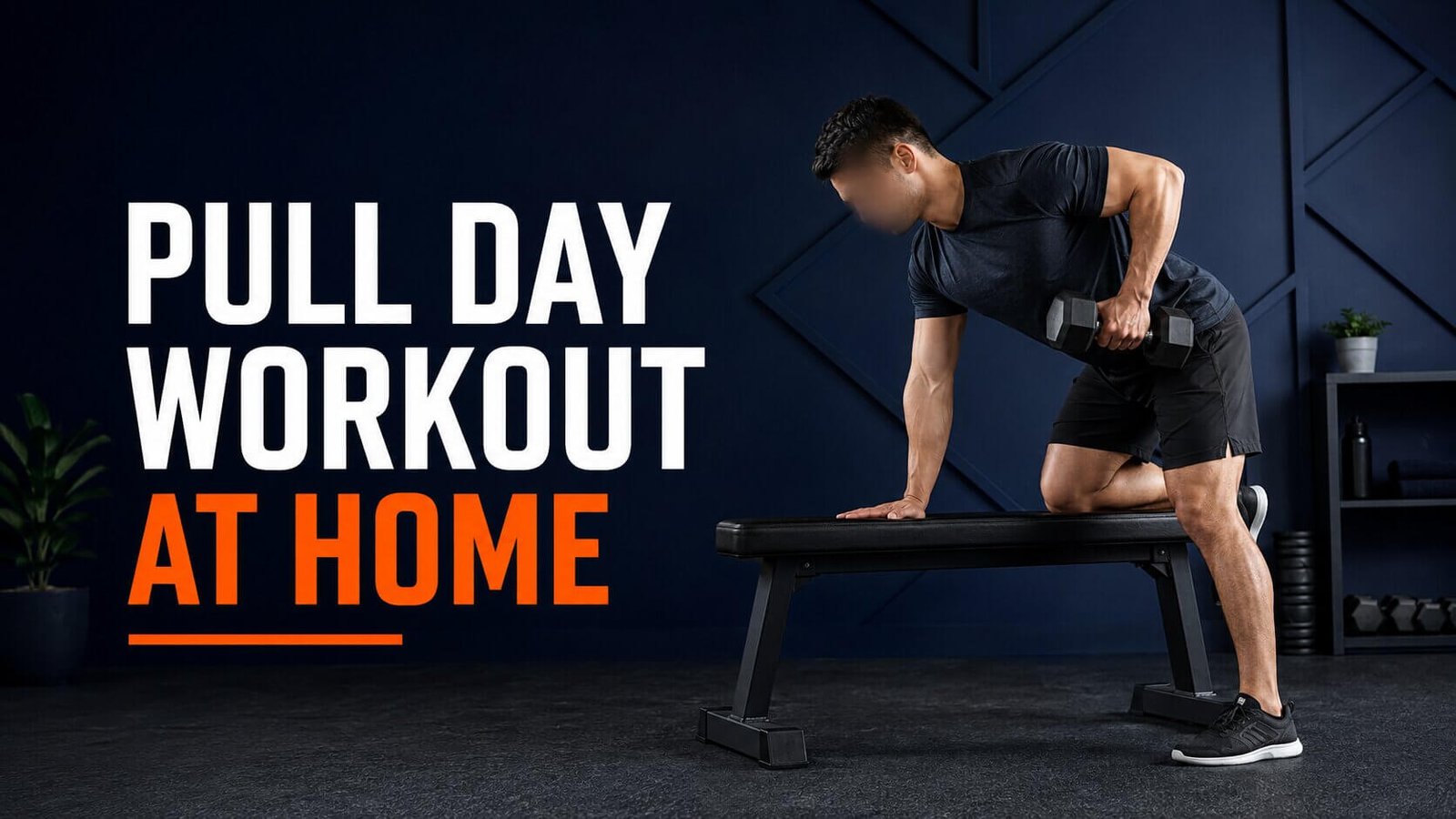
An effective pull day workout at home should include a horizontal row, a vertical or lat-focused pull when possible, a rear-delt movement, and an elbow-flexion exercise for the biceps. A resistance band, dumbbell, loaded backpack, or rated pull-up bar makes these patterns much easier to train and progress.
This guide provides dumbbell/backpack and resistance-band routines, plus an honest zero-equipment fallback.
What Is a Pull Day Workout?
A pull day groups exercises that pull resistance toward your body or use elbow flexion. In a conventional push-pull-legs split, pull day trains the back, rear shoulders, biceps, and forearms; push day covers the chest, shoulders, and triceps; and leg day covers the lower body.
The most useful home pull day includes four movement roles:
- Horizontal pull: Dumbbell, backpack, or band row
- Vertical or lat-focused pull: Pulldown, pull-up, chin-up, or pullover
- Rear-delt and upper-back movement: Reverse fly, face pull, or band pull-apart
- Elbow flexion: Biceps or hammer curl
You do not need several nearly identical rows or curls. Four or five well-chosen exercises can provide a complete session when they become progressively challenging.
Do Deadlifts Belong on Pull Day?
Deadlifts can appear on pull day in some bodybuilding programs, but this guide uses the conventional home push-pull-legs structure and keeps hip hinges on leg day. That prevents lower-body fatigue from dominating an upper-body back-and-biceps workout.
Training splits are organizational tools rather than biological rules. If your established program places deadlifts on pull day and you recover well, that structure can also work.
What Muscles Does Pull Day Train?
Pull day trains multiple muscles rather than a single “back muscle.” Rows, pulldowns, rear-delt movements, and curls cover different joint actions, which is why a balanced session uses more than one exercise pattern.
Latissimus Dorsi
The lats help move the upper arm down and back. Pulldowns, pull-ups, rows, and pullovers train them through different paths.
Trapezius and Rhomboids
The trapezius and rhomboids contribute to shoulder-blade movement. Rows, face pulls, pull-aparts, and reverse flies train them. Let the shoulder blades move naturally instead of pinching them rigidly throughout every repetition.
Rear Deltoids
The rear deltoids move the upper arms backward and outward. Reverse flies, face pulls, pull-aparts, and wider-elbow rows train them. Use controlled repetitions rather than swinging heavy weights.
Biceps, Brachialis, and Forearms
The biceps and other elbow flexors assist rows, pulldowns, and chin-ups. Palms-up curls and neutral-grip hammer curls add direct work. One or two curl variations are usually enough.
Can You Do an Effective Pull Day at Home?
Yes, provided you have a practical source of resistance. Dumbbells, a secure backpack, resistance bands, and a properly installed pull-up bar can support effective rows, pulldowns, pull-ups, rear-delt work, and curls.
The American College of Sports Medicine’s 2026 resistance-training update recognizes elastic bands, bodyweight movements, and home routines as effective options for improving strength, hypertrophy, and physical function. Consistency and appropriate challenge matter more than using a particular brand or type of equipment.
A 2019 systematic review and meta-analysis found no clear superiority between elastic and conventional resistance training for upper- or lower-body strength. Only eight studies were included, and the populations and programs varied, so this should not be interpreted as proof that every band exercise equals every free-weight exercise. It does support bands as a legitimate strength-training tool. See the review indexed by PubMed.
The main challenge is progression. When a backpack, dumbbell, or band no longer makes a set difficult within your planned repetition range, you need more load, more band tension, a harder variation, or additional controlled range.
Why No-Equipment Pull Training Is Limited
True no-equipment pull training is limited because your back and biceps need resistance to pull toward you. The floor conveniently resists a push-up, but it does not provide an equivalent row or pulldown.
Prone Y-T-W raises and reverse snow angels can train upper-back control with the weight of your arms. Self-resisted rows and curls let one limb or your legs provide resistance. These exercises are useful for travel, movement practice, or temporary maintenance, but progressively loading the lats and elbow flexors is difficult.
Some online routines recommend pulling on doorframes, towels shut inside doors, or the underside of household tables. These setups can fail if the door, hinge, towel, anchor, or furniture is not designed for exercise. This article does not treat them as default options.
If long-term back development is the goal, an inexpensive loop band, long resistance band, secure backpack, adjustable dumbbell, or rated pull-up bar provides a clearer progression path.
How to Choose Your Home Pull Equipment
Choose equipment based on which movement patterns it can provide safely. You need neither a full home gym nor every option on the table.
| Available equipment | Best uses | Main limitation |
|---|---|---|
| Loaded backpack | Rows, pullovers, curls | Grip and loading increments may be awkward. |
| Dumbbells | Rows, reverse flies, pullovers, curls | No true vertical pull without other equipment |
| Long resistance band | Rows, pulldowns, face pulls, curls | Tension varies; anchoring must be secure. |
| Loop band | Pull-aparts, some rows and curls | Limited range for certain movements |
| Pull-up bar | Pull-ups, chin-ups, hanging progressions | Requires secure installation and adequate strength |
For most beginners, one dumbbell or backpack plus a resistance band provides enough variety. A band can create a vertical pull, while the weight makes rows and curls easier to track.
10 Pull Day Exercises at Home
These exercises cover the major pull-day roles with several equipment options. Select four or five based on what you can perform safely rather than doing all 10 in one workout.
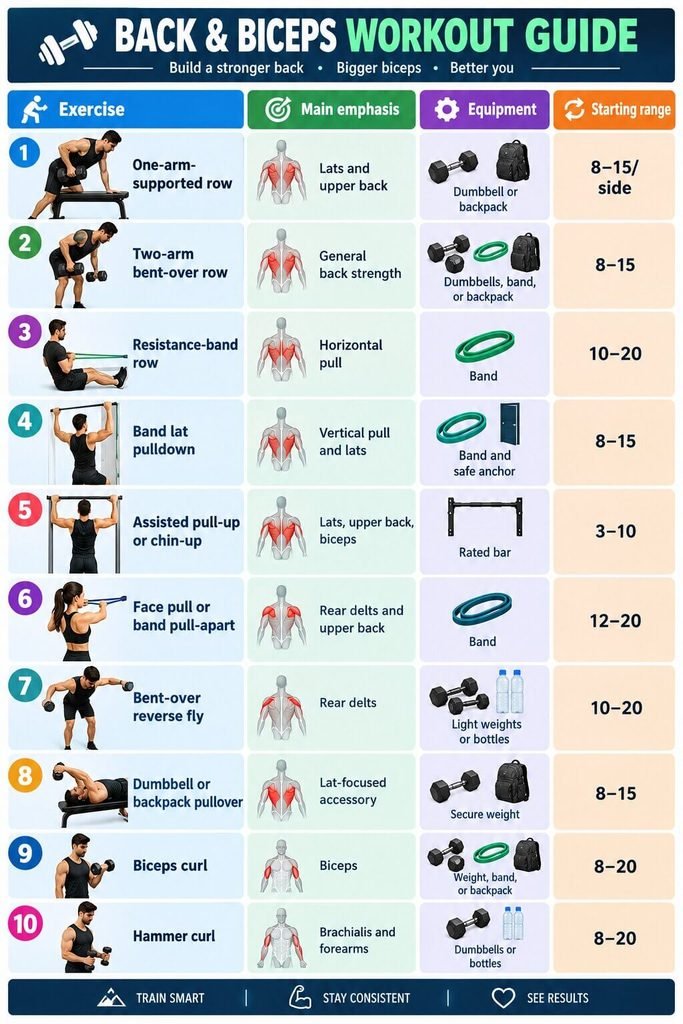
These repetition ranges are practical starting points, not universal scientific rules. Choose a load that makes the end of the set challenging without forcing momentum or reducing the range on every repetition.
1. One-Arm Supported Row
The one-arm row requires only one dumbbell or backpack. Support your free hand on a stable surface, hinge, pull toward your lower ribs, and lower comfortably. Keep your torso mostly still. See the ACE single-arm row guide for a basic reference.
2. Two-Arm Bent-Over Row
The bent-over row trains both sides with dumbbells, a backpack, or a band under the feet. Hinge, hold a stable torso angle, and pull toward your lower ribs. Use a supported one-arm row if your lower back limits the set.
3. Resistance-Band Row
A band row provides adjustable horizontal resistance. With a secure torso-height anchor, pull toward your ribs without leaning back. If no safe anchor exists, stand on a long band and perform a bent-over row. Inspect it first.
4. Band Lat Pulldown
The band pulldown creates a vertical pull without a cable machine. Attach the band to a purpose-built overhead anchor and pull your elbows toward your sides. Use rows and pullovers if safe anchoring is impossible.
5. Assisted Pull-Up or Chin-Up
Pull-ups and chin-ups provide a challenging vertical pull on a rated bar. Beginners can use foot assistance, a correctly installed band, or slow negatives. Avoid uncontrolled jumping and unverified doorway bars.
6. Face Pull or Band Pull-Apart
Face pulls and pull-aparts train the rear delts and upper back. Pull toward your face from a secure anchor, or spread an unanchored band in front of you. Use pull-aparts when an anchor is unavailable and avoid shrugging.
7. Bent-Over Reverse Fly
The reverse fly trains the rear delts with light dumbbells or bottles. Hinge with soft elbows and raise your arms outward. Use less weight than for rows and avoid swinging or shrugging.
8. Dumbbell or Backpack Pullover
The floor pullover provides a lat-focused option without an anchor or bar. Lower one secure weight behind your head through a comfortable range and return. Keep a slight elbow bend and never use an unstable backpack overhead.
9. Biceps Curl
The biceps curl adds direct arm work after back exercises. Keep your upper arms near your sides and curl dumbbells, a band, or a secure backpack without swinging.
10. Hammer Curl
The hammer curl uses a neutral grip to train the elbow flexors and forearms. Keep your wrists neutral and lower smoothly. Skip this optional second curl if the session already provides enough arm work.
Dumbbell or Backpack Pull Day Workout
This routine covers horizontal pulling, lat-focused work, rear delts, and elbow flexion without requiring a bench or pull-up bar. Use dumbbells when available or a securely loaded backpack where noted.
| Exercise | Sets | Repetitions | Rest |
|---|---|---|---|
| One-arm-supported row | 3 | 8–15/side | 90–120 seconds |
| Dumbbell or backpack pullover | 2–3 | 8–15 | 75–120 seconds |
| Bent-over reverse fly | 2–3 | 10–20 | 45–75 seconds |
| Biceps curl | 2–3 | 8–15 | 60–90 seconds |
| Optional hammer curl | 2 | 10–20 | 60–90 seconds |
The optional hammer curl is unnecessary if your arms are already fatigued. Beginners can start with two sets per exercise and add work only after technique and recovery are consistent.
This session takes approximately 25–40 minutes. Perform rows first because they use the most muscle and load. Rear-deltoid and curl variations follow after the larger back movements.
Resistance-Band Pull Day Workout
This routine provides both horizontal and vertical pulling when you have a long band and safe anchor. If an anchor is unavailable, use the substitutions listed below the table.
| Exercise | Sets | Repetitions | Rest |
|---|---|---|---|
| Band lat pulldown | 3 | 8–15 | 75–120 seconds |
| Standing or seated band row | 3 | 8–20 | 75–120 seconds |
| Face pull or pull apart | 2–3 | 12–20 | 45–75 seconds |
| Band biceps curl | 2–3 | 8–20 | 60–90 seconds |
| Band hammer curl | 2 | 10–20 | 60–90 seconds |
Use a stand-on-band bent-over row when a torso-height anchor is unavailable. Replace anchored face pulls with pull-aparts. If you cannot create a safe overhead setup, replace the pulldown with dumbbell or backpack pullovers.
Band color is not a standardized measure across manufacturers. Record the specific band, grip position, stance, and anchor distance so you can reproduce and progress the exercise.
Temporary Zero-Equipment Pull Workout
This routine can provide upper-back movement and self-resisted arm work when no external resistance is available. It is a temporary fallback, not an equal replacement for progressively loaded rows and vertical pulls.
| Exercise | Sets | Repetitions or time | Rest |
|---|---|---|---|
| Prone Y-T-W raise | 2 | 5–8 each position | 45–60 seconds |
| Reverse snow angel | 2 | 8–15 | 45–60 seconds |
| Self-resisted seated towel row | 3 | 15–30 seconds | 60 seconds |
| Self-resisted biceps curl | 2 | 8–15/side | 45–60 seconds |
For the towel row, sit with your legs extended, loop a towel around the soles of your feet, and pull the ends while pressing your feet gently into the towel to create opposing force. Do not jerk the towel or force your knees and back into uncomfortable positions.
For the self-resisted curl, one arm curls while the opposite hand supplies smooth downward resistance. Match the effort on both sides and maintain a controlled speed.
Sets, Reps, Rest, and Exercise Order
Most beginners can start with two or three sets per exercise and approximately 8–20 repetitions. Pull-ups may use lower repetitions, while rear-delt and band exercises often work well at the higher end.
Exercise order should move from the largest, most demanding pull toward smaller accessory movements:
- Pull-up, pulldown, or main row
- Second row or lat-focused exercise
- Rear-delt or upper-back accessory
- Biceps curl
- Optional hammer curl
End most sets with roughly one to three controlled repetitions available. Training to absolute failure is not required for an effective general program; current ACSM guidance describes routine momentary failure as optional for the average healthy adult.
Rest approximately 75–120 seconds after demanding rows, pulldowns, and pull-ups. Rest 45–90 seconds after reverse flies, pull-aparts, and curls. Take longer when short rest prevents you from maintaining technique.
How to Progress Your Home Pull Workout
Progress by adding controlled repetitions before increasing resistance. This double-progression method works with dumbbells, backpacks, bands, and most exercise variations.
- Select a range, such as 8–15 repetitions.
- Use the same setup while gradually adding repetitions.
- Reach 15 clean reps on every set in two workouts.
- Add a little load, shorten the band, or use a stronger band.
- Return to the lower end of the range and build again.
Other progression options include a longer controlled range, a brief pause, or one additional set. Change one variable at a time so you can identify what made the workout harder.
Pull-Up Progression
Build pull-ups with assistance and controlled lowering rather than repeated failed attempts. A practical sequence is
- Scapular pull-up
- Foot-assisted chin-up
- Band-assisted chin-up or pull-up
- Slow negative
- Full chin-up
- Full pull-up
- Loaded repetition
You do not need to master every step. Choose the variation that allows several technically consistent repetitions or controlled negatives without jumping or swinging.
Where Pull Day Fits Into Your Week
Pull day usually appears once or twice weekly within a balanced program. Include pushing and leg training rather than repeating back-and-biceps sessions while neglecting other major muscle groups.
Three-Day Push-Pull-Legs Schedule
| Day | Workout |
| Monday | Push |
| Wednesday | Pull |
| Friday | Legs |
This structure trains each category once weekly. It can work, although a beginner with only three training days may prefer full-body workouts to practice each movement more frequently.
Six-Day Push-Pull-Legs Schedule
| Day | Workout |
| Monday | Push |
| Tuesday | Pull |
| Wednesday | Legs |
| Thursday | Rest |
| Friday | Push |
| Saturday | Pull |
| Sunday | Legs |
This higher-frequency split is for people who already tolerate more training. It is not necessary for beginners. For the companion session, use the push day workout at home.
Common Pull-Day Mistakes
The most common mistakes are turning rows into torso swings, choosing several redundant curls, and using unsafe anchors. Correct setup and progression matter more than collecting a long exercise list.
Pulling Mostly With Momentum
Reduce the load if your torso repeatedly twists, rises, or jerks to finish a row.
Shrugging Every Repetition
Keep your neck long during rows, pullovers, and reverse flies without forcing the shoulders rigidly downward.
Using Only Curls
Curls do not replace rows, pulldowns, pull-ups, or pullovers. Train the back first.
Performing Only One Pulling Angle
Combine rows with pulldowns or pull-ups when possible. Use rows plus pullovers when vertical pulling is unavailable.
Losing the Hip Hinge During Rows
Keep your torso angle stable. Use a supported row if your lower back or hamstrings limit the set.
Adding Too Many Biceps Exercises
Your biceps assist every compound pull. One curl variation is enough for many beginners.
Band, Door, and Furniture Safety
Pull exercises can place considerable force on anchors and household objects. Inspect the entire setup before every session and avoid any option you cannot verify.
- Check bands for cuts, cracks, thinning, and damaged handles.
- Use an anchor specifically designed for resistance-band exercise.
- Follow the anchor and band manufacturers’ installation instructions and load limits.
- Position door anchors so pulling force closes the door more firmly rather than opening it toward you.
- Lock the door when appropriate and keep other people away from it.
- Test the setup gently before applying full effort.
- Keep your face away from the band’s recoil path.
- Do not use glass doors, weak hinges, loose handles, sharp edges, or movable furniture.
- Use only a pull-up bar designed, installed, and rated for the intended movement.
For a detailed setup checklist, see How to Anchor Resistance Bands at Home.
Stop the exercise for sharp or increasing shoulder, elbow, wrist, or back pain. If you have a current injury, recent surgery, major balance limitation, or a condition affecting exercise tolerance, ask an appropriate healthcare professional for individualized guidance.
Frequently Asked Questions
What exercises belong on pull day?
Include a row, vertical or lat-focused pull, rear-delt movement, and curl.
Can I do pull day at home without equipment?
You can use prone and self-resisted exercises, but zero-equipment pulling is limited. A band, backpack, weight, or rated bar is easier to progress.
How can I train my back without a pull-up bar?
Use loaded rows, band rows, pullovers, reverse flies, and pull-aparts. A bar is useful but optional.
Are four exercises enough for pull day?
Yes. A row, lat-focused movement, rear-delt exercise, and curl cover the main roles.
Do I need both rows and pulldowns?
They provide different paths, so both are useful. Otherwise, combine rows with pullovers or pull-ups.
Are pull-ups necessary for building the back?
No. Rows, pulldowns, and pullovers can train the back when progressed consistently.
Should back or biceps come first?
Train the back first because its larger movements require the biceps to assist.
How often should I perform pull day?
One or two weekly sessions can work. Recover before repeating a hard session.
How long should a home pull workout take?
Most sessions take 25–40 minutes depending on sets and rest.
Can a backpack replace dumbbells?
A secure backpack works for rows and curls, but grip, shifting contents, and load increments can be awkward.
How do I stop my arms from taking over rows?
Use a manageable load and pull the elbow smoothly rather than curling the weight. Some biceps work is normal.
Are Romanian deadlifts part of pull day?
They can be, but this guide places hip hinges on leg day. Either structure can work.
How should resistance bands be anchored safely?
Use a purpose-built anchor, follow its instructions, inspect the band, and avoid improvised setups.
Conclusion
A productive pull day workout at home needs resistance you can pull safely and progress over time. Begin with a row, add a pulldown, pull-up, or pullover for the lats, include a rear-delt movement, and finish with one curl variation.
Choose the dumbbell or backpack routine when you prefer measurable external load. Choose the band routine when you have a secure anchor and want both horizontal and vertical pulling. Use the zero-equipment plan only as a temporary fallback, not as an equal substitute for progressively loaded back training.
Record your exercises, loads, band setup, sets, and repetitions. Once you reach the top of the target range with consistent technique, make one small progression and continue building from there.