
A practical tricep workout at home without weights can use four movements: a close-grip push-up, bodyweight triceps extension, standard push-up, and plank-to-push-up. Perform it twice per week with two or three controlled repetitions available.
This workout does not require dumbbells or resistance bands. It also avoids mandatory chair dips, unstable furniture, explosive push-ups, and advanced calisthenics.
Tricep Workout at a Glance
Complete all sets of one exercise before moving to the next. Beginners should use the lowest set totals during Week 1 rather than performing every optional set.
| Exercise | Sets | Repetitions | Rest |
|---|---|---|---|
| Close-grip wall or incline push-up | 2–3 | 6–15 | 60–120 seconds |
| Wall or counter bodyweight triceps extensions | 2–3 | 6–12 | 60–120 seconds |
| Standard incline or floor push-up | 2 | 8–15 | 60–120 seconds |
| Wall, counter, or floor plank-to-push-up | 1–2 | 6–10 per side | 60–90 seconds |
| Program detail | Recommendation |
|---|---|
| Experience level | Beginner to early intermediate |
| Frequency | 2 nonconsecutive days per week |
| Duration | Approximately 15–25 minutes |
| Starting volume | About 6–8 working sets |
| Effort | Finish most sets with 2–3 good repetitions available |
| Initial duration | Follow for 4 weeks before major changes |
The chest and front shoulders also contribute to every push-up variation. This is a triceps-focused session, not complete isolation.
Can Bodyweight Exercises Strengthen the Triceps?
Yes. Bodyweight pressing exercises can strengthen the triceps when they provide enough resistance and become progressively more difficult. Close-grip push-ups emphasize elbow extension, the triceps’ primary action, while the chest and shoulders assist.
The American College of Sports Medicine’s 2026 resistance-training guidance recognizes bodyweight and home-based exercise as effective options. It emphasizes consistent, progressive training rather than unnecessary program complexity. ACSM resistance-training guidance
Laboratory studies have reported greater triceps activation during narrow-base push-ups than during some wider hand positions. However, electromyography, or EMG, measures electrical activity during an exercise; it does not prove that one variation will produce more long-term muscle growth. Cogley et al., 2005, Youdas et al., 2010
A separate randomized study found that progressive calisthenic push-up training improved upper-body strength over four weeks. The practical lesson is to progress the exercise level—not to repeat an easy version indefinitely. Kotarsky et al., 2018
What Do the Triceps Do?
The triceps brachii sits on the back of the upper arm and straightens the elbow. It has long, lateral, and medial heads that contribute together rather than functioning as completely separate muscles.
The long head also crosses the shoulder joint. A no-weight routine offers fewer convenient overhead-loading options, so bodyweight push-ups and extensions provide the main practical movements.
Exercise selection may change relative demand, but no single push-up completely isolates one triceps head. Training consistently and progressing resistance matter more than trying to “carve” each head with a long exercise list.
Prepare a Safe Workout Space
Use a stable wall or counter and test the surface before applying body weight. Clear enough space to maintain a straight body position without hitting furniture.
Do not perform incline exercises on a movable chair, stool, light table, glass surface, or stacked objects. A wall is the safest starting point for both close-grip push-ups and bodyweight triceps extensions.
Four-Minute Upper-Body Warm-Up
A short warm-up should rehearse elbow extension and pressing without tiring the triceps. Complete one controlled round.
- March in place while moving your arms for 60 seconds.
- Perform 8 slow shoulder rolls in each direction.
- Bend and straighten your elbows for 10 controlled repetitions.
- Perform 6 wall push-ups.
- Perform 6 easy wall triceps extensions.
- Perform one brief practice set using an easier variation than your first working set.
How to Perform the Triceps Exercises
Choose one variation under each heading and repeat the same setup for several workouts. End a set when your body position, range, or elbow control changes noticeably.
1. Close-Grip Wall or Incline Push-Up
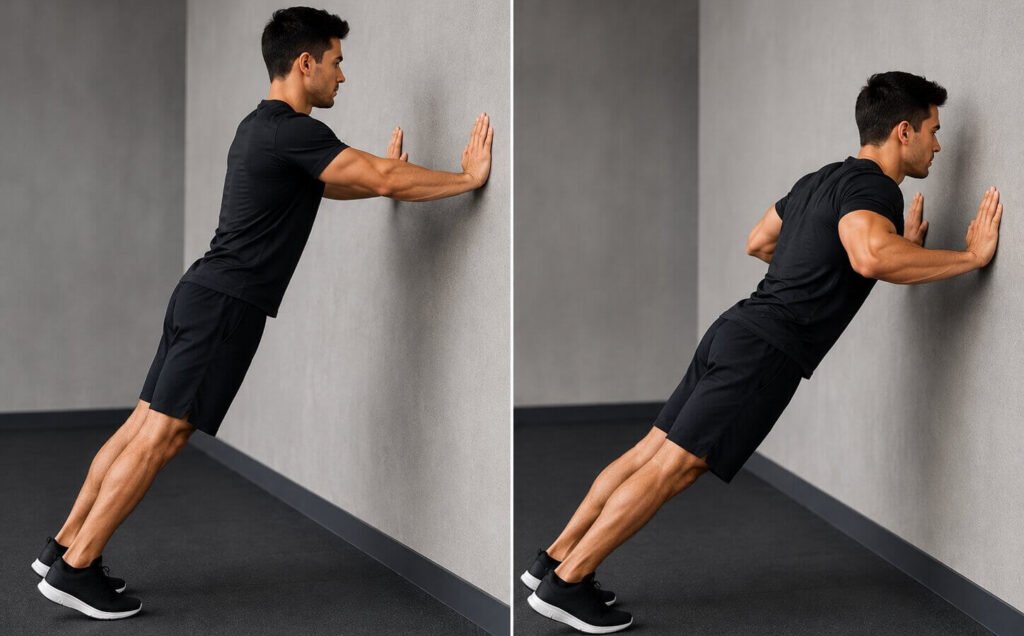
The close-grip push-up is the main compound exercise. A wall or high counter lets beginners train the movement without forcing floor repetitions.
Place your hands approximately shoulder width apart on a stable surface. Step back, maintain a straight body position, bend your elbows, and lower your chest toward your hands. Press away until your elbows are straight without forcing them beyond their comfortable position.
Keep your elbows relatively close to your torso, but do not pin them completely against your sides. Use the angle that feels natural and controlled.
Progression: Wall → high counter → lower stable surface → floor close-grip push-up.
2. Wall or Counter Bodyweight Triceps Extension
A bodyweight triceps extension emphasizes elbow movement more directly than a standard push-up. The surface height determines how much body weight the arms must control.
Face a wall and place your hands around forehead height and shoulder-width apart. Step back into a straight-body position, bend only your elbows so your forehead approaches the space between your hands, then straighten your elbows to press away.
Keep your upper arms reasonably steady and avoid turning the movement into a full push-up. Begin close to the wall; step farther away or use a lower stable surface only after the movement is controlled.
Progression: Upright wall extension → farther-from-wall extension → high-counter extension → lower-counter extension.
3. Standard Incline or Floor Push-Up
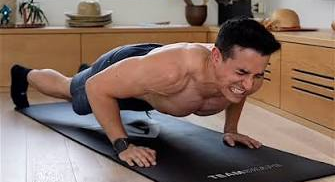
A standard push-up adds productive triceps volume while also training the chest and front shoulders. Use it after the more triceps-focused movements.
Place your hands shoulder-width apart or slightly wider. Maintain a steady trunk, lower through a comfortable range, and press the surface away. Use an incline when fewer than eight controlled floor repetitions are available after the earlier exercises.
Progression: Wall → incline → floor → pause or slow-lowering push-up.
4. Wall, Counter, or Floor Plank-to-Push-Up
The plank-to-push-up trains repeated elbow extension while challenging shoulder and trunk stability. It should remain controlled rather than becoming a fast conditioning exercise.
From a wall, incline, knee, or floor plank, lower one forearm and then the other to the support. Place one hand down and press back to straight arms. Alternate which arm leads each repetition.
Use a higher surface if your hips rotate substantially or you cannot control the transition.
Progression: Wall → counter → knees on floor → full floor version.
Are Diamond Push-Ups Necessary?
No. A close-grip push-up can emphasize the triceps without touching the thumbs and index fingers together. The forced diamond position may be uncomfortable for some wrists and does not guarantee better results.
Place your hands shoulder-width apart and adjust slightly for comfort. What matters is controlled elbow extension, sufficient effort, and progression—not creating a perfect geometric shape with your hands.
Are Chair Dips Safe or Necessary?
Chair dips are not necessary for this routine. They require suitable equipment, can be difficult to scale, and place the arms behind the torso in a shoulder position that some people find uncomfortable.
Ordinary chairs may also slide or tip. Close-grip push-ups and wall or counter triceps extensions provide easier difficulty adjustments without relying on furniture behind your body.
If you already perform dips comfortably, use purpose-built equipment that is installed and rated correctly. Do not add dips simply because an online routine calls them “equipment-free.”
How to Choose the Correct Difficulty
Select a variation that allows at least six controlled repetitions while leaving approximately two or three additional repetitions available. A wall exercise is the correct starting level when incline or floor repetitions change your position.
| Current performance | Recommended change |
|---|---|
| Wall variation is challenging | Stay close to the wall and shorten the range if needed |
| More than 15 wall repetitions are easy | Step farther away or use a high counter |
| High-counter repetitions exceed the range | Use a slightly lower stable surface |
| Low-incline push-ups are controlled | Test a floor close-grip push-up |
| Floor repetitions exceed the range | Add a pause, slow lowering, or external resistance |
Change surface height in small steps. A lower surface can increase difficulty more than expected.
Sets, Repetitions, Rest, and Effort
Start with approximately six to eight total working sets. Use 6–15 repetitions for most movements and finish around 2–3 repetitions in reserve, or RIR.
RIR estimates how many more good repetitions you could have completed. An RIR of 2 means approximately two controlled repetitions remained. The number does not need to be exact.
Rest 60–120 seconds between sets. Take longer after demanding close-grip push-ups or extensions if another set would otherwise lose repetitions or range. Short rest may increase fatigue without improving the resistance stimulus.
Two-Day Weekly Schedule
Train the triceps on two nonconsecutive days, such as Monday and Thursday. This permits regular practice without repeating hard elbow-extension work every day.
| Day | Activity |
|---|---|
| Monday | Triceps workout |
| Tuesday | Lower body, pulling, cardio, or rest |
| Wednesday | Rest or manageable activity |
| Thursday | Triceps workout |
| Friday–Sunday | Other training and recovery as appropriate |
This triceps routine is not a complete program. Include pulling, lower-body, shoulder, and trunk exercises elsewhere in the week. The CDC recommends muscle-strengthening activity for all major muscle groups on at least two days per week. CDC adult activity guidelines
Four-Week Progression Plan
Use the first month to establish controlled movement and a repeatable schedule. Increase one training factor at a time.
| Week | Training plan | Main goal |
|---|---|---|
| 1 | 1–2 sets per exercise, 2 sessions | Select safe variations and use about 3 RIRs. |
| 2 | 2 sets for most exercises, 2 sessions | Add repetitions within each range |
| 3 | Add one set to close-grip push-ups if recovered | Increase volume selectively |
| 4 | Maintain sets and progress one variation | Lower one surface or add a brief pause |
Do not add a set just because Week 3 arrives. Maintain the current plan if soreness persists, elbow or shoulder discomfort develops, or repetitions decline.