A good beginner home workout routine does not need dozens of exercises or daily high-intensity sessions. Start with two full-body workouts per week, practice a small group of basic movements, and increase the challenge gradually as your technique and fitness improve.
The routine below takes about 20–30 minutes and uses body weight, a stable chair or counter, and an optional backpack or resistance band. It is designed for generally healthy adults who are new to structured exercise or returning after a long break—not for injury rehabilitation or condition-specific training.
Beginner Home Workout Routine at a Glance
Perform this full-body routine two or three times per week on nonconsecutive days. Start with one set per exercise during your first week, then build toward two sets if you recover comfortably and can maintain good technique.
| Plan detail | Beginner target |
|---|---|
| Frequency | 2–3 nonconsecutive days per week |
| Session length | About 20–30 minutes |
| Exercises | 6 full-body movements |
| Starting volume | 1–2 sets per exercise |
| Repetitions | Usually 6–15, depending on the exercise |
| Rest | About 60–90 seconds, or longer when needed |
| Effort | Finish most sets with 2–4 controlled repetitions remaining. |
| Equipment | Stable chair or counter; optional backpack or resistance band |
The 2026 American College of Sports Medicine (ACSM) resistance-training guidance emphasizes that consistency matters more than a complicated “perfect” program. It also recognizes bodyweight exercises, elastic bands, and home-based routines as useful training options for healthy adults. ACSM, 2026
Who Is This Routine For?
This plan is for generally healthy adults who want a manageable introduction to strength and general fitness at home. It works especially well for people who have limited space, little equipment, or difficulty following longer programs.
You can use the routine if you are:
- Completely new to structured exercise
- Returning after an extended period of inactivity
- Looking for a low-impact alternative to jumping-based circuits
- Trying to build strength, movement confidence, and a consistent habit
- Able to exercise independently without condition-specific supervision
The routine is not a personalized medical or rehabilitation program. If you have an injury, chronic health condition, disability, recent surgery, or other concern that affects exercise, ask an appropriate healthcare or exercise professional how to modify your activity.
What Do You Need to Work Out at Home?
You need enough clear floor space to lie down and extend your arms, plus a stable support for easier squats, lunges, and push-ups. A gym membership and specialized machines are not required.
Useful items include:
- A stable chair placed where it cannot slide
- A wall, countertop, or sturdy table edge for incline push-ups
- An exercise mat or folded towel for floor comfort
- A securely closed backpack loaded with soft, nonbreakable items
- An optional resistance band in good condition
Inspect your space before starting. Remove loose rugs and nearby objects, wear footwear appropriate for the surface, and do not use unstable furniture. If you use a backpack, close every compartment and avoid sharp, fragile, or shifting objects. Inspect resistance bands for cracks or damage before each session.
The Honest Limitation of No-Equipment Training
Bodyweight training makes squats, lunges, bridges, push-ups, and core exercises easy to perform at home, but training the pulling muscles of the upper back is harder without resistance. A backpack row or resistance-band row provides a more direct pulling exercise.
A prone W raise can be used temporarily when no resistance is available, but it is not an equal replacement for a progressively loaded row. Avoid improvising rows from doors, tables, sheets, or furniture unless the setup is specifically designed and verified to support your full body weight.
Start With a Five-Minute Warm-Up
A short warm-up should gradually increase movement and let you practice easier versions of the exercises ahead. It does not need to be exhausting or complicated.
Complete the following movements at a comfortable pace:
- March in place: 60 seconds
- Arm circles and reaches: 30 seconds in each direction
- Slow hip hinges: 8 repetitions
- Chair sit-to-stands: 8 repetitions
- Wall push-ups: 6 controlled repetitions
- Ankle rocks or heel raises: 8 repetitions per side
The goal is to feel warmer and more coordinated, not tired. Reduce the range of motion or hold a stable support if any movement feels difficult.
The Full-Body Beginner Home Workout Routine
This routine trains the main movement patterns with six beginner-friendly exercises. Complete all sets of one exercise before moving to the next, or perform one set of each as a slow circuit if that feels more enjoyable.
| Exercise | Sets | Repetitions | Easier option |
|---|---|---|---|
| Chair squat or sit-to-stand | 1–2 | 8–12 | Use a higher chair and your hands if needed |
| Wall or incline push-up | 1–2 | 6–12 | Use a higher surface |
| Backpack or resistance-band row | 1–2 | 8–15 | Use less resistance; prone W raise if none is available |
| Glute bridge | 1–2 | 10–15 | Use a comfortable, shorter range |
| Supported reverse lunge or split squat | 1–2 | 6–10 per side | Use support or repeat chair squats |
| Bird dog or dead bug | 1–2 | 6–10 per side | Move one limb at a time |
Rest for about 60–90 seconds between sets. Take longer if your breathing has not settled or you cannot begin the next set with control.
1. Chair Squat or Sit-to-Stand
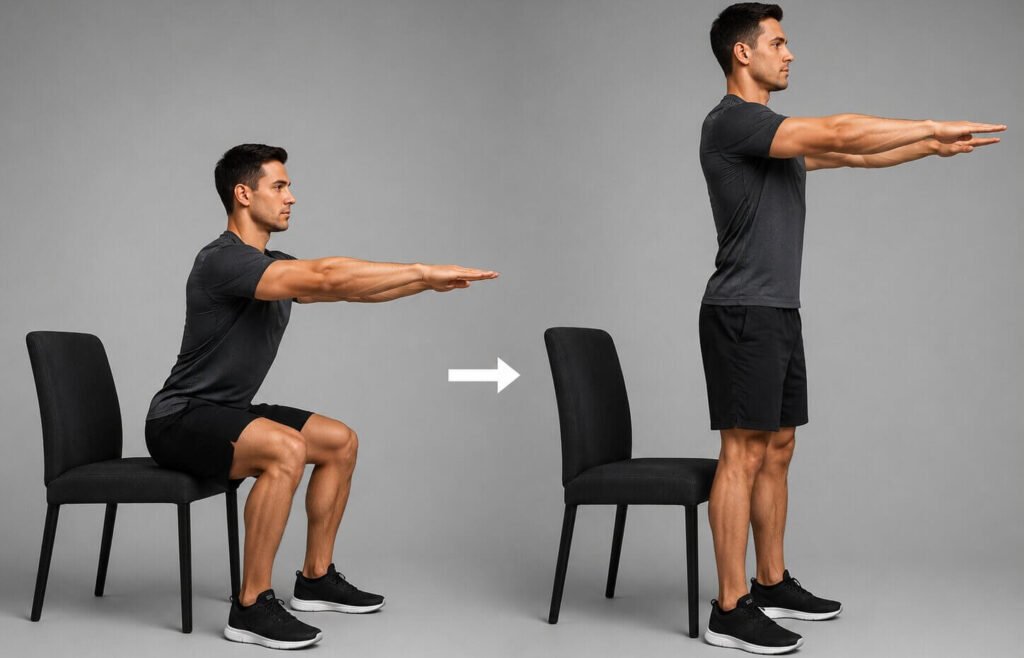
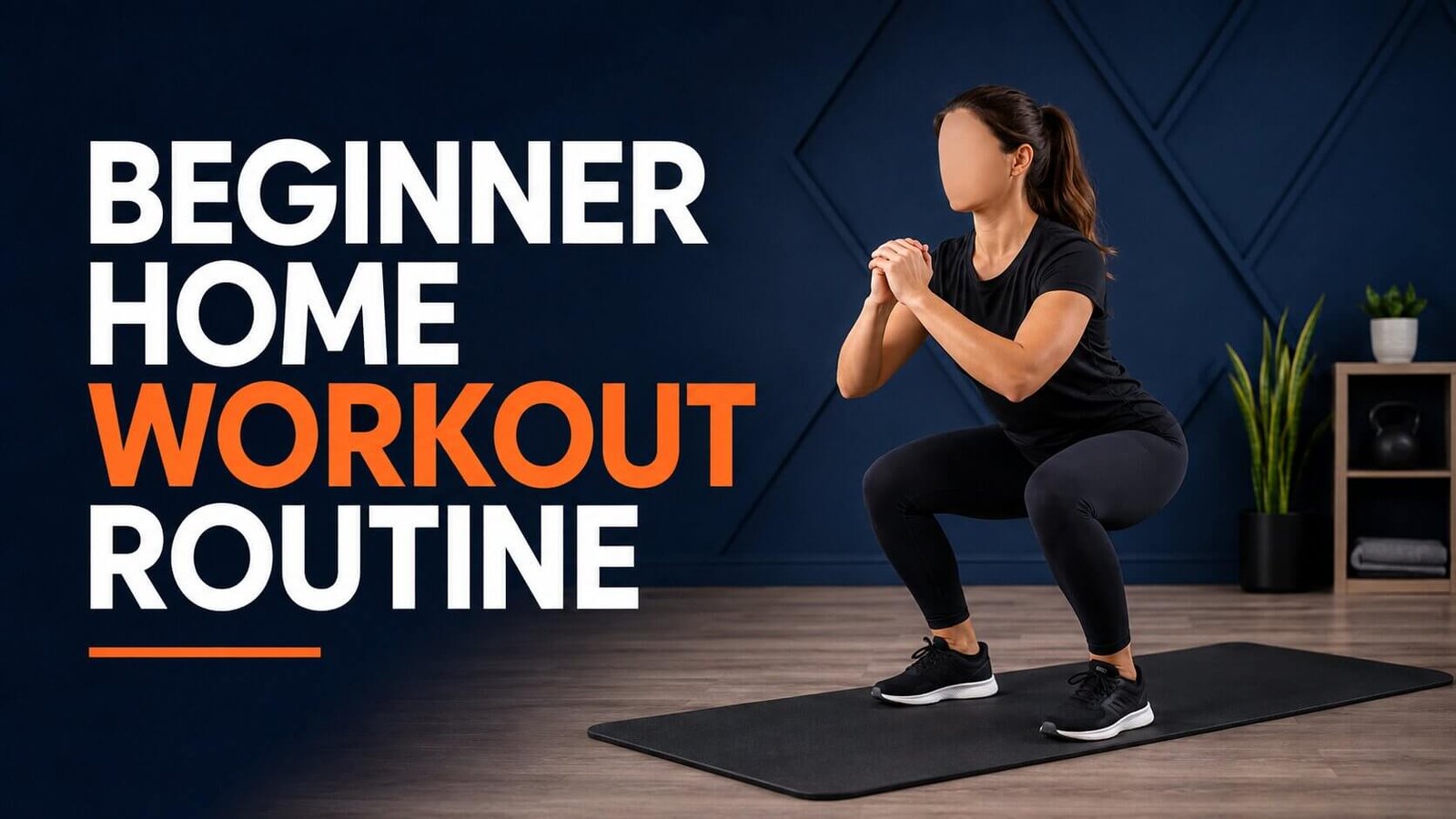
The chair squat trains the hips and legs while providing a clear depth target and a stable starting position. Choose a chair height that lets you stand without dropping, rocking, or pushing through discomfort.
Stand with your feet in a comfortable position in front of the chair. Reach your hips back, bend your knees, and lower under control until you lightly touch the seat. Press through your whole foot to stand. Keep your knees generally moving in the same direction as your toes.
Make it easier by using a higher seat or lightly assisting with your hands. Make it harder by slowing the lowering phase, pausing above the chair, or holding a light backpack against your chest.
2. Wall or Incline Push-Up
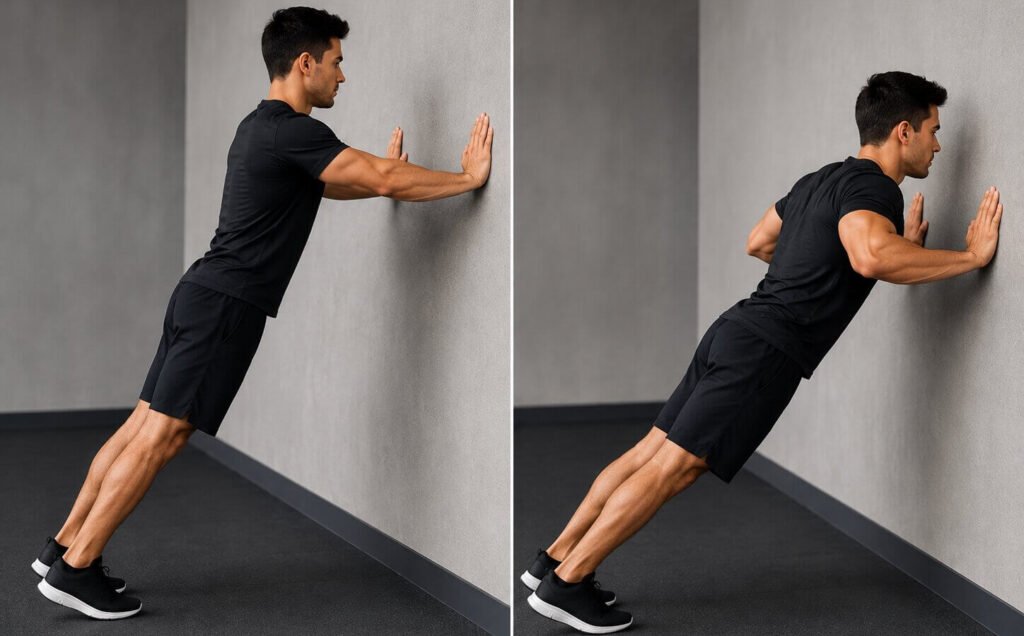
An elevated push-up trains the chest, shoulders, triceps, and trunk without requiring a floor push-up. The higher the surface, the less body weight you need to lift.
Place your hands on a wall or stable surface slightly wider than shoulder-width. Walk your feet back, keep your body in a straight line, and bend your elbows to bring your chest toward the surface. Press away without letting your hips sag or your shoulders shrug.
Begin at a height where you can complete at least six controlled repetitions. Progress by using a lower surface before attempting full floor push-ups.
3. Backpack or Resistance-Band Row
Rows train the upper back and arms, balancing the pushing work in the routine. Use a light resistance that you can control without twisting or jerking.
For a one-arm backpack row, place one hand on a stable support, hinge at your hips, and keep your back in a comfortable neutral position. Pull the backpack toward the side of your torso, pause briefly, and lower it slowly. Repeat on both sides.
For a band row, use a setup intended for the band and follow the manufacturer’s anchoring instructions. Do not rely on a loose or unverified door setup. If you have no safe resistance, perform prone W raises for shoulder-blade control while planning to add a suitable pulling option later. See this resistance-band home training guide for more exercise and progression options.
4. Glute Bridge
The glute bridge trains the hips while keeping both feet and the upper body supported on the floor. It is a useful introduction to hip extension, a movement used in walking, climbing stairs, and lifting objects.
Lie on your back with your knees bent and feet flat. Gently brace your trunk, press through your feet, and lift your hips until your torso and thighs form a comfortable line. Pause, then lower with control. Avoid forcing your lower back into an exaggerated arch.
Make the exercise harder by adding a pause at the top or performing more controlled repetitions. Do not rush to a single-leg variation until the standard version feels stable.
5. Supported Reverse Lunge or Split Squat
A supported lunge trains each leg separately and adds a balance challenge. Holding a stable counter or chair can make the movement more manageable without removing its training value.
For a reverse lunge, step one foot back and lower only as far as you can control. Push through the front foot to return. For a split squat, keep both feet in place and move straight down and up through a comfortable range.
If either variation feels too difficult, repeat the chair squat for a second set instead. A beginner routine should match your present ability; no individual exercise is mandatory.
6. Bird Dog or Dead Bug
Bird dogs and dead bugs train trunk control while your arms and legs move. The goal is steady positioning, not speed or an extreme range of motion.
For a bird dog, begin on your hands and knees. Extend one leg, one arm, or the opposite arm and leg without rotating your torso. For a dead bug, lie on your back with your hips and knees bent, then slowly lower one heel or extend the opposite arm and leg while keeping your trunk controlled.
Start by moving one limb at a time. Use a smaller range if your back position changes or you need to hold your breath.
A Simple Four-Week Beginner Workout Schedule
The first four weeks should build skill and consistency rather than maximize fatigue. Repeat the same basic routine long enough to learn the exercises and judge whether they are becoming easier.
| Week | Strength schedule | Starting goal |
|---|---|---|
| 1 | Monday and Thursday | 1 set per exercise; learn the movements |
| 2 | Monday and Thursday | Build toward 2 sets where recovery is comfortable |
| 3 | Monday and Thursday; optional Saturday | Maintain 2 sets and add controlled repetitions |
| 4 | Monday, Wednesday, and Friday, or remain at 2 days | Progress one variable in one or two exercises |
The third weekly strength session is optional. Staying with two sessions is appropriate if you are still experiencing substantial soreness, struggling with technique, or finding three days difficult to maintain.
Use non-strength days for rest, easy walking, or another comfortable activity. Avoid treating a missed day as failure—continue with the next planned session instead of doubling your workload.
How Many Sets and Repetitions Should Beginners Do?
One or two sets of each exercise is a practical starting point. Use a repetition range rather than forcing the same number on every movement, because different exercises and modifications create different levels of difficulty.
For example, you might perform eight chair squats, six incline push-ups, and twelve glute bridges. Those numbers are useful if each set remains controlled and moderately challenging. They are not targets you must reach at the expense of technique. Readers with a specific strength or muscle goal can also review this guide to choosing the right repetition range.
How Hard Should Each Set Feel?
Finish most beginner sets when you can still perform approximately 2 to 4 good repetitions. The last repetitions should require focus, but they should not involve breath-holding, jerking, or a major change in technique.
Training to complete muscular failure is not required for the average healthy adult. ACSM’s 2026 evidence review found that advanced techniques, including routinely training to momentary failure, are often unnecessary for general health and fitness. ACSM, 2026
How Long Should You Rest?
Rest about 60–90 seconds between beginner sets, but treat this as a flexible starting range. Larger exercises such as squats and lunges may require more rest than bird dogs or wall push-ups.
Begin the next set when your breathing is under control and you can concentrate on technique. Shortening every rest period may make a workout feel harder without making it more productive.
How to Progress Your Home Workout
Progress by making a small, measurable change after your current version becomes controlled and repeatable. Do not change every exercise at once.
Use this order:
- Improve control and range of motion. Learn the current version first.
- Add repetitions. Move toward the top of the listed range.
- Add a set. Progress from one set to two.
- Add light resistance. Use a slightly heavier backpack or stronger band.
- Choose a harder variation. Lower the push-up surface or use a more challenging squat variation.
When you reach the top of a repetition range for every set in two consecutive workouts—with steady technique and several repetitions still available—progress one variable. Record the exercise, variation, sets, and repetitions so you do not have to rely on memory.
Progress is not perfectly linear. Sleep, stress, schedule changes, and ordinary day-to-day variation can affect performance. A temporary lower-repetition session does not mean the routine has stopped working.
How to Combine Strength Training With Walking or Cardio
Add aerobic activity gradually instead of turning every strength workout into a fast circuit. Walking, cycling, dancing, and low-impact cardio can complement the routine without interfering with learning the strength exercises.
The CDC recommends that adults work toward at least 150 minutes of moderate-intensity aerobic activity per week, along with muscle-strengthening activity for all major muscle groups on at least two days. The aerobic activity can be divided into smaller sessions, and some activity is better than none. CDC: Adult Activity Guidelines
A realistic starting week might include:
- Two full-body strength workouts
- Two or three 10–20-minute walks
- Light daily movement as your schedule allows
Treat 150 minutes as a public health target to build toward, not a requirement for your first week. Increase your walking time or frequency gradually as your fitness and routine become more stable.
Common Beginner Home-Workout Mistakes
Most early problems come from doing too much, choosing unsuitable variations, or following a plan with no progression. A simple routine works better when you can repeat it consistently.
Starting With Daily High-Intensity Workouts
Daily jumping circuits and all-out intervals are not necessary for a beginner. Start with manageable sessions and leave recovery time between full-body strength workouts.
Choosing the Hardest Exercise Variation
A floor push-up is not automatically better than a wall or incline push-up. The best starting variation is the one that provides a challenge while letting you control every repetition.
Training Only the Muscles You Can See
Plans made entirely of squats, push-ups, and abdominal exercises can miss pulling work for the upper back. Add a safe row when possible and acknowledge the limitation if no pulling resistance is available.
Turning Every Set Into a Speed Test
Moving faster can increase breathing and fatigue, but it may also make a new exercise harder to learn. Use a controlled pace first; add faster conditioning work separately when appropriate.
Changing the Routine Every Session
Constant variety makes progress difficult to measure. Keep the main movements consistent for at least four weeks and change an exercise only when you need a safer variation, lack suitable equipment, or have clearly outgrown it.
Ignoring Pain or an Unsafe Setup
Sharp or increasing pain is not a sign that an exercise is “working.” Stop, reassess the movement and environment, and seek qualified guidance when symptoms persist or concern you.
Recovery, Soreness, and Rest Days
Recovery supports consistent training and gives you time to adapt to unfamiliar exercise. Schedule at least one day between full-body strength sessions during this beginner phase.
Mild muscle soreness can occur after a new workout, especially during the first weeks. Reduce the next session’s volume or repeat the easier variation if soreness limits normal movement. Severe, sharp, or worsening pain deserves more caution than ordinary post-exercise tenderness.
Basic recovery habits include:
- Sleeping on a regular schedule
- Eating balanced meals rather than relying on workout supplements
- Drinking according to thirst and environmental conditions
- Using easy movement on rest days if it feels comfortable
- Avoiding extra sets simply because the first workout felt easy
More exercise is not automatically better. A routine that fits your schedule and recovery is more useful than an ambitious plan you cannot repeat.
When Should You Seek Professional Guidance?
Ask for professional guidance when a health condition, injury, disability, pregnancy, recent procedure, or recurring symptom may change which exercises are appropriate. This general routine cannot account for individual medical needs.
The CDC notes that moderate physical activity is safe for most people but advises adults with chronic conditions to discuss suitable types and amounts of activity with a clinician. It also recommends checking before beginning vigorous activity in certain circumstances. CDC: Adding Physical Activity as an Adult
Stop exercising and seek appropriate care if you experience chest pain, fainting, severe or unusual shortness of breath, or sudden significant pain. Do not use an online routine to diagnose or train through concerning symptoms.
Frequently Asked Questions
Is Working Out at Home Effective for Beginners?
Yes. Home workouts can improve strength and physical function when the exercises cover the major muscle groups, the working sets are sufficiently challenging, and the routine progresses over time. ACSM’s updated guidance recognizes bodyweight, band, and home-based resistance training as effective options.
How Many Days per Week Should a Beginner Work Out?
Two full-body strength workouts per week are a practical starting point. Add a third nonconsecutive session when the routine feels manageable, your technique is stable, and you are recovering comfortably.
Is a 20-Minute Home Workout Enough?
Twenty minutes can be enough for a useful beginner strength session if you focus on a small number of full-body exercises. It may not cover the CDC’s complete weekly aerobic-activity recommendation, so add walking or another aerobic activity separately.
Can Beginners Exercise at Home Without Equipment?
Yes, beginners can train many movement patterns using body weight alone. Pulling exercises are the main limitation, so a backpack or resistance band can make a home routine more balanced and easier to progress.
Should I Perform This Routine Every Day?
No. Perform it two or three times per week with a rest or light-activity day between sessions. Daily easy walking or mobility may be comfortable, but hard full-body resistance training is unnecessary every day.
What if I cannot do a push-up or lunge?
Use an easier variation. Perform push-ups against a wall or higher surface, and replace lunges with supported chair squats until your control improves. An exercise should be adapted to your current ability rather than forced.
How Do I Know When to Make an Exercise Harder?
Progress when you can reach the top of the repetition range for every set in two consecutive workouts with controlled technique and two or more good repetitions still available. Add only one challenge at a time.
Can I Combine This Routine With Walking?
Yes. Walking works well on non-strength days or after a short strength session. Start with a duration you can repeat comfortably and build gradually toward the weekly aerobic-activity guidelines.
Practical Recommendations
Start with less work than you think you can handle, then earn each increase through consistent, controlled sessions. This approach makes it easier to identify which exercise caused a problem and reduces the urge to abandon the plan after an overly difficult first week.
For your first session:
- Clear a safe workout space.
- Complete the five-minute warm-up.
- Perform one set of each exercise.
- Record your variation and repetitions.
- Wait at least one day before repeating the routine.
After four weeks, review your training log. If your technique, repetitions, and consistency have improved, continue progressing the routine. If your main goal becomes muscle growth, move to a more specific progressive resistance plan, such as this guide to building muscle at home, rather than simply making the circuit faster.
Conclusion
The best beginner home workout routine is simple enough to repeat and flexible enough to match your current ability. Two weekly full-body sessions, six balanced exercises, gradual progression, and regular walking provide a practical foundation without requiring a gym or daily intense training.
Begin with one set of each exercise this week. Record what you complete, repeat the session after at least one rest day, and make only one small change when the current version becomes controlled and repeatable.