Disclosure: This article may contain affiliate links. If you purchase through one of these links, we may earn a commission at no additional cost to you.
For most beginners, a flexible 4-inch nylon belt with easy adjustment is a better starting point than an extremely stiff powerlifting belt. It lets you experiment with belt position and tightness while learning how to brace without dealing with a long leather break-in period.
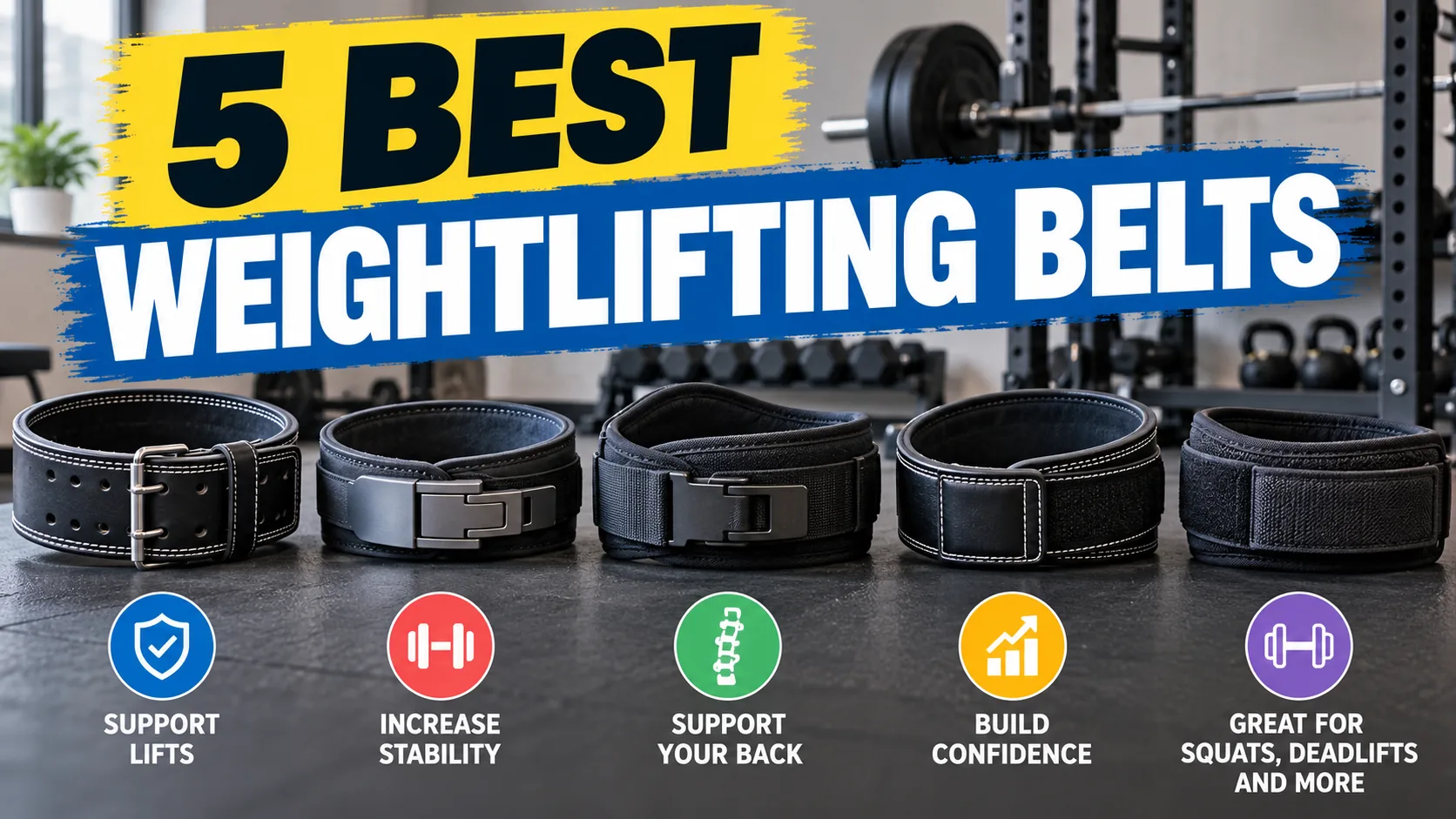
The Element 26 Self-Locking Weightlifting Belt is the strongest all-around option in this group for a first belt because it combines a uniform 4-inch nylon body with a quick-release, infinitely adjustable closure. The Gymreapers Quick Lock Belt offers a similar training style with clearly published sizing and a 6.35 mm nylon construction, while the Harbinger 4-Inch Nylon Belt keeps the design simpler.
If straight 4-inch belts press uncomfortably into your ribs or hips, the contoured Schiek Model 2004 deserves consideration. For Olympic lifting and workouts involving more movement between exercises, the Warm Body Cold Mind 4-Inch Nylon Belt provides another flexible alternative.
A lifting belt does not replace learning how to brace, and it should not be treated as proof against back injury.
Key Takeaways
- Element 26 Self-Locking Belt: a strong overall choice for beginners who want easy micro-adjustment and quick release.
- Gymreapers Quick Lock Belt: a useful alternative with a uniform 4-inch width, 6.35 mm thickness, and a broad published size range.
- Harbinger 4-Inch Nylon Belt: a straightforward option if you want a flexible nylon belt without a specialized self-locking design.
- Schiek Model 2004: contoured alternative for lifters who find uniform-width belts uncomfortable around the ribs or hips.
- Warm Body, Cold Mind 4-Inch Nylon Belt: particularly relevant to Olympic lifting and mixed functional training.
- Measure around your torso where the belt will sit, not by your pants size.
- A belt should give you something to brace your abdominal wall against; it should not be tightened so aggressively that you cannot establish a useful breath and brace.
- Small laboratory studies have found higher intra-abdominal pressure during some belted squat and deadlift conditions, but research does not justify claiming that belts automatically prevent spinal injury.
Best Weightlifting Belts for Beginners Compared
| Product | Best For | Material | Shape | Closure | Main Trade-Off |
|---|---|---|---|---|---|
| Element 26 Self-Locking Belt | Most beginners | Nylon | Uniform 4 in | Self-locking metal buckle | Less rigid than a leather powerlifting belt |
| Gymreapers Quick Lock | Quick-lock alternative | Nylon | Uniform 4 in | Steel roller + Velcro | Still relies partly on hook-and-loop fastening |
| Harbinger 4-Inch Nylon | Simple beginner use | Nylon | Uniform 4 in | Roller buckle + hook-and-loop | Fewer specialized features |
| Schiek Model 2004 | Contoured fit | Nylon-based | 4.75 in back, tapered sides | One-way Velcro | Wider rear section than straight 4-in belts |
| WBCM 4-Inch Nylon | Olympic/functional training | Nylon | Uniform 4 in | Metal self-locking clasp | Less powerlifting-specific than stiff leather belts |
1. Element 26 Self-Locking Weightlifting Belt — Best Overall for Beginners
The Element 26 Self-Locking Weightlifting Belt is the most beginner-friendly all-around option in this lineup because its nylon body is easier to adjust than a traditional prong belt and its self-locking buckle lets you fine-tune tightness without being restricted to preset holes.
Element 26 currently lists a uniform 4-inch profile, 100% premium nylon construction, full-metal self-locking buckle, quick-release mechanism, and infinitely adjustable fit. The company also currently offers a lifetime warranty.
Why It Makes Sense as a First Belt
A first-time belt user rarely knows their preferred belt tension immediately.
You may find that:
- A slightly looser fit works better for deadlifts
- A firmer setting feels better for squats
- The belt needs to sit higher or lower depending on torso length
- Your preferred fit changes as you learn to brace.
A continuously adjustable nylon strap lets you experiment without moving between fixed buckle holes.
That is useful during the learning stage.
Key Features
- Width: uniform 4 inches
- Material: 100% nylon
- Closure: full-metal self-locking buckle
- Quick-release mechanism
- Continuous rather than fixed-hole adjustment
- Sizes currently range from XS through 2XL
- Current lifetime warranty
Element 26 also provides fit guidance showing that slight overlap or a small gap between the padded ends can be acceptable as long as the belt can be secured correctly.
What “Self-Locking” Means
The buckle locks the nylon strap into position when loaded, while a release roller allows the user to loosen it between sets.
That is mainly a convenience and adjustment feature.
Element 26 uses absolute marketing language about the buckle never slipping or failing. Those statements are manufacturer claims and should not be interpreted as an independent guarantee that mechanical failure is impossible.
Pros
- Easy to micro-adjust
- Uniform 4-inch body
- Quick-release design
- Nylon requires little traditional break-in
- Suitable for several strength-training styles
- Current lifetime warranty
- Easier to loosen between sets than many prong belts
Cons
- Less rigid than a thick leather powerlifting belt
- Lifters who prefer a very stiff brace may eventually want something heavier
- Hook-and-loop fabric and buckle components still require inspection over time
- Manufacturer performance claims should not be treated as independent testing
Best For
Beginners learning to use a belt for squats, deadlifts, general strength training, Olympic lifting, or mixed gym workouts.
Not Ideal For
Someone who already knows they specifically want a stiff 10–13 mm leather powerlifting belt.
Amazon: Check Element 26 Self-Locking Belt on Amazon.com
2. Gymreapers Quick Lock Belt—Best Quick-Lock Alternative
The Gymreapers Quick Lock Belt is a strong alternative if you want a uniform 4-inch nylon belt but prefer Gymreapers’ roller-and-Velcro closure. Its published dimensions also make it easier to understand exactly what you are buying: the belt is 4 inches wide throughout and 0.25 inch, or 6.35 mm, thick.
Why It Stands Out for Beginners
Sizing is one of the easiest ways to get a lifting belt purchase wrong.
Gymreapers explicitly instructs users to measure around the core with normal training clothes on rather than relying on pants size.
Its current published range is
| Size | Core Measurement |
|---|---|
| XS | 21–26 in |
| S | 25.5–32 in |
| M | 29–35 in |
| L | 33–39 in |
| XL | 36.5–43 in |
| 2XL | 42–50 in |
| 3XL | 47–56 in |
That broad range makes this product relevant to more body sizes than many belts marketed only in S–XL.
Key Specifications
Gymreapers currently lists:
- Material: nylon
- Width: 4 inches throughout
- Thickness: 0.25 in / 6.35 mm
- Steel release roller
- Velcro fastening
- Quick-lock setup
- XS through 3XL
- Current lifetime replacement guarantee for defects
Why 6.35 mm Matters
Thickness affects how rigid a belt feels, but material matters too.
A 6.35 mm nylon belt should not be compared directly with a 6.5 mm leather belt as though thickness alone predicts stiffness. Nylon flexes differently from leather.
For a beginner, moderate flexibility can be useful because the belt can conform more readily during squats, deadlifts, and dynamic lifting.
Pros
Cons
Best For
Beginners who want a quick-lock nylon belt with detailed sizing guidance and a wide fit range.
Not Ideal For
Someone seeking maximum leather-belt rigidity for specialized powerlifting.
Amazon: Check Gymreapers Quick Lock Belt on Amazon.com
3. Harbinger 4-Inch Nylon Belt — Best Simple Beginner Option
The Harbinger 4-Inch Nylon Belt strips the concept back to a flexible nylon body, a wide support strap, hook-and-loop fastening, and a steel roller buckle.
Harbinger currently specifies a full 4-inch belt, 3-inch support strap, flexible heavy-duty nylon web, and heavy-gauge steel roller buckle.
Why Simplicity Can Be Useful
Beginners do not necessarily need:
- a lever mechanism,
- thick leather,
- competition certification,
- interchangeable buckles,
- extreme stiffness.
If the goal is simply to learn how a belt feels during squats and deadlifts, a flexible nylon belt can provide that experience with little setup complexity.
You tighten the strap to the level you want, secure it, brace against it, and release it after the set.
Key Features
- Width: 4 inches
- Support strap: 3 inches
- Heavy-duty flexible nylon webbing
- Heavy-gauge steel roller buckle
- Hook-and-loop adjustment
- Current sizes: Small through X-Large
Where the Simpler Design Gives Something Up
Compared with Element 26’s self-locking buckle, Harbinger relies more directly on the roller-and-hook-and-loop setup.
That does not automatically make it inadequate.
It simply means that someone prioritizing a dedicated mechanical locking buckle may prefer Element 26 or another self-locking model.
Pros
- Simple construction
- Flexible nylon
- 4-inch width
- Steel roller buckle
- Easy to adjust
- Little break-in required
- Straightforward choice for first-time belt users
Cons
- Fewer specialized closure features
- Limited current size range compared with Gymreapers
- Less rigid than leather powerlifting belts
- A uniform 4-inch profile may not suit every torso shape
Best For
A beginner who wants a basic, flexible training belt without paying for features they may not need.
Not Ideal For
Someone who already knows they want a highly rigid or lever-based belt.
Amazon: Check the Harbinger 4-Inch Nylon Belt on Amazon.com
4. Schiek Model 2004 — Best Contoured Belt for Beginners
The Schiek Model 2004 makes sense for beginners who dislike the feeling of a straight 4-inch belt pressing against the ribs or hips. Instead of maintaining the same width around the entire torso, the Model 2004 uses a 4.75-inch rear section, tapered sides, a downward-angle design, and hip/rib contours.
Why Belt Shape Matters
A 4-inch uniform belt can work very well for one person and feel uncomfortable for another.
Torso anatomy varies.