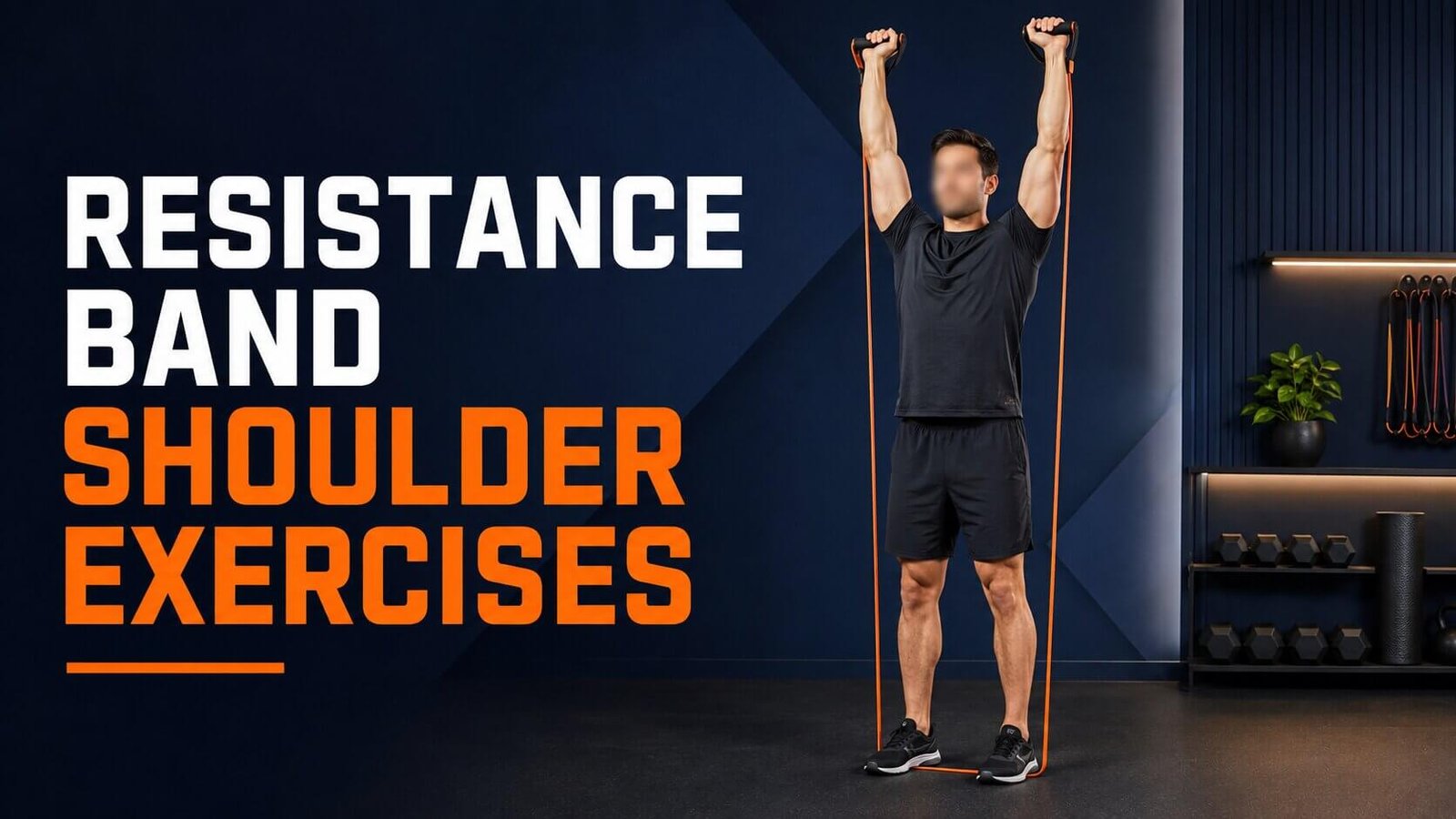
Resistance bands can train your front, side, and rear deltoids at home. A complete shoulder session needs only a press, a lateral-raise pattern, a rear-shoulder exercise, and an optional rotation or shoulder-blade movement. You do not need to perform every exercise in this guide at once.
Below are 10 resistance band shoulder exercises, a no-anchor beginner workout, and an anchored routine. You will also learn which band to use, how to progress when colors and resistance labels are inconsistent, and how to separate general shoulder training from rehabilitation.
Safety note: Inspect the band, handles, seams, and anchor before every session. Keep your face and other people outside the potential recoil path. Stop if you feel sharp, radiating, or worsening pain, numbness, sudden weakness, or joint instability. If you are recovering from a shoulder injury or surgery, follow the plan given by your clinician.
Resistance Band Shoulder Exercises at a Glance
Select four or five exercises for a workout. Use presses and raises as primary movements and rotations as lighter accessories.
| Exercise | Main emphasis | Band type | Anchor? | Role |
|---|---|---|---|---|
| Band shoulder press | Front and side deltoids, triceps | Long loop or handled tube | No | Primary |
| Single-arm lateral raise | Side deltoid | Long loop, tube, or therapy band | No | Primary |
| Band front raise | Front deltoid | Long loop or tube | No | Optional accessory |
| Bent-over band reverse fly | Rear deltoid and upper back | Long loop or tube | No | Primary or secondary |
| Band pull-apart | Rear deltoid and scapular muscles | Therapy band or light loop | No | Accessory |
| Anchored band face pull | Rear deltoid, upper back, external rotators | Tube or long loop | Yes | Secondary |
| Low-anchor band Y-raise | Deltoids and scapular muscles | Tube or therapy band | Yes | Accessory |
| No-anchor external rotation | Rotator cuff and rear shoulder | Therapy band or light loop | No | Conditioning accessory |
| Anchored external rotation | Infraspinatus, teres minor, rear deltoid | Therapy band or tube | Yes | Conditioning accessory |
| Anchored internal rotation | Subscapularis, chest, and shoulder | Therapy band or tube | Yes | Conditioning accessory |
Can Resistance Bands Build Stronger Shoulders?
Yes. Bands can provide enough resistance for shoulder strength and muscle development when sets require meaningful effort and the challenge increases over time.
A systematic review and meta-analysis found no clear difference between elastic and conventional resistance training for upper- or lower-body strength across the included studies. The research involved different populations and protocols, so it does not prove that every band movement equals every dumbbell or machine exercise. It does support elastic resistance as a legitimate training method.
The 2026 American College of Sports Medicine position stand also recognizes elastic-band and home-based resistance training as useful options. Its broad message is that consistent, progressive training matters more for most healthy adults than finding a complicated “perfect” method.
A light band may become too easy for pressing, while a heavy loop may be easy at the bottom and excessive near lockout. Several resistance levels make progression easier.
Shoulder Muscles Trained
The shoulder is not one muscle. A balanced routine trains the deltoids while also recognizing the smaller muscles that rotate and control the upper arm and shoulder blade.
Front, side, and rear deltoids
The anterior deltoid at the front of the shoulder helps raise the arm forward and contributes to pressing. The lateral deltoid helps raise the arm out to the side. The posterior deltoid moves the upper arm backward and assists horizontal abduction, as in a reverse fly.
You cannot isolate one region perfectly. A shoulder press primarily trains the front and side deltoids but also uses the triceps, upper chest, and supporting muscles. Reverse fly and face pulls involve the rear deltoids plus muscles of the upper back.
Rotator cuff
The rotator cuff consists of the supraspinatus, infraspinatus, teres minor, and subscapularis. Together, these muscles help rotate and control the upper arm in the shoulder socket. External- and internal-rotation exercises use light resistance because the purpose is controlled rotation, not moving the heaviest band available.
Shoulder-blade muscles
The trapezius, rhomboids, serratus anterior, and other muscles guide the scapula, or shoulder blade. Your shoulder blades should not remain forcibly “down and back” during every exercise. They normally rotate upward during an overhead press and move around the rib cage as your arms move.
Muscle Building vs. Shoulder Conditioning
Presses, lateral raises, front raises, and reverse flies are the main exercises for building the deltoids. Pull-aparts, Y-raises, face pulls, and rotation exercises provide additional work for the rear shoulder, upper back, rotator cuff, and scapular muscles.
This distinction prevents two common errors. The first is trying to build the shoulders with only very light external rotations. The second is treating a hard bodybuilding workout as rehabilitation for a painful joint.
The American Academy of Orthopaedic Surgeons includes elastic-band external and internal rotation in a general shoulder-conditioning program. [3] That supports these exercises as recognized strengthening options. It does not mean the same resistance, range, frequency, or exercise is suitable after every injury or operation.
If your goal is general strength or muscle development, perform your press and main raise first. Add one rear-shoulder exercise and, if useful, one light rotation exercise. If you have a diagnosed condition, use the exercise selection and dosage provided by your physical therapist or physician.
Choosing the Right Resistance Band
Long loops, handled tubes, and flat therapy bands can all train shoulders, but each suits different setups.
| Band type | Best uses | Main limitation |
|---|---|---|
| Long closed loop | Presses, lateral raises, reverse flies, no-anchor workouts | Thick loops may become too heavy near the top |
| Handled tube | Presses, raises, face pulls, anchored exercises | Handles, clips, and seams add possible failure points |
| Flat therapy band | Pull-aparts, external rotation, internal rotation, light raises | Gripping and durability can limit heavier pressing |
| Mini loop | Short-range shoulder activation around the wrists or forearms | Usually too short for full presses and standing raises |
Band colors are not standardized
“Red” or “medium” does not represent the same force across manufacturers. Laboratory measurements show that elastic-band tension changes with elongation, and published reference values apply to the products and conditions tested.
Record the band, grip, stance, anchor distance, and repetitions. These details are more repeatable than color alone.
How to select resistance
Choose a band that lets you reach the bottom of the target range with a smooth return and about 2–3 technically sound repetitions left. Use a lighter band for lateral raises and rotations than for shoulder presses.
It is too heavy if you lose position, shorten the range, bend your wrists, or rush the return. It is too light if you exceed the range with many reps left.
Why band exercises get harder near the top
Elastic resistance normally increases as the band stretches. A floor-anchored lateral raise therefore feels easier near your thigh and harder near shoulder height—an ascending resistance curve.
Bands do not provide equal tension throughout every rep. Slack creates little resistance. Begin with mild tension when possible without exceeding product instructions.
Five-Minute Shoulder Warm-Up
A warm-up lets you practice the movement and assess how your shoulders feel that day. It does not guarantee that an exercise will be pain-free or prevent every injury.
- Walk briskly or march for 60 seconds.
- Perform 8–10 small-to-large shoulder circles in each direction.
- Complete 8 wall slides within a comfortable range.
- Perform 10 very light band pull-aparts.
- Complete one easy practice set of your shoulder press and first raise.
Do not fatigue the rotator cuff with several hard warm-up sets. The last practice set should make you feel prepared, not weaker.
Beginner Resistance Band Shoulder Workout Without an Anchor
This routine uses a long loop, handled tube, or flat band without attaching it to a wall or door. It trains the deltoids and finishes with light external rotation.
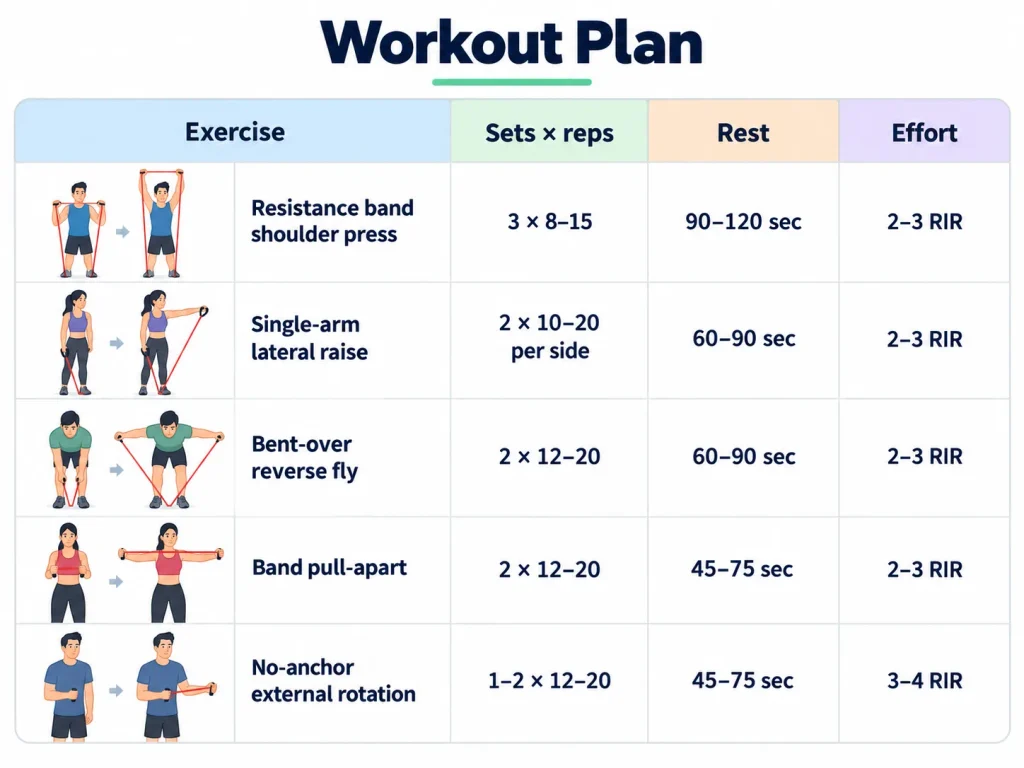
RIR means repetitions in reserve. If you finish 12 reps and estimate that you could complete two more without changing form, the set was about 2 RIR.
Start with one external-rotation set. The complete routine then contains 10 working sets and takes about 20–30 minutes. Perform it once weekly at first. Add a second weekly session only if your shoulders recover and performance remains stable.
If you already do challenging push-ups, chest presses, or other overhead pressing, reduce the shoulder-press volume or omit it from one session. Your front deltoids and triceps are already working during those exercises.
10 Resistance Band Shoulder Exercises
1. Resistance Band Shoulder Press
The band shoulder press is the primary compound exercise. It emphasizes the front and side deltoids while the triceps and upper chest assist.
How to do it:
- Stand in the middle of a long loop or handled tube with your feet about hip-width apart.
- Bring your hands to shoulder height with the band behind your forearms, if the product permits that setup.
- Brace gently and keep your ribs stacked over your pelvis.
- Press upward and slightly inward through a comfortable path.
- Allow your shoulder blades to rotate naturally as your arms rise.
- Lower your hands slowly to shoulder height.
Avoid leaning backward, turning the movement into a push press, or forcing your hands behind your head. If the band becomes excessively heavy at the top, use one foot, a lighter band, or a single-arm version. Progress with reps, greater starting tension within product limits, or a stronger band.
2. Single-Arm Resistance Band Lateral Raise
The lateral raise directly trains the side deltoid. A unilateral setup makes it easier to adjust tension and prevents a strong side from hiding a weaker one.
How to do it:
- Secure one end of the band under your foot and hold the other end in the same-side hand.
- Stand tall with a slight elbow bend and your hand near your thigh.
- Raise your arm out and slightly forward rather than directly sideways.
- Lead with the elbow while keeping the hand and forearm aligned.
- Stop around shoulder height or earlier if that is your comfortable range.
- Lower under control, complete the set, and switch sides.
Do not rotate your thumb sharply toward the floor, shrug, or lean away to gain range. Start with the weaker side and match its repetitions. To progress a light band, stand on more of it or pause near the top.
3. Resistance Band Front Raise
The front raise isolates shoulder flexion and emphasizes the anterior deltoid. It is optional because presses, push-ups, and chest exercises already train this region.
How to do it:
- Stand on the band and hold the ends in front of your thighs.
- Keep a small, fixed bend in your elbows.
- Raise your hands forward to about shoulder height.
- Pause briefly, then lower without allowing the band to snap back.
Avoid rocking backward or lifting higher simply to create a larger movement. Use one arm if the band is too light. Omit this exercise when front-shoulder work already dominates your weekly program.
4. Bent-Over Resistance Band Reverse Fly
The reverse fly trains the rear deltoids with help from the middle trapezius, rhomboids, and other upper-back muscles.
How to do it:
- Stand in the middle of a long band and hold the opposite ends so the band crosses in front of your legs.
- Hinge at your hips, soften your knees, and keep your spine long.
- With slightly bent elbows, raise your arms outward.
- Stop when your upper arms are roughly level with your torso or at your controlled limit.
- Lower slowly until the band retains mild tension.
Keep the torso still and avoid shrugging or turning it into an upright row. Use a lighter band, stand more upright, or reduce the range to make it easier. Add a short pause to make a light band harder.
5. Resistance Band Pull-Apart
Pull-aparts train the rear shoulders and scapular retractors without an anchor. They work well as an accessory, warm-up, or short movement break, but they are not a complete shoulder program.
How to do it:
- Hold a light band in front of you near shoulder height.
- Keep your elbows soft and wrists neutral.
- Pull your hands apart as your upper arms move outward.
- Stop before your shoulders roll forward or your ribs flare.
- Return slowly until your hands are close but the band remains controlled.
Choose a grip wide enough to complete the range without straining. Gripping closer makes the same band harder; gripping wider makes it easier. Do not repeatedly overstretch a short band to force it to your chest.
6. Anchored Resistance Band Face Pull
The face pull trains the rear deltoids and upper back. Adding comfortable external rotation can involve the posterior rotator-cuff muscles, but the movement should remain light and controlled.
How to do it:
- Attach a tube or loop to a manufacturer-approved anchor near the face or upper-chest height.
- Face the anchor and step back until the band has mild starting tension.
- Pull toward your face with your elbows moving outward.
- Finish with your hands beside your face and your upper arms in a comfortable position.
- Return slowly without letting the band pull your shoulders forward.
Avoid leaning, jerking, or forcing high elbows. Regress by stepping closer or using less resistance; progress with reps, distance, or a finish pause.
7. Low-Anchor Resistance Band Y-Raise
The Y-raise uses light resistance to train upward arm movement and shoulder-blade control. It is an accessory, not a heavy overhead press.
How to do it:
- Attach two band ends or handles to a secure low anchor behind you.
- Face away from the anchor with one handle in each hand.
- Begin with your hands near your hips and thumbs pointing mostly forward or up.
- Raise your arms diagonally so your body and arms form a Y.
- Stop within a comfortable overhead range, then return slowly.
Use a very light band. Avoid back arching, aggressive shrugging, or forced range. Substitute wall slides if the setup feels awkward.
8. No-Anchor Band External Rotation
This bilateral exercise trains external rotation with a light band and no fixed anchor. It is useful for controlled shoulder conditioning but should not replace presses and raises.
How to do it:
- Hold a flat band with both palms facing up or toward each other.
- Bend your elbows to about 90 degrees and keep them near your sides.
- Gently move both hands apart while your elbows remain relatively still.
- Stop before your wrists bend or shoulders roll backward.
- Return slowly to the start.
Use light resistance and a manageable range. Move the forearms rather than turning them into a pull-apart; add control and reps before tension.
9. Anchored External Rotation at the Side
Anchored external rotation trains the infraspinatus and teres minor, with assistance from the posterior deltoid. The elbow stays near the torso while the forearm rotates outward.
How to do it:
- Set a secure anchor around elbow height and stand sideways to it.
- Hold the band in the hand farthest from the anchor.
- Bend the elbow to 90 degrees and place a small rolled towel between the elbow and ribs if helpful.
- Rotate the forearm away from your abdomen without twisting your torso.
- Pause briefly and return under control.
Reduce resistance or range if the elbow drifts or torso rotates. Follow a clinician-prescribed setup after injury or surgery.
10. Anchored Internal Rotation at the Side
Internal rotation trains the subscapularis with assistance from the chest and other shoulder muscles. Like external rotation, it should be smooth and relatively light.
How to do it:
- Stand sideways with the working arm closest to an elbow-height anchor.
- Hold the band with the elbow bent and close to your side.
- Begin with the forearm angled away from your abdomen.
- Rotate the forearm inward across the front of your body.
- Return slowly without letting the band pull your arm back.
Avoid torso twisting or painful elbow pressure. Use light resistance; internal rotation is optional and may be prescribed differently in rehabilitation.
Anchored Resistance Band Shoulder Workout
This workout uses a secure high, low, or elbow-height anchor as required. It balances deltoid work with rear-shoulder and rotation accessories.
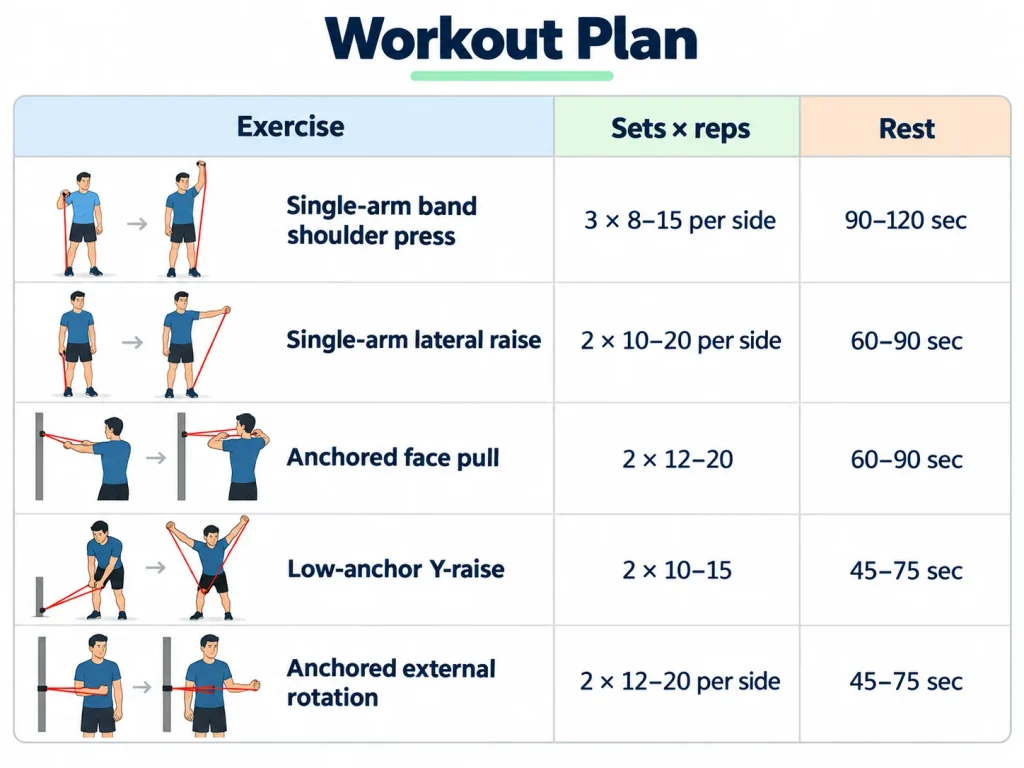
Stand on the band for presses and reposition the anchor as needed. Test every setup with minimal tension and use straight sets.
Beginners can omit the Y-raise or use one rotation set. Favor repeatable work over an exhausting, constantly changing circuit.
Sets, Repetitions, Rest, and Frequency
Most healthy beginners can train shoulders once or twice weekly. Begin with about 6–10 direct working sets in a session, including presses and raises, then adjust according to recovery and other upper-body training.
Use these practical starting ranges:
- Shoulder presses: 2–3 sets of 8–15 reps
- Lateral, front, and reverse raises: 2–3 sets of 10–20 reps
- Pull-aparts, face pulls, and Y-raises: 1–3 sets of 12–20 reps
- External and internal rotation: 1–2 light sets of 12–20 reps
- Rest: 90–120 seconds for presses and 45–90 seconds for accessories
- Effort: about 2–3 clean reps in reserve for most work; keep more in reserve on unfamiliar rotations
These are starting points, not medical prescriptions. Effort matters: 18 challenging reps can be useful, while 12 effortless reps may not be.
Count indirect shoulder work
Push-ups and presses train the front deltoids; rows involve the rear deltoids. Count this overlap before adding volume.
Leave at least one recovery day between hard sessions. Reduce sets or intensity if performance falls, joint symptoms rise, or soreness disrupts normal movement.
How to Progress Resistance Band Shoulder Exercises
Progressive overload means raising the challenge while preserving range and control. Since bands show no precise working weight, standardize and record the setup.
Double-progression example
Suppose you perform three sets of band shoulder presses in an 8–15-rep range:
| Session | Set 1 | Set 2 | Set 3 | Decision |
|---|---|---|---|---|
| 1 | 11 | 10 | 9 | Keep the setup |
| 2 | 12 | 11 | 10 | Keep the setup |
| 3 | 14 | 13 | 12 | Keep the setup |
| 4 | 15 | 15 | 15 | Increase resistance |
| 5 | 10 | 9 | 8 | Build up again |
At the top of the range, strengthen the band or safely increase starting tension, then return to fewer reps.
Ways to progress without a stronger band
- Add repetitions within the target range.
- Shorten the working length by changing your grip or stance when allowed by the manufacturer.
- Step slightly farther from a secure anchor.
- Use one arm instead of two.
- Add a one-second pause near the hardest point.
- Lower or return for two to three seconds.
- Add one set after performance and recovery are consistent.
Change and record one variable at a time; combining distance, length, tempo, and rest changes hides what produced progress.
Modifications for Limited Overhead Comfort
Overhead pressing is useful but not mandatory. If the movement feels restricted or uncomfortable, first reduce the tension and range rather than forcing your hands to a predetermined position.
Try these options:
- Press one arm at a time so each shoulder can follow its own path.
- Use a split stance and lighter band to reduce compensatory back extension.
- Stop just before the uncomfortable portion instead of forcing a lockout.
- Replace the press with a pain-free lateral raise or scaption-style raise.
- Perform more rear-shoulder work while seeking professional guidance for persistent symptoms.
Do not assume every clicking sound means injury, but do not ignore painful clicking, weakness, instability, or worsening symptoms. A generic band routine cannot diagnose the cause.
Common Resistance Band Shoulder Workout Mistakes
Doing every exercise in one workout
Ten exercises are redundant. Choose one press, one lateral raise, one rear-shoulder movement, and one conditioning accessory.
Using the same band for every movement
A pressing band may be too heavy for raises and rotations. Select resistance for each exercise.
Beginning with too much slack
Slack removes starting resistance. Adjust stance, grip, or anchor distance when the product permits.
Overstretching the band
Excessive stretch can make the top uncontrollable and exceed product limits. Use a longer or lighter band.
Shrugging through every raise
Aggressive shrugging and elbow bending change the raise. Reduce resistance and control the range.
Forcing the shoulder blades down and back
The scapula rotates upward during pressing. Control your torso without rigidly pinning the shoulder blade.
Treating a burn as proof of effectiveness
A burn is not proof of progress. Track controlled reps, tension, range, and performance.
Calling every band exercise rehabilitation
Conditioning is not rehabilitation. Painful or postoperative shoulders may require individually selected loads, ranges, and exercises.
Resistance Band and Anchor Safety
Elastic equipment stores energy while stretched. If a band, handle, or anchor fails, it can recoil quickly.
- Inspect the entire band for tears, cracks, thinning, discoloration, damaged seams, and loose handles.
- Replace damaged bands instead of attempting a temporary repair.
- Follow the manufacturer’s limits for stretching, knotting, anchoring, and outdoor use.
- Use a purpose-built door, wall, or rack anchor rated for the band when available.
- Confirm that the door, frame, post, or rack is stable and cannot open, tip, or slide.
- Test every new anchor with light tension before assuming your exercise position.
- Stand so a failure would not send the band toward your eyes or another person.
- Keep children and pets outside the training area.
- Control the return and remove tension before releasing the band.
- Avoid wrapping a high-tension band around your hand if it could tighten or restrict circulation.
Stop training if you experience sharp, radiating, or worsening pain, numbness, sudden weakness, swelling, or instability. Persistent or recurring symptoms should be assessed by an appropriate healthcare professional.
Frequently Asked Questions
Can resistance bands build shoulder muscle?
Yes. Use challenging sets, sufficient effort, and progressive resistance. Several band strengths make progression easier.
What are the best resistance band exercises for shoulders?
A shoulder press, lateral raise, and reverse fly cover the main deltoid regions. Add a pull-apart, face pull, or rotation if useful.
Can I do a band shoulder workout without an anchor?
Yes. Presses, raises, reverse flies, pull-aparts, and bilateral external rotations need no fixed anchor.
Which type of resistance band should I use?
Use long loops or tubes for presses and raises, and therapy bands for pull-aparts and rotations. Mini loops are usually too short.
How many shoulder exercises should I perform?
Three to five are enough: a press, lateral raise, rear-shoulder exercise, and optional rotation or scapular movement.
How many sets and repetitions should I do?
Begin with 2–3 sets of 8–15 for presses, 10–20 for raises, and 1–2 light sets of 12–20 for rotations.
How often should I train shoulders with bands?
Start once or twice weekly, leave a recovery day, and account for presses, push-ups, and rows.
Are band pull-aparts enough for shoulders?
No. They train the rear shoulder and upper back but do not replace presses and lateral raises.
Are resistance bands good for the rotator cuff?
They suit controlled internal and external rotation, but a generic exercise is not an individualized rehabilitation plan.
Can I perform band shoulder exercises every day?
Hard shoulder training need not be daily. Start once or twice weekly with recovery between demanding sessions.
Why do band exercises feel harder near the top?
Tension rises as the band stretches. Starting length, stance, and anchor distance change that rise.
Should I use bands when my shoulder hurts?
Do not treat unexplained pain with a generic workout. Stop painful movements and seek assessment for persistent, recurring, or function-limiting symptoms.
Build a Repeatable Four-Movement Routine
Start with a band shoulder press, single-arm lateral raise, reverse fly, and pull-apart. Use the no-anchor workout if you train while traveling or lack a secure attachment point. Choose the anchored workout when you can safely add face pulls, Y-raises, and rotation work.
Record the band, setup, sets, reps, and estimated RIR. Progress one variable at a time and keep the movements comfortable and controlled. A short routine repeated consistently will outperform a complicated circuit that cannot be measured.
For a complete plan, combine this article with an upper-body resistance band workout or how to build muscle with resistance bands at home. Use how to anchor resistance bands at home before trying new attachment points.
You can also explore resistance band back exercises, resistance band bicep exercises at home, and resistance band leg exercises. For equipment-free and dumbbell alternatives, see how to build shoulder muscles at home.