
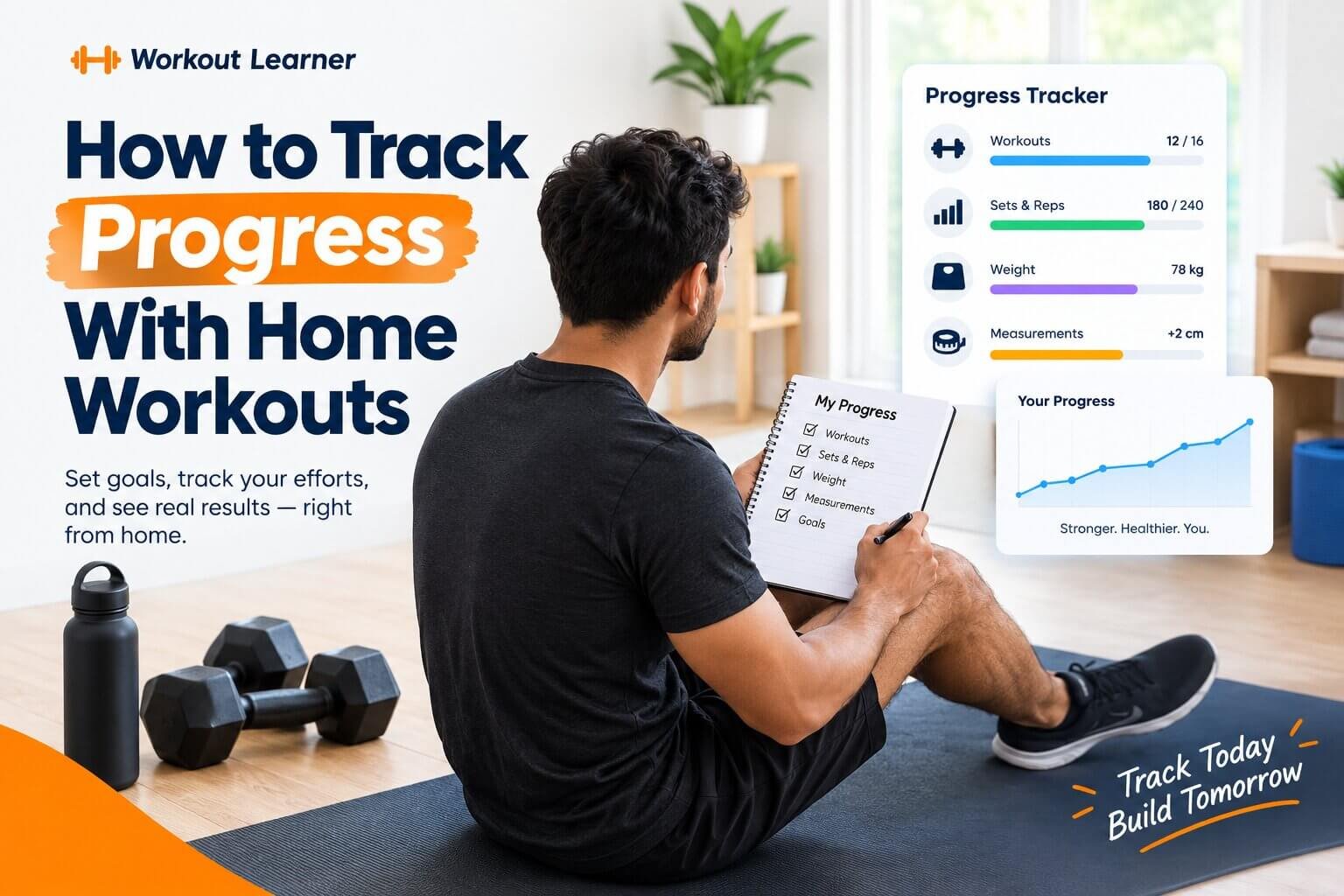
To track progress with home workouts, record what you did, compare the same exercises under similar conditions, and review the trend every few weeks. The most useful signs of improvement are more controlled repetitions, greater resistance, harder exercise variations, better technique, improved endurance, and greater consistency.
You do not need a gym, smartwatch, or complicated app. A notebook, phone note, calendar, or spreadsheet can provide enough fitness tracking data. The key is to measure a few things that match your goal and use the same standards each time.
Why track home workout progress?
Workout progress tracking shows whether your routine is creating a useful challenge and whether you are following it consistently. Without a record, it is easy to overlook small improvements or repeat the same workload long after it stops being challenging.
Tracking also makes home training easier to adjust. If your exercise tracker shows that you reached the top of your repetition range with good form, you may be ready to add resistance or choose a harder variation. If performance falls while sleep, energy, and joint comfort also worsen, you may need more recovery or a less demanding week.
Home training is a legitimate way to improve fitness. The American College of Sports Medicine’s 2026 resistance training guidance states that elastic bands, bodyweight exercises, and home-based routines can improve strength, muscle growth, and physical function. It also emphasizes that consistent participation matters more for most healthy adults than a complicated program (ACSM, 2026).
Establish a baseline before judging results.
A baseline is your starting measurement. Complete one normal week of training and record your main exercises, workout schedule, performance, and recovery without trying to set a personal record in every session.
Choose three to six repeatable indicators that match your goal. For example:
- Pushup repetitions with the same variation
- Squat repetitions with the same backpack load
- Resistance band row repetitions using the same band setup
- Number of planned workouts completed
- Distance covered during a 20-minute walk
- Comfortable range of motion in a consistent mobility drill
Write down the test conditions. The same movement can become much easier or harder when you change the band length, anchor point, tempo, range of motion, rest period, or exercise order. Consistent conditions make comparisons more meaningful.
Avoid testing an all-out one-repetition maximum at home, especially when you are new to strength training or do not have suitable equipment and supervision. Repetition-based benchmarks with controlled technique are usually safer and more practical for beginners.
What should you track during home workouts?
For most strength sessions, record six things: exercise variation, resistance, working sets, repetitions, effort, and technique. Add duration or distance for cardio and a short recovery note when it may help explain performance.
1. The exact exercise variation
Record the specific version of each exercise, not just the muscle group. “Pushup” is more informative than “chest,” while “feet-elevated pushup” is more precise than “pushup.”
Examples include:
- Knee pushup
- Standard pushup
- Feet-elevated pushup
- Bodyweight squat
- Backpack squat
- Light band row
- Heavy band row
- Assisted split squat
The variation matters because 12 standard pushups represent a different demand from 12 knee pushups.
2. Sets and repetitions
Record the repetitions completed in every working set. Writing only the best set hides fatigue across the rest of the exercise.
| Date | Exercise | Resistance | Reps by set | Effort |
|---|---|---|---|---|
| Aug. 3 | Standard pushup | Body weight | 10, 9, 2008 | 2 RIR |
| Aug. 10 | Standard pushup | Body weight | 12, 10, 2009 | 2 RIR |
| Aug. 17 | Standard pushup | Body weight | 12, 12, 10 | 1–2 RIR |
This record shows measurable strength and endurance progress even if visible physical changes are not obvious.
3. Resistance and equipment setup
Record dumbbell weight, backpack load, or the resistance band setup. Band color alone may be unreliable because color systems differ between manufacturers.
For resistance band workouts, note:
- Brand or labeled resistance, if available
- Band thickness or color
- Number of bands combined
- Anchor position
- Distance from the anchor
- Whether you shortened or doubled the band
For a backpack exercise, record the approximate total load or list the items inside. Consistency matters more than laboratory-level precision.
4. Effort
An effort rating helps show whether the same repetitions are becoming easier. One practical method is repetitions in reserve, or RIR: the approximate number of controlled repetitions you believe you could have completed when the set ended.
- 3 RIR: About three good repetitions remained
- 2 RIR: About two remained
- 1 RIR: About one remained
- 0 RIR: No additional controlled repetition seemed possible
RIR is an estimate, not a perfect measurement. A small study found it reliable for prescribing load in novice young men, but its narrow sample means the result should not be generalized to everyone (Lovegrove et al., 2022). Beginners often become better at judging effort with practice.
You do not need to take every set to complete muscular failure. Current ACSM guidance reports that failure training is not consistently necessary for the average healthy adult (ACSM, 2026).
5. Range of motion and technique
Better movement quality counts as progress, even when the repetition number stays the same. Useful technique markers include:
- A deeper, controlled squat
- A more stable lunge
- Straighter alignment during pushups
- Better shoulder blade control during rows
- Less swinging during curls
- A slower, controlled lowering phase
- Improved balance during single-leg movements
Short technique notes are often enough: “heels stayed down,” “full elbow extension,” or “last two reps lost control.” If possible, occasionally record a short video from a consistent angle for your own technique review. Stop if a movement causes sharp pain, dizziness, chest discomfort, or unusual shortness of breath.
6. Rest intervals and workout duration
Record rest time when it affects your comparison. Completing the same work with less rest can reflect better work capacity, but reducing rest should not come at the expense of form or the quality of the next set.
Total workout time can show improved efficiency, although a shorter session is not automatically better. More warmup time, longer rests for demanding strength work, or added exercises can make a productive session longer.
7. Consistency
Track planned and completed sessions on a weekly exercise calendar. Consistency is both a progress marker and the foundation that allows other improvements to occur.
Use this simple calculation:
Workout completion rate = completed sessions ÷ planned sessions × 100
If you planned three workouts and completed two, your completion rate was about 67%. Treat this as neutral information, not a grade. The purpose is to make next week’s plan more realistic.
Self-monitoring and goal setting are common behavior-change tools, and interventions using consumer activity trackers can produce modest increases in physical activity. However, the results vary among people and programs, so a device or journal should support a workable routine rather than become another burden (Ferguson et al., 2022).
8. Recovery
Record a short recovery check because training performance depends partly on your readiness that day. A one-to-five scale is enough.
| Indicator | Example rating |
|---|---|
| Energy | 4/5 |
| Sleep quality | 3/5 |
| Muscle soreness | 2/5 |
| Joint comfort | 5/5 |
| Motivation | 4/5 |
Do not interpret normal, temporary tiredness as a diagnosis. Look for repeated patterns. Persistent pain, worsening joint discomfort, faintness, or symptoms that concern you warrant stopping the exercise and seeking guidance from a qualified health professional.
How to track strength progress without heavier weights
You can track progressive overload at home by increasing the challenge in measurable ways. Heavier resistance is one option, but it is not the only one.
Progress may look like:
- More controlled repetitions at the same resistance
- More working sets, when appropriate
- A stronger resistance band
- A heavier dumbbell or backpack
- A harder exercise variation
- A larger controlled range of motion
- Less assistance
- A longer pause in the difficult position
- Better control at the same tempo
- The same work at a lower perceived effort
Change one main variable at a time when possible. If you add reps, shorten rest, change the variation, and slow the tempo in the same session, you will not know which change caused the performance difference.
A simple progression method
Use a repetition range, such as 8–12 controlled reps:
- Select a resistance or variation that allows you to complete the lower end of the range with good form.
- Keep the setup consistent and gradually add repetitions.
- When you can reach the top of the range across your planned sets with good control and the intended effort, make the exercise slightly harder.
- Your repetitions may drop toward the lower end of the range. Build them up again.
Example:
| Week | Band row setup | Reps | Next decision |
|---|---|---|---|
| 1 | Medium band | 10, 9, 2008 | Keep setup. |
| 2 | Medium band | 11, 10, 2009 | Keep setup. |
| 3 | Medium band | 12, 12, 11 | Keep setup. |
| 4 | Medium band | 12, 12, 12 | Try a slightly harder setup. |
| 5 | Heavy band | 9, 8, 2008 | Build reps again. |
This is a practical way to track strength gains without testing maximum loads.
Choose progress markers that match your goal.
The best ways to measure home workout results depend on what the program is meant to improve. Do not expect one metric to represent strength, endurance, mobility, health, and consistency at the same time.
| Goal | Primary progress markers | Useful supporting markers |
|---|---|---|
| Strength or muscle development | Resistance, reps, working sets, exercise variation | RIR, range of motion, technique |
| Muscular endurance | Reps at the same resistance, total controlled work | Rest needed; technique late in the set |
| Cardiovascular fitness | Time, distance, pace, circuit rounds | Heart rate, recovery, effort |
| Mobility or flexibility | Comfortable range of motion, control | Left-to-right differences, ease in daily movement |
| General fitness | Completed sessions, weekly activity, and strength and endurance benchmarks | Energy, confidence, everyday function |
Strength and muscular endurance
Compare the same exercise at the same resistance and technique standard. More controlled reps, a harder variation, or the same performance at a lower effort can signal improvement.
Cardiovascular fitness
Use repeatable tests that do not require specialized equipment:
- Distance covered during a fixed-time walk
- Time needed to complete a familiar, safe route
- Number of controlled rounds in a fixed-time circuit
- Pace at a similar perceived effort
- How quickly breathing returns toward normal after the same session
Do not turn every cardio workout into a maximum test. Use normal training data and repeat a chosen benchmark every four to six weeks.
For context, US guidelines recommend that adults work toward 150–300 minutes of moderate aerobic activity per week plus muscle-strengthening activity at least two days per week. Youth ages 6–17 have a different guideline: at least 60 minutes of moderate-to-vigorous activity daily, with age-appropriate muscle and bone strengthening activity included during the week (US Department of Health and Human Services). These are public health targets, not requirements for judging one workout.
Mobility, balance, and movement quality
Choose a consistent movement screen that is relevant to your goal; record comfortable range of motion, stability, and whether the movement is pain-free. Use the same warm-up, stance, surface, and measuring method each time.
More range is not always better. Control and comfortable function matter more than forcing a position.
Optional ways to track body-related changes
Body weight, measurements, clothing fit, and progress photos can provide additional information, but none can show the full effect of a workout program. They are optional and should not replace performance, health, recovery, and skill-based measures.
Body weight
One scale reading is difficult to interpret because body weight can change with hydration, food in the digestive system, stored carbohydrate, and other short-term factors. Research examining short-term weight fluctuation found that much of the change can come from fat-free mass, particularly body water (Bhutani et al., 2017).
Adults who choose to track weight should compare longer-term trends under reasonably similar conditions rather than reacting to a single reading. Anyone who finds weighing stressful or compulsive can skip it.
Body measurements
Optional measurements may include waist, upper arm, chest, hip, or thigh circumference. Use the same tape position, posture, and conditions each time. Every four to six weeks is usually more informative than checking repeatedly within the same week.
Progress photos
Photos are not necessary. If an adult chooses to use them, consistent lighting, clothing, posture, camera distance, and time of day make comparisons less misleading.
For children and teens, progress is better centered on strength, movement skill, energy, confidence, enjoyment, and regular participation, not frequent body checking or appearance comparison.
Do you need a fitness tracker or workout app?
No. A paper workout journal, phone note, spreadsheet, or calendar can track home workout progress effectively. Choose the simplest system you will use consistently.
| Tool | Best for | Main limitation |
|---|---|---|
| Paper journal | Fast notes without screen distraction | Harder to graph or search |
| Phone notes | Simple, portable workout log | Requires manual organization |
| Spreadsheet | Custom tables, totals, and trends | Takes time to set up |
| Workout app | Exercise history, timers, templates | Features and cost vary. |
| Smartwatch or wearable | Steps, heart rate, time, distance | Some estimates are inaccurate. |
| Calendar or habit tracker | Consistency and schedule | Limited performance detail |
Commercial wearables can be useful, but they are not equally accurate for every metric. A systematic review found that measurement validity varied by device and activity; no brand was consistently accurate for energy expenditure, while step count and heart rate generally performed better in certain settings (Fuller et al., 2020). Treat “calories burned” as a rough estimate, not an exact workout result.
If you change devices, be cautious when comparing the old and new data. Differences may reflect the device rather than a fitness change.
A simple home workout log template
A useful workout log should take less than a minute to update between exercises or immediately after the session. Start with the minimum information needed to make your next workout decision.

Add this short session summary:
- Workout duration:
- Planned session completed: Yes / Partly / No
- Energy: 1–5
- Joint comfort: 1–5
- Main improvement:
- Adjustment for next time:
For walking or circuit training, replace sets and reps with time, distance, pace, or rounds.
How often should you measure fitness progress?
Record workout details during every session, review consistency and recovery each week, and assess broader trends every four to six weeks. This schedule provides useful feedback without encouraging constant testing.
After every workout
Record:
- Exercise and variation
- Resistance or setup
- Reps for each working set
- Effort
- Relevant technique notes
- Time, distance, pace, or rounds when applicable
Every week
Review:
- Planned versus completed sessions
- Strength or endurance improvements
- Exercises that may need adjustment
- Recovery patterns
- Any persistent discomfort
- Next week’s realistic schedule
Every four to six weeks
Review:
- Performance in your chosen benchmarks
- Exercise progression
- Cardio or muscular endurance
- Movement quality and mobility
- Optional adult body measurements
- Whether the schedule remains sustainable
Avoid rewriting the entire program after one disappointing workout. Performance naturally changes with sleep, stress, recovery, illness, and the order of exercises. A trend across several comparable sessions is more informative.
How do you know if your home workout is working?
Your home workout is likely working when at least one relevant measure improves over several weeks while technique and recovery remain acceptable. Visible appearance change is not required for a program to improve fitness.
Signs your workout is working include:
- More repetitions with the same resistance and form
- A stronger band, heavier load, or harder variation
- Better control or range of motion
- The same workout feels easier
- More distance or rounds at a similar effort
- Better exercise consistency
- Improved confidence and movement skill
- Everyday tasks feel easier
The reverse is not automatically failure. A single low-performance day may reflect poor sleep, stress, a different setup, or normal variation.
What to do when home workout progress stalls
First, confirm that the plateau is real by comparing several sessions performed under similar conditions. Then check consistency, exercise setup, effort, recovery, and whether the exercise still matches your goal.
Use this order:
- Check the record. Have reps, resistance, or technique truly stayed unchanged for several comparable sessions?
- Confirm consistency. A program cannot be evaluated fairly if planned sessions are often missed.
- Standardize the setup. Check band length, anchor position, exercise order, rest, tempo, and range of motion.
- Review effort. If every set ends with many easy reps left, a small progression may be appropriate.
- Review recovery. Repeated fatigue, poor sleep, soreness, or discomfort can suppress performance.
- Make one adjustment. Add a small amount of resistance, choose a slightly harder variation, change the rep target, or reduce excess work.
- Allow time. Follow the adjusted plan long enough to establish a trend.
More work is not always the solution. If pain persists, technique breaks down, or a medical condition affects exercise tolerance, seek advice from an appropriate health or exercise professional.
Common workout progress tracking mistakes
Tracking only body weight
Scale weight cannot tell you whether strength, endurance, technique, mobility, or work capacity improved. Use goal-specific performance measures first.
Recording only the best set
Your first set may improve while later sets decline. Record every working set to understand the full session.
Changing exercises too frequently
Constant variation makes comparisons difficult. Keep several core movements consistent long enough to follow a trend, while changing an exercise when safety, comfort, equipment, or goals require it.
Counting poor-quality repetitions
Extra reps gained through a shorter range of motion or loss of control are not directly comparable with earlier controlled reps.
Failing to record the band setup
Changing anchor distance or band length changes resistance. Record enough detail to reproduce the setup.
Treating wearable calorie estimates as exact
Wearable energy expenditure estimates have meaningful error. Use time, distance, steps, pace, and performance trends when those measures fit your goal.
Testing too often
Frequent maximum-effort tests create fatigue and can distract from training. Collect normal workout data and repeat submaximal benchmarks periodically.
Overreacting to one workout
Progress is not linear. Look for a pattern across multiple comparable sessions.
Tracking too many metrics
A complex fitness journal often becomes unsustainable. Begin with three to six useful measures and add another only if it changes a decision.
Practical recommendations for beginners
Use this simple four-step system:
- Choose one primary goal: strength, endurance, mobility, consistency, or general fitness.
- Select three to six indicators. For strength, that might be exercise variation, resistance, reps, RIR, technique, and completed sessions.
- Log each workout. Keep the entry short and consistent.
- Review every four weeks. Keep what works and make one clear adjustment where needed.
A good tracking system answers three questions:
- What did I do?
- Is performance, skill, or consistency improving?
- What is the smallest sensible change for the next session?
If your system cannot answer those questions, simplify it or replace irrelevant metrics.
Frequently asked questions
What should I record in a workout log?
Record the date, exact exercise variation, resistance or equipment setup, repetitions for every working set, effort, and useful technique notes. Add time, distance, pace, or rounds for cardio workouts.
How do I track progressive overload at home?
Track increases in controlled reps, resistance, working sets, range of motion, exercise difficulty, pauses, and movement control. Change one main variable at a time so the improvement remains clear.
How can I track strength without heavier weights?
Use repeatable submaximal benchmarks. More controlled reps with the same setup, a harder bodyweight variation, less assistance, greater range of motion, or the same performance at lower effort can all show strength progress.
How often should I review my workout log?
Review it each week and perform a broader assessment every four to six weeks. One session rarely provides enough evidence to change an entire program.
Should I use body weight to track workout results?
Body weight is optional and does not measure fitness by itself. Adults who choose to track it should focus on longer-term trends under similar conditions and combine it with performance and health measures.
How often should I take progress pictures?
Progress pictures are optional and are not necessary for tracking fitness. Adults who use them can compare images every four to six weeks under consistent conditions. Younger people should prioritize performance, skill, energy, and enjoyment instead of appearance monitoring.
How can I measure endurance improvement at home?
Compare distance, pace, workout duration, circuit rounds, recovery, or perceived effort under similar conditions. Completing the same session with better control or a lower effort can indicate improved endurance.
Is a spreadsheet better than a fitness app?
Neither is automatically better. A spreadsheet provides customization, while an app may offer templates and automatic graphs. The best exercise tracker is the simplest one that records the information you need consistently.
Are smartwatch calorie estimates accurate?
They are estimates, not precise measurements. Research shows that consumer wearables vary in accuracy and are generally less reliable for energy expenditure than for some measures such as steps or heart rate.
Why am I not seeing visible workout results?
Visible change may occur on a different timeline from strength, endurance, technique, and health improvements. Check whether your performance, consistency, and recovery trends are improving before assuming the program is ineffective.
What should I do after missing several workouts?
Resume with a manageable session rather than trying to “make up” every missed workout at once. Record what interrupted the schedule, make the next week more realistic, and rebuild consistency gradually.
Conclusion
Learning how to track progress with home workouts does not require sophisticated equipment. Record a few goal-specific measures, compare the same movements under similar conditions, and look for trends across several weeks.
Start with exercise variation, resistance, sets, reps, effort, technique, consistency, and recovery. Those measures show whether you are doing more useful work, moving better, and following the plan. Optional tools such as wearables, body measurements, and photos can add context, but they should not control the evaluation.
Next step: Copy the workout log template above and use it for your next four weeks of training. At the end of that period, identify one clear improvement and one small adjustment for the following month.