Affiliate Disclosure: This article may contain Amazon affiliate links. If you purchase through one of these links, we may earn a commission at no additional cost to you.
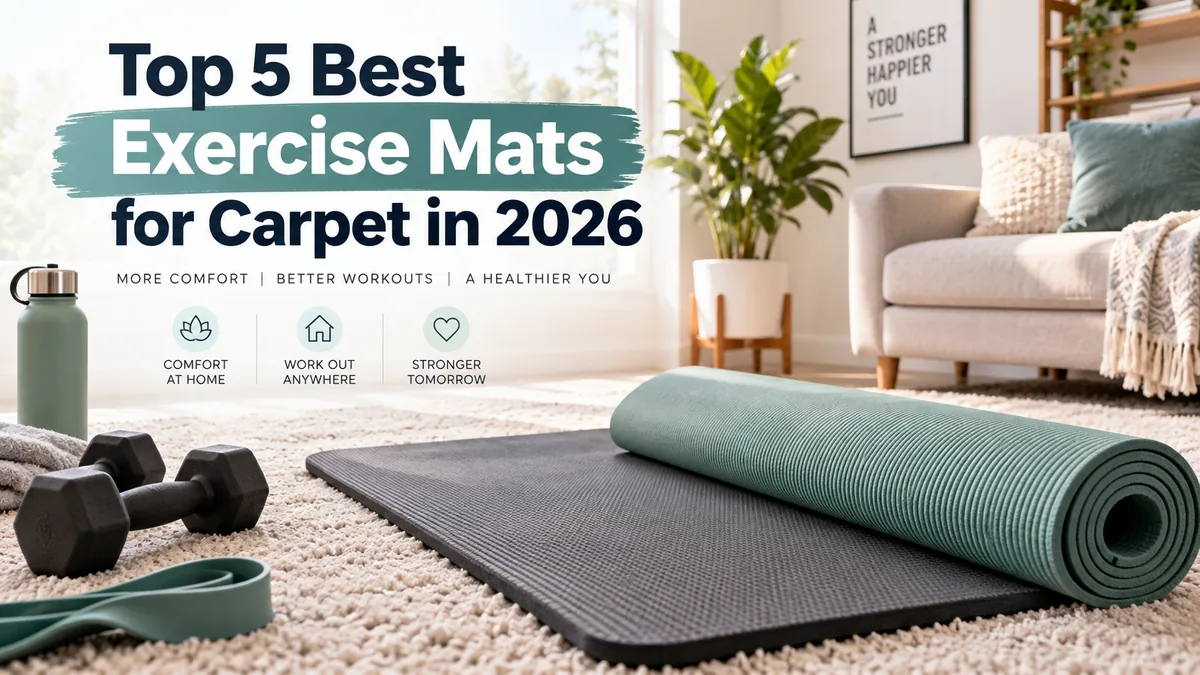
Carpet changes what you should look for in an exercise mat.
On hardwood or tile, mat grip is mostly about friction against a firm surface. Carpet introduces another moving layer underneath you. The fibers and padding can compress when you push through your hands or feet, which can make a lightweight mat creep, wrinkle, or feel unstable.
For most full-body workouts on carpet, the Gorilla Mats Premium Large Exercise Mat 6′ × 4′ is the strongest overall option in this lineup. Its large 24-square-foot surface, high-density 1/4-inch construction, and patterned underside make it much better suited to burpees, lunges, strength circuits, and general home workouts than a narrow yoga mat. Gorilla Mats also specifically references protecting carpet and other household floors.
The best mat changes with your training, though. The AIREX Pilates 190 is particularly strong for Pilates and controlled floor work, with independent testing reporting stable performance on carpet as well as hard flooring. The Hugger Mugger Para Rubber Mat is heavier and denser than typical foam yoga mats, which makes it a better candidate when lightweight mats tend to bunch. The Manduka PRO Travel 2mm is intentionally thin and designed to layer over hotel carpet, making it useful on firmer low-pile carpet. And the Yoga Design Lab Combo Mat combines a dense natural-rubber base with a moisture-activated microfiber surface for yoga and sweat-heavy sessions.
The main buying rule is
On carpet, prioritize density, weight, and stability—not simply thickness.
Quick Comparison
| Exercise Mat | Best For | Main Carpet Advantage |
|---|---|---|
| Gorilla Mats Premium 6' × 4' | Best overall | Large, dense workout surface for full-body movement |
| AIREX Pilates 190 | Best for Pilates | Firm, supportive foam with independent carpet testing |
| Hugger Mugger Para Rubber | Best when mats bunch | Heavy 6.6-lb natural-rubber construction |
| Manduka PRO Travel | Best for low-pile carpet | Adds very little extra softness |
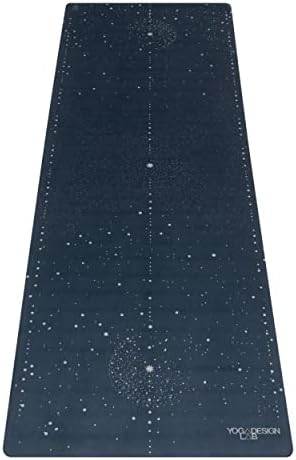
| Yoga Design Lab Combo | Best for sweaty yoga | Dense rubber base + moisture-activated top |


How We Chose Exercise Mats for Carpet
This guide is based on current manufacturer specifications, independent product testing where available, and current carpet-specific training guidance—not claimed hands-on testing by Workout Learner.
For carpet, we prioritized different factors than we would for hardwood.
Density
Carpet already provides some cushioning.
Adding another soft, compressible layer can make the surface feel even less stable.
Current carpet-focused gym guidance similarly notes that lightweight foam mats tend to compress and shift, while denser/heavier materials are more likely to remain planted.
Mat Weight
A heavier mat has more mass, resisting the sideways movement created by:
- lunges
- transitions
- push-ups
- mountain climbers
- yoga flows
That does not guarantee zero movement, but weight is an important carpet-specific factor.
Carpet Pile
Low-pile office-style carpet and plush bedroom carpet behave very differently.
The deeper and softer the carpet, the harder it is for a portable mat to create a genuinely stable surface.
Workout Type
A large HIIT mat and a yoga mat solve different problems.
We separated recommendations for:
- general workouts
- Pilates
- yoga
- low-pile carpet
- sweat-heavy sessions
instead of pretending one mat is ideal for every use.
Resistance to Bunching
A mat can have excellent top-surface grip and still move with the carpet underneath.
That is why we considered:
- mass
- material density
- backing texture
- mat dimensions
rather than relying only on “non-slip” marketing.
1. Gorilla Mats Premium Large Exercise Mat 6′ × ‘4’—Best Overall
The Gorilla Mats 6′ × 4′ model is the best overall choice here if your carpeted room is used for full-body workouts rather than yoga alone.
- Instant Home Gym in Any Room – Goodbye gym membership. Just unstrap and unroll to transform any room in your house into …
- Unmatched Performance – Gorilla Mats is known, trusted and loved by over 300,000 shoppers like yourself and endorsed by …
- Protects Floors and Joints – If there’s anything worse than sore joints after an high intensity workout, it’s finding ou…
Current specifications include:
- 6 × 4 ft
- 24 sq ft
- 1/4-inch high-density PVC
- non-slip upper surface
- patterned underside
- shoe-friendly construction
- roll-up storage
- lifetime manufacturer warranty.
Pros
- 24 sq ft training area
- 1/4-inch dense construction
- Good fit for HIIT and general workouts
- Patterned non-slip underside
- Suitable for shoes
- Large enough for lateral movement
- Roll-up storage
- Lifetime manufacturer warranty
Cons
- Much larger than a conventional mat
- More cumbersome to store
- Premium-price category
- Deep plush carpet can still reduce stability underneath it
Best For
General home workouts, HIIT, bodyweight circuits, and users who want one large workout surface over carpet.
Not Ideal For
If your training is almost entirely yoga or Pilates, AIREX, Hugger Mugger, Manduka, or Yoga Design Lab is easier to manage.
Why Size Matters on Carpet
A standard yoga mat is only about two feet wide.
That can feel restrictive during:
- burpees
- bear crawls
- lateral lunges
- jumping jacks
- mountain climbers
- dumbbell circuits
- kettlebell work
The Gorilla mat gives you a wider surface so your hands and feet stay on the same training material throughout the movement.
That is especially useful on carpet, where repeatedly stepping from mat to carpet can create an inconsistent surface.
Firm Rather Than Pillowy
At 1/4 inch, this mat is cushioned but not excessively thick.
That is useful because carpet already compresses.
A very soft mat on top of soft carpet can create too much movement. Carpet-specific gym flooring guidance likewise notes that density and resistance to compression often matter more than simply adding thickness.
Patterned Underside
Gorilla Mats uses a circular-pattern bottom intended to resist sliding. The manufacturer also specifically discusses using the mat to protect carpet or hardwood during home exercise.
No portable mat can guarantee zero movement on every carpet type, particularly deep plush carpet, but the large footprint and denser construction give it an advantage over thin, lightweight mats.
Better for Mixed Training Than Yoga Alone
This is where the gorilla earns the top position.
It works well for:
- HIIT
- strength circuits
- push-ups
- burpees
- mobility
- kettlebells
- light dumbbell work
- bodyweight training
If you only practice Pilates or yoga, a narrower mat may be easier to store.
2. AIREX Pilates 190 — Best for Pilates
The AIREX Pilates 190 is the strongest choice here for Pilates and controlled floor training because it combines cushioning with a relatively firm, non-stretchy surface.
- AIREX EXERCISE MAT: The Airex Yoga Pilates exercise mat is a…
- ALL-PURPOSE WORKOUT MAT: This versatile, Airex Yoga Pilates …
- PREMIUM CLOSED CELL FOAM: High-quality construction ensures …
Current AIREX specifications list:
- approximately 190 × 60 cm
- 8 mm thickness
- approximately 1.4–1.7 kg, depending on current regional specification
- high-density closed-cell material
- flat-lying design
- slip-resistant surface.
AIREX specifically describes the Pilates 190 as firmer than its other mats and designed to provide better support during demanding Pilates exercises.
Pros
- 8mm cushioning
- Firm, supportive surface
- Approximately 75 inches long
- Independent carpet stability evidence
- Lies flat after unrolling
- Closed-cell construction
- Easy to clean
Cons
- Narrow for full-body HIIT
- Not intended for shoe-heavy workouts
- More expensive than basic foam mats
- Deep plush carpet may still reduce overall stability
Best For
Pilates, controlled core training, stretching, mobility, and barefoot floor work.
Not Ideal For
Choose Gorilla Mats for burpees, jumping, shoes, and wider full-body movement.
Independent Carpet Performance
This product has stronger carpet-specific evidence than most mats in this category.
In Verywell Fit’s 2026 testing, testers reported that the AIREX Pilates 190 did not move on:
- carpet
- hardwood
- tile
during both static and dynamic Pilates exercises.
That does not mean it will behave identically on every thick, plush carpet.
But it is useful independent evidence rather than a manufacturer-only claim.
Why 8mm Works Well Here
Pilates benefits from some cushioning because:
- spine
- hips
- knees
- elbows
often contact the floor.
But the surface still needs to feel predictable.
AIREX uses high-density material rather than very soft foam, which helps provide cushioning without making the mat excessively unstable.
Barefoot or Socks
AIREX advises using this mat barefoot or in socks rather than sneakers.
That makes it much more appropriate for Pilates, stretching, and controlled mat exercise than shoe-based HIIT.
3. Hugger Mugger Para Rubber Mat—Best When Lightweight Mats Keep Bunching
The Hugger Mugger Para Rubber Mat makes sense when your main complaint is that lighter yoga mats ripple, wrinkle, or creep over the carpet.
- Superior, non-slip grip on both sides
- Natural rubber is durable, and long-lasting
- 1/4″ thickness with excellent cushion and shock absorption
Hugger Mugger currently lists:
- 70 × 24 inches
- 5 mm thickness
- 6.6 lb weight
- natural-rubber construction
- open-cell structure
- non-slip grip on both sides.
That 6.6-pound weight is important.
Many inexpensive foam yoga mats weigh far less.
Pros
- 6.6 lb dense construction
- 5 mm thickness
- Natural rubber
- Grip on both sides
- Good resistance to lightweight-mat bunching
- Firm enough for controlled standing practice
Cons
- Heavy for a standard-size yoga mat
- Natural-rubber odor may be noticeable initially
- Not appropriate for latex-sensitive users
- Narrower than a full workout mat
- Primarily a yoga-style mat rather than HIIT flooring
Best For
Yoga and controlled bodyweight training when light mats keep bunching or shifting on carpet.
Not Ideal For
If you need a shoe-friendly HIIT area or large lateral workout zone, Gorilla Mats is more appropriate.
Why Weight Helps on Carpet
When you push backward in Downward Dog or transition through a flow, the carpet fibers can move beneath the mat.
A lightweight mat can move with them.
A heavier mat applies more downward force and can settle into the carpet surface more effectively. Current carpet-specific yoga guidance similarly emphasizes mat mass and density as useful defenses against bunching and creeping.
Dense Natural Rubber
Hugger Mugger’s natural-rubber construction provides a very different feel from light TPE or EVA foam.
It is:
- denser
- heavier
- grippy
- relatively firm
Those characteristics generally make more sense on carpet than adding another thick, soft layer.
Latex Allergy Warning
Hugger Mugger explicitly says not to use this mat if you have a latex allergy.
That limitation should not be buried in fine print.
Storage Trade-Off
At 6.6 pounds, this is not a lightweight travel mat.
That extra mass helps on carpet but makes it less convenient to carry.
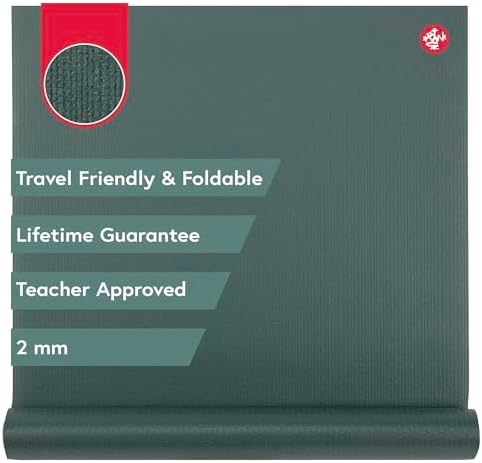
4. Manduka PRO Travel 2mm—Best for Firm, Low-Pile Carpet
The Manduka PRO Travel takes the opposite approach from a thick exercise mat: it adds only 2 mm of material over a carpet that already provides cushioning.
- BEST-IN-CLASS PERFORMANCE & TRAVEL-FRIENDLY: Trusted by yoga…
- PREMIUM STUDIO-QUALITY CUSHIONING: Our thin 2mm Travel mat r…
- STAYS PUT DURING PRACTICE: A no-slip dot pattern on the bott…
Manduka describes the current PRO Travel as
- 2 mm thick
- high-density
- foldable
- closed-cell
- designed for floor-like stability
- specifically suitable for layering over hotel carpet and rental/studio mats.
Pros
- Only 2mm thick
- High-density construction
- Designed for layering over carpet
- Foldable
- Closed-cell surface
- Easy to store
- Good for firm low-pile carpet
Cons
- Very little extra cushioning
- Poor choice for plush carpet
- Narrow standard yoga footprint
- Not intended as HIIT flooring
- Not ideal if knees need substantial padding
Best For
Yoga and mobility on firm, low-pile carpet where additional thickness would make the surface too soft.
Not Ideal For
Medium- or high-pile carpet that already feels unstable underfoot.
Why Thin Can Be Better on Carpet
Consider the layers beneath your foot:
foot → exercise mat → carpet → carpet pad
If the carpet is already soft, adding another thick foam layer can increase wobble.
A 2mm mat does not try to create more cushioning.
Instead, it provides:
- a familiar practice surface
- hygiene barrier
- top-surface grip
- minimal additional compression
That makes sense on firm low-pile carpet.
Not for Plush Carpet
This recommendation needs a clear limitation.
If your carpet is
- deep
- shaggy
- heavily padded
- extremely soft
A 2 mm mat cannot turn it into a hard studio floor.
The whole mat will still move with the carpet underneath.
Travel-Friendly Storage
The PRO Travel folds rather than only rolls.
That makes it particularly easy to:
- place in a closet
- take to a hotel
- pack for travel
- use in a temporary workout area
5. Yoga Design Lab Combo Mat — Best for Sweaty Yoga on Carpet
The Yoga Design Lab Combo Mat is the most relevant choice here for hot yoga, power yoga, or other sweat-heavy barefoot sessions on carpet.
Current specifications include:
- 70 × 24 inches
- 3.5mm or 5.5mm
- approximately 4.9–7.1 lb, depending on version
- natural-rubber base
- recycled-PET microfiber top
- moisture-activated surface grip
- carrying strap.
Pros
- Heavy natural-rubber base
- Moisture-activated grip
- 3.5mm and 5.5mm options
- Useful for sweaty practice
- Integrated mat-and-towel design
- Carry strap included
Cons
- Grip is designed to improve with moisture
- Natural rubber adds weight
- Not ideal for shoe-based HIIT
- Narrow standard mat footprint
- Manufacturer carpet guidance is stronger than independent carpet testing for this exact model
Best For
Hot yoga, power yoga, vinyasa, and sweat-heavy barefoot workouts on relatively firm carpet.
Not Ideal For
Choose Gorilla Mats for burpees, jumping, shoes, and wide full-body movement.
Why It Fits Carpet
Yoga Design Lab’s current carpet-specific guidance recommends dense, heavy natural-rubber mats because their weight helps resist carpet movement and bunching.
The company specifically identifies the Combo Mat as a carpet option because of its dense rubber base.
That is manufacturer guidance, not independent comparison testing, so it should be interpreted accordingly.
Moisture-Activated Top
The microfiber surface becomes grippier as moisture increases.
That makes the mat especially relevant to:
- hot yoga
- power yoga
- vinyasa
- sweaty barefoot bodyweight work
For dry-hand practice, a mat with immediate textured grip may be more convenient.
Which Thickness for Carpet?
For carpet, I would generally lean toward the 3.5mm version unless additional joint cushioning is a priority.
Why?
Because the carpet itself already adds softness.
Yoga Design Lab’s own carpet guidance identifies the roughly 3.5–5.5mm range as appropriate and emphasizes avoiding excessive softness.
Low-Pile vs Medium-Pile vs Plush Carpet
The carpet itself may matter more than the mat.
Low-Pile Carpet
Examples include many:
- commercial carpets
- office-style carpets
- tightly woven apartment carpets
These provide the best foundation.
Good options include:
- Manduka PRO Travel
- AIREX Pilates 190
- Hugger Mugger
- Yoga Design Lab Combo
- Gorilla Mats
depending on the workout.
Medium-Pile Carpet
As the fibers become taller, mat weight and density become more important.
Good directions include:
- Gorilla Mats for general workouts
- Hugger Mugger for yoga
- AIREX for Pilates
A very lightweight travel mat is more likely to move here.
Plush or High-Pile Carpet
This is the hardest situation.
A mat can grip the carpet surface while the carpet itself still compresses underneath it.
Living. Fit’s current carpet-gym guidance similarly notes that plush carpet creates greater instability and that larger/heavier flooring becomes more important as carpet softness increases.
For:
- heavy lifting
- balance-intensive work
- fast lateral movement
- rack/bench setups
A portable exercise mat may not provide the stable foundation you need.
You may need a firmer flooring system or rigid platform instead.
Why the Thickest Mat Is Not Always Best on Carpet
Carpet already provides cushioning.
Adding thick, soft foam creates another compressible layer.
Imagine:
foot
↓
soft exercise mat
↓
soft carpet
↓
carpet pad
Each layer can deform when you load it.
That may feel comfortable when lying down but less stable during:
- lunges
- squats
- planks
- push-ups
- balance poses
- single-leg exercises
Current carpet-specific guidance from both gym flooring and yoga sources similarly emphasizes density over simply adding thickness.
How Thick Should an Exercise Mat Be on Carpet?
There is no single ideal thickness.
Around 2–5mm
Good for:
- low-pile carpet
- yoga
- standing poses
- users who want a firmer feel
Examples:
- Manduka PRO Travel
- Hugger Mugger Para Rubber
- Yoga Design Lab Combo 3.5 mm
Around 6–8mm
Good for:
- Pilates
- floor exercises
- controlled bodyweight work
Example:
- AIREX Pilates 190
This range adds more cushioning without automatically becoming very soft.
Around 1/4 Inch
Good for:
- mixed workouts
- HIIT
- bodyweight circuits
- large workout mats
Example:
- Gorilla Mats
Material density matters just as much as the thickness number.
Best Exercise Mat for HIIT on Carpet
Gorilla Mats is the strongest choice in this lineup.
HIIT usually involves more movement than a yoga mat can accommodate:
- burpees
- jumping jacks
- lateral shuffles
- mountain climbers
- lunges
The 6′ × 4′ Gorilla gives you 24 square feet to work with and is specifically designed for activities including HIIT, plyometrics, and strength work.
One Important Caveat
If your carpet is very plush, even a large mat can move with the carpet underneath.
For aggressive jumping or lateral training, the underlying flooring still needs to feel stable.
Best Pilates Mat for Carpet
AIREX Pilates 190 is the strongest Pilates-specific option.
Its strengths include:
- 8mm cushioning
- firm high-density structure
- long 190 cm body
- flat-lying design
- independent carpet testing
Verywell Fit reported no movement during Pilates work on carpet, hardwood, or tile.
That makes it one of the best-supported carpet recommendations in the lineup.
Best Yoga Mat for Carpet
There are several answers depending on the carpet and practice.
Low-Pile Carpet: Manduka PRO Travel
Choose Manduka if you want:
- thin profile
- floor-like stability
- minimal extra softness
Manduka explicitly positions it for use over hotel carpet.
If Mats Keep Bunching: Hugger Mugger Para Rubber
Choose Hugger Mugger if mass is the priority.
At 6.6 pounds, it is much heavier than typical travel or budget yoga mats.
Sweaty Practice: Yoga Design Lab Combo
Choose the combo for:
- hot yoga
- power yoga
- vinyasa
where the moisture-activated microfiber top becomes a useful feature.
How to Stop an Exercise Mat From Bunching on Carpet
If your current mat wrinkles or moves, work through these steps.
1. Identify Your Carpet Type
Low-pile carpet is easier to stabilize than thick plush carpet.
2. Choose More Density
Avoid automatically replacing a lightweight soft mat with an even thicker lightweight soft mat.
Look for:
- high-density material
- heavier construction
- firm support
3. Add Mat Weight, Not Just Thickness
Heavy rubber mats tend to resist carpet movement better than very light foam mats.
4. Use a Larger Surface for Dynamic Training
A larger mat distributes contact over more carpet and reduces how often you step off its edges.
5. Keep the Carpet and Mat Clean
Dust, lint, and debris can accumulate beneath portable workout mats.
6. Allow the Mat to Lie Fully Flat
Do not start fast movements while corners are still curling after storage.
7. Recognize When the Carpet Is the Problem
If the carpet and pad compress dramatically, another yoga mat may not solve the issue.
A more rigid platform may be needed.
Exercise Mat vs. Home Gym Flooring on Carpet
This article is about personal exercise mats.
That is not the same thing as flooring for heavy gym equipment.
Exercise Mats Make Sense for:
- yoga
- Pilates
- stretching
- mobility
- push-ups
- bodyweight circuits
- light dumbbell/kettlebell training
Consider Dedicated Gym Flooring for:
- squat racks
- heavy benches
- treadmills
- exercise bikes
- heavy free weights
- dropped barbells
Living. Fit’s carpet-gym guidance recommends substantially heavier and denser rubber flooring for equipment and heavy strength training than the portable mats used for bodyweight exercise.
Do not assume a yoga mat is structural support for a rack simply because it works well for push-ups.
Common Buying Mistakes
Buying the Thickest Mat Available
More foam can mean more wobble.
Prioritize density and workout type.
Ignoring Carpet Pile
A mat that works beautifully on low-pile carpet may feel unstable on plush carpet.
Buying a Lightweight Yoga Mat for HIIT
Narrow, light mats are more likely to move during aggressive transitions.
Buying a Huge HIIT Mat for Yoga Only
The opposite mistake also happens.
If you stay within a 24-inch-wide practice area, a 6′ × 4′ mat may create unnecessary storage problems.
Expecting “Non-Slip” to Mean the Carpet Cannot Move
The mat can grip the carpet fibers while the carpet itself shifts beneath it.
Using a Personal Exercise Mat Under Heavy Equipment
Workout mats and equipment flooring are different products.
Ignoring Material Sensitivities
Hugger Mugger’s Para Rubber contains natural rubber and should not be used by someone with a latex allergy.
Clear Purchase Recommendations
For Most Full-Body Workouts: Gorilla Mats 6′ × 4′
Choose Gorilla Mats if you do HIIT, strength circuits, bodyweight training, or mixed workouts and want significantly more room than a standard yoga mat provides.
Its large size is the main advantage.
For Pilates: AIREX Pilates 190
Choose AIREX if Pilates, controlled core work, and floor exercise are your priorities.
It combines 8mm cushioning with firmer construction and has useful independent carpet-testing evidence.
When Lightweight Mats Keep Bunching: Hugger Mugger Para Rubber
Choose Hugger Mugger if you want a dense, heavy yoga mat rather than a light foam design.
Its 6.6-pound weight is the key differentiator.
For Firm Low-Pile Carpet: Manduka PRO Travel
Choose Manduka if your carpet already provides enough cushioning and you want to avoid making the surface softer.
Its 2mm profile is intentionally minimal.
For Hot Yoga and Sweaty Workouts: Yoga Design Lab Combo
Choose the Combo Mat if sweat management and top-surface grip are central to your practice.
The moisture-activated microfiber top distinguishes it from conventional rubber/PVC mats.
Carpet Decision Table
| Your Situation | Product to Compare First |
|---|---|
| Best overall mixed workout mat | Gorilla Mats 6' × 4' |
| HIIT/bodyweight circuits | Gorilla Mats |
| Pilates | AIREX Pilates 190 |
| Lightweight mats keep bunching | Hugger Mugger Para Rubber |
| Firm low-pile carpet | Manduka PRO Travel |
| Hot/sweaty yoga | Yoga Design Lab Combo |
| Need wide movement area | Gorilla Mats |
| Want firm, controlled floor work | AIREX |
| Deep plush carpet | Consider firmer flooring, not just another mat |
Frequently Asked Questions
What is the best exercise mat for carpet?
For mixed full-body workouts, Gorilla Mats 6′ × 4′ is the strongest overall choice in this lineup because it provides a large, dense workout surface suitable for burpees, strength circuits, and HIIT.
For Pilates, AIREX Pilates 190 is the better specialized choice.
Do exercise mats work on carpet?
Yes, but performance depends heavily on the carpet.
Low-pile carpet usually provides a much firmer foundation than thick plush carpet.
On very soft carpet, the mat may move because the underlying carpet compresses.
Is a thick or thin exercise mat better on carpet?
Neither is automatically better.
For standing and balance work, a denser, thinner mat often feels more stable.
For Pilates and floor work, somewhat more cushioning can be useful.
Material density matters as much as thickness.
Why does my exercise mat bunch up on carpet?
Carpet fibers move when you push against them.
A lightweight mat can move with those fibers and develop ripples or folds.
Heavier, denser mats generally resist this better.
Can I use a yoga mat on carpet?
Yes, particularly on low-pile carpet.
For plush carpet, a typical lightweight yoga mat may feel unstable or bunch during transitions.
What is the best yoga mat for carpet?
For low-pile carpet, Manduka PRO Travel is useful because it adds only 2 mm of material, and Manduka specifically positions it for layering over carpet.
For a heavier yoga mat, the Hugger Mugger Para Rubber or Yoga Design Lab Combo are better comparisons.
Is an 8mm mat too thick for carpet?
Not necessarily.
AIREX Pilates 190 uses 8 mm high-density material and is specifically designed to remain supportive rather than excessively soft. Independent testing also found it stable during Pilates exercise on carpet.
What exercise mat is best for plush carpet?
There is no portable mat that can completely eliminate the instability of very deep carpet and thick padding.
A larger/heavier mat can help, but for balance-heavy or strength-focused training you may need a firmer flooring solution.
Can I do HIIT on carpet?
You can perform many bodyweight HIIT exercises on carpet, but the surface needs to remain stable.
A large mat such as Gorilla Mats is more appropriate than a narrow yoga mat for movements such as burpees and lateral drills.
Can I put a squat rack on an exercise mat over carpet?
A personal exercise or yoga mat is generally not the right product for this job.
Heavy equipment benefits from dedicated dense gym flooring and, on plush carpet, may require a more rigid underlying surface.
Final Summary
The best exercise mat for carpet depends on two things:
- your carpet
- your workout
For most mixed workouts, the Gorilla Mats Premium Large 6′ × 4′ is the strongest all-around choice. Its 24-square-foot surface provides much more useful movement area than a conventional yoga mat, while its high-density 1/4-inch construction is better suited to HIIT, strength circuits, and bodyweight workouts than thick soft foam.
The AIREX Pilates 190 is the more appropriate choice for Pilates and controlled floor exercises. It combines 8mm of supportive cushioning with a firmer high-density design, and independent testing reported stable performance on carpet.
The Hugger Mugger Para Rubber Mat makes sense if lightweight mats tend to bunch. Its 6.6-pound natural-rubber construction gives it much more mass than a typical budget yoga mat.
The Manduka PRO Travel 2mm is best viewed as a thin topper for firm, low-pile carpet. It intentionally avoids adding another thick layer of cushioning and is specifically designed to work over carpet.
And the Yoga Design Lab Combo Mat is the better match for hot yoga and sweat-heavy practice because its microfiber top becomes grippier with moisture while the dense rubber base helps keep the mat planted.
The key rule is simple:
Do not automatically buy the thickest mat for carpet.
Start with the carpet pile. Then choose enough density, weight, and surface area for the type of exercise you actually do.
If the carpet is very soft or deeply padded, especially for heavy strength training or fast lateral movement, a personal exercise mat may not be enough. In that case, a firmer flooring system is the better solution.