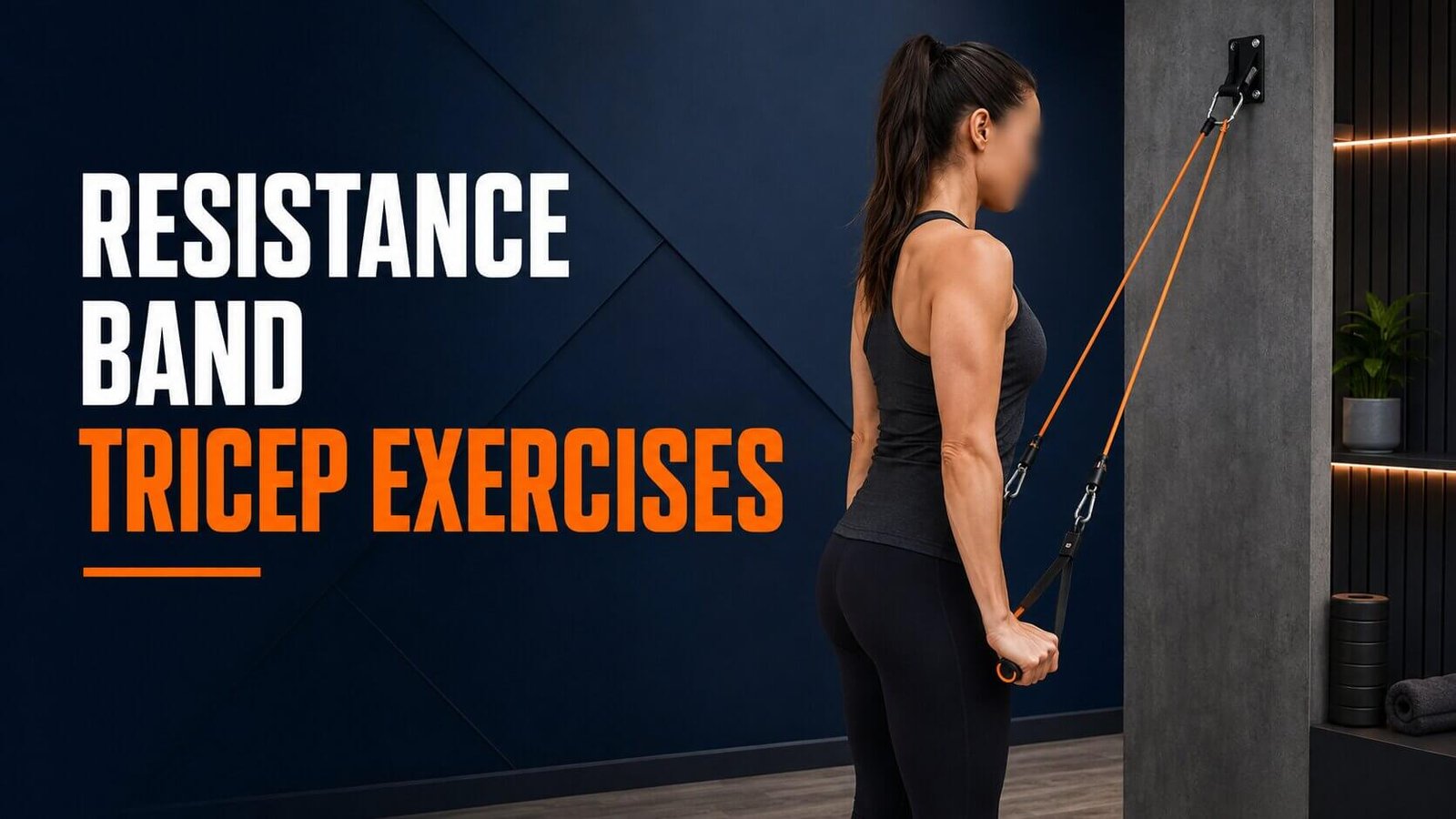
Resistance bands can strengthen and build your triceps when the exercises are challenging, your setup keeps tension through a useful range, and you progress over time. A balanced band workout needs only two or three patterns: a compound press, an overhead extension, and a pushdown or other extension with the upper arm beside the torso.
You do not need to perform all 10 exercises in one session. Choose three or four that suit your band and available anchor, complete controlled sets, and record your setup so you can make the workout harder as you improve.
Can Resistance Bands Build Your Triceps?
Yes. Resistance bands can build triceps strength and muscle if they provide enough resistance, your sets become challenging, and you gradually increase the training demand. Their main limitation is that setup, grip comfort, and available band tension may eventually restrict progression.
A systematic review found that elastic and conventional resistance training produced similar strength improvements across the included studies, although populations and protocols varied. This does not prove that a light band equals a heavy cable or dumbbell in every exercise. It shows that elastic resistance is a legitimate training method when it is used progressively. Read the systematic review and meta-analysis.
The American College of Sports Medicine’s 2026 resistance-training guidance also recognizes bands and home-based programs as effective options. Consistency and an appropriate training effort matter more than following a complicated routine or using a specific type of equipment. See the ACSM resistance-training guidance.
For practical muscle-building sets, choose resistance that makes the final repetitions noticeably slower while your technique remains controlled. If you can perform dozens of easy repetitions and stop only because the exercise is inconvenient, adjust your grip, starting tension, band strength, or exercise.
How the Triceps Work
The triceps brachii is the large muscle on the back of the upper arm. Its long, lateral, and medial heads work together to extend, or straighten, the elbow.
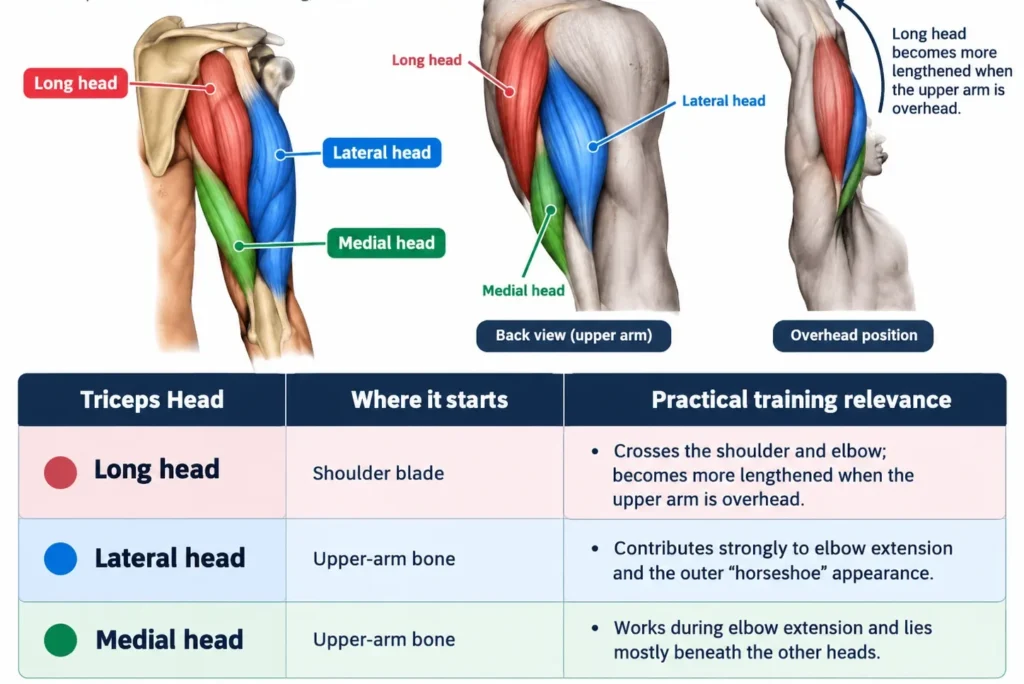
You cannot switch two heads off and isolate only one by rotating your hand. Grip position can affect wrist comfort, stability, and how much resistance you can control, but claims such as “underhand grip isolates the medial head” are too certain.
Shoulder position has a clearer anatomical effect because the long head crosses the shoulder. In a 12-week study, 21 adults trained one arm with overhead cable extensions and the other with extensions performed beside the torso. The overhead condition produced greater whole-triceps and long-head growth. The study supports including a comfortable overhead movement, but it used a cable machine and one specific protocol. It does not establish that every overhead band exercise is best for every person. Read the peer-reviewed study.
Overhead Extension vs. Pushdown
An overhead extension trains the triceps with the upper arm elevated, while a pushdown keeps it closer to the torso. Using one of each provides two distinct shoulder positions without requiring many nearly identical variations.
Choose the movement you can perform through a comfortable range. If an overhead position irritates your shoulder or elbow, use a shorter pain-free range or select a pushdown, floor extension, or close-grip press instead. Persistent pain deserves assessment from a qualified healthcare professional.
Choosing a Band and Anchor
A long loop or handled tube works best for most resistance band tricep exercises. Mini loops are usually too short for comfortable overhead extensions and pushdowns.
| Equipment | Best uses | Limitation |
|---|---|---|
| Long loop band | Pushdowns, overhead extensions, kickbacks, crossbow extensions, and banded push-ups | Can pinch the hands when resistance becomes high |
| Tube band with handles | Pushdowns, floor presses, kickbacks, and overhead extensions | Fixed length can limit starting-tension adjustments |
| Flat therapy band | Light extensions, technique practice, and high-repetition work | May be too light for long-term strength progression |
| Purpose-built door anchor | Pushdowns, cross-body pressdowns, and anchored overhead extensions | Must be installed and tested correctly |
Band colors are not standardized. Record the manufacturer, resistance label, grip position, and distance from the anchor instead of writing only “medium band.”
Elastic resistance increases as a band stretches, and the tension-to-elongation relationship differs among products. This normally makes a band exercise harder toward the end of the movement, although joint position and setup also affect the challenge. Research on band elongation and tension.
Do You Need a Door Anchor?
No. You can train the triceps by standing on the band, holding one side with the opposite hand, or securing it beneath your hands or upper back. A purpose-built anchor is still useful because it makes pushdowns and some overhead extensions easier to reproduce.
Never rely on a loose door handle, movable furniture, or an object that can tip. Install the anchor according to its manufacturer, position it so the pulling force keeps the door closed, and test the setup with light tension before every exercise.
10 Resistance Band Tricep Exercises
The best choices cover an overhead extension, a neutral-arm extension, and a compound press. The following list includes six no-anchor options and four movements that use a secure anchor.
1. Single-Arm Overhead Band Triceps Extension
The single-arm overhead extension is one of the most practical no-anchor exercises for training the triceps in a lengthened position. Working one side at a time also lets you adjust tension precisely.
How to do it:
- Stand on one end of a long band with the foot on the same side as the working arm.
- Hold the other end and bring your hand behind your head without placing the band around your neck.
- Point your elbow upward and keep your ribs stacked over your pelvis.
- Straighten your elbow until the arm is extended without aggressively snapping into lockout.
- Lower your hand slowly until you feel a comfortable triceps stretch.
Start with: 2–3 sets of 10–20 repetitions per arm.
Common mistake: Arching the lower back to create more range. Use a lighter band, shorten the range, or perform the exercise in a half-kneeling position.
Make it easier: Use a lighter band and a higher grip position.
Make it harder: Grip lower on the band or move to a stronger band while keeping the same range.
2. Two-Arm Overhead Band Triceps Extension
The two-arm version allows both triceps to work together and may feel more stable than a single-arm extension. It works best with a tube band with handles or a long loop that you can grip comfortably.
How to do it:
- Stand on the center of the band with one or both feet.
- Bring both hands behind your head and point your elbows generally forward rather than forcing them tightly together.
- Brace your trunk and keep your neck relaxed.
- Extend both elbows until your arms are straight overhead.
- Return under control without letting the band pull your hands down quickly.
Start with: 2–3 sets of 8–20 repetitions.
Common mistake: Letting the elbows and shoulders move through a large arc. Some natural movement is acceptable, but the main action should occur at the elbows.
Make it easier: Use the single-arm variation so each arm handles less band tension.
Make it harder: Increase the band’s starting tension or use a stronger band.
3. Crossbow Triceps Extension
The crossbow extension is a useful no-anchor option when standing on the band feels awkward. One hand holds the band near the opposite side of the chest while the working arm extends outward.
How to do it:
- Hold one end of the band against the upper chest with your nonworking hand.
- Grasp the other end with the working hand and bend that elbow so the hand begins near the opposite shoulder.
- Keep the working upper arm approximately level with the floor.
- Straighten the elbow across the body until the arm is extended.
- Return slowly while the nonworking hand keeps the anchor position steady.
Start with: 2–3 sets of 10–20 repetitions per arm.
Common mistake: Rotating the torso to pull the band. Reduce the resistance and keep the chest facing forward.
Make it easier: Hold the anchoring hand closer to the working shoulder.
Make it harder: Increase the distance between your hands at the starting position.
4. Resistance Band Triceps Kickback
The band kickback trains elbow extension with the upper arm beside or slightly behind the torso. A band can keep the top of the repetition challenging, where a dumbbell kickback may feel easier if gravity no longer creates much torque.
How to do it:
- Stand on one end of the band and hold the other end with the working hand.
- Hinge at the hips and support yourself with the free hand on your thigh or a stable surface.
- Bring the working upper arm beside your torso and bend the elbow to roughly 90 degrees.
- Extend the elbow until the arm is straight without lifting or twisting the shoulder.
- Return slowly to the bent-elbow position.
Start with: 2–3 sets of 12–25 repetitions per side.
Common mistake: Swinging the entire arm. Keep the upper arm relatively still and let the forearm move around the elbow.
Make it easier: Stand on less of the band or grip closer to its end.
Make it harder: Increase starting tension or use a low anchor behind you.
5. Banded Close-Grip Push-Up
The banded close-grip push-up is a compound exercise for the triceps, chest, and front shoulders. It provides more resistance as you press toward the top, but it is appropriate only after you can perform controlled close-grip push-ups without a band.
How to do it:
- Place a long loop band across your upper back below the base of your neck.
- Secure each side beneath your palms and assume a high-plank position.
- Place your hands around shoulder-width apart; they do not need to touch.
- Lower your body as one unit while your elbows travel back at a comfortable angle.
- Press the floor away until your elbows are straight.
Start with: 2–4 sets of 6–15 repetitions.
Common mistake: Using a narrow diamond position that causes wrist or elbow discomfort. A shoulder-width grip can still emphasize elbow extension while allowing a more comfortable joint position.
Make it easier: Remove the band or elevate your hands on a stable bench.
Make it harder: Use a stronger band only if it stays securely across the upper back and under the palms.
6. Supine Close-Grip Band Press
The supine close-grip press is a floor-based compound alternative for people who cannot yet perform push-ups. The triceps work with the chest and shoulders as you press the hands upward.
How to do it: